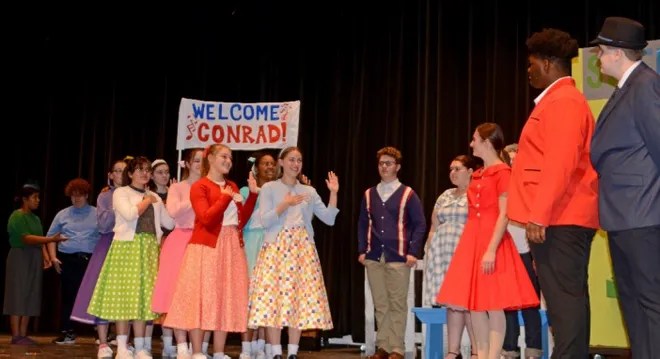
I have no idea what can be done about this now, but it is among the saddest consequences of the culture wars and The Great Stupid, and, as is so often the case, the casualties are children….which means that in the long-term, the casualty will be American society itself.
Ethics Alarms has periodically chronicled the sagas of high school theatrical productions halted or distorted by various politics- or ideology-based complaints and protests, but I never focused on what a tightening strangle-hold on cultural education this phenomenon represents. The New York Times examined the problem here, and though the Times slant seeks to blame it all on conservatives (you know, those meanies who also want to “ban books”), the description of the problem is accurate and gloomy. A sample:
School plays — long an important element of arts education and a formative experience for creative adolescents — have become the latest battleground… recently left-leaning students and parents have pushed back against many shows over how they portray women and people of color. The latest wave of objections is coming largely from right-leaning parents and school officials…Drama teachers around the country say they are facing growing scrutiny of their show selections, and that titles that were acceptable just a few years ago can no longer be staged in some districts. The Educational Theater Association released a survey of teachers last month that found that 67 percent say censorship concerns are influencing their selections for the upcoming school year…
In emails and phone calls over the last several weeks, teachers and parents cited a litany of examples. From the right there have been objections to homosexuality in the musical “The Prom” and the play “Almost, Maine” and other oft-staged shows; from the left there have been concerns about depictions of race in “South Pacific” and “Thoroughly Modern Millie” and gender in “How to Succeed in Business Without Really Trying” and “Bye Bye Birdie” and “Grease.” And at individual schools there have been any number of unexpected complaints, about the presence of bullying in “Mean Girls” and the absence of white characters in “Fences,” about the words “damn” (in “Oklahoma”) and “bastards” (in “Newsies”) and “God” (in “The Little Mermaid”)….Challenges to school productions, teachers say, carry far more weight than they once did because of the polarized political climate and the amplifying power of social media….
Teachers now find themselves desperately looking for titles that are somehow both relevant to today’s teenagers and unlikely to land them in trouble.
“There’s a lot of not wanting any controversy of any kind,” said Chris Hamilton, the drama director at a high school in Kennewick, Wash. Hamilton said this past year was the first time, in 10 years of teaching, that a play he proposed was banned by school administrators… “The level of scrutiny has grown,” Hamilton said.
Around the country, in blue states as well as red, theater teachers say it has become increasingly difficult to find plays and musicals that will escape the kind of criticism that, they fear, could cost them their jobs or result in a cutback in funding. “People are losing their jobs for booking the wrong musical,” said Ralph Sevush, the executive director of business affairs at the Dramatists Guild of America. “A polarized society is fighting out the culture wars in high schools,” he added.
Obviously, to those who follow Ethics Alarms, student theater was a very important part of my education, skill acquisition and socialization, not only in high school, but throughout college and law school as well. But it was not until law school that a political controversy arose regarding one of my productions, and I was in position to rebut and ignore it. I doubt that I could today. Interpreting all performance art through ideological, political and social policy lenses means that almost every script can be divisive: all it takes is some empty-eyed fanatic from either end of the cultural divide to see a potential platform for their mission, and the fight is on.
“There’s a lot of not wanting any controversy of any kind,” says the Washington drama director. Well, high school theater shouldn’t cause controversy; theater is supposed to be fun, a memorable social activity, and entertaining to audiences across all ages and groups. That literally can’t happen if social justice warriors and grievance junkies and the incurably inflexible and intolerant are perpetually ready for battle.
The problem facing high school theater is similar to the problem now facing Disney. Disney became a powerful and positive force in American culture by creating entertainment that seemed to include all segments of the American public. The company could do this because it was assumed, and most Americans believed, the nation had a single, desirable set of values, a shared vision, and a common history that new arrivals would soon adopt and support. Conveying those things was considered uncontroversial and virtuous; nobody thought that when a movie or the Mickey Mouse Club or a ride conveyed the message that something was good, it was taking sides, and that it was simultaneously asserting that something else was wrong that a significant segment of society believed in.
There were periodic divisions, or course; they surfaced when there was a sea change in the culture, like Rock n’ Roll. But those resolved themselves quickly: first they were burning Elvis records, then he was on The Ed Sullivan Show, and soon he was making movies, appearing in Vegas, and getting drafted like every other red-blooded American kid. The culture was monolithic, and, Borg-like, assimilated everyone and everything. Disney contributed greatly to the process.
But because of many individuals, developments, events and movements too numerous and complex to analyze here, there simply is no agreed-upon national culture any more, and many of the now shattered and uncompromising segments not only refuse to be assimilated, they demand that the rest assimilate with them. They have their own versions of history, and consider other versions wrong, or “offensive.” They get their news from sources that slant, warp and censor facts to appeal to their special audience, not the public as a whole. There are no universally accepted cultural influences, and controversies flourish as never before.
High school should be a no-cultural controversy zone…and I should be able to balance a fishbowl on my nose. It’s impossible, and the now almost totally woke education establishment has made the problem worse by actively seeking to indoctrinate students into its own favored world view and political orientation. Parents don’t trust teachers, and they shouldn’t; they should have stopped trusting them decades ago. Once, controversies over high school plays were almost unheard of: no teachers in their right minds would schedule a show that romanticized premarital sex, drug use, violence, or atheism. Now, however, the requirements to avoid attacks from a new class of activists who realize they can gain power and influence by bending others to their will are legion and multiplying.
We are rapidly reaching ethics zugswang. Producing high school shows increasingly triggers protests from one group or another; old shows or new, it doesn’t matter. Not producing shows withholds from students a whole set of experiences, thrills and training that will enrich their lives.
The scariest part of the Times article is the mention of local controversies surrounding “Bye Bye Birdie,” “Grease” and “Mean Girls.” That’s the full list of the successive “perfect” high school musicals, each about high school students, each a window on a chapter in American culture in a particular era. They are all big cast shows that balance male and female roles; there is lots of exuberant dancing; no political issues are treated as anything but objects of humor, and anyone offended by any of the three should get psychiatric help. And yet…here we are.
Good job, everybody. A decline in high school plays will inevitably cause problems for college theater, and a crisis for live theater generally: it is a passion that is usually developed early or not at all. Live theater is already in deep trouble, and it has been a part of the foundation of civilization for centuries.
This is an educational, cultural, societal problem with more significance than most people realize. I must confess, I have no ideas for a way out. There may not be one.
 Ethics Alarms
My thought while reading through this (spurred by the reference to Fences, a play with which I am unfamiliar) is that, if there was ever a case to be made that non-traditional casting should not matter, it would be in high school theater.
When I was in High School, if you wanted to be part of the play, they would find a spot for you, whether as an extra or even the behind the scenes (set production, etc.). Now, this was a small high school (400 students) in the inner city (maybe 20% minority at the time). The productions I remember were Oliver, Sound of Music, Oklahoma. Traditional casting of any of those would not include many (or any) minorities. And, that was simply not an issue. There were probably several minority students in Oklahoma.
Incidentally, Oliver was played by a girl. She had short hair, sang well, and really fit the part (the fact that she did not have a deep voice probably also helped). No one batted an eye at that.
I don’t know. Maybe it’s because high school theater should be a lot like youth sports. The point of them is not to put on a professional performance. Of course, you want to do well. However, the product, the play or the game, is almost the byproduct of the lessons (teamwork, dedication, responsibility, the specific skill sets that go into each task) the students must learn. Those are the skills that they will carry through life, even if they never perform professionally.
Well, if I ran the show, that would be my approach.
-Jut
I agree with everything you say here, Jut. Just a point of clarification: “Fences,” an August Wilson play, really can’t be done with non-traditional casting, any more than “Raisin in the Sun.” It’s about a troubled black family, a bitter black father who felt he was robbed of an MLB baseball career by segregation, and the black community. Denzel Washington produced and directed the film version of the drama with him in the leading role: I recommend it.
“Denzel Washington produced and directed the film version of the drama with him in the leading role: I recommend it.”
Second!
Not that it helps matters, but I’m going with “They started it” on this situation. If it hadn’t been for the creeping push for years to introduce leftist indoctrination into schools, those on the right may have had little objection to the occasional variance in entertainment productions.
Parents got fed up, and realized they could push back with some success. Now they’re more likely to (maybe rightly) view a relatively inconsequential issue as just more camel’s nose under the tent, and feel they can’t afford to let it go.
It’s more than just that they started it. Political conservatives, moderates and independents tolerated pretty much everything the political left did for decades, and were repaid for it with accusations of oppression. Letting them do whatever they want was oppressive because people were silent about it. The whole world didn’t jump on their bandwagon simply because they heard about it, and that made the left angry. So they started demanding that everyone begin wholeheartedly endorsing their point of view or be branded a horrible person. THAT is when things spun out of control. They did get people voicing opinions all of a sudden, but the opinions were the opposite of what they wanted. The left is made up of fanatics who accuse everyone else of being bullies while they run around punching people in the face, both metaphorically and literally. Now they have stirred up a hornets nest and everyone is upset because the non-left is fighting back for the first time in decades. The more fanatical, angry and loud the left gets, the more intolerant of the behavior everyone else gets. Then the press blames the non-left for everything while praising the left for how “tolerant” they are and big corporations try and censor everyone who is sick of the leftists’ shit. Leftist ideology is just not all that persuasive, and trying to force everyone to convert is not going to work.
You cannot impose cultural change from above. All you can do is create chaos.
Since leftists control education, it was easier to get THEIR censorship through because the schools supported it. About 15 minutes before I read this post, the news was covering a bill that would exempt all ‘bad’ foods from SNAP and only allow ‘healthy’ foods on the basis that since these same people are on Medicaid, they should be forced to eat ‘healthy’ so they don’t cost the government money on healthcare. Well, what about Medicare? What about Obamacare plans? It may seem like they aren’t connected but they are. The central purpose is constrol.
Jack wrote, “This is an educational, cultural, societal problem with more significance than most people realize. I must confess, I have no ideas for a way out. There may not be one.”
Another microcosm piece of evidence that our society/culture is being completely undermined. There are too many signs to list and ignore.
We witnessed a 21st century social and cultural turning point and most of us blew it off as inconsequential, I didn’t. There was a call to action voiced by Presidential Candidate Barack Obama in 2008, “Change will not come if we wait for some other person or some other time. We are the ones we’ve been waiting for. We are the change that we seek.”, and that call to action was taken very seriously by the political left and they have been obsessed with it ever since. They’ve gone cultish with their anti status quo and pro change. The political left has taken that call to action to absurdity and now there are epidemic levels of absurdities infecting our society and we have a very deeply divided nation is the result.
We’ve seen it time after time since 2008 that if you are against the political left’s anti status quo changes or anything the political left proposes then you’re evil, period, end of discussion. Yes it really is just that simple in their minds. Those that oppose this kind of complete social/cultural destruction are faced with choices to reverse the trend and none of the critical thinking or logical choices seem to be working because the left has categorically rejected critical thinking and logic.
A reasonably predictable societal/cultural collapse is drawing near and a black hole of chaos is sucking everyone in. I hate to say it but this will likely end up in a very bloody civil war.
A few weekends ago, my Better Half and I went to see a very high quality local production (augmented by several ‘hired gun’ leads) of Guys & Dolls. We’d both been in drama club together in high school half-a-century ago and had been in the cast of G&D. Our drama club had also done Fiddler, Flower Drum Song, Teahouse of the August Moon, and several others. Not one of them could be produced today as written because of the Wrath of the Perpetually Aggrieved.
We thoroughly enjoyed the G&D production, but were also attuned to things that might have offend the Perpetually Aggrieved – and, given how low the bar has been set these days, in G&D there were loads of things that would have done so. However, as far as we could tell, nothing in the script had been changed to protect the delicate feeling of certain attendees. It was performed as written.
There were also a few POC in the cast and Nathan Detroit was played by a black actor – and he was AWESOME…and certainly not a diversity hire. The role was his because he could act, sing, and dance with the best of them. And, yet, the production company saw no reason to flaunt the fact that they’d cast a Black man as Detroit. It was almost as if they expected the audience to enjoy the production for what it was – and not as vehicle for virtue signally.
I was trying to think of plays and musicals that would be considered “safe” for a high school to do today. Once “Inherit the Wind” was a standard: history, philosophy, law, Americana. But I suspect that now some parents would see it as an effort to turn students against religion, or the play as promoting controversial science. “Guys and Dolls” should be one of the safest musicals to do—and any of the leads could be cast with any race—but it would be a target of feminists because of the stereotypical portrayal of women as “dolls.” Loesser’s other great musical, “How to Succeed…” is a permanent non-starter now, even though it accurately reflects the “Mad Men” culture. The blatant sexism in the show made me wince decades ago.
“Little Shop of Horrors”? Or is the female lead too passive and scatterbrained? Is the doo-wop chorus still acceptable?
LSOH is, as I thought it would be when I saw the original production, a popular high school show, if a tough one to pull off. I think it’s safe for now. Audrey is a ditz, and the show does involve domestic abuse, murder, torture and mayhem. I’m sure there are communities where it wouldn’t be acceptable, but in general, I agree.
And it’s a brilliant show.
This makes me so incredibly sad. I’ve always touted theater as a place for every child to succeed. You don’t have to be a triple threat. Do you like to build things? Paint things? Sew? How about physics? Learn how to properly weight and work a fly rail. Learn how to read a lighting schematic and work the light board. Run the box office. Learn how to handle money and manage a budget. Marketing and PR? Yep, there’s that too. Learn how to work as a team, work hard, really hard, think on your feet, and fix mistakes on the fly. Shows that are no longer “politically correct?” The lessons to be taught are in the thing itself.
Anecdote: I was in a small summer theater run by college kids on the east coast of Massachusetts. We showed up every night for rehearsal in the church hall; half of us still in our bathing suits, barefoot and sunburned. Most of us rode our bikes to get there. I think we produced the damn shows using our babysitting money. Politically correct? I don’t know. We had 15 year olds in garter belts singing “Big Spender” – so there’s that. Those summers, to this day, are the most indelible experiences of my life; a time of incredible growth, independence gained, and friendships made; many of which are still going almost 40 years later.
From that scrappy little theater came an actress with a 30 career in Paris, an award winning Broadway lighting designer who now flies all over the world lighting for Disney, a grammy nominated jazz singer, a head animator for Pixar studios, and an Emmy winning Hollywood producer who has worked with the likes Robert De Nero, among others. Other kids were so fascinated by the science and physics of theater, they went on to graduate from MIT with degrees in who knows what – but theater was the impetus.
Theater provides learning that goes far beyond just a single subject matter. The whole of the child experiences something that can’t be taught in a classroom. They take with them skills that will support them, no matter where they land, for the rest of their lives.
I have no ideas for a way out of what is surely a death knell for theater – and the loss of limitless opportunities for so many kids – either.
*taking my sad self down from my soap box. What a depressing way to start a Wednesday.
I’m sorry. I intended that post to be depressing way to end the Fourth of July.
Alicia,
There is so much in your comment to agree with about general theatrical experiences for the younger participants in both High School and Community Theater. The range of talent is all over the place and it’s great pulling out those talents and watching them blossom. The team and confidence building that usually takes place is exceptional. I too have worked with many youth in the theater that have gone on to work in professions on Broadway, Hollywood, TV both in performance and behind the scenes.
Yes, Steve, blossom is the word. Take the most quiet, awkward kid, plunk a headset on him and teach him the fly rail and he becomes a proud, confident kid who’s trusted to move a thousand pound batten, and who feels and knows that he is a part of something bigger than himself. It’s magical.
Theater is supposed to be fun, although sometimes hard work. It is not supposed to be grim and militant. This reminds me of one of those articles about why classic fantasy like LOTR “hasn’t aged well.” One of the reasons given is that literature “doesn’t represent all people in the world today.” No, it doesn’t. It couldn’t and remain what it was supposed to be. Insist that everything represent everybody in a certain way, and we are just going to end up with endless empowerment stories with perfect female leads, which is quickly going to become boring.