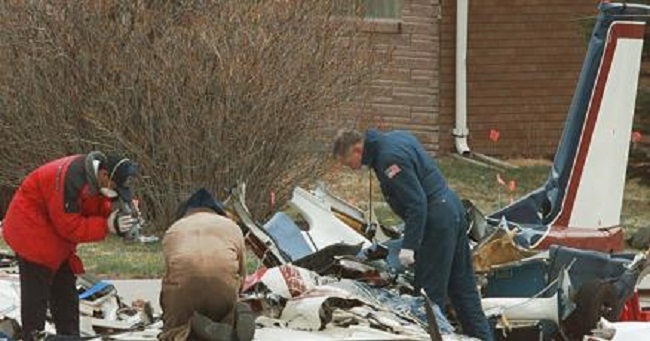
My position on parents endangering young children by seeking “all-time youngest” records for them and forcing them into unnecessarily dangerous recreational activities the kids can’t possibly understand or consent to is, I fear, unalterable. (Above is the 1996 wreck of the plane piloted by 7-year-old Jessica Dubroff, whose parents had her attempting to become the youngest trainee pilot to fly a light aircraft across the United States. Local, national, and international news media cheered on Dubroff’s story until she, her training pilot and her father died in the crash. )
However outdoors enthusiast Sarah B. mounted as strong a case against my position as I can imagine, in two successive comments combined here as Sarah B.’s Comment of the Day on the post, “Not This Issue Again! Arrest These Parents For Child Endangerment, Please…”:
***
I think there may be a misunderstanding on how Wyoming papers handle kid stories which I think changes a few things.
In small towns like most of Wyoming (not the urban hell that is Casper, Cheyenne, or Laramie), a story with a kid gets written long before a story about Bud Light and Dylan Mulvaney. I made the front page of our local paper at least a half dozen times as a kid, and made the paper dozens of times. Every year, the middle school and high school band/choir concerts would make the front page the day after they were held. If you consider that we did three concerts a semester for each of band and choir in high school, and two concerts a semester for each of middle school band and choir, that is ten days where the kids make the front page each school year. The high school homecoming royalty would make the front page on Thursday after the Wednesday reveal, the parade would always make front page on Friday, the game on Saturday, with the dance making page two. Prom was front page material. When four kids from our school got the best scholarship to the University of Wyoming one year, we made the front page. Every semester honor roll for every level of school made about third page. Placing in a math competition, debate competition, etc would always get a name in the paper, usually a picture too, and often on the front page. High school sports covered the front page every week.
I say this to emphasize my belief that this shouldn’t be considered as bad as you think. Newspapers gush over “youngest” this and “oldest” that. It makes people read the paper. National news is a page six or eight item and international news, like a war between Ukraine and Russia, is usually found below the fold on the comics page, under the Sudoku and Dear Abby.
People want the stories with the kids. Front page news is preferred to have a picture of a kid. A kid doing something good, like winning the coupon for a free pizza at the drawing at the library book fair, is a great front page story. Getting to the top of Devil’s Tower is just as good, and should be considered with the same gravity.
This is just standard newspaper fodder, nothing to get so excited about.
As for your issue with climbing, what activities do you consider out of the normal, with too much risk? Many people consider high school football to be normal and I know that you agree with me that it has too much risk. Is biking normal? What about hiking? Camping? Bouldering (certainly a normal thing in my rural childhood) is a difference in scale, not kind to climbing. Horseback riding? Boating? Fishing? Hunting? What is a normal activity that families do with kids that I don’t list here? These are all the norm where I grew up.
I think that this is another cultural difference between urban and rural USA. Having kids do fun things with an element of risk is considered to be good parenting in most of the rural areas I know. If you cannot learn to handle risk with your parents watching over you, especially at a young age, you will never handle risk well is the argument. There are studies that support this, not that they should matter. Going hiking, climbing, horseback riding, etc are all considered to be good healthy activities that you tend to do better at the younger you do them. We take our kids hiking and camping, because there is an element of risk. Generally items that do not force us to combat risk do not involve personal growth, and the duty of parents is to guide their children’s personal growth. Theatre, your passion, tends to be too far away (four hours one way) and expensive for us. We have different values, because we really do live in different worlds.
I take far more issue with people having private pools than climbing a mountain. I believe that there is more concern from school sports than a parent guided climb. Devil’s Tower, at least the trail they used, would not be my first choice, but according to the article, it wasn’t their first choice either. They had been doing this for three years. Whether or not she made it up under her own power, she did make it to the top. She got to look out over the plains from the top of Devil’s Tower, and that’s pretty cool. If this tempts the family into doing stupid stuff like climbing K2, well, that’s a problem, but until then, it is merely a fun activity, as far as I’m concerned.
***
I responded in part,
“6? SIX? Try this as a thought experiment: if, seconds after that photo on the right, the clasp had shattered due to a manufacturing flaw (or a parent had failed to secure the girl properly) and she had fallen to a bloody death, would the media be defending the parents? Would an age limit on climbers not be immediately installed—maybe even a law? There is no reason to subject a young, trusting, completely inexperienced and dependent child to even a small risk of death or serious injury with such speculative benefits.…”
My point, which I didn’t make clear, was that a tragic result of this story would have immediately made everyone slap their heads and say, “What was I thinking? Of COURSE letting a 6-year-old child do this is irresponsible, because no child should die, ever engaging in a purely gratuitous and needless activity with the risk of serious injury involved.” Sarah, quite properly, turned to my usual “moral luck” point…
***
You are letting the outcome of an action determine whether or not the action is good. The chances of that happening are extremely slim. I have never seen the movie, but I do know that when you climb, you check your equipment long before you reach this kind of stressor for exactly that reason. Would the media still be happy? No. Would they be extolling the kid or the parents? No. Would they be crying for more stupid laws? They always do. Should they? No. Should we care what the media thinks? Absolutely not. I do doubt an age limit would be imposed on climbers. Devil’s Tower is closer to Newcastle than Jackson, and most of the non-Cheyenne/Jackson/Laramie populace believes, if something stupid happens, well, we will be sorry, but we don’t generally believe in legislating our problems away.
We check our climbing equipment for a reason. Properly maintained and monitored equipment fails very rarely. It is far more likely for us to be injured or killed when being driven to the doctor’s office. We still drive to the doctor’s office. The risk at climbing is negligible when compared to putting your kid in a car, but you want parents to feel bad about what is a normal activity.
As I have pondered this response most of the day, I think that we look at dangers differently in a rural community. First, the park next to the Kindergarten/First Grade building is a home to rattlesnakes. They pull a half a dozen or so monsters out of there a month. There is a warning when you go to the park that rattlesnakes have been seen here recently, but it is the nicest or second nicest park in town. The other parks are not much better for snakes, so we just know to teach our kids from a very young age how to be safe around rattlers. You can’t just say, there will be no rattlesnakes in the parks. It won’t happen without changing the entire community. Mountain lions don’t come through town every year, but they do come frequently. A neighbor a few houses down from my dad had a cougar prowling on her garage for several days before animal control found out how to get it down with no fatalities. The fact that it didn’t attack anyone was pretty much a miracle. My town has herds of deer that wander through. If a deer sneaks up on you and gets mad or scared, you can get killed. They jump over whatever fences they want and kill dogs every year. We all know that kids are at special risk if the deer are around, and they often are. I personally had 18 deer on my lawn at one time. If a kid gets snake bit, the hospital can’t deal with that crap. They can only rehydrate, set bones, and give stitches. Anything else gets life-flighted to Denver.
They can’t even deliver babies. We have to drive 100 miles while in labor to have a baby. One day, when I was out of town, my husband had appendicitis. He drove himself 120 miles to have it removed. This is how life works out here, and this is in one of the larger towns in Wyoming. Most smaller towns are more remote, and they don’t have hospitals as nice as ours. They are far more accustomed to having an NP or two who sees people three to four days a week for minor ailments and sends you on down the road to get an X-ray when your kid falls down the stairs.
This tends to breed a hardy populace. We tend to, as a populace, have the opinion that shit happens. When something that has a low chance of happening goes wrong and someone dies, it is tragic, but it is a fact of life. We don’t try and legislate pain away, nor do we say that small risks are too big. If we didn’t go hunt, fish, camp, etc with our kids, what would we do with them?
I don’t think that it is unethical to raise children to love and live in the wild. The wild is safer than town, usually. The predators here are easily scared off. Cars drive far more carefully and are less likely to hit someone. You are forced by mother nature to pay attention to what goes on around you, and the greater attention you pay, the less risks you have. When we are in a creek or lake, not only do we have flotation aids that are missing in a swimming pool, but we also do not have kids crawling all over, hiding a silent drowning with their antics. Falls hurt, but they are just as likely at home. Relative risk is king. Very few things we do routinely are more dangerous than driving or riding in a car, but we do that multiple times a day. Most of these activities are far safer for our children than riding in a car.
I recently had a relative die while camping. He was sitting in a manicured lot, under a tree that gets scrutinized multiple times a year by arborists. The tree was dead and snapped, pinning him in his wheelchair and tearing him up badly. If he had been in a city park, the chances of that happening would have been no higher than it was out in the wilderness. They called the local ambulance from a town 30 miles away and after checking him out, loaded him on a helicopter to Billings. If he had been in town, five miles down the road from the wilderness area, they would have called the local ambulance from the town 25 miles away, and after checking him out, loaded him on a helicopter to Billings. There is no difference.
I was not joking about these activities and a six year old. You talk about the excesses of the Vogels, who went way too far, but biking is a great family activity for children as young as 3 months with a proper seat and a helmet. Hiking is something that you can start having kids enjoy as young as about a year if you plan to carry them. I have hiked my children as young as four who have done 5 miles at 10,000 feet. There is no substantial risk. Camping is not done in the backyard, it is done in the wilderness, usually at as young as three months. I don’t know what the risk is here either. Given that my kids, at three or four, climb trees, bouldering seems far safer. Most boulders are way closer to the ground than tree branches. I looked away to pull some weeds from away from the pepper plants for a moment and my four year old recently was at about six or seven feet up my tree. I’m less concerned by a three or four foot boulder. Kids can die while horseback riding, but that is uncommon and horseback riding is a great skill for kids to learn. Many kids also milk cows and help herd sheep at six.
I’m not kidding about hunting. Setting aside when a kid should have their own gun, kids do not shoot animals at six. Many families don’t even use guns to kill their animals. My parents prefer to use bows. But what do you do with your kids when you go get your meat for the year? Do you just leave them home alone? A six year old is perfectly capable sitting in the field, or for a very high energy kid, perhaps mom stays at the tent during dawn and dad stays at dusk, so each get the chance to shoot their animal. Besides, when kids come, they get to learn about life and death, not to mention anatomy and how to field dress an animal. When you have watched an animal die so that you can eat, I think you have far more appreciation of the necessities of life than a kid who just goes to the grocery store to watch mom grab a pack of chicken breasts. You also learn a lot about an animal when you have to stalk it so that you can kill it. These experiences are healthy, as long as you use a smidgen of common sense and don’t be stupid about it.
If these fairly safe activities are too dangerous for a six year old, what, in all seriousness, is an acceptable “kid activity” in your mind?
 Ethics Alarms
Well stated Sarah. I did not weigh in on the original post because I grew up in an era that kids could ride bikes without helmets or go fishing without an adult keeping a watchful eye on me. Your point about scale is well taken. Falling from 10 feet can be just as dangerous as falling from 1000 feet. Granted the probability of death is higher as the height of fall increases but you can argue the probability of a fall decreases as the distance increases. How is this activity more dangerous than mom or dad driving on the Capitol beltway? Parents in the DC region are familiar with traffic patterns and the craziness of drivers who consider themselves more important than all others so they push you out of the way. I for one will not drive a vehicle in DC anymore because the risk of being carjacked has risen dramatically but locals still risk it. People tend to be more attentive and don’t take shortcuts when the consequences rise.
I believe you have identified why some people would consider this irresponsible parenting. Not having an understanding of the precursor activities or training events that were undertaken would lead someone unfamiliar with various activities that involve risks they cannot measure to find these activities an abomination.
Full disclosure: I was a frequent flyer at Union Memorial hospital as a child.
Great comment Sarah. Your family/kids are most fortunate to live where you do and how you do. Evokes a lot of fond memories. Broken bones, a lot of stitches, and a dented forehead, but that was normal in my family and neighborhood. I survived and am not a fearful person.
I presume there are no wokesters in your neck-of-the woods?
We do have wokesters, but most of them are concentrated in Cheyenne, Laramie, Lander, and Jackson with overflow to Star Valley.
Most Wyoming Democrats are more conservative than blue state Republicans. Transplants aren’t that way, but until Trump, our Democrats and Republicans at least seemed sane. We have lost sanity since 2015 and wokeness has become more prevalent.
What do you do outside during your Wyoming winters?
Anything dangerous?
My parents drive a ram 3500 with a utility trailer out to the middle of a frozen lake and set up a bonfire to huddle around until the tip ups tell us we have dinner. Not really dangerous, no matter the Jeff Foxworthy jokes. If it’s above -10, we pull sleds on the ice with four wheelers and flip teens and adults out onto snow drifts or just stay on the four wheelers and spin cookies. Little kids (like my four) get simple rides.
Another fun thing to do is take on the continental divide at Togwotee with hunting sleds (the ones designed to haul elk or moose carcasses), aim down slope, and launch. Then, once we finally stop, the people who hate sledding but love snowmobiling haul us back up to the top.
Nothing very dangerous, but lots of fun.
Yeah, there are some pretty steep pinches in that area (around Togwotee). I bet the sledding is awesome.
Interesting observations, Sarah.
i was watching “Yellowstone” the other day. Do Wyomingites harbor disdain for “outsiders” buying up lots of land and not really understanding the local culture? I know it used to be common in Texas – I being a transplant from Ohio, I received much derision as a “damn Yankee” (I didn’t realize that was a declaration of war!).
jvb
The short answer is that it depends on your answer to two questions. Did you bring your politics? Can you drive in the snow?
Indeed. Is there a place in Wyoming for a life-long Rush fan from Ohio (and, yes, I can drive in the frickin’ snow, considering that I learned to drive in December/January in Northeast Ohio – a harrowing experience if there ever is one), and I generally keep my politics to myself.
jvb
Probably. Expect a pretty rural way of life as compared to NE Ohio. Right now it isn’t a great time to find land, because the Californians are buying lots in droves. My step-dad is selling a 2500 sqft house on 5 acres for nearly 600K. It’s insane right now.
Honestly, a more conservative bent on the politics will be a benefit. Be a good neighbor, help out around the area and at church. Bring baked goods to the neighbors when you move in. You’ll be fine.
Awesome. Is being a life-long Rush fan a help or a hinderance, as my long-suffering wife would say, “Oh, please! Grow up and face reality!”
jvb
If you can pretend to be a Pokes fan too, (Pokes is slang for Wyoming Cowboys/Girls teams), you’ll fit right in. My dad listened to Rush all the time.
Living in Chicago sounds more unethical than adventuring in Wyoming.
When I was 16, a friend and I were swimming at the beach and got pulled out by a riptide. One minute we were in waist deep water about 70-80 feet from the shore, and the next the water was too deep to touch the ground and we were several hundred feet from shore. We observed our predicament, tested our hypothesis by briefly attempting to swim back and verifying that it was impossible, then swam sideways for about half an hour before turning to a diagonal trajectory and swimming back to shore. 2 hours later we dragged ourselves onto the beech and temporarily threw ourselves down on the sand to rest near some annoyed tourists. They were glaring at us for encroaching within 10 feet of where they had set up their stuff, so we told them in blunt teenage fashion to relax, we had no intentions of staying there, we were just tired from getting pulled out by a riptide. Their annoyance quickly turned to horror and alarm that there were riptides in the ocean. Jack’s reaction kind of reminds me of those tourists.
There is risk in anything people do. A roller coaster car can go flying off the track, a bear can eat you while hiking, a snake can bite you while mowing the lawn and an ocean can drown you in a riptide. Locals tend to know the risks of local activities and know how to address them when they happen. They are taught from a young age what they should do when some particular risk comes to pass so they don’t end up in the obituaries when that risk comes to pass. If you get pulled out by a riptide, swim sideways to get out of it before you try and get back to shore. What would have happened if our parents never took us to the beach out of fear of drowning?
I can see how some of the things Jack mentions, like trying to get a teenager to circumnavigate the world in a plane or sailboat, might be unethical because it is a parental figure living vicariously through their offspring. Pushing your kids to do risky things so you can get some spotlight isn’t ethical. I agree with Sarah B. that engaging in normal outdoor activities with your children is a different category of activity, and isn’t unethical just because some local reporters happen to notice you doing it.
WordPress isn’t letting me comment on my own posts, only reply to other comments, so I’m going to use NP’s comment to make a few general points:
1. Taking a 6-year-old up Devil’s Tower is not a “normal outdoor activity.” We can quibble about where lines are drawn, but we should be able to agree that six is per se too young and vulnerable. I really don’t comprehend how anyone argues otherwise. A six-year-old may not even remember the experience.
2. The parents are living vicariously through their offspring in all of these instances, just as sports and stage moms and dads are when they force their kids to concentrate intensely on their talents in those fields.
3. “This tends to breed a hardy populace.”= “Survival of the fittest” applied to small children.
The Catholic church says the “age of reason” is seven years old. First grade. A little early in my book, but I can live with it.
Thanks for the perspective, Sarah! This is a great take on the constructive principle of preparation and how it is better than the two extreme tradeoff approaches to disaster–negligence and susceptibility. People who know what they’re doing can proceed with confidence. The deciding factor for society may be how well we can ensure that people are disciplined enough to take preparation seriously.