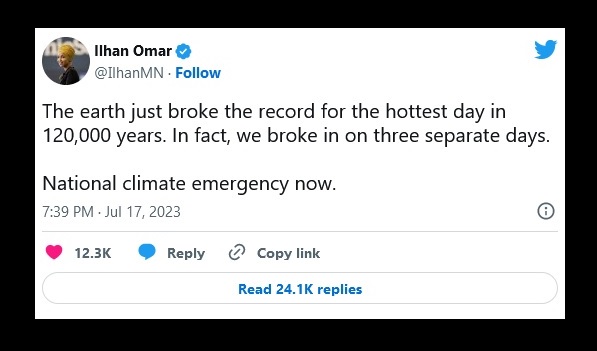
I was so tempted to headline this post with the res ipsa loquitur tag, but didn’t at the last minute. The reason: I was convinced that as obvious as the scientific and logical nonsense her tweet represented should be, a lot of usually intelligent people wouldn’t allow themselves to see it, because, as Ethics Alarms notes repeatedly, “bias makes you stupid.” The post’s comments turned out to be a marvelous example of that.
One persistent defender of Omar insisted that it was crucial that I had checked the alleged authority for her gaffe before criticizing her. It happens that I did, but I didn’t need to. Nobody did: that’s the whole point. If the woman had the requisite number of brain cells to rub together to start a bonfire, she would have known what emerged from her keyboard when she typed that was hilariously silly with the application of basic critical thinking skills.
Recently, Major League Baseball teams broke the record for the most runs scored in all games on a single day. It was remarkable, because the record was more than a century old: the day occurred in the 19th century. All of the articles about this event specified the day. If, as Omar’s ignorant tweet claimed, the Earth had broken its previous record for “hottest day in 120,000 years,” there would be a day from 120,000 years ago that held the broken record. No source mentioned such a day, however, because there are no daily records of the Earth’s weather—daily temperature is weather, not climate—from 120,000 years ago or even a thousand years ago (though we know Pompeii got pretty damn hot when Mt. Vesuvius erupted in 79 AD.) Estimates of global climate in the periods before records were kept depend on “proxy data.” Here is a chart explaining what proxy data can tell scientist about distant climates:
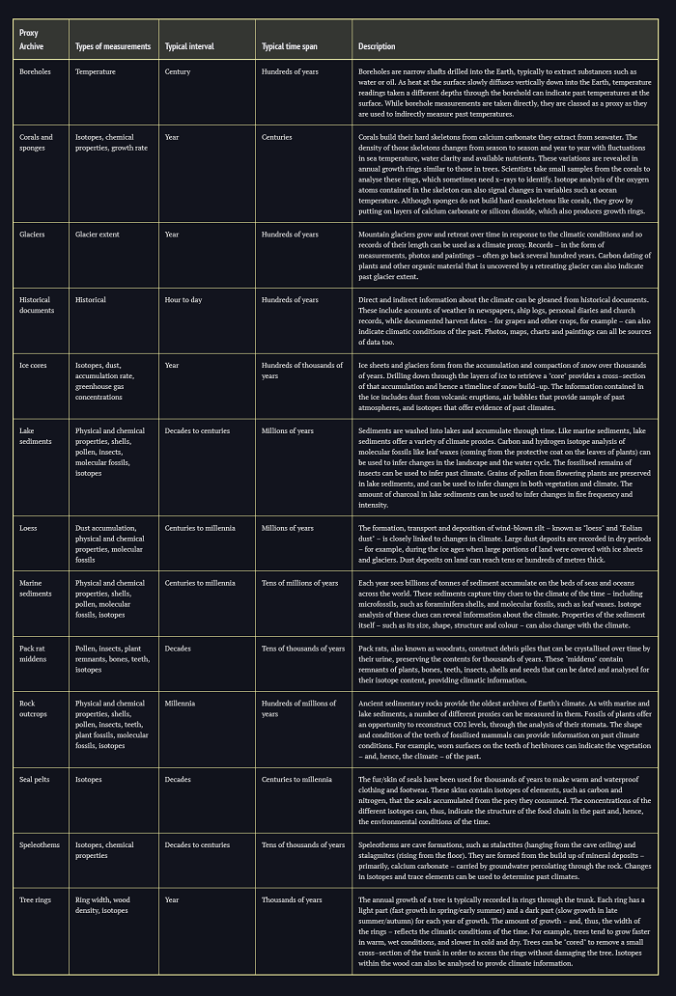
Note that only one box (Fourth one down) in the chart lists “days,” and the proxy data that can tell researchers anything about how hot it was on a day before there were methods and equipment to do the measuring is “historical documents.” Well, there were no historical documents 120,000 years ago….of course. That being the case, what did the data that Omar was parroting—or thought she was—really allegedly show?
It must have shown that the three days she referenced exceeded the average temperature for the period in question. Did it mean that there were not individual days in that period that were hotter than the three days she was citing? No. Did it mean that those three days were hotter than any part of the period 120,000 years ago? No. Did it mean that there have not been hotter days in the intervening 120,000 years? No! Essentially, Omar’s tweet was referencing a “record” that didn’t exist, because she was so eager to make a dramatic statement about climate change that would spark support for declaring a “national emergency” that she embraced a classic apples-and-oranges fallacy. You shouldn’t have to know anything about climate science to recognize that the tweet was bad science and bad logic. Yet multiple journalists made the same error. That doesn’t excuse Omar. Elected officials are supposed to be smarter and more responsible than journalists.
In related news, Nate Silver, now exiled to substack, writes in part:
In March 2020, a group of scientists — in particular Kristian G. Andersen the of The Scripps Research Institute, Andrew Rambaut of The University of Edinburgh, Edward C. Holmes of the University of Sydney, and Robert F. Garry of Tulane University — published a paper in Nature Medicine that seemingly contradicted their true beliefs about COVID’s origins and which they knew to be misleading. The paper, “The proximal origin of SARS-CoV-2”, has been cited more than 5,900 times and was enormously influential in shaping the debate about the origins of COVID-19…
We know this because of a series of leaked and FOIAed emails and Slack messages that have been reported on by Public, Racket News, The Intercept and The Nation along with other small, independent media outlets. You can find a detailed summary of the claims and a copy of the emails and messages here at Public. There’s also good context around the messages here (very detailed) or here and here (more high-level).
The messages show that the authors were highly uncertain about COVID’s origins — and if anything, they leaned more toward a lab leak than a spillover from an animal source. But none of that was expressed in the “Proximal Origin” paper, which instead said that “we do not believe that any type of laboratory-based scenario is plausible”...In the Slack and email messages, the authors worked to manipulate the media narrative about COVID-19’s origins and to ensure that their private uncertainty wasn’t conveyed in conversations with reporters. They also thought they were going to get away with it. “The truth is never going to come out ”, wrote Rambaut in one message. This went beyond mere motivated reasoning. There was an enormous gap between what the authors believed privately and what they stated publicly…As someone who has spent a lot of time trying to convey statistical and epistemic uncertainty to the public, I’m deeply disappointed by the scientists’ conduct here and how unmoored they were from any attempt at truth-seeking…
…the coverage of the recently leaked emails and Slack messages at major center-left outlets like The New York Times has been pathetic. The Times portrayed Andersen as the victim of a Republican witch-hunt — rather than someone at the center of a major scientific scandal of his own making.
And second, journalists ought to have decent bullshit detectors — including toward scientists, academics and other experts. even if the incidence of bad apples is relatively rare among scientists and academics — rarer than it might be among politicians or other groups that journalists intrinsically treat with more skepticism — it’s clearly not exceedingly rare. It was just this week that the president of Stanford was forced to resign in a research scandal. …
I also think journalists are more prone toward being manipulated by bad apples in academia and science than they were ten or twenty years ago….journalists ought to treat scientists like they do any other source — that is to say, with an appropriate dose of skepticism.
And because journalists don’t, and because they typically lack the integrity, knowledge or skill to check the pronouncements of scientists and “experts” when their claims make good copy or support the reporter’s own agenda and biases, elected officials ought to treat media reports about scientists’ claims “with an appropriate dose of skepticism.”
 Ethics Alarms
This kind of reminds me of a conversation I watched on the topic of vaccines.
The person saying that vaccines were dangerous (A) was putting forth the normal talking points, the other person (B) was making the argument (that I agree with in spirit, although not exactly how it was being put in this case) that his opponent didn’t actually care.
B’s point was that A didn’t care about the science until two years ago. Up until then, if A had walked into a doctors office and said he was going to Mexico, the doctor would have suggested Twinrix, and A probably would have taken it. If A has kids in school, A already trusted the vaccine schedule. Chances are that A already has a whole slew of vaccine-enabled antibodies in his system. Decades and decades of life, never asking a question about a vaccine, and now, this is what holds you up?
I don’t like that point, phrased that way. I think that people are mostly willing to go along to get along while they aren’t being inconvenienced, but if you’re going to inconvenience someone you probably owe it to them to be able to explain why, and what someone choses to care about is ultimately up to them.
The way I would put it, and have, is that if you are going to care deeply about the topic, you owe it to yourself to be informed. It’s intellectually lazy not to understand what the vaccine does, how it acts, what the reasonable outcomes are and what the complications might be at this point. If you’ve approached the topic from a genuine place of intellectual curiosity, I don’t think that you can avoid the realities of it.
And politicians in particular need to be more open and honest with things like this. They need to be informed enough that they can opine relatively intelligently on the topic. Part of the reason the Covid vaccine became so controversial was because the politicians and medical experts were overpromising, underdelivering and (by their own admission) lying.
Masks were always going to be effective as a tool in short contact interactions. It was bizarre to me how that narrative bounced back and forth. The infection curves in nations that had mandatory masking were on average better than those that did not, it was obvious to me that there was something to it. The CDC started by saying that masking was a tin foil hat conspiracy theory and that we shouldn’t try to buy masks because a run on the market might deprive medical professionals of PPE. The latter was true, to a point, medical professionals don’t normally share a PPE supply chain with the public, but they were having a hard time keeping their PPE in stock, so they were cannibalizing the open market. The former, Fauci eventually admitted, was just a lie. They knew that masks were always going to be of *some* benefit, and we could have had discussion on the relative efficacy… If it weren’t for the fact that the same people who just told us that masks were tin foil hattery hadn’t made a moral imperative out of them.
And there were so many examples like this… The CDC and the WHO were in a running gun battle for almost two months, taking alternately opposing positions with themselves over whether or not your family pets could be viral vectors. The number of people who either killed or abandoned their pets on the information coming out of that fight was fucking atrocious.
And that’s without broaching vaccine efficacy. “It will prevent infection” had to be one of the stupidest talking points I’ve ever seen. Why promise that?! The entire reason that we got an annual flu vaccine was because coronaviruses mutate fast enough that while there would always be some amount of protection, we were basically guaranteed to get diminishing returns on it and no flu shot in the history of ever had previously been billed as 100% protection against infection. What it does is decouple cases from serious effects… Which the Covid vaccine did, the death curve after the vaccine came out was a blip in relation to the case curve.
But again… Overpromise and under deliver, leading to this:
Which gets me onto the topic of boosters. The problem isn’t that the vaccine “wore off”, the problem was that the virus mutated. And so if we’re going to provide new boosters derived off new and current strains of Covid… Sure. But if the there isn’t a change to the vaccine, and the reason that vaccine efficacy started to wane was because the virus mutated… Then what was a booster supposed to do?
I could go on and on and on… Expert after expert hemorrhaging credibility on something that I probably largely agree with them on, which is a special flavor of frustrating. For what I assume are political reasons.
Which brings me back to the topic of climate change: I’ve been threatened every year of my life. I remember save the rainforest drives in primary school. I remember learning about the ozone layer, I remember the fear campaigns telling me every year for the last 30 that the Earth has five years left. If there is a topic where the experts have more damaged their credibility than this one, I can’t imagine what it is.
It’s obvious that our climate is changing. Earth’s climate has never been static – See the ice age. But it seems to me at least probable that the rate of change is increasing, and I’d be very surprised of humanity wasn’t to blame for some part of it. Even most of it. Frankly, if humanity isn’t responsible for most of it, that’s almost more frightening, because it means that we don’t have a way to stave it off and that’s going to have serious downstream implications. But the prescriptions from activists are insane. There is a responsibility, if you want to be taken seriously, to be open, honest, and reasonable. And when I say that to activists, they balk, like I’m holding up Earth-saving programs over a tone issue. It’s not that… If you could convince me that your prescription was actually reasonable, you could be as big an asshole as you wanted. If I actually thought that the plastic straw ban would be effective, I’d be in favor. If I actually saw a reasonable way to move away from a carbon economy, I’d support it (and please give you your views on nuclear power as a litmus test on your reasonability.). But I don’t, so I don’t. And if you’re an activist that wants my support, or the support of people like me… That’s a you-problem.
Here’s an indication why I don’t trust climate writers for the New York Times (and others) – A ‘scare’ headline, a scary sub-head, and a very important related fact minimized fairly well by being placed below about a dozen paragraphs and a half dozen ads and graphics (from an online NYT article today).
The Headline: Warming Could Push the Atlantic Past a ‘Tipping Point’ This Century
The Subhead: “The system of ocean currents that regulates the climate for a swath of the planet could collapse sooner than expected, a new analysis found.”
The part many readers will never see: “Evidence from ice and sediment cores indicates that the Atlantic circulation underwent abrupt stops and starts in the deep past. But scientists’ most advanced computer models of the global climate have produced a wide range of predictions for how the currents might behave in the coming decades, in part because the mix of factors that shape them is so complex.”
I regard any story or op-ed with the “could”/”might”/”some say” hook fake news. It’s one of my least favorite categories.