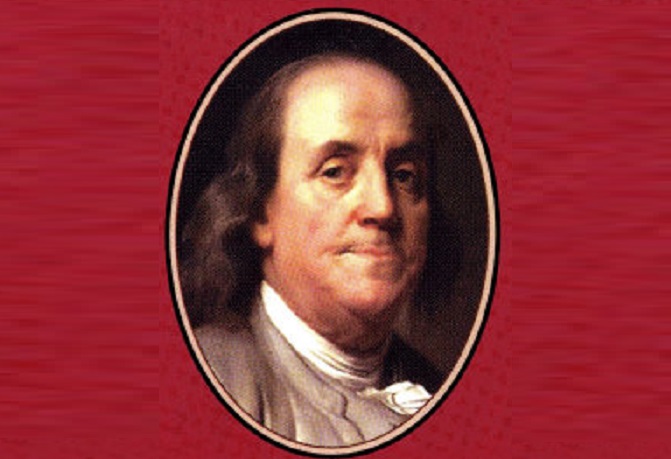
“Thinking aloud is a habit which is responsible for most of mankind’s misery.”
Benjamin Franklin, quoted in the 2008 series “John Adams,” spoken by Franklin (Tom Wilkerson) as advice to Adams (Paul Giamatti)
I wasn’t looking for more perspective on Donald Trump’s most recent disqualifying outburst when I revisited the first two episodes of HBO’s 2008 series “John Adams” after many years. My wife and I were just seeking something intellectually stimulating, inspiring and real to watch after completing the bizarre fictional entanglements of “The Affair.” By pure happenstance, however, a dramatized conversation between John Adams and Benjamin Franklin following a session of the Continental Congress in 1775 had immediate relevance both to the post and several of the comment threads following it in which Trump defenders praised his apparently unbreakable habit of blurting out or typing every thought that jumps into his head.
John Adams, we know, had some of the same inclinations and periodically suffered for them throughout his life. After undermining the cause of independence by foolishly undiplomatic remarks to adversary John Dickinson in a debate over whether to raise a Continental army to assist Massachusetts in fighting the British, Adams is admonished by Franklin. Adams expresses surprise that the sage doesn’t approve of candidly expressing one’s beliefs, and Franklin replies, in an authentic quote, “Thinking aloud is a habit which is responsible for most of mankind’s misery.”
Next Franklin dresses down Adams for insulting Dickinson in public. Ben’s argument isn’t an authentic quote, but it applies to Trump as well: “It’s perfectly acceptable to insult someone in private. Sometimes they might even thank you for it afterwards, but when you do it in public, they tend to think you are serious.”
Adams, a smarter and better man than Trump, at least tried to absorb Franklin’s wisdom although his nature was opposed to it. Both quotes, from the real Franklin and the fictional one, are valid: I wonder if Donald Trump ever watched the “John Adams” series. Adams was the past President who most shared Trump’s failings in personal diplomacy and rhetorical self-restraint, and they both were single-term Presidents in part because of this shared weakness.
Watching the drama also caused me to wonder how many public schools, if any, show the series to their students, who would not only learn a great deal but absorb some of the wonder of the amazing confluence of radical ideas, personalities and events that resulted in the United States of America. I’d be surprised if any schools do; they are all too busy having to teach how the United States was built on racism.
 Ethics Alarms
Schools might have to edit a couple of scenes – the tar and feathering scene, Adams’ passionate reunion with Abigail, Nabby’s breast cancer surgery. Ironic as they’d probably have no problem showing students other films with less instructional value and more offensive content.
In fact, Adams was more circumspect in his letters to Abigail, admitting his vanity and other foibles. At least, he seemed to have the self-awareness that Trump appears to lack.
But you are correct, of course, that students could benefit from knowing more about Adams. After all, he was a Founding Father who adamantly opposed slavery and did his share of manual labor at Peacefield along with his hired servants.
The series is enlightening about a great deal besides Adams himself, all launching points for further discussions and research: remarkable Abigail, the origins of the Revolution, the politics of slavery, Sam Adams, Jefferson, Lee, Franklin, Dickinson, Rutledge, Knox, family dynamics, vaccines, sea travel, George Washington (and the Great Man Theory, which Washington exemplifies perhaps better than anyone, the Boston Massacre, the judicial system, self defense and guilt beyond a reasonable doubt, as well as the purpose of defense lawyers…and that’s just off the top of what I laughingly call my head…
Also…the intersection of historical fiction, history, and entertainment, politics, ethics, idealism, culture (those scenes in Paris!), sexual discrimination and women’s rights…
I think my favorite part was when Jefferson, weary from all the debate about what should be in the Declaration of Independence, laid his dainty head down on a couch like the suffering artist he was.
I liked Franklin spinning around in Jefferson’s rotating chair: American inventors is also a tangent.
And George Washington turning to Adams after the whole debate about the President’s title and saying, “Yes…Mr. President” and looking directly at Adams, adding, “and nothing else.”
David Morse’s Washington is terrific. I don’t think most viewers knew enough about Washington to realize how subtle and deft his portrayal was.
George Washington was subtle to begin with. Ended a plot to potentially overthrow the budding republic and install him as dictator with a set of reading glasses.
Whereas Adams obsessed about whether he was appreciated and get credit for what he accomplished, Washington just did what he did in full confidence of his influence and ability, never appearing to worry about what anyone thought but him. He lived a charmed life, had natural authority and leadership ability, and didn’t seem to fear anything.
All Presidential rankings by default should have Washington as #1. Meaning the real debate is who is #2.
(probably Lincoln).
So then is the real debate who is #3?
William Henry Harrison?
For doing the least to expand the Federal Government’s scope?
“Talk less. Smile more.” –Something applicable that Aaron Burr didn’t actually say, from the musical Hamilton.
Regarding your belief that school children should watch this series, I was talking to my husband about how it seemed there was a lack of good American History movies that could be shown on what are referred to in our house as Nat Geo days, or otherwise known as mommy migraine days. As a homeschooling mom, I tend to use movies to educate while I lay on the ground in a puddle when the migraines hit. Schoolhouse Rock is my go to, along with nature documentaries, though having to jump every time an imperative sentence is used in Disney’s Cinderella (the original, of course) is a good English and PE alternative.
What age range do you think this is appropriate for and where does one find this series? Any other movies or series that you would recommend that children watch to better understand American History?
It was an HBO show. It is available on DVD so you should be able to order it. I would say it’s appropriate for middle schoolers with the caveat that you should know your kid and understand that there may need to be some creative editing depending on your standards for content.
– a sailor is tarred and featured by some of the Sons of Liberty who strip him before applying said tar and feathers so there is a brief moment of full-frontal male nudity.
– Adams, after several years apart from Abigail, has a fully-clothed but passionate response to seeing her again.
– Their daughter develops breast cancer as an adult and has a mastectomy. The surgery is depicted, breasts exposed.
Ooh…that’s requiring more maturity than we can hack at the moment. My kids are little and struggling with Conjunction Junction. Perhaps in a few years.
Adams and Trump both lost their re-election bids, but there’s a teeeeeeensy bit of difference in the caliber of their successors.
It was a close call, though! Adams nearly was succeeded by Aaron Burr: now THERE’s a fascinating alternate history…
I, too, went to “John Adams” for enlightening educational entertainment. I followed it with “Armistad” and then “A Man for All Seasons.” Too many excellent ethics quotes to enumerate. Every one over the age of 13 should see these. They should also read “Red Badge of Courage” and “All Quiet on the Western Front” That is my curriculum for Ethics Education
“What miserable drones and traitors have I nurtured and promoted in my household who let their lord be treated with such shameful contempt by a low-born cleric!”