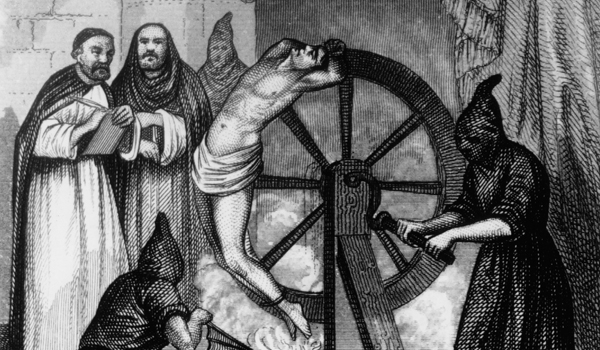
Col. Lanny J. Acosta Jr, the military judge in the U.S.S. Cole bombing case, threw out confessions by the Saudi defendant Abd al-Rahim al-Nashiri in a 50-page decision yesterday. After all, the man accused of planning Al Qaeda’s suicide bombing on Oct. 12, 2000 in Yemen’s Aden Harbor that killed 17 U.S. sailors had been tortured by the CIA, or as th agency likes to describe it, “subjected to enhanced interrogation.” Yes, I seem to remember there was something in the Constitution that said you can’t do that. Quite a few things, actually.
Dirty Harry was also lectured on the same point, if I recall, 50 years ago.
Testimony in the pretrial hearings revealed that Nashiri, who has been in custody since his arrest in 2002, was subjected to “both authorized and unauthorized” physical and emotional torture as he was sent through the C.I.A. secret prison network that wound from Thailand to Poland to Afghanistan and finally Guantánamo. Among the practices used on him were waterboarding (to be fair, Prof. Yoo told the White House it wasn’t technically torture), keeping the prisoner a cramped box, isolation, sleep deprivation, running a loud drill next to his hooded head and rectal abuse to coerce him to answer interrogators’ questions about future and suspected Qaeda plots. [Wait—rectal abuse??] Eventually, after more than a year of all this, Nashiri was conditioned to answer his captors questions, and evidently did.
By the time he was questioned by federal agents in January 2007, lawyers and experts argued, the prisoner had been trained to respond to his interrogators’ questions.
Judge Acosta ruled that the extensive torture of Nashiri made it unreasonable for the terrorist to believe “that his circumstances had substantially changed when he was marched in to be interviewed by the newest round of U.S. personnel in late January 2007,” as prosecutors argued. “If there was ever a case where the circumstances of an accused’s prior statements impacted his ability to make a later voluntary statement, this is such a case,” Acosta wrote. “Even if the 2007 statements were not obtained by torture or cruel, inhuman, and degrading treatment, they were derived from it.”
The judge added, “Exclusion of such evidence is not without societal costs. However, permitting the admission of evidence obtained by or derived from torture by the same government that seeks to prosecute and execute the accused may have even greater societal costs.”
I would have left out the “may,” but otherwise, bingo.
Now do “right to a speedy trial.”
 Ethics Alarms
I am sure many will disagree with your assessment of ethics hero status. That, of course is a result of short-sighted thinking. If we allow ourselves to agree that one group is worthy of “enhanced interrogation” but such practices are abhorrent if used on “our group” then nothing will stop the slide down the path that results in “our group” having fewer and fewer persons exempt from such methods.
Right, time enough has passed after Sept. 11 that we can wax ethically, and not view ourselves in a hypocrital light. (It helps that the daily news doesn’t include IED deaths, and our Most Wanted Iraqui Playing Cards are worn out.) How many Senators voted to go to war in the dubya days?
Recently saw the movie Rules of Engagement w/Samuel L Jackson and Tommy Lee Jones. There might be some parallels to this Lanny J Acosta hero piece – its ‘enhanced interrogation’ condemnation and why USMC Col Childers got off in the movie. Leadership isn’t necessarily nice. And the whole idea … indulge me: Herm Edwards “You play to win the game!”
A great deal of winning the game requires winning the hearts and minds of the people on both sides.
Much of war is a propaganda game and if we can be seen as barbaric combatants it plays into the enemy’s strategy of portraying us as the evil one.
In today’s world war is not just about killing and breaking stuff it is also about messaging. If if we’re just the former we could have exterminated every rogue in Afghanistan and Viet-Nam and been out of there in a few months.
I fully agree Jack, and I applaud judge Acosta (and you). It’s truly scary how easily many people nowadays are fine with ignoring and circumventing crucial constitutional prohibitions, limits, and protections under the pretense of furthering some public good, often of disputed value (like the whole push to limit free speech under the guise of combating ‘hate speech’).
On a side note, it’s disgusting that Bush II and his circle of neocons did and continue to escape accountability. They should have been tried as war criminals for the invasion of Iraq (even though Saddam had to go)!!
Well, heck, Bush did give Saddam and his sons 48 hours to get out of Iraq and go into exile, but they didn’t, so, “he had to go” maybe wasn’t quite strong enough.
And, along with accountability for ‘Bush and his neocons’, there should be accountability as well for the 373 members of Congress who voted for the Authorization for Use of Military Force, the intelligence officials who assured the administration Hussein had weapons of mass destruction and was seeking more, and for the international officials (including members of the UN Security Council) who failed to hold Hussein to the terms he agreed to at the end of the so-called ‘first gulf war’.
I know you’re being sarcastic, but I’ll address anyway:
1) I’m not making excuses for the congressmen, but they were relying on the administration’s assertions. Nonetheless, yes, they should be held responsible, and we need to correct our system—Congress has been ceding power to the executive (and, worse, unelected bureaucrats in the administrative agencies) for decades; that is one of the main causes of the situation we’re now, and why winning the presidency has become such a critical thing.
2) many people in those very agencies questioned Bush’s claims; they simply ended up saying what wanted to be said. So, yes there should be accountability there too—in fact, one can argue that the way the FBI and CIA acted the last few years (incl. the Steele affair, the Hunter laptop, etc.) is an outgrowth of these agencies becoming completely subjugated by the executive and losing all oversight by other branches;
3) despite all you heard and want to believe, Saddam did comply; the West (mainly US) just kept moving the goalposts because the intent was to never remove the sanctions regime as long as Saddam remained in power. In fact, Bush could not get a UN/security council authorization to take action (and it wasn’t just Russia and China; France too, so 3 out of 5 permanent members were against it). However you slice it, and despite all “legal” justifications made at the time, the invasion was not authorized and thus in violation of international law—but who’s gonna hold the US accountable
I’m not sure that the CIA, FBI and other alphabet agencies are accountable to anyone. They seem to simply run amuck doing whatever they want. Separation of powers needs a mighty big refresh.
With regard to my response to ‘He has to go”, yes, a bit snarky and a bit sarcastic, but, if he really had to go, persuasion was far down on the list of methods to get that done. With regard to the rest, the majority opinion was to go in and get rid of Hussein.
I was a Kennedy liberal, and these words rang true for me: “Let every nation know, whether it wishes us well or ill, that we shall pay any price, bear any burden, meet any hardship, support any friend, oppose any foe to assure the survival and the success of liberty.”
In Iraq then, as in Afghanistan a lifetime ago (seemingly), as in Ukraine now, the success of liberty is not easily purchased. Getting rid of Hussein was a step in the right direction, but, political will being what it is, backward steps since then have been a surrender to the foes of liberty. So, I’ll stand by my statement that indeed, he did have to go, and that military action was the way to get it done.
But, we nowadays cannot seem to find the political will to do what is necessary once the battles are over, to promote the values we say we stand for, to take the time needed to engrain those values, to not abandon our allies, to not leave them to the fate of the concentration camps (re-education?), the hazards of trying to escape by boat to nations which may be welcoming or may try to shoot the boats out of the water, to the terror of resisting and the horror that eventually comes from giving in to the Taliban.
Iraq is done. We aren’t going back any time soon. Today, it’s Ukraine. We were weak when it was Georgia. We were weaker yet when it was Crimea. So, what now? Forego liberty because it’s, oh, just somewhere else?
[From The New York Times, by Carol Rosenberg, published Sept. 20, 2021 and updated Oct. 13, 2021.]
This is the same ethics hero Acosta who found (in 2021) a limited right for use of information obtained through torture. That ruling subsequently was overturned by a Pentagon appeals panel.
Acosta had found that evidence obtained during the torture of a defendant could be considered in determining pretrial matters. Rather than reject the evidence entirely, Acosta ruled that while juries could not see that type of evidence, prosecutors may invoke such information for very narrow use on matters that are a judge’s rather than a jury’s domain.
Defense lawyers disagreed and appealed, successfully.
This whole case is well worth study especially by lawyers, law enforcement officials, and members of the military. The latest 50-page decision cited at the top is well worth reading by anyone interested in what their government does; the legalese is not all that difficult.
In defense of W, Saddam was a demonstrated belligerent. Among his many machinations, he had a nuclear weapons research facility that required the Israelis to destroy, he started a war with Iran in which he used outlawed chemical agents killing untold thousands, and he invaded, occupied, and brutalized a neighboring country.
And after a Bush Sr. coalition had him forcibly removed from Kuwait, he continued his belligerence by constantly probing and violating restrictions placed on him while waiting for his next opportunity to cause mayhem, and it was his belief the west would do nothing. Meanwhile he and his cronies/sons perpetuated a literal reign of terror on his own people. Concluding he needed to be removed was an easy call.