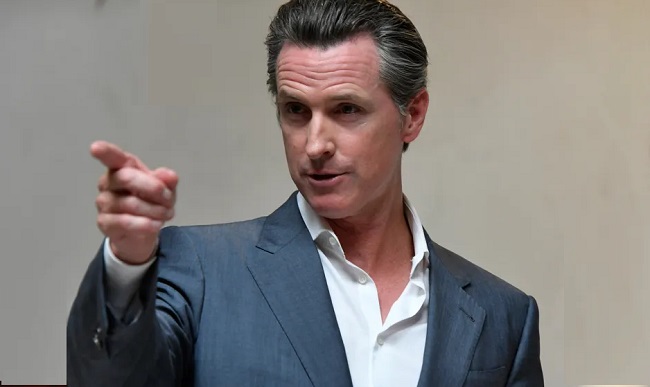
In California, the governor has the power to appoint a senator to serve until the next regularly scheduled statewide general election. Current California Governor Gavin Newsom had the opportunity to exercise this power because, in a previous example of unethical conduct by a California elected official, Senator Diane Feinstein had died in office after irresponsibly running for re-election when she was already 85 and declining in health and mental acuity. (California voters, who would vote for a pet rock if it had a (D) next to it, dutifully sent her back to the Senate anyway).
Newsom is running a shadow campaign to be the Democratic Party’s nominee for President in 2024 in case President Biden does a Feinstein, and has recently shown his utter lack of integrity (but we knew that) by vetoing three progressive bills that his rhetoric had previously supported, one that would have given striking union workers in California the opportunity to apply for unemployment benefits, another requiring judges to consider children’s gender identities in custody disputes, and a third that would have barred California’s prison system from sharing information about incarcerated immigrants with federal officials, in keeping with California’s “sanctuary state” position. You can almost hear the wheels turning: Newsom knows that progressives will vote for him over Donald Trump no matter what he does, so he’s trying to look like a moderate to those millions of apathetic and ignorant voters who haven’t been paying attention to what’s happening in California under his watch. Good plan! Unethical, weasel-like, but smart.
In a similarly cynical calculation, Newsom promised in 2021 to appoint a black woman should Feinstein’s seat become open. Not only was this an announcement that Newsom placed pandering to poweful Democratic constituency groups over seeking the most qualified person to fill a crucial legislative position, it also was a betrayal of his duty to the population of Claifornia, all of whose interests must be served by a U.S. Senator, but also to the citizens of the United States as a whole, who require the best representation in their republic available. Gender and skin color are not qualifications for high elected office.
Well, never mind, progressives gotta progress. But Newsome went a step further in his unethical ways, choosing to appoint as the interim Senator the black, female, rabidly pro-abortion activist Laphonza Butler, the leader of EMILY’s List, which has as its sole mission electing women who believe that allowing abortion on demand is the most important issue of our time. U.S. Senators should not be single issue advocates, but, again, Newsom has gauged that abortion is the one major reason a lot of women are supporting Democrats, so this is a Newsom for President maneuver. Another bonus us that Butler is a Lesbian: yes, to Democrats and progressives, who one chooses to share a bed with is considered a qualification for high office. Before EMILY’s List, the last bit of evidence we had regarding Butler’s competence was her performance as Kamala Harris’s campaign manager when she ran for President. As you no doubt recall, Harris couldn’t win a single delegate.
And yet that’s not even the main reason the appointment of Butler is problematic. Butler doesn’t live in California, nor is she a California resident. She is a Maryland resident, and registered to vote there. This may trigger a Constitutional crisis.
The Constitution establishes the following qualifications for Senators in Art. I, § 3, cl. 3: “No Person shall be a Senator who shall not have attained to the Age of thirty Years, and been nine Years a Citizen of the United States, and who shall not, when elected, be an Inhabitant of that State for which he shall be chosen.” Though Butler lived in the Golden State for much of her life and still owns a home there, she isn’t a resident or “inhabitant” of California now. Newsom’s claims that it is sufficient for Butler to re-register to vote in California before being sworn in tomorrow, as planned. But Article I looks to a senator’s residence “when elected,” and not when sworn in. The residence requirement comes with the explicit limitation that if the candidate isn’t an inhabitant “when elected,” he or she isn’t eligible to serve.
Huh. Is an appointment treated by the Constitution the same as being elected? Writing at the Volokh Conspiracy, Stephen Sachs doesn’t think so. Under the Seventeenth Amendment, he explains, the Senators from each state are “elected by the people thereof,” with the following exception: “When vacancies happen in the representation of any State in the Senate, the executive authority of such State shall issue writs of election to fill such vacancies: Provided, That the legislature of any State may empower the executive thereof to make temporary appointments until the people fill the vacancies by election as the legislature may direct.”
“That’s what’s happening here,” Sachs writes. “California’s legislature has allowed its governor to make a ‘temporary appointment[], which will last until the next election. But that doesn’t mean the residence requirement applies only to senators chosen by the people at large (or, say, that Newsom could choose to appoint somebody from Alaska or New York instead). The phrase “when elected” is broader than that, because it was adopted as part of the 1788 Constitution, when each state’s senators were “chosen by the Legislature thereof” (Art. I, § 3, cl. 1), usually one legislative house at a time. So “elected” here means a whole process of official choice, not only some first-past-the-post vote by the general citizenry.”
He adds, “And the 1788 Constitution also provided for executive appointments, in Art. I, § 3, cl. 2: ‘[I]f Vacancies happen by Resignation, or otherwise, during the Recess of the Legislature of any State, the Executive thereof may make temporary Appointments until the next Meeting of the Legislature, which shall then fill such Vacancies.’ The Seventeenth Amendment was adopted “in lieu of” the “chosen by the Legislature” requirement, as well as “so much of paragraph two of the same section as relates to the filling of vacancies.” But it left the qualification requirements in Clause 3 intact. So the “when elected” requirement is still good law, and its most natural reading would include whatever form of official choice establishes a person as a putative senator. If Newsom already signed the paperwork on Oct. 1, and if Butler were still a Maryland resident at the time, those papers are no good, and he has to sign new ones after she actually establishes California residence.”
Gee, you’d think that a Presidency-worthy Governor would have checked all of this out before acting.
Naturally, following the recent tendencies of the party and its supporters of late, the response to this self-made crisis by Newsom is a) to shug it off; after all, it’s only the Constitution…and b) to try to cover it up. EMILY’s List scrubbed Butler’s listed residency in Maryland from Butler’s bio on its website, though she hadn’t yet established residency in California. Butler also removed her location data from her social media accounts. Is the pool of choices of California residents really that weak—is even the pool of black, female lesbians that weak—that Newsom felt it necessary to go all the way to Maryland for a replacement U.S. Senator? Apparently.
Oh, I’m sure Democrats won’t let this little detail get in the way of Newsom’s cynical appointment. Under Art. I, § 5, cl. 1., “[e]ach House shall be the Judge of the Elections, Returns and Qualifications of its own Members,” so the courts can’t get involved. The Senate will be the final tribunal to decide whether Butler is eligible to serve, and even missing a vote (Feinstein’s) a straight party roll call on Butler’s eligibility would seat her, with Vice-President Harris breaking the 49-49 tie. You never know, though: there might be some Democratic Senators who decide, much as they would hate to vote against a black, female, lesbian and might face progressive backlash for doing so, that having taken their oath…
I do solemnly swear (or affirm) that I will support and defend the Constitution of the United States against all enemies, foreign and domestic; that I will bear true faith and allegiance to the same; that I take this obligation freely, without any mental reservation or purpose of evasion; and that I will well and faithfully discharge the duties of the office on which I am about to enter. So help me God.
…their duty to our founding document and the law of the land must prevail over narrow partisan agendas.
Hahahaha! Just kidding! There is no chance whatsoever that there are any Democratic Senators like that in Congress today, and no GOP Senators with such courage and integrity either, if the roles were reversed.
I’ll close with the comment by Sachs, who is the Antonin Scalia Professor of Law at Harvard Law School, in response to the inevitable protests that the Constitutional objection to Butler’s appointment is just “a technicality.” “We should all remember the dictum of the late Judge James Clinkscales Hill, when a lawyer in front of him referred to a rule as a “technicality,” he writes. “‘Counselor, a wise old judge once said to me: “A ‘technicality’ is another word for a rule of law on which you lose. A rule of law on which you win is a ‘cornerstone of justice.'”
 Ethics Alarms
I don’t know. I think Rand Paul might do it. There are a few other GOP senators I think might want to, but lack the backbone to do such a thing.
Yup. I was wondering about Paul even as I wrote that. He’s the only one who would get at least 50-50 odds from me.
This appointment is SUCH an inside baseball move. Appoint a political consultant to the Senate! You’re kidding. And worse, she’s also a former SEIU organizer. Next, we’ll have an AFGE rep in the Senate. The unions will control the federal government the way they control municipal and state governments. Great. We’ll have Senators and Congress people unionizing Congress. The Senate can go on strike for better pay and benefits and a four day work week.
I predicted ( albeit only to my wife) that he would find a black, lesbian woman to fill the role. I allowed for a black transwoman as a possibility. However, I did not foresee that he would go to the other coast for his selection.