
There has already been an addition to what is known about this horrible ethics story. That’s the main (but far from only) villain of the tale above, Lindsey Hill, who plotted to extort Major League pitching star Trevor Bauer, as described in Part 1. I had never seen a photo of her before: she looks exactly as I would have expected her to look. Hill is already hard at work trying to squeeze every last drop of celebrity out of her scheme, and, of course, the popular culture being the scummy place it is, there are plenty of disgusting people out there ready to accommodate her. Now that Howard Stern is old and woke, she moved on to Alex Stein, who had her as a guest on his show “Prime Time With Alex Stein” on Glenn Beck‘s Blaze Media network. Stein is a professional asshole whose idea of comedy is to disrupt public meetings and confront politicians in public. Having Hill on his show gave this creep a chance to get into graphic descriptions of sexual activities, a la Stern.
Hill played the cliche “I’m an alcoholic, pity me” card, then tried to stick to her lie using various strategies. She reminded her host that two more women came out as she was in the process of extorting Bauer to claim he had abused them too. Two words regarding that: Bret Kavanaugh. The me-too #MeToos provided even less convincing evidence than Hill did, and we now know she was lying. She also offered the risible explanation of the damning morning-after video revealed by Bauer that bad lighting was to blame for the apparent absence of the injuries she had claimed. Was bad lighting also responsible for her grinning like the Cheshire cat?
Since we’ve started on Hill, I might as well finish.
1. Lindsey Hill, Villain
As I said, she’s the Number #1 Ethics Villain, and she did far more harm than just derailing Trevor Bauer’s career and reputation. She kicked #MeToo in the metaphorical solar plexus when it already was reeling. “Believe all women” had already been discredited as a slogan, but thanks to Hill, “Don’t automatically believe any women” is about to take its place. And there was more damage, which I will discuss here later.
Several conservative commentators have already opined that the law needs to find some way to punish sociopathic predators like Hill. Writes Miranda Devine in the New York Post, “It will never end until there are penalties for making false allegations that ruin a man’s life. Hill needs to be charged, like Jussie Smollett was for faking a hate crime. Without consequences, malignant behavior only proliferates.” That sounds good, but this will only happen when women’s rights activists and the eager-to-pander politicians who grovel to them reverse course after opposing any negative consequences for women who falsely claim rape, harassment or sexual abuse. The standard argument remains the same: women are already too reluctant to accuse powerful men of sexual misconduct, and if they face real penalties should their allegations not meet evidentiary standards, even fewer will brave the storm, so more evil men will have their way. This is, and has always been, a utilitarian balancing act, with no clear or ideal solution.
The best that can be done about people like Hill right now is cultural and societal shunning. We should make sure everyone knows that generically attractive blonde face and her name, and employers as well as potential friends and lovers should be well aware that she’s a grifter who cannot be trusted. Post her image and deeds widely. If she ends up alone and making a living in low rent peep shows or as a geek biting the heads off live chickens, good. That’s one kind of justice.
It is only fair to mention that there is an unintended benefit of Hill’s vile conduct. Providing an ugly, throbbing example of how the #MeToo ideology can be abused (and why the Obama/Biden directive to colleges and universities to stack sexual misconduct cases against male students) is useful to those fighting these excesses. Thanks, Lindsey! You’re a blight on society, but not a completely useless one.
2. Trevor Bauer, Ethics Hero
Bauer is the only hero in the train wreck. He did nothing wrong (how he and his consenting sex partners choose to enjoy themselves is not wrong) and consistently denied wrongdoing throughout his ordeal. He followed the system, worked through his labor union and kept his mouth shut other than to tersely insist on his innocence. He did not attack Major League Baseball, nor take to social media to tell the world about Hill. Although well-versed in that mode of pubic communications, Bauer did not seek pity, threaten, or post drawings of himself standing with Jesus. His conduct throughout has been exemplary.
Most admirable of all, Bauer did not pay off Hill. No weenie he. It would have been easy to do so, his career would have continued unblighted, and he would barely miss the money: even with his suspension without pay for more than a season, Bauer has made $111,654,099 so far in his career, and at 32, he may not be done yet. In this matter he is an exemplar and role model. He was determined to fight, and that’s what ethical people should do. True, because he was already rich, Bauer could afford to be principled, but so many others who also can afford it, don’t.
This is as good a place as any to note Hall of Fame Braves pitcher Tom Glavine’s comment on the Bauer fiasco. “I would not want to be playing any professional sport in today’s world,” he said. “Listen, the money’s great, it always gets better every generation, but the things that guys have to deal with today, it’s off the charts. I mean, you can’t go anywhere without somebody having a camera. You can’t go anywhere without somebody videotaping.” In short, they are marks for evil people like Lindsey Hill, and unscrupulous women empowered by society’s current groveling to feminists and #MeToo activists.
3. Ethics Villains, the sports media.
Virtually no journalists questioned Bauer’s guilt, because journalists today are progressive toadies. They painted him as a monster, because Woke World wanted him to be a monster. Nobody dug, nobody gave Bauer the benefit of the doubt, nobody questioned baseball’s decision to suspend him even though no charges were brought: Hill, being a woman, was obviously a victim and had to be believed. Baseball writer Ken Rosenthal, a familiar presence on MLB broadcasts who will be much in evidence as baseball’s post-season advances, authored a column for “The Athletic” (owned by the Times) last January criticizing the Dodgers for not releasing Bauer sooner, titled “Dodgers’ decision to cut ties with Trevor Bauer shouldn’t have been difficult at all.” So far, Rosenthal (Full disclosure: I had a tiff with him in an email exchange long ago, in which he snottily accused me of not being objective in my analysis of a particular player’s value—unlike him, the expert. It turned out my analysis was right and his was wrong. I never heard from him.) has been absolutely silent, like his similarly embarrassed colleagues. Outkick contacted him, asking for a reaction to the exoneration of Bauer, and received no response. Then it contacted the Times and the Athletic. They ducked as well.
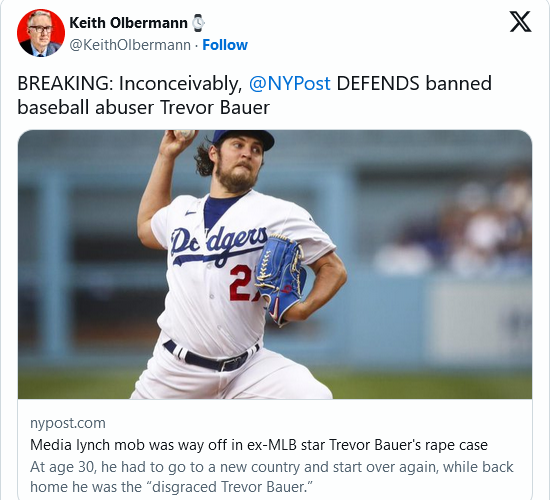
Special dishonorable mention: Keith Olberman: Olberman was once an excellent baseball analyst for ESPN. Progressive Derangement gradually made him into a parody of a biased journalist. Naturally, he was a star on MSNBC during the Bush years. Here was his reaction after Bauer made it obvious that he had been smeared and defamed:
4. Category Undetermined: Major League Baseball
Domestic violence is a tough problem for all sports. In one respect, baseball is lucky. For reasons too complicated to discuss here, baseball players are far less prone to beating up their wives and lovers than NBA and NFL players. In fact, the most publicized instance of domestic abuse involving a player was when actress Tawney Kitaen was arrested for abusing California Angels pitcher Chuck Finley. Nonetheless, baseball carries a self-imposed branding mandate that its players must embody American values and goodness, so it has a hard line regarding domestic violence, putting it on the same level as PED use and gambling, both of which relate more directly to the game on the field. Baseball long ago adopted the policy that it would decide when a player’s conduct warranted punishment regardless of what the justice system decided, because the context is different. Baseball must protect its image.
I do not disagree with that policy. The Chicago White Sox players who helped gamblers fix the 1919 World Series were acquitted at trial, but the first Commissioner of Baseball, the fearsome Kenesaw Mountain Landis, banned them for life anyway, and quite possibly saved the game by doing so. I don’t know what MLB’s independent investigation uncovered or thought it uncovered regarding Bauer, but the publicized details (some of which are recited in Part 1, and more below) were extraordinarily ugly. The decision not to prosecute Bauer didn’t mean he wasn’t a sexual abuser. Had he been allowed to play, baseball is sure to have suffered. Many fans would have protested. The situation was truly ethics zugzwang: letting the pitcher play would have damaged the game, the other players, the owners, the sponsors—everyone. Not letting him play was unfair to Bauer—maybe. At that point, nobody but Bauer, Hill and their lawyers knew about Hill’s incriminating texts, plotting to trap the pitcher.
Baseball’s ethics mistake was suspending Bauer without pay after the initial administrative leave. I cannot fault it for not allowing him to play America’s Pastime as long as he was under such a terrible cloud.
Major League Baseball was put in this position by Lindsay Hill; it is one of her victims. If you want to hold Bauer responsible for not being more careful choosing his sex partners considering his obligations to the game, I won’t disagree.
5. Category Undetermined: The LA Dodger and the other 29 teams.
Was is ethical and fair that no team signed Bauer to pitch for them after his suspension was lifted? I can’t say it was unethical, for the same reasons discussed above.
Back in 2007, when Barry Bonds was released by the San Francisco Giants and became a free agent, I wrote a controversial article for a baseball website explaining why none of the teams would sign him, even though his 2007 season had been excellent. By that time Bonds was universally assumed to be a steroid abuser who had broken numerous records while cheating. The evidence was overwhelming, but still, he had not flunked any official drug tests or been convicted of any crime. I wrote that no baseball team would allow its reputation to be linked to a bad actor like Bonds no matter how much he might help the team. The only team that I had any doubts about was the Yankees, since that franchise has never cared much about ethics. In the essay, I explained the cognitive dissonance scale that readers here are so familiar with. Bonds would drag any team down the scale, I wrote. He wasn’t getting signed.
Well, some well-known baseball experts wrote in to say I was an idiot, that of course Bonds would be signed. I was on a call-in baseball show on Sirius-XM, and the hosts laughed at me. Teams want to win! I was told. They don’t care about ethics!
Barry Bond never played another baseball game.
I think teams made the same calculations regarding Bauer. They were afraid of the cognitive dissonance scale. I can’t blame them for that.
6. Ethics Villains: #MeToo, “Believe All Women,” Time’s Up,” the Obama/Biden weakening of due process and the presumption of innocence regarding sexual harassment, and the related social media anti-male mobs.
I don’t have to rehash this again here; there’s been plenty of metaphorical ink spilled already on Ethics Alarmsabout the unethical anti-male, presumed guilty mentality being pushed by the political Left to the detriment and destruction of too many men to list. This is the reason predators like Lindsay Hill can prevail; it is why they exist.
7. Confusion
I was initially going to comment on the ethics of Hill’s lawyers. Additional information I encountered today makes that inadvisable: the legal issues are too muddled, and so are the legal ethics issues. Nothing here changes my conclusions about the train wreck, but it does put a different perspective on some of it.
Two days ago, Legal Affairs and Trials with Meghann Cuniff, which I had never heard of before, published a transcript of the recording of a conversation between Hill and Bauer that was being recorded and listened to by police without Bauer’s knowledge. Here’s a section as quoted on the site…remember, Hill is fishing for incriminating evidence:
“I really do appreciate all your sweet messages and stuff and, like, they do make me better. … The thing for me is, like, it’s kind of like blurry for me, obviously, because I was like coming out of, like, in and out of consciousness. So I did ask you to hit me?” Lindsey Hill asked the then-Los Angeles Dodgers star in a May 22, 2021, phone call covertly recorded by the Pasadena Police Department with Hill’s cooperation.
Bauer paused before saying softly, “Yeah.”
Hill grimaced through a sigh and said, “Oh yeah. OK.”
“I’m trying to wrap my head around it because obviously, like, I’m in a lot of pain, and I don’t remember, like, specifically asking you to, like, hit me. Like, did you mean to hit me that hard?” Hill asked as two police deceives sat beside her.
Bauer mumbled, “No” before saying, “and like, that’s why it’s confusing. I didn’t feel like I hit you that hard, you know? And certainly, like, I tried telling you multiple times, ‘Do you want to stop? Are you OK?’ And, like, you said to keep going. So I just was trying to follow your lead on it.”
Hill later said she wanted them to “accept boundaries and, like, move forward, but, like, for my own peace of mind, like, I just have to communicate, like, I never, like, said it was a free for all.” She referenced her hospitalization and said “it’s just been a lot.” Bauer replied that he didn’t want to hurt her.
“We, like, checked multiple times about having a safe word and, like, and all that, like, I thought that it was, like — I thought you were OK. I would check multiple times like, ‘Hey are you OK? You want to stop or not?’ You said no. So, like, I was — that was kinda my way of, like, trying to make sure that we weren’t crossing any boundaries.”
Hill told him later in the call that she didn’t remember him asking her if she was OK, and “we never, like, talked about, like, punching, you know?”
“Like getting punched and that kind of thing, which resulted in the black eyes, and like the head stuff,” Hill said, referring to her concussion. She continued, “I just, like, I don’t know. I never like thought that that’s, like, what it was gonna be, you know? Because we just, like, hadn’t, like, talked about that.”
“Yeah, I understand that for sure,” Bauer said. He said a few minutes later, “I never wanted to get to that point … I will never get to that point again, I promise. … I know that doesn’t change anything. Like, I’m hurting too, and this, like, I know you’re experiencing it much more than I am.”
I wonder, after reading that, if any teams will want to sign Bauer even now.
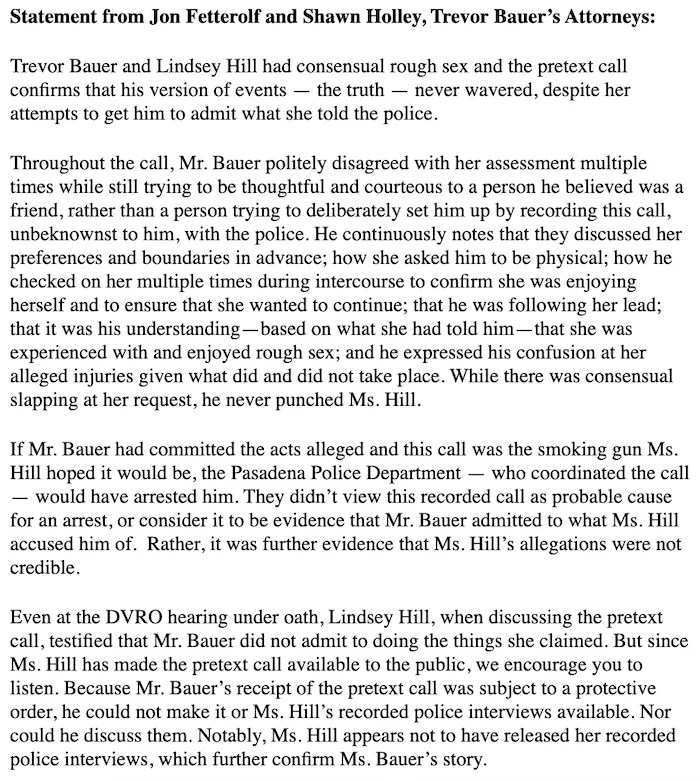
Then yesterday, Bauer’s lawyers released this:
 What a mess.
 Ethics Alarms
I don’t really know that much about this (nor do I particularly want to), so I have to be circumspect in what I say.
Generally speaking, I believe that indulging sexual fantasies and what I believe fall under the category of “base desires” may be legal, but many average people (the kind of people, for example, who make up MLB’s audience) find them incomprehensible, perverse and wicked. That imputes a judgment to the performers of these acts — when the performer is a star and thus an inadvertent role model for some, it creates massive cognitive dissonance in the player’s fans and strong revulsion in those who are indifferent, inclined to dislike him, or just hate all wealthy white athletes indiscriminately.
From what I have read, it’s hard for a person like me who does not follow baseball not to be revolted. My judgment is that he was a wealthy man and decided to live his sex life on the edge and unsurprisingly got caught up in the, shall we say, “flexible ethics” of the people who inhabit that fantasy land.
As we often see in ethics heroes, Bauer’s conduct as a whole was not ethical, but his response to the depredations of Hill and the rest of the ethics villains in this train wreck most certainly was worthy of Ethics Hero status. The sad fact is that it will be hard to point to him with approval when thinking about Ethics Heroes. Acting out sexual fantasies, even legal ones with people that drag it into the light has an intolerably high ick factor for many people.
As you say, a train wreck, and an astonishing number of villains.
7. There’s a huge problem with younger guys who’ve grown up with internet porn: They don’t seem to understand that what they see in porn is all staged. Guys, it’s not real, it’s porn. It’s made up. Do not, repeat, do not try this at home. Your dates are not being paid to act out a fantasy in front of a camera. They are actual young women on a date with a guy. Snap out of it.
And frankly, in this case, ironically, I think the girl invited Bauer to engage in a fantasy as part of her extortion plot.
Well sure she did. And apparently another ball player tipped her off the the pitcher was looking for kinky sex mates.
Glad I’m not young and single and dating. And worth fifty-one million bucks.
“The standard argument remains the same: women are already too reluctant to accuse powerful men of sexual misconduct, and if they face real penalties should their allegations not meet evidentiary standards, even fewer will brave the storm, so more evil men will have their way. This is, and has always been, a utilitarian balancing act, with no clear or ideal solution.”
I don’t see why we don’t treat these claims similarly to frivolous lawsuits–there are situations, like Jussie Smollet and this case, where there’s overwhelming evidence that her claims were made up in order to cash in (or in Smollet’s case, cash in on victimhood status for a better job/pay rate). Those situations should be prosecuted using the standard ‘beyond a reasonable doubt’ threshold. If it’s a ‘he said/she said’ situation, there’s no evidence that it was frivolous and shouldn’t be prosecuted. Just like with frivolous lawsuits, if a woman starts claiming every other man she meets has assaulted her, it becomes obvious that she is engaging in frivolous accusations and should be prosecuted.
But the current standard being employed by MLB, universities, and public opinion, could have easily left this man unemployed, if not in prison, except for the fact that the dumb woman made an incriminating video at the wrong time.
This follow-up is outstanding! I’ve read it twice…and those won’t be the last times I read it.
You wondered if a team would sign Trevor at this point. I happen to think it could, and will, happen if Bauer wants to return to baseball. I think he does. In general, teams are starved for pitching, and while I don’t agree with the hosts of the talk-show on which you were a guest (“Teams don’t care about ethics!”), I think more than one GM will be interested in him. Fans love an underdog, people love the story of a wrongfully-accused person being exonerated in the end, and I think teams will be attracted to an arm a couple years removed from Cy Young status with innings to give.
Glenn Logan’s point above is well-taken. Sexual fantasy, fetishes, and (maybe) rough sex in particular are subjects with which most people are pretty squeamish, and now that the truth is out, there’s an “ick” factor that has to be overcome. Having said that, it’s possible many people will look beyond that to the story of a wealthy man who was targeted, preyed upon, manipulated, and nearly destroyed by someone who was only “in it for the money.” Michael R’s response to my comment in Pt 1 was revealing for sure. Apparently this happens a LOT more often than I realized – in arenas far from sports and big money – so a lot of people may relate to Bauer’s predicament, even if they can’t stand the thought of a man playing rough with a woman in the middle of sex.
I initially did not agree with your #4 and #5 assessments (MLB and the teams in an undetermined state), but the more I read what you wrote, the more I agreed with it. The Dodgers, the remaining teams, and baseball as an organization were all victims of this scam, and they probably handled things about as well as could have been hoped, given how horrible this was.
I’m really glad for Trevor Bauer. As a many-year player and lifelong fan of the game, I want to believe the best of its participants. We’ve been sucker-punched so many liars: Bonds, A-Rod, McGwire, and Rose to name just four. How refreshing to have one that told the truth, even when it cast him in a rather ugly light.
Thanks so much again, Jack. This space is filled with great efforts and from one baseball fan to another, I think these two pieces are among the very best.
Thanks, Joel. I believe, as you know, that one of baseball’s unique virtues is that it is a veritable well of ethics lessons, issues, conflicts and dilemmas. I also have learned that a lot of otherwise regular readers have their eyes glaze over when I do a baseball related column, but this is an unusually rich incident, and I was determined to cover it thoroughly.
I was thinking about why baseball players get into less trouble than other professional athletes. I’m thinking it’s because baseball is SO DAMNED HARD. Even more than golf, baseball has to be humbling for even MLB players and even the stars. Plus, it’s such hard work.
In short, the game’s difficulty builds character rather than egos.
As you know, Ted Williams agreed with you. He said hitting a major league pitch was the single most difficult feat in sports. Of course, this was self-complimenting, since he was so good at it. But statistics and common sense say he was correct.
I’ve mentioned it here before, but a paladin character in a webcomic that I read described “good” (the character alignment) as distinguishable from “evil” because good always requires evidence before condemning and punishing someone, but requires no evidence to help someone. Evil would do the opposite, requiring evidence to help but requiring no evidence to impose harm.
If someone claims they were assaulted but has insufficient evidence, we can still help them. We can act under the assumption that they were assaulted; we just can’t take them at their word who the culprit was. That won’t solve all problems related to assaults and the accusations thereof, but it’s a start.
If there is evidence that the alleged victim is lying (and not just mistaken) then we can apply penalties to them. No matter who is being punished, though, we need to be careful that the evidence being used to condemn them hasn’t been fabricated.
A couple of thoughts from the perspective of a former pro-athlete agent. The first is that Bauer himself has to bear a considerable amount of responsibility for this situation. People in pro sports, especially very successful people in pro sports, are counseled regularly by their agents, by their teams, and by their leagues, about getting sexually involved with people whom they don’t know and with whom they haven’t established some kind of relationship track record. This will probably sound bizarre to this group, but there is a sizeable cohort of predatory women who will use every sexual tool at their disposal to secure financial support from athletes. Note that I didn’t say professional athletes, because this type of thing starts in high school. I had clients who were essentially seduced by women a decade older (we’re talking 25-year-olds) once these kids were identified as potential superstar athletes. In those cases, of course, the goal was to get a baby that would later translate into a decade and a half of child support and financial security once the athlete made it big. When the athletes get into the professional ranks, the baby thing is still very much in play, but because these guys are already rich there are lots of other ways to extract money. See, e.g., Trevor Bauer. BTW, the NIL industry makes this type of conduct even more likely than before for high school jocks because the payday arrives sooner.
All of this gets explained to these guys once they become professional jocks (and it’s also mentioned in college sports). They ignore the advice at their peril.
As for the reactions of the Dodgers and MLB, I agree that it’s hard to fault them. Like every other pro sport, baseball is the entertainment business. People go to be entertained and the presence of a misogynist lightning rod is not exactly contributing to an enjoyable and entertaining experience at the ballpark. While winning can greatly increase the average fan’s tolerance for misbehavior or illegal conduct by a player – remember Ray Lewis and Ray Rice?- there are limits and Mr. Bauer seems to have crossed the line to such an extent that even his immense talent wasn’t enough to balance out what baseball thought was a huge negative. Looking at this situation from the entertainment business angle, it’s clear that principles of due process or fairness are far less important than the perception of the fanbase. For entertainers, the audience’s perception is the performer’s reality. Agents constantly try to impress that on their clients, often with limited success.
Finally, I absolutely think that there should be some kind of criminal sanction for the false reporting in this case. I won’t hold my breath.