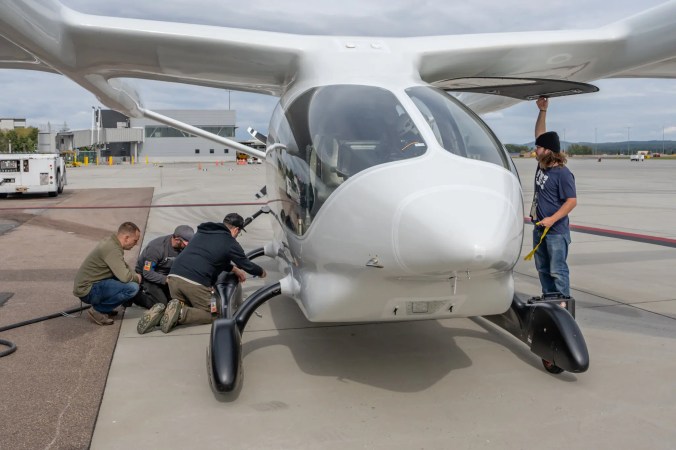
This will, I assume, eventually be recognized as part of the Climate Change Hysteria Ethics Train Wreck.
The New York Times is all excited about the prospect of electric planes, and updates us on their progress. New experimental battery-powered airplanes are showing us “what aviation could look like years from now — one in which the skies are filled with aircraft that do not emit the greenhouse gases that are dangerously warming up the Earth.”
Of course, “modern batteries can support limited range and weight. As a result, the aircraft that they power can generally carry only a handful of passengers, or the equivalent load in cargo.” Not only that, but “widespread flights won’t be possible without expanded infrastructure like vertical landing and takeoff sites and public support” and “the cost of producing such aircraft will also be high to start, limiting their use to the well-heeled and to critical services like medical evacuations.”
Hey, that’s all right: the U.S. has money to spare on projects like this. It’s not like that 1 trillion dollars in interest the U.S. amasses yearly now, the single biggest item in the budget, is real money.
By the time these battery powered planes are ready to replace the old, dependable fuel variety, we’ll be way past the doomsday deadline, so what exactly is the point? “The challenge and the promise of electric aviation today are like those of the automobile at the turn of the 20th century,” one enthusiast tells the Times. ““Things settled down 20 years later, and eventually costs fell… and it changed the way things were done, the way people lived.”
It’s a misleading analogy. The automobile represented a major upgrade in the quality of transportation, so it was clear early on that the expense, investment and labor needed to get the new system running would pay off. Electric airplanes won’t fly any better than the current variety; they’ll just theoretically solve a theoretical problem that may not be a problem at all, and that, according to the very same experts who are predicting the problem, will be beyond solving by the time this partial solution is ready for prime time.
Moreover, all it will take is one bloody crash of the new improved battery-powered aircraft carrying passengers to send travelers back to the Boeing 737 Max. Just as the “Hindenburg” killed air ships, just as a single crash killed Bucky Fuller’s Dymaxion, just as a second crash killed the Space Shuttle program, rational people are not going to choose to risk life and limb when there are proven, effective, safer options (in the case of the Space Shuttle, the option is staying on terra firma.)
We shall see, but right now, the Times’ enthusiasm is at best premature.
 Ethics Alarms
Both Space Shuttle disasters were intentional. The people in charge were told what would happen. They were given good advice about what to do. The results were caused by hubris. The people in charge believed that their underlings could be disregarded because the ‘little people’ didn’t make as much money as the top managers. The ignorance and arrogance of the ruling class elites killed all the people on the space shuttles. Space travel has inherent dangers, but both space shuttle disasters were caused by intentional decisions that resulted in exactly the outcome they were told of.
Here goes me talking about something I know (having almost been hired for one the electric company startups in my area about four years ago.) I’m leaving the name out, but I’ll talk a bit about their business plan.
Electric planes, like electric cars, are not here to replace the existing fleet. Just like many families have an internal combustion engine car for long-distance driving and a second electric for local commutes, electric aviation is meant to cover short routes in areas where electricity is way cheaper than the equivalent in gas. To be fair, this has to do with subsidies in many places, but in the Pacific Northwest where hydro power is still a thing (until the environmentalists get rid of all the dams) it is very competitive.
One problem with the aviation environment to make this analogy work is that it really only applies to private and semi-private luxury flying. It’s still pretty much impossible to complete on price against a flying bus that can carry 200 folks. Even on the short hauls, we are talking at least 40 or 50 bodies versus 20 in an electric, and that’s a reconfigured cabin as uncomfortable as your regional carrier economy. For the general public tickets will not see a decrease compared to the equivalent traditional plane running at 50% capacity. So your target market is now reduced to people already paying 10x for the private flight experience. You can offer now cheaper at the margins, but you still need to build the infrastructure to support that, and it depends on your timeline how much you charge for that. Cynically (or realistically) you can get the folks paying for semi-private flights to pony up more money for a nominally “green” flight, but at least the guys I interviewed with knew enough about battery disposal to not lean too hard on the eco-friendly talk.
So what you have here is a technology that can only be profitable in a narrow market segment, requiring strong infrastructure investment, and in an industry known for fairly tight margins even at the luxury end. These guys bet was that oil price was going to increase significatively in the next 10 year period (not wrong, so far) giving more space for a small luxury carrier to take over the local semi-private market and buying multiple dozen units. No, I was not convinced, but last time I checked they were still around.
Just one final comment: safety-wise this company is as good as any of the big plane makers or better (cough Boeing cough).
They’re not going to replace an Airbus A380 any time soon, that’s for sure.
That starting picture is doctored…don’t know why.
“…a theoretical problem that may not be a problem at all…”
My engineer father preferred the phrase, “an ingenious solution to a nonexistent problem.” We are seeing a lot of those when ideology ignores rational reality.
The question I have is how many Solyndras or Proterras will we fund before we learn that these firms can only exist with massive subsidies by government. We would have been better off giving boatloads of cash to hundreds or thousands of inner city entrepreneurs because we would at least have a fraction of those be successful without on going subsidies.
Replacing modern day turbo fan engine airliners with electric powered planes of comparable capacity is simply preposterous. The only thing that comes to mind is the rubber band powered balsa wood planes we could buy for ten cents at the five and dime. I think the ranges of such planes will be equivalent.
Here is a post on Usenet newsgroups regarding electric buses.
https://groups.google.com/g/talk.politics.guns/c/xTcg7nFSlJY/m/ShNCdWjqBAAJ
“In certain urban/municipal environments, e-Buses really
CAN be viable.
But only to a point.
The very very important TRICK here is to be SENSIBLE,
not ideological. Work the numbers and do what’s wise.
Or is that too reasonable ?”- 56d.1152
On the topic of climate change hysteria: