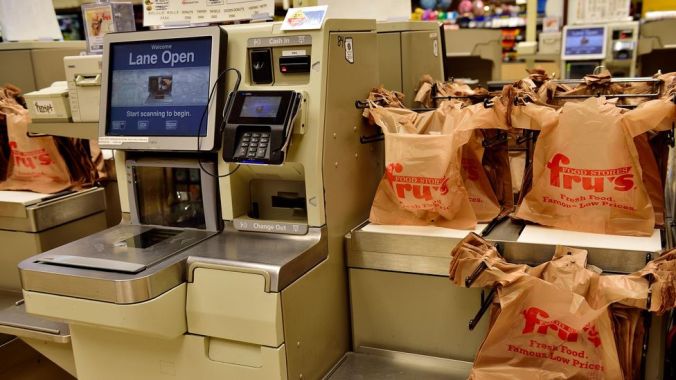
I am happy to say that I foresaw this mess the first time I encountered these things, in a local Home Depot, if I recall correctly. even if they worked reliably and were user friendly—and they don’t and aren’t—it was obvious from the very dawn of the era that they would allow retailers to reduce staff while making the shopping experience less pleasant for consumers. And so it has. But it wasn’t sold that way, and, as usual, much of the public was ovine in its acceptance. Sure, long checkout lines would be a thing of the past! Now you wouldn’t have to deal with the underlings who man the registers. Store employees would be free and able to answer inquiries! Wunderbar!
Right. You still have to wait in line. The checkout kiosks are persnickety if you, for example, fail to set a purchase down in the right spot. Scanning items doesn’t always work, and its easy to scanned an item more than once. Problems and glitches arise so frequently that counter staff are constantly called on to deal with them, meaning that customers who wisely eschewed the delightful self-checkout adventure are stranded in line. Heaven forfend that you try to self-checkout a product with some kind of purchase restriction. Meanwhile, a lot of self-checkout machines break down, and because it’s expensive to fix them, often sit useless for a while, causing more back-ups.
Self-checkout is no faster than the old cashier system (unless the customer is a former cashier); that it feels like it’s faster in largely one of perception. “Trained cashiers can scan and bag goods faster than even the most aggressive or enthusiastic shopper,” a 2002 New York Times story about the topic observed “But actual checkout speed tells only part of the story. Self-checkout has a psychological effect: as long as the shopper is taking an active part, it seems to go faster.”
Not to me it doesn’t. What I perceive is stores operating with skeleton crews, and badly trained ones at that. It’s not all the fault of the damn kiosks, but stores appear less well-maintained, shelves take longer to be re-stocked, and there are fewer employees available to help customers. (I walked out of my CVS last week, leaving my cart at the door, after waiting ten minutes for assistance. “I’m going to Walgreen’s!” I shouted as I left.) Notes The Atlantic, correctly, “Self-checkout is far from solely responsible for this doom loop, but it has contributed to the way certain stores have rotted from the inside.”
Rotted is the right word. Reduced staff is one of the reasons for the surge in theft and shoplifting. I have several times found myself so frustrated trying to buy something with time pressures that I have thought, “Heck, I’m just going to walk out the door with this.” Of course, ethicists can’t do that, but if we have that thought popping up in our brains, what are normal shoppers thinking? Theft, as well as the losses from the unscanned and mis-scanned items that poorly designed kiosks create, is a natural consequence of the self-checkout technology, and those who installed it had to know this. They didn’t care.
A few companies are admitting that this “improvement” made things worse. Walmart has removed the kiosks entirely from some stores.Costco has moved more staffers to assist its self-checkout areas. However, “progress,” when it is really regression, seldom can be reversed. Understaffed stores are almost certainly here to stay. I’m just hoping enough stores continue to have the option of checking out purchases with real human beings.
Human contact is worth waiting for, unless the humans are poorly trained, surly, and incompetent. Hmmmm.
Maybe I need to give those check-out machines another chance…
 Ethics Alarms
To say nothing of:
The places that have a small platform on which to load your groceries while checking out which is a huge inconvenience when you have a full cart of purchases. Inevitably, an item gets buried in bagged goods and I don’t spot it until I am loading up the trunk, requiring me then to go back inside to pay for it.
That annoying computer voice that chastises you for not scanning fast enough, for having an unexplained item in the bagging area or for not being able to scan an item because of an obstruction blocking the scanner. That, you Nickel-Plated Nincompoop, is my gut.
The plastic bags that will not open to save your life.
The fruits and vegetables that don’t have a little tag to be scanned, requiring me to use the search function. I’m not 100% convinced I’ve chosen the correct type of tomato so who knows if I’ve been overcharged?
When I inevitably run into a snag and the machine won’t work because I’ve scanned too quickly, scanned more than 50 items or tried to use a coupon, the employee who is supposed to come help me is standing with three co-workers chatting up a storm.
I will only use those things if I have a few items or if there are absolutely no regular check-out lanes open.
I don’t disagree with the characterization of your experience, and I think some of this might be an Americanism, but I think that you’ve just had bad experiences.
One of the first project teams I was a part of started up the Extra Foods in Fort McMurray, Alberta. This was 20 years ago, and frankly we didn’t sign NDAs, so let’s peel the curtain back a bit: Most Extra Foods at the time were about 20-40,000 squarefeet. This store was larger, I think because the company was interested in testing the water on bigger stores because the store with the next-step-up footprint (Superstore) was unionized and the Extra Foods locations weren’t, and they wanted to see if they could operate bigger locations without a union. They pulled out all the stops: The 60,000 squarefoot store cost $20,000,000 to build and did about 1.3 million dollars a week in sales, which didn’t take into account the gas bar or liquor store in the same lot. The employees were paid $0.05 an hour more than their unionized counterparts downtown. And topically: We pioneered self checkouts for the largest grocery chain in Canada.
We didn’t do this to save money. You’re absolutely right: They’re expensive. Between the cost of the system, maintenance, and software updates, the replacement cycle against the labour they replaced was probably five times longer than the expected life of the unit.
We did it because we were in Fort McMurray, and there was no labour. The Food location employed about 300 people at any given time, the first year in operation, that location had 200% turnover. Almost 1000 people worked in that store that year. And it wasn’t because the pay sucked (We started at $13/hour in 2005) or that the conditions sucked… It was because we were in the oilfield. No one came to Fort McMurray to work in a grocery store, they came to work a rig. What they didn’t expect was that the field wouldn’t just hire them on the spot… They had to apply, interview, take a physical, pee in a cup, and wait, usually about a month, while their bills added up. So they applied to the grocery store to bridge the gap in their employment. It took a very long time to build up a workforce of housewives, kids, and stoners before we found an equilibrium.
Back to the UScans.
They sucked. Blew entire herds of donkey balls. The scales were finicky, the cash acceptors clogged constantly, the coin dispensers had to be counted daily, and filled, putting produce through was a nightmare, and the system *really* struggled with coupons. There were days I’d have liked nothing other than to light them on fire.
The thing with technology though, is that it gets better.
The first thing that went away was cash. Not having the receivers to clog or the dispensers to deal with solved probably half of all the issues we ever had with them. The tolerance limits on the scales were adjusted to better reflect reality. Barcodes were added to store coupons.
Eventually, this turned one body into six tills (because, unlike the situation you described, there’s supposed to be an attendant for the Uscans to fix errors) and those six tills operated about as efficiently as three express lanes.
And again: This isn’t a matter of saving money. It doesn’t. It’s about operations.
Juxtapose that with this:
“What I perceive is stores operating with skeleton crews, and badly trained ones at that. It’s not all the fault of the damn kiosks, but stores appear less well-maintained, shelves take longer to be re-stocked, and there are fewer employees available to help customers.”
There’s no universe where having a Uscan leads to fewer people stocking shelves. Those jobs are different, cashiers don’t stock shelves. The problem is a labour shortage that’s been growing for years, took a dip around Covid, and came back in full force: The unemployment rate is a historic low. The labor participation rate is in the shitter.
In my experience, and again, the American experience might be different, but in my experience, the problem is that there just aren’t people willing to do the jobs that the robots are taking.
If you thought Fort Mack 20 years ago was something, you shoulda been with me in Flin Flon Manitoba in the mid 70’s working summer breaks from college in the Nickel mines…
All of this is so true.
The automated checkers are definitely not faster, they ARE more prone to double-scanning – it happens at least once every time we check out more than 10 items – and they break down a lot. The only advantage I see (and this is a personal one) is that I get to pack the bags, and I’m way more efficient at it than the hired help.
I think you bring up a good point about the reduced staff. Those people traditionally could be tasked with other jobs during slower times – facing the merchandise, restocking, cleaning a bit – and that doesn’t get done nearly as much. Wal-Marts, sad to say, are especially bad. Our local stores are dirty, under-stocked (often with pallets of product clogging the aisles), and staffed with people that seem to barely know where they work. It’s terrible. To their credit, they are trying to improve, but I dread going in there. And it’s not just Wal-Marts…all the stores are suffering from these automation maladies. But hey, at least the reduced-staff checkers get $15 an hour…
I think you have Aldi’s in VA. If you ever have a chance, go there. Their human checkers are the fastest on the planet. And the Clancy’s Jalapeno Kettle Chips are the very best!!
‘Nother Aldi’s fan, here.
Their Burman’s Dijon Mustard won our Taste Test by beating out Maille’s, who’ve been making the stuff for ding nigh three (3) centuries!
PWS
At a fraction of the cost, to boot!
PWS
Paul,
Yeah, overall selection there is less than a Wegmans or Albertsons, but everything is very good, and it’s cheaper.
“I walked out of my CVS last week, leaving my cart at the door, after waiting ten minutes for assistance. ‘I’m going to Walgreen’s!’ I shouted as I left.”
Love it!
That CVS that is the bane of your existence.
JL
I’ve had somewhat better experiences with self checkout, in most cases. However, I only use them when I’ve got a small number of items, other lines are busy, and the scanners don’t have a large queue of fully loaded carts. I almost never use cash.
Walmart seems to have decided weight checking is more hassle than just accepting additional losses from careless customers and/or shoplifting, so it’s just scan and bag. They also have more self checkouts than regular lines, even if every regular line was busy, at least locally. Winco has cheaper groceries, but they make you bag your own even if you have an employee scanning and their regular lines are always backed up, so it’s a different cost/benefit there. Albertsons, I prefer the line unless there is an open scanner right away and just a few things, but they do always have someone to monitor the self checkout area.
I think that the de facto $15 per hour minimum that government’s response to Covid created has probably created a lot of the impetus for the spread of self checkout.
Multiple times I’ve been in a store with my wife and she seems to always heads towards the self checkout lanes, every single time I say something to the effect of let’s help keep a checker employed and then head to a lane with a physical person checking out shoppers.
Personally I don’t care one bit if the self check out equipment works correctly or not, I don’t use the instant gratification self checkout lanes no matter what store I’m at. Personal contact with other people in your community is important and when you’re part of a community and you can easily support others in your community with simple choices like this. If they’re incompetent and need more training then be part of the solution and try to help them learn. Choose to veer away from instant gratification and be a visible part of the community.
Me, I’m for ’em.
I’m convinced that Safeway had a corporate policy which stated that an additional checkout line was to be opened if, and ONLY if, two customers got so frustrated with waiting in line that they abandoned their full carts and walked out the door. Safeway does a good job of always having an attendant working the self-checkout area. Bottom line: one way or the other, you can get out of Safeway much more quickly than before.
I know that I wrote a novel, but this point is important and some of the subsequent comments aren’t taking it into account, so I’ll try to highlight it on it’s own:
The economics of self serve checkouts are shit. They are not a cash saving investment. Between the cost of the hardware, the software package, physical and software maintenance, and the fact that you still need labour intervention, the amortized cost of these units are not recovered in labour savings during the expected lifecycle of the units.
You are not saving anyone’s job by refusing to use a self serve checkout. There is a labour shortage, has been for the better part of two decades in some markets, and it isn’t getting better. We could have all kinds of discussions on why that is and how it might be helped, but in the short term, this really is a break-your-nose-to-spite-your-face situation… If you don’t have a problem using self-checkouts, and you choose to stand in line, you’re probably just making literally everyone around you, yourself included, more miserable for pyrrhic points.
Except when I rarely have a packed cart and there’s no one in a tended checkout lane, I’m delighted to use the self-checkout. Particularly if I’m only buying a few things.
Oh, I genuinely hate the damn things. I have never—NEVER—used one when I didn’t need to call for assistance. Never Furthermore there lines to access the machines, and, for example, at my incompetent CVS, they often neglect to have sales marked. A human can say, “You know, this is two for one!” And I can say, “Will you wait a minute while I grab a second one?” The machines won’t hold a place. What I have noticed is that the kiosks are best for a single purchase transaction. But I don’t do single purchase transactions.
I still write paper checks when I can (yes, I’m a dinosaur), so I always prefer staffed checkouts where available. Costco trained me in the use of self-checkouts, but they have plenty of staff available to assist clueless geezers like me (or people who have difficulty hoisting huge bulk packages up to the scanner — also like me). My local Sam’s Club had far fewer staff in the checkout area (and a slightly different self-checkout procedure from that at Costco), so although my husband and I headed for the self-checkout area there, we got stumped at certain points, and had to wait a LONG time for assistance. I don’t mind self-checkouts as much when credit cards are the only payment method accepted, BUT I do want adequate staffing levels to assist customers. (And if I need help scanning stuff or bagging it, I’d prefer help from store staff over that of family members. (Sorry, guys! The store staff are faster and (usually) better-trained at doing this quickly/efficiently than you are.))
I am wondering if this is a store issue or a tech issue. Today, I had to go to a hearing in Montgomery County, Texas, which is 50 miles from my office and on a good day, it takes six or months to get there. Awful travel. Awful.
Oddly, though, I made it to court in time to eat lunch and, lo and behold, what did my belly see when I exited the freeway? The Golden Arches, that’s what. So I stopped and immediately wished I hadn’t. At this store, the self-serve kiosk met me with friendly letters saying, “Use me!” I tried to access my app to redeem points. Nope. Their app is far too stupid to use. Then, when I ordered, I selected the Quarter Pounder meal, including fries and a beverage (no bourbon, though). I had to add the fries and soda, which made me go back to the “meals” page three times. There was no “Finish and pay” button. You had to review your order, then re-review it, and then select some other button somewhere on the screen that I found by mere chance. Then, when I tried (again!) to redeem my points, my order somehow got canceled and I had to start the whole thing over again. To make matters even worse, when the order came out I didn’t have cheese and the food was tasteless (well, that relative . . .).
Now, contrast that with Whattaburger: their app is easy to use, doesn’t require a “share your location” requirement to access your points, and meals are just that – they are meals which include fries and a soda. You have options to upgrade and change but ordering from the app is quick and easy and redeeming points is beyond simple. They do have cashiers but if you elect to pay with a card and/or redeem points, the app makes it all possible and magically, your order is correct (with cheese, too!) and quick.
I have used the self-checkouts and Home Depot, Lowe’s, Walmart and other stores, including CVS. Those experiences have been fine.
As an aside, I tend to agree with HT that this is a personnel/worker issue more than a time and money saver for either the store or the customer. Isn’t labor (labour in honor of our Canadian friends) the biggest cost for any employer? If the employer can reduce that cost and still meet customer demands, the employer/business is going to do that.
jvb
I was at a convention several months ago with my sisters, and I was out in the wild scouting for lunch. I love McDonald’s food, and their website (and my memory) said that they had salads — one of my sisters is a vegetarian. So I went inside the nearest McDonald’s and tried to navigate the self-service kiosk. It was not a fun experience — much like you, I pieced together an order but searched hither and yon for the salads. I finally gave up and tried to get an employee to talk to me, which was a non-trivial challenge.
Once I was able to ask my question, he said that they had no salads. When I said that their website listed them, the only response was a shrug. I then thought, well I put all that time into fighting the kiosk and putting together my order — why not just finish it up and get my other sister’s meal elsewhere. The damned kiosk has cleared my order, so I’d have had to start from scratch.
I didn’t. I said screw this, and went somewhere else.
The real problem for McDonald’s is not that I left in a huff. But unhappy customers, being human, are wont to relate their unhappy experiences to other people, as many as possible. So there is a ripple effect for dissatisfied customers, just as there is the other way for happy customers. Most companies I think realize this and that’s why they do their best not to have a customer storm out, muttering and cursing.
Case in point — how many readers here have a bad impression of WordPress? Or CVS for that matter…..
Me! Me!
So my first experience with self checkout was at Albertson’s in West Texas in the early 2000s. I would be shopping a lot at 3 am or thereabouts, so staff in the store was pretty scarce. I don’t recall any serious problems, and they did not have a person whose job it was to watch the self checkout machines.
My recollection is that the machines were actually a bit more sophisticated than today’s — for example you could enter a quantity if you were buying multiples of the same item and not have to scan every can. That’s certainly gone, although the full service checkout clerks can still do that (if they bother).
My current experiences are with Harris Teeter and Food Lion. I prefer to use the full service lanes — they do a better job scanning and bagging usually than I do, and leaning over or grabbing stuff under the cart is no longer a trivial task.
Generally at Harris Teeter there is a much longer line at the self-checkout, although most who go there don’t have a lot of items. They usually only have one or maybe two lanes staffed, unless it’s a big rush hour. There is always someone assigned to cover the self-checkout aisle. Coupons and cash require manual intervention, but overall it seems to run fairly smoothly.
So overall, I’ve had pretty good experiences with the self-checkout at grocery stores.
I thought you were done with CVS forever. Or did they finally respond to your complaints by saying they fired everyone involved in the incident with the no-discount machine?
Unfortunately, CVS, as its quality declines steadily, is still so much closer to my house that I occasionally can’t spare the time to take the trip to Walgreen’s, the competition. And since you asked, they have apparently lost the two employees involved in that fracas from last year. I just transferred the rest of my NINE prescriptions to Walgreen’s, which, at least here, does not use an automatic checkout.
I’m good with the self-checkout (bias alert: I did cashier for a couple of years) – If I don’t have a packed cart, it’s super easy and I can still pay attention to my prices and flag the attendant if I perceive an error. With that said, I missed the training where it explained how to calculate the number of bags used and apply the $0.10 fee on each, so I skip that part. They ain’t paying me for my labor, I ain’t paying for a bag fee that was deceptively imposed by government officials as “single use plastic”. Uh, no. At a minimum, I double use plastic bags, and as many as 5 times each.
They say for those nifty little reusable bags that you’d have to use it about 100,000 times to equal the environmental impact of the plastic bags and most crap out at 10,000 times. (I haven’t used my ‘reusable’ bags more than 100.) So no payment for my labor + government deception + no training on machines = no bag fee from me. (Besides, they won’t stop a person walking out with actually unpaid merchandise – would they actually confront a paying customer for a government fee?)
Count my ethics rationalizations. My alarms are ringing and it’s music to my ears on this issue.
Am I the only one here that uses a delivery service provided by the store? Safeway. For $3.95, I get a four hour window for when my groceries will arrive. The driver brings the groceries into my kitchen and is always pleasant.
Their trucks are refrigerated, so the groceries arrive in a better state than if I had to drive them home in my car.
For $3.95, I don’t need to leave the house, drive to the store, find parking, peruse the aisles, wait in line, truck the groceries to the car, drive them home, et al.
The only downside is that I can’t return or reuse those damn plastic bags.
The last time I visited a store in person, Obama was President, so I can’t speak to the self-checkouts of today. I tried to use them so that I would be able to use them in the future when humans were made redundant.
I ultimately avoided them due to my inability to please the machine enough that it would allow me to continue without an employee hovering nearby to fix the three or four mistakes I somehow never learned from.
I had another motive for using a manned checkout. I had an African Grey parrot that was in love with one of the checkers. I usually brought him or another parrot with me while I went about the day, but this checker really impressed my Grey. He would make happy noises that I almost never got to hear and his vocabulary expanded exponentially. The checker talked to him and made reciprocal happy noises, which made him happy, which made me happy. I don’t know if you can put a price on that.
If he were still alive and that checker is still in place, I’d make a special trip.
Over the years, I’ve gotten to know the delivery manager and she knows what I buy and goes the extra mile by pulling stock from the shelves preemptively so that my orders can be filled. The closest equivalent I can muster is finding an empty shelf, tracking down an employee and asking if there was more stock ‘in the back.’ Safeway delivery is a tremendous value.