Surprise! You thought I had forgotten, didn’t you? It has been a long time, almost a year, since the last installment of this series, inspired by President Joe Biden’s spectacularly awful, divisive, incompetent and destructive first two years. Now it’s approaching three, and Biden looks worse than ever. I admit to being paralyzed after considering Woodrow Wilson in Part 3. It is hard to imagine a President being much worse than Wilson, which is remarkable, considering how long Democratic historians maintained the myth that he was one of our greatest chief executives. This fills me with hope that eventually history’s verdict on Barack Obama will align itself with objective reality, but I’m getting ahead of myself.
Since May on 2022, when I began this inquiry, the performance of President Biden has only worsened. Nonetheless, he still has more than a year to go, and that’s assuming that he does not get re-elected to a second term. To be fair, I should have divided this competition into two divisions, one for single term Presidents (or less), and the other for those who served more than one term. After all, Woodrow Wilson, the current head of the leaderboard, couldn’t possibly have done as much damage if he hadn’t been re-elected in 1916 with the now mordantly ironic slogan, “He Kept Us Out of the War.” I must admit, however, Biden has done a spectacular amount of harm in less than three years. It’s impressive.
Following Wilson came a President now routinely ranked as one of the worst, Warren G. Harding, #29 (1921-1923), and he didn’t make it through even three years, dying suddenly of cardiac arrest at the youthful age (by today’s Presidential standards) of 57. I began my lifetime fascination with the Presidency reading that Harding was tied with Buchanan and Johnson for the bottom of the barrel. The record just doesn’t support that assessment. While Harding was alive, he enjoyed more popularity than all but a few Presidents while in the White House. His low ranking is attributable to first, the eruption of several scandals, notably the Teapot Dome scandal, in his cabinet after his death, and second, the sordid accounts for Harding’s remarkable sexual profligacy and adultery. While no historian has asserted convincingly that Harding was himself corrupt or complicit in the scandals, he did appoint the crooks, and was accountable. Like Donald Trump, he appointed many cronies and allies who lacked the character and qualifications for public service. There was plenty of smoke that a more attentive POTUS would have sniffed out. As for the sexual misconduct, presumably post-Harding revelations about Bill Clinton and Jack Kennedy should place this in proper perspective. As several commentators have noted in recent decades of Harding historical rehabilitation, many of his accomplishments are impressive.
He released the political prisoners locked up by Wilson for opposing The Great War, including Socialist leader Eugene V. Debs. Also reversing Wilson, Harding called for passage of anti-lynching legislation, and asked Cabinet officers to find places for blacks in their departments. Harding also promoted technological advances like radio and spent what would today be billions on highway expansion and improvements. Economically, the so-called “misery index” ( combining unemployment and inflation) had its sharpest decline in U.S. history under Harding. Wages, profits, and productivity all improved dramatically. In retrospect, it seems that much of Harding’s bad reputation is based on an over-emphasis on the negatives in his administration, relatively little scholarship devoted to anything else besides the scandals, and the fact that the history community was and is overwhelmingly biased against Republicans.
Harding was a better single term President than Buchanan, Pierce, and Johnson among his predecessors, and his years in office don’t approach the carnage Woodrow Wilson left behind.
Verdict: He’s DISQUALIFIED for consideration as the Worst President Ever.
Harding’s Vice-President was “Silent Cal” Coolidge, #30, (1923-1929) another very popular President. Coolidge ended up serving almost exactly one and a half terms after inheriting the office from Harding, though he easily could have won another elected term. Conspiracy theorists have suggested that he knew the Great Depression was coming, so Cal got out before the wheels fell off: I doubt it. Nonetheless, a good case can be made that Coolidge’s laissez faire approach to the economy laid the land mines that exploded under Herbert Hoover, but not a good enough case to put Cal in the Worst President race. Coolidge, one of the Right’s favorite Presidents, presided over the peak of the Roaring Twenties and everyone had a great time. He was lucky, but luck is a big part of any American POTUS’s ranking. Like the 1928 election, Calvin Coolidge isn’t a factor in the WPE competition.
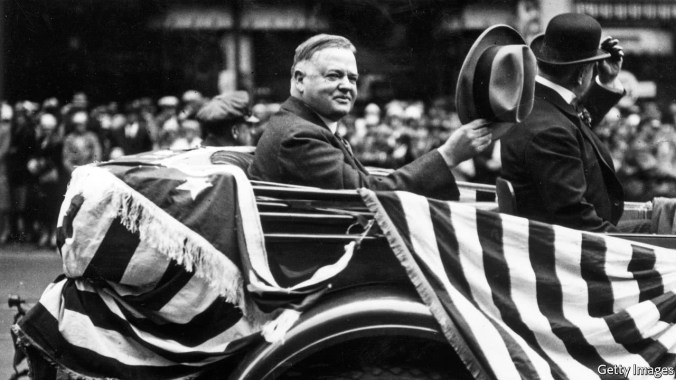
Herbert Hoover, #31 (1929-1933) may have been the unluckiest elected President of them all. The stock market crash wasn’t his fault and it was part of a world depression; there wasn’t much he could do about it once the economy caved in. One of the most brilliant Presidents and an ingenious administrator, Hoover might have been a very successful leader at another time: every other challenge he took on in his impressive career of pubic service he met with brio. Unfortunately, he had the wrong personality and political philosophy to deal with the Great Depression and the public’s shaken faith in its institutions. One has to rate his term in office a failure: we judge Presidents on their successes. Nevertheless, Hoover never had a chance.
I’m declaring him DISQUALIFIED for the title of Worst President Ever.
I’m going to pass right over FDR, #32 (President for Life). He is responsible for a lot of bad decisions, but nobody would seriously try to make the case that the man generally ranked as one of the top three U.S. Presidents was really the worst. His policies, guts, political skills and personality probably saved the nation and the world, even as he came frighteningly close to being a benevolent American dictator. Let’s move on.
#33, Harry S Truman (1945-1953) also shouldn’t take up much of our attention here. He is easily the second most successful VP ever to take over from a fallen President, after Teddy Roosevelt, of course, and even Teddy didn’t have to face the crises and tough calls that Harry did. Truman also exceeded all reasonable expectations—nothing in his background suggested the leadership qualities he displayed, and again, while there is plenty of legitimate criticism to be leveled at Harry’s performance, Truman deserves no less of a ranking than the middle of the pack, and probably a bit higher than that. Not a bad President, not bad at all.
Dwight D. Eisenhower, #34, has risen higher and higher in historical assessments as time goes on, as we see more and more Presidents prove what a difficult job it is. Ike made the job look easy; of course, he was the only President for whom the job was a step down: being in command of the Allied Forces during World War II was tougher. Eisenhower knew how to wield American power during the Cold War, and presided over calm and prosperity in the deceptively unflappable 50’s while major social changes were roiling beneath the surface. Ike had failures too, making him especially unpopular with liberals: he didn’t take as tough a stance against Jim Crow as he could have (and should have), and his strategy of letting Sen. McCarthy flame out without the White House openly opposing him will always be debated. Nevertheless, he was a strong and popular leader whom the public respected and coould look up to. Those were the days….
It looks like we have no new candidates for the worst in this installment! I’m as surprised as you are.
I promise it won’t take a year from me to post Part 5, covering JFK, LBJ, Nixon, Ford, Carter and Reagan. As it stands now, our finalists for Worst President are Pierce and Buchanan (Part 1), Andrew Johnson (Part 2) and Wilson (Part 3)
 Ethics Alarms
Thank you for this…again!!
I’m sure I’ve written this before, but it’s a bucket-list item of mine to read at least one bio of every President. Parenthetically, I recently finished a bio of President Van Buren, but am stopping forward progress to read Chernow’s bio of Washington (which has been called the best single-volume biography written) and maybe Meachem’s bio of Jefferson. So I love…no, LOVE…reading your thoughts on each of them, particularly the Presidents (and there are many) for which I still have only cursory knowledge.
It’s a good goal. A hard one, too. I have only been able to find one very short biography of Pierce and of William Henry Harrison. Most of my library searches bring up juvenile books or books that aren’t straightforward biographies but include biographical material in a work about an event.
There is a good biography of McKinley called “President McKinley” by Robert W. Merry and a decent one by Ari Hoogenboom about Hayes, “Rutherford B. Hayes: Warrior and President”.
Thanks! For WHH, I have Owens’ “Mr. Jefferson’s Hammer”. Yeah, finding good material on Presidents after Jackson and before Lincoln takes some effort (though a pretty good bio of President Tyler – “President Without a Party”) was published a couple years back.
Anyways, I have found a lot of useful information from Steven Floyd’s website. He’s read a pile of bios and reviewed them at his site, and I find it a great resource when looking for material.
https://bestpresidentialbios.com/
I read at least one bio of every President elected up to the time of my graduation while resarching my honors thesis. It was obvious then that a lot of the lesser and unpopular POTUSes hadn’t received adequate attention from historians.
It’s somewhat interesting to note that Wilson and Obama are the only presidents (in my knowledge) to have remained in DC after leaving office.
Well, Mount Vernon is mighty close!
To be fair (as they say in Letterkenny) it was there before the city.
I don’t think you can read anything into Wilson, since I think his brain had mostly checked out before his term ended.