Re-posted below from July, 2019 is an Ethics Alarms essay about the ironic and troubling thoughts George Clooney’s film “Good Night And Good Luck” triggered when I viewed the 2005 film for the first time. I watched it again last night, and its commentary on politics, journalism, the McCarthy era and television struck me as even more relevant than it did the first time. I highly recommend seeing the film again, and definitely watch it if you missed the movie entirely.
The last line in the post was “I think George Clooney might want to watch it again.” Now, maybe not: I think George is smart enough to understand its resonances now. July 2019 was in the middle of the Trump Presidency, and the McCarthy era’s political use of imaginary conspiracy theories to impugn and destroy its enemies seemed uncannily similar to the Russian collusion witch hunt recently completed to try to bring down President Trump. But 2019 was before the Biden administration, and its concerted effort to use any means necessary to make the U.S. a single -party nation. McCarthy wanted to the public think the Democrats were surreptitiously advocating Communism as he and his allies employed totalitarian tactics to prevail. Today it is the Democrats who have chosen to make the public fear the other party, only in 2023, they really are embracing Marxism, and use Orwellian tactics to cast Republican as aspiring fascists.
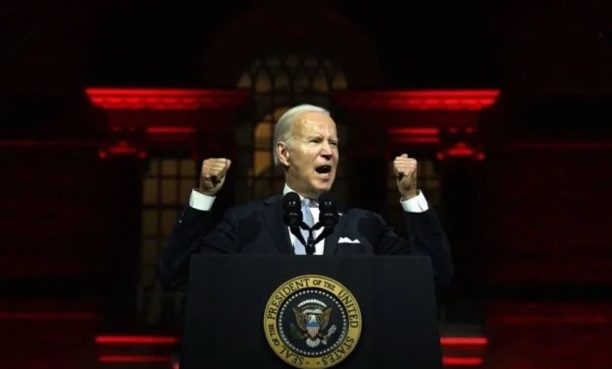
The Nancy Pelosi-Liz Cheney kangaroo court hearings on the January 6 riots could have been designed by Joe McCarthy. American journalism’s ethics rot has accelerated noticeably since 2019. Clooney’s paean to responsible “advocacy journalism” in 2005 seemed aspirational; today, it just appears sad and naive.
And there is more; your alarms will be ringing. I also am re-posting an excellent comment to the post by Arthur in Maine. How I missed it as a Comment of the Day I don’t know, but today I’m remedying that error.
***
I avoided George Clooney’s film “Good Night And Good Luck” when it was released, because I knew it had been designed as an anti-Bush administration allegory, weaponizing Edward R. Murrow’s battle with Senator Joe McCarthy as progressive propaganda. See the courageous and principled journalists stand up against ruthless Republican bullies! See the dangerous power-abusers strike back with guilt by association allegations and by attacking the messenger! See the objective, non-partisan journalists help bring down the threat to democracy!
I finally watched the film this week, and was struck by several things. First of all, the movie, which Clooney directed as well as co-starred in (as Fred Friendly) was much better and fairer than I expected: let that be a lesson to me.
Second, David Strathairn as Murrow once again showed what an excellent and under-appreciated actor he is, although his voice is an inadequate substitute for Murrow’s rich baritone. Third, Senator McCarthy really was a sinister creep, and it radiates from the screen. Those who still defend him, like Ann Coulter, are allying themselves with the Prince of Darkness. The man claimed that the ACLU was a Communist front organization!
Most of all, however, I was struck by how ironic and convoluted the film’s analogies had become in just 14 years, and found myself wondering who Murrow would regard as the bad guys today. For example, Murrow, speaking of McCarthy’s hearings on Communists in the Army and elsewhere, tells his audience that while Congressional hearings are an important part of the body’s oversight function, the line between legitimate hearings and “persecution” is thin. What would he think about today’s Democrats’ endless fishing expeditions designed to find some justification for impeaching the President?
Murrow went on television to condemn McCarthy’s repeated accusations based on assertions of facts, evidence and documents that didn’t exist. Would he have done the same today, but with his target being Rep. Adam Schiff (D-Ca) or Gerald Nadler (D-NY), both of whom have repeatedly, McCarthy-like, claimed to have “proof” of President Trump’s collusion that didn’t exist?
What would Murrow have said about today’s broadcast news, when in the Fifties he was bemoaning TV’s tendency to tell Americans what they wanted to hear in order to maximize profits, rather than revealing uncomfortable truths? Who would Murrow regard as the 2019 equivalent of Joe McCarthy? Would it be the President, for his penchant for attacking journalists as “enemies of the people”? Would it be Democrats who have used guilt by association and false accusations of conspiring with Russia for cynical their political gain? Or would it be mainstream media darlings like the Southern Poverty Law Center, which designates organizations as “hate groups” just as falsely and irresponsibly as McCarthy declared organizations to be “Communist fronts”?
Finally, how would Murrow square 2019 news media with the vision he and his CBS news colleagues share in the film (and apparently shared in real life) of broadcast journalism’s duty to be a courageous, non-partisan watch-dog on government and politics, whose only stakeholder is the public and whose only mission is to reveal the truth?
I recommend the film highly. I think George Clooney might want to watch it again.
***
Arthur in Maine:
I’ll look for the film. Meantime, there are a few important aspects to the Murrow story worth noting (not certain if these are in the film).
First, Murrow was actually something of a Johnny-come-lately to the whole McCarthy train wreck. Other journalists had already exposed his frauds, but in those days there was no such thing as national media, other than the tree Alphabet news channels – and in those days, less than half of American households had a TV set, and many of those households didn’t have access to all three major networks. So while Murrow was hugely important to the story, his role in McCarthy’s undoing has become something of a matter of legend (“print the legend.”).
Second, and I find this the more interesting part, Murrow inadvertently played a big role in making media what it is today. There were two main watershed moments in the development of the largely-American conceit of “objective reporting.” The first came courtesy of Joseph Pulitizer, who endowed the first journalism school (Columbia) and started holding his own editors and reporters to higher standards as a response to advertiser pressure regarding yellow journalism (to which Pulitzer’s papers weren’t exactly strangers). In other words, it was a business decision.
The second came when William S. Paley, who led CBS at the time, thought that Murrow and his colleagues (especially Murrow) were injecting far too much of their personal political beliefs in their reporting and issued and edict that anchors were to say NOTHING that stated or implied them.
Most other nations didn’t follow suit. From my perspective, one of our biggest challenges as a nation is that we were all raised to believe that the media is objective – or at least tries to be. It never was; it just did a reasonably credible job of hiding its biases.
It no longer tries to hide them. Once we get our heads around that idea, we’ll be better off.
If there’s anything left of the Republic by the time that happens, that is.
 Ethics Alarms
Apologies for off-topic musing…
I haven’t seen the film in many years, but it is due for another viewing, not least because I did a season of summer stock with David Straithairn, who played Murrow. I signed his paychecks!
Thank goodness you also have trouble spelling his name! I feel much better. David Strathairn’s name is filed in my brain next to Jason Statham, and I always get them mixed up.
I find Strathairn to exemplify the terrific actor who somehow can’t carry a movie–he lacks “it,” whatever “it” is. Clooney isn’t as good, but he has “it” to spare.
I spelled it correctly on his contract and paychecks. He’d probably forgive me a typo fortysomething years later.