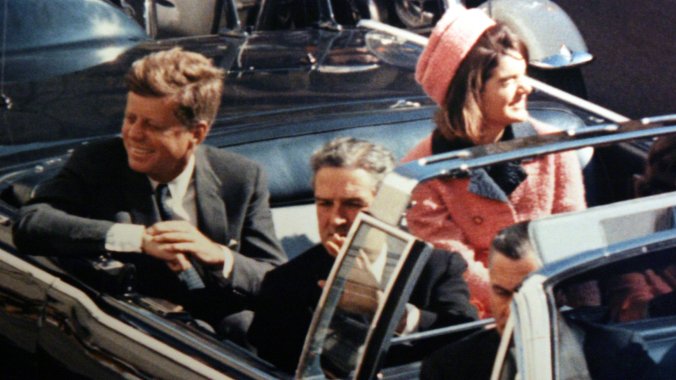
One might view posting this today, on the anniversary of President Kennedy’s assassination in Dallas, as being in questionable taste. I would argue that it is the perfect day to consider the legacy of President #35, John Fitzgerald Kennedy (1961-1963).
For JFK was saved from historical infamy by moral luck, once for certain, and maybe twice. The first was during the Cuban Missile Crisis, a culmination of blunders that could have started World War III and would have, if a less rational Soviet leader had been Kennedy’s adversary. The second was the assassination, recalling snide comments by various wags that the early deaths of Elvis and Truman Capote were “good career moves.” Kennedy’s death transformed him into an icon, frozen in youth and vitality, a brilliant leader whose death caused darkness to fall. In truth, Kennedy’s three years in office were marked by few successes and serious mistakes that outlived him, like his continuing U.S. involvement in the Vietnam War. In an era in which the news media were less inclined to keep secrets for a President, JFK might have been impeached. His obsessive adulterous escapades endangered national security: among his many conquests were a Mob moll and an Israeli spy.
Kennedy cannot be fairly judged one of the worst Presidents, however, because he filled the crucial role of President as Symbol of America and the living flag as well or batter than all but a few modern Presidents, in a small group that includes FDR, Eisenhower, Reagan, and Obama. This, plus the fact that he had less than three years to add something positive beyond the Peace Corps and the space program to his legacy, takes him out of the Worst President race.
Verdict: DISQUALIFIED.
#36, Lyndon Baines Johnson (1963-1969), also doesn’t make the cut. For all the pain and national scarring the Vietnam War inflicted, Johnson didn’t start it (or end it), and few Presidents, maybe none, would have been able to successfully negotiate the cultural A-Bomb of the Sixties.
Anyone who doubts LBJ’s effectiveness should listen to the archived phone tapes of his personal maneuvering, cajoling and threatening former Congressional associates to get his Civil Rights bill passed. For some reason historians like to say that Kennedy, if he lived, would have signed a similar law; that’s a dubious assumption. Kennedy probably wouldn’t have won in 1964 by a landslide: Nelson Rockefeller might have been the next President, and it was the Southern Democrats, Johnson’s cronies, who were the main obstacles to civil rights. You don’t have to agree, with the benefit of hindsight, with all of “The Great Society” to agree that Johnson was one of our most skilled Presidents, though a flawed and unlucky one.
Verdict: DISQUALIFIED.
Now, at last, we come to a genuine contender for Worst President Ever: Richard Milhous Nixon, #37 (1968-1974). Even he’s problematic: although he is the only President so far who would have been legitimately impeached and convicted, Nixon was, before the Watergate conspiracy, another very skilled and effective President. He was one of our smartest White House residents (but then so was Wilson), and understood the office from the start as few have. Nixon had many important policy achievements as well, and those accomplishments came in the teeth of strong opposition and bias from the news media (though nothing as extreme as Republican Presidents have faced in this century), and almost unanimous hate from an entire generation.
For the most part, this project has taken the approach that Presidential missteps should not be considered in a vacuum, that a President’s accomplishments and virtues should counter-balance his worst moments and features whenever possible. Nixon, however, has to be the exception. He either engineered or allowed a frontal assault on our democracy, not just in the Watergate scandal but before, when he deliberately sabotaged the Vietnam peace talks in order to gain power. Nixon began the process of eroding the public’s trust in the office of the President, and it never fully recovered even before the one-two punch of Trump and Biden. A strong argument can be made that Nixon did more damage to the institution of the Presidency than anyone before or since.
He goes into the finals with Pierce, Buchanan, Andrew Johnson and Wilson. The competition for Biden just got a lot tougher.
I assume we don’t need to haggle over #38, Gerald Ford, who only got to serve a little over two years, was not prepared for the office by experience, talents, personality or temperament, appears to have done the best a lifetime plodder like him could do, had no constituency, and, to be fair, never had a chance. The one decision he is remembered for was an important and right one: pardoning Richard Nixon and sparing the nation an ugly political prosecution. (I know how ironic that statement seems in 2023.)
Verdict: DISQUALIFIED.
Now we come to the President Joe Biden has been most frequently compared to: Jimmy Carter, #38 (1977-1981). It’s a comparison that is, I think, unfair to Carter. He was another one of our smarter Presidents, but, in my view, was elected because after Johnson and Nixon exhausted Americans decided they didn’t want a President at all, just a nice, competent guy who promised never to lie to them and wouldn’t cause trouble. His administration was a single-term wreck, giving the public a sense that the country was drifting. That sense became unmanageable during the Iran hostage crisis that ultimately brought Carter down, but he was widely viewed as weak before that. Both conservatives and liberals were dissatisfied with Carter, and there is near unanimous agreement that his was a failed Presidency. At the left-leaning think-tank Brookings, Carter’s flop was “a puzzlement” that could only be explained thusly…
The root of the problem is that Jimmy Carter is the first Process President in American history.“Process President”—using a definition by Aaron Wildavsky and Jack Knott—means that Carter places “greater emphasis on methods, procedures and instruments for making policy than on the content of policy itself.”Carter is an activist. He wants to do things. Yet his campaign statements should have warned us that save for the human rights thrust in foreign policy, his passion in government is for how things are done, rather than what should be doneCarter is an activist. He wants to do things. Yet his campaign statements should have warned us that save for the human rights thrust in foreign policy, his passion in government is for how things are done, rather than what should be done.He believes that if the process is good the product will be good. In other words, if he sets up a procedure for making policy that is open, comprehensive (his favorite word), and involves good people, whatever comes out of this pipeline will be acceptable (within certain budgetary limits). But process is only a tool for getting from here to there—it is not a substitute for substance. And good processes can produce conflicting, competing and confusing programs.
Interesting. This analysis places Carter on the opposite end of the spectrum from Nixon, as well as Biden and Trump and many of our most successful Presidents, who believed in getting accomplished what needed to be done, and process be damned if necessary. Carter’s addition of the Departments of Energy and Education can be attributed to the faith in process, but I doubt that a strong argument can be made that either of those bloated bureaucracies did much more than add to the national debt. I think it is beyond argument that Carter was a very weak President; I doubt that he can win this race to be crowned the worst, but he earned a place in the competition.
He makes the field six.
Let’s not argue about Ronald Reagan, #39 (1981-1989). The Left hates him, because he was a transformational conservative. Iran-Contra was a genuine scandal that might have ended a less popular Presidency, but Reagan still repaired much of the damage done to the office before him, and deserves substantial credit for winning the Cold War. As I already mentioned, he also played President beautifully, and that’s literally half the job.
There are lively debates to be had over whether Reagan was one of our best Presidents, but anyone claiming he was one of the worst is either biased or ignorant.
***
That’s it for this installment: the field is now Pierce, Buchanan, Andrew Johnson, Wilson, Nixon, and Carter. The final batch, Bush 1 through Trump, will add as many as three; who will they be?
Stay tuned.
 Ethics Alarms
I believe this should be part 5. Part 4 was posted on 11/19.
That being said, I remember your President’s Day rundown of the difficult times Presidents have governed through after Chris Cillizza claimed that the job was impossible. Your assertion that the job has always been hard but is only impossible for those who aren’t good enough to do it has stuck with me since.
I practically memorized that post from reading it so many times so I am going to predict that Bush I is going to be on it because of the wasted potential he had to accomplish anything substantive and failed to take advantage of it.
Speaking of wasted potential — after his reelection in 2004, Bush came and said basically “I have a lot of political capital right now and now’s the time to use it.”
I have long believed that had he chosen his issue better — had he chosen immigration reform he would have had a very good chance of getting something substantial done. He had the background from Texas, he had support from Hispanics, I think he had a generational opportunity to get something truly bipartisan done.
And, this is possibly one reason current Republican candidates are so leery of tackling Social Security. Bush tried it and his ship sank like the Titanic. What chance would lesser men have?
Fixed. Thanks. The old joke about going to Harvard and not being able to count seldom applied more perfectly.
You are more charitable to Johnson than I would be. I view his lies to the public and his ‘credibility gap’ as starting points in a long decline in respect and trust for the presidency (which was obviously supercharged by Nixon). To be fair, I think he garnered a lot of mistrust by the media that Kennedy likely would not have had, and it may have been partly as a reaction to the contrast between the two men.
Nixon — I thought he did so many really good things. But, but then he betrayed us, or at least that is how it feels to me. When you talk about fatal flaw or signature significance, Nixon’s photo has to be right on those pages. The if onlys in his case are so bittersweet.
One final note: Thanks again for this awesome series.
Your encyclopedic knowledge of all our presidents is amazing. I believe I’ve read a good amount of American history, but I tip my hat to you.
What DG said!
PWS
Red meat for conspiracy theorists:
Seeing vital looking JFK and John Connally in that Lincoln makes one long for a time when national politicians weren’t all antiques.
Well, nobody tries to shoot the old guys; it’s not worth the bullets.
As many as 3?
That could mean as few as Zero.
Hmmmm….
Bush 1
Clinton
Bush 2
Obama
Trump
Biden
Not 3.
Bush 1 is a one-termed that has none of Carter’s weaknesses. Bush managed to squander a good deal of good will. If he had issues, it was more of perception than substance. Perot hurt him. He lacked charisma.
Enter Clinton. He had charisma. He was part of the new generation. I do not like Clinton but he was a politician in a way that Bush 2, Obama, Biden and Trump were not.
Clinton, like Reagan and Kennedy, knew how to be generally like able. Clinton’s drawback is the impeachment. I recall at the time thinking it was justifiable, but see the obvious downside of political impeachments.
Bush 2 was not bad but not great. He was a politician, but a less competent one than Clinton.
Bush v. Gore was a unique thing for the Presidency and was harmful. But, 9/11 helped Bush. Bear Stearns and Obama did as much to hurt him as anything else.
Obama? (Bias alert). Obama is probably the least competent of the previous 3. Bush 1 and Bush 2 were marginal politicians, but 8 years as VP and a few years as a Texas Governor still beats a few months as a U.S. Senator after years as an activist.
Add to Obama’s lack of a general resume, his record on race is damning. Wilson’s re-segregation of the federal government was a huge step backward for race relations in America. He deserves contempt for that. However, between the Presidencies of Wilson and Obama, no President has been as deliberate or negligently incompetent on issues of race.
Trump is pretty much a category unto himself. No wonder the politicians hated him. I will not tar him with the degradation of political discourse. He certainly played a part in that, but I will not blame him for his opposition’s decision to sink to the lowest common denominator. The media could have controlled that. The media jumped into the mud-pit with Trump.
If nothing else, Trump had some successes and may have had the advantage (?) of keeping his campaign promises.
Biden? Too early to say, but it does not look good. As dumb as Biden might have been, his downsides are not his fault. I could be wrong, but I view him as two-steps above Wilson post-stroke, which is still 3-steps below the Alzheimer-afflicted Reagan liberals have complained about for the last 35 years.
(I would have thought Biden would have put Reagan senility complaints to rest, but, kind of by nature, hypocrisy has no need of logical consistency. )
As many as 3? I vote 1: Obama.
-Jut