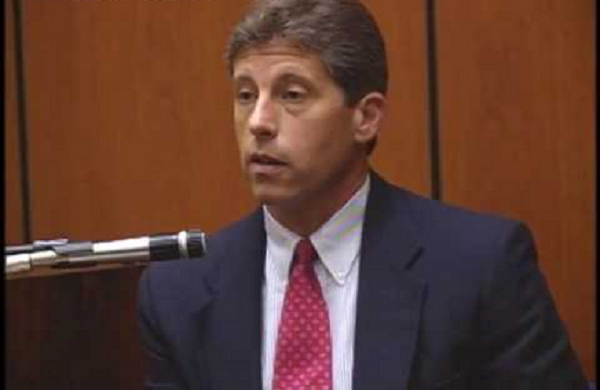
I challenged veteran EA commenter Jim Hodgson to respond to the oft-repeated accusation that “all cops lie.” Here is his response, a Comment of the Day on the post about the retired Boston detective who manufactured evidence to get more than a dozen (at least) innocent people convicted and jailed, “KABOOM!! Apparently There Is No Criminal Law To Charge This Police Detective Under”.…
Oh…I do want to make it clear that the choice of Mark Fuhrman to lead off this COTD is not in any way intended to subvert Jim’s points. I just believe that when asked for an example of a cop lying on the stand to avoid revealing information that might endanger a conviction, Fuhrman is who most Americans would think of first. My mind goes immediately to the corrupt detective played by Orson Welles in “Touch of Evil,” but you know me and old moves….
***
I think a lot of the phenomenon of police corruption (of all types) is dependent on where an officer works (the particular agency and its culture as well as the jurisdiction and its culture, crime rate, etc.), in addition to the moral character of the individual officer. I spent my whole career here in the mid-south, the so-called “Buckle of the Bible Belt,” in small cities and rural counties. The largest agency I worked for (27 years) had about two hundred officers and maybe forty civilian employees when I retired in 2014. Crime rates where I worked were nothing compared to major population centers. Our citizens were typically much more worried about residential burglary than violent crime. We usually had no more than two or three homicides per year, and perhaps six to ten armed robberies annually, mostly traveling criminals off the interstate highway.
I began my career in 1974. New York’s Knapp Commission had just released its final report on NYPD corruption (think “Frank Serpico”) a little over a year before I began. The report of the U. S. President’s Commission on Law Enforcement and the Administration of Justice report was pretty fresh, as well as the multi-volume report of the National Advisory Commission on Criminal Justice Standards and Goals. Most agencies in this region were trying to overcome the stereotypes of Southern “good-old-boy” knuckle-dragging law enforcement, and embracing new and higher standards in recruitment, hiring, training, retention and performance. Police corruption of all kinds was certainly at the forefront of concern for local politicians and police executives, and that trickled down throughout their agencies.
My police academy emphasized honesty, integrity, and adherence to the law and ethical standards. Throughout my career, the agencies I worked for and the prosecutors I worked with were scrupulous about ethics and integrity in the policing process.
As a uniformed officer, investigator or supervisor, I never felt pressured to lie or empowered to manufacture evidence or testimony against a defendant, either by my higher-ups or my peers, nor did I ever even hint at condoning dishonesty from those who worked for me. The idea of convicting an innocent person was abhorrent to us. That would mean the innocent were further suffering while the guilty went unpunished. Our emphasis was always on conducting complete and thorough investigations. We went only where the evidence led us. As a budding investigator, I encountered the general attitude from my superiors about losing a case in court that was, “We do the best job we can following the best police practices and the law, and if they get off this time, we’ll get them the next time, and with criminals there’s almost always a next time.”
If any of my peers ever lied on the witness stand, I never found out about it. I’m not saying that no one ever lied, I’m just saying it was not acceptable and would have been punished if found out. In over forty years on the job, I personally knew and worked with one corrupt officer who was caught after taking a substantial bribe to protect a gambling operation. He was promptly fired and, when convicted, went to prison for a couple of years. Another detective struck a suspect during an interrogation; he was also fired.
As a detective supervisor, I once recommended demotion (the extent of my authority) for a detective for blatantly lying in a pre-trial consultation with prosecutors about his police experience and his prior role in a multi-jurisdictional drug task force. One of the prosecutors called me to verify some things the detective had told them about himself, and I was shocked at his self-aggrandizing prevarications. His lies had nothing to do with the facts or evidence in the case at hand, but I no longer trusted him. He was reassigned from my unit and left our agency for another job shortly after that incident. A few people might have thought my reaction was too harsh, but allowing deception is a slippery slope.
I worked for and with some commanders who occasionally gave me reason to question their competence, but none who gave me cause to question their honesty. I served on the command staffs of three different sheriffs over the last sixteen years of my career. I was never asked by any of them to do anything that was immoral, unethical, or illegal.
Shortly after I became an adjunct instructor at our regional police academy in 1997, I got the opportunity to add Police Ethics to my teaching repertoire. I taught the topic for more than twenty years there. I authored my former agency’s new code of ethics in 2010, and even helped them review and update it a couple of years ago. I’m pretty bullish on this subject.
It has been my experience that communities will generally get the quality of law enforcement that they insist upon, just like other public services such as schools, roads, fire service, etc. Citizens must notice and pay attention to how their community is policed. Sheriffs, chiefs of police and other law enforcement executives must be kept mindful that citizens are watching what is done and how it is being done. Police executives should embrace community policing to keep the agency and the community in communication with one another. Transparency has to be more than a buzzword.
Again, if I had worked in jurisdictions where crime was rampant, and the public, the press, the politicians and the police brass were pressuring officers to solve cases, and turning a blind eye to shortcuts, where the ethical culture was less rigorous and where the community was more tolerant of police overreach and corner cutting, I might have seen more folks engage in misconduct. I certainly heard and read about such places, but never worked in one, nor would I have.
 Ethics Alarms
The issues mentioned in Jim’s COTD were good to read and learn from. I both commend and thank retired law enforcement officer Jim Hodgson for his many years of ethical, beyond reproach service to the communities in which he served. Thank you, Jim.
On a flip-side, I would love to read a commentary from Jim regarding his experience and thoughts concerning what he clearly must have witnessed far too many times and years of the dishonesty, unjust actions, and corruption post-law enforcement …that is, within the office of prosecutors and jurists on the bench who “took the cases from there,” after the arrests. I am persuaded that the greater problem is not police, but in the judiciary.
Ian, you bet me too it. I was going to ask if the incentive to embellish or otherwise create a false impression of the facts may actually originate in elected prosecutor’s offices. What is the incentive for a rank-and-file officer or detective to lie other than to cover their own asses? I will concede that having a high clearance rate may open up some promotion opportunities, but the risks associated with prevarication seem to me grossly weighted in favor of integrity.
Police officers are not lawyers so I could envision the prosecutor (who is trained in how to use language) could manipulate an officer on the stand or lead him to word something that is technically true but suggests guilt by following it up with an officer’s opinion. Jurors are people and the officer’s opinion carry more weight than perhaps it should. As such, prosecutors make an appeal to the officer’s authority.
Prosecutors, know that they cannot suborn perjury but opinions are not facts so they can rely on the police officer to carry the costs of going too far with their embellishments.
I always look forward to Jim Hodgson’s take on these subjects. Far too often we develop our opinions from very limited data. Jim allows us into the weeds so we can see the landscape much better.
Thanks Jim.
Jack, thanks for the COTD, especially since I hammered the thing out in fits and starts during breaks from playing with my grandsons over the course of the day. If the points I made contributed to the better understanding of the issues, I suppose it wasn’t as confusing as I feared it might be. I appreciate the kind words from Ian and Chris, but I want to make it clear that I consider myself in no way unique in regard to policing with integrity. I have many friends and former colleagues, some retired and some still on the job, whose service is at least equally as commendable as my own. It was my privilege to serve, and I know they feel the same way. Heck, I still serve as a policy analyst (volunteer) for the agency from which I retired.
In regard to the influence of prosecutors and jurists, I can again only speak accurately from my own experiences. The prosecutors’ offices I worked with were almost always short staffed and the individual attorneys had heavy caseloads. As in most jurisdictions, there is a lot of plea bargaining, in addition to programs like judicial diversion. Unfortunately, the familiar dichotomy in representation between defendants who can afford a good attorney and those who depend on the public defender exists in this judicial district just as in most other jurisdictions. Our public defender is a very competent guy, but his office is a revolving door for young attorneys building their careers. Their caseloads are even heavier than the prosecutors’. Everyone knows that it is likely to be the defendant with the high-powered attorney who gets the best plea deal or fares batter at trial. I met a few prosecuting attorneys over the years for whom it was just a numbers game, tallying wins and losses like a batting average. They wouldn’t try a case they weren’t certain of winning. Seeing them plea down what I felt to be winnable cases was always tough to swallow.
Officers are taught that when testifying in court, they are to answer only the question that is asked, either by the prosecutor or the defense, without embellishment. I have had prosecutors ask a question in such a way that my answer was perhaps more damaging to the defendant than even I anticipated, but the defense attorneys are pretty good at leveling that out by an objection or during a cross-examination, and the defense is pretty good at using that same tactic. I never personally experienced having my testimony twisted to the extent that it became an untruth. Perhaps I was just lucky. It was certainly disquieting at times to have the judge ask me a question from the bench, sometimes just as my testimony was ending and I had begun to relax. I got to witness one heated exchange between a judge and a prosecutor when the judge began questioning the state’s witness (not me, thank God) in a tone of voice that implied doubt about the credibility of the witness. Most of the judges in our courts were good, although a very few were petty tyrants to everybody within range. Our officers had a reputation for being well-prepared for court, always on time and very respectful, and I always felt we got respect from the judges in return.
Regarding opinions, officers may readily express what is called in my state a “lay opinion,” which “results from a process of reasoning familiar in everyday life,” or give “expert testimony” that “results from a process of reasoning which can be mastered only by specialists in the field.” In other words, when the officer’s expertise in a particular area has been established to the court’s satisfaction by documenting his or her training, knowledge and experience in that area. A lay opinion would be something like stating that a person was tall or short, or even that a liquid substance on the floor appeared to be blood, but I would have to qualify as an expert before I could testify, for example, that bruising around the eyes is indicative of skull trauma. I was qualified as an expert witness in a few areas in both our criminal and civil courts.
Contrary to what many people may believe, the way criminal investigations are conducted involves multiple investigators along with prosecutors who are familiar with the case file, and it would be unusual for any deception to not be detected by someone in that group. Again, if the culture of the organization demands integrity, it won’t pass unnoticed. The consequences would be dire.
I really believe that television shows and films shape a lot of the public’s perceptions, attitudes and expectations about what the criminal justice system is like and how it works. Thus, the public sees a lot more of the more interesting, corrupt side of things than the dull good (but more realistic) side, least in the jurisdictions where I worked. There are a lot more towns and counties like mine than there are cesspools of corruption. Maybe people now just expect corruption to be rampant, just about everywhere.
Jim,
Can I ask you an off-topic question, which is your experience dealing with the sex-offender registry? Was this an area within your experience, and if so, did you find the registry helpful or not? As I’ve moved to Ohio from Wyoming, I’ve seen the registry figure a much larger role in law enforcement, and I’m curious as to whether you have much to say about it.
Thanks,
Ryan
A bit late to the party here, but doesn’t all this mean that there had to be a (one or more) corrupt prosecutor that a bears more responsibility for the unjust results of these cases than the corrupt cop? If, as noted in the original post, the wording of confessions being identical and the same crackhead woman testifying in multiple cases seem to implicate the prosecutor(s) even more than the investigator. What’s that acronym for not a lawyer? I’m not one.