This is not, I think you will agree, an ethical course of action.
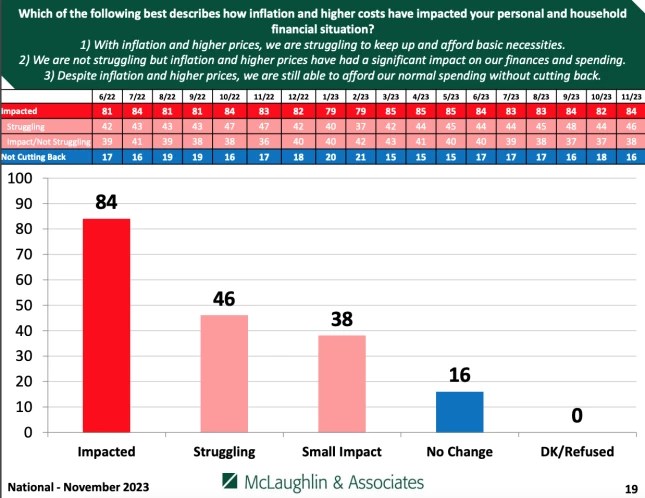
In the McLaughlin & Associates national survey represented above, 84% of likely voters said inflation and higher costs have adversely affected their lives. 46% said they were “struggling to make ends meet.”A recent NBC News poll found only 38% of voters on the national level approve of President Biden’s handling of the economy. A New York Times/Sienna College poll conducted last month found 52% of registered voters in key swing states had a poor view of the economy.
The White House and Democratic propaganda merchants approach to this is to claim that the silly public just doesn’t understand how wonderful everything is, including prices. Thus the White House released cheery press releases and social media posts patting itself on its metaphorical back because the average cost of the feast was down approximately 4.5% compared to last year according to the American Farm Bureau’s annual survey. That meant that a typical Thanksgiving meal of 12 classic dishes for a feast of 10 would average $61.17 a diner, compared to last year’s record high average of $64.05. Big whoop.
The Wall Street Journal quickly pointed out the deceit. “The latest White House lecture is that inflation has fallen from 9.1% in June 2022 to 3.2% last month,” its editorial board wrote in a scathing editorial headlined, “President Biden’s Thanksgiving Dinner.”
“But disinflation—inflation rising at a slower rate—isn’t the same as deflation, which is falling prices. Thanksgiving dinner prices are rising less fast than they did in the last two years, but they’re still rising.” The WSJ has called attention to this very special form of dishonesty before, as when Biden periodically says that he has reduced the National Debt or the budget deficit when the truth is that the size of the deficit, which adds to the debt, has come down. It means, “We are not going broke as fast as we were,” and the deception about inflation means the same thing regarding the public. “You” takes the place of “we.”
The WSJ virtual “fact-check” continued, “The price index for poultry items that includes turkey is up nearly 30% compared to November 2020,” the board wrote. Potato prices are up “more than 12% since Thanksgiving 2020;” and rolls are pricier by “27% from three years ago, while the butter to spread on them has risen 25%.” To the Biden narrative that gas prices are falling, down 55 cents a gallon over the past two months to $3.33, according to AAA, the Journal editors counter that regular unleaded gasoline is still “70% more expensive than it was three years ago.”
The inflation triggered substantially by Biden policies raised prices significantly, and when, as we all fear (or should) Biden faces off again against Donald Trump, what will matter is how much worse the economy post-pandemic under Biden is compared to pre-pandemic under Trump. Those permanent over-all cost-of-living price increases are not getting reversed, and the inflation coincides with inflation-adjusted weekly earnings falling roughly 5%” since 2020—you know, when that fascist, constantly lying, crazy bungling autocrat was President. For some businesses, like, say, just to pick a random example out of the air, mine, the figure is closer to 33%.
Pardon me for not rushing to buy my pro-Biden lawns signs because the disastrous inflation that already raised prices didn’t rise quite as much as expected last month.
The strategy for covering up the constant policy failures of the Democrats and their addled President has been denial, distraction and “it isn’t what it is”(Rationalization #64) from the very beginning, all assuming that the public is even more gullible and easy to mislead than it is.
That in itself is a reason not to trust them.
 Ethics Alarms
It’s the great shift. Remember when debt was the problem.
Now we discuss deficit. Look we got the deficit down!
Now more we’ll hear about the deficit being increased by less than it increased in the past. Long gone will be talk of debt or even surplus.
So now we don’t talk about rising prices anymore. We talk about how fast or slow the prices are rising!
This is nothing new. I was writing about pol (of both parties) conflating the debt and the deficit over a decade ago. Whichever party is in power talks about deficits and trends. Whichever party is out of power talks about debt and absolutes. This doesn’t excuse “everybody does it” arguments, but being appalled only when the other guy does it isn’t exactly ethical, either.
*pols
But what does any of this junk have to do with ethics????
Unless an official claims that they reduced the debt by reducing spending and current spending was not less than a prior year can we claim they are conflating deficits and debt. The only President I can recall mixing them up is our current one.
With that said, given that the only thing either party’s administration can directly control is the amount of the budget deficit it makes sense for them to focus their attention on that metric. However, it is unlikely that either party can directly affect the deficit due to entitlement programs and who is in control of Congress. Clinton gets praise for a balanced budget but it would have never happened without Newt Gingrich pressuring him to reform or eliminate a number of programs. Many initiatives costs don’t even show up in budgets of the administration that shepherded them through a friendly legislature.
It also makes perfect sense for the opposition to question budgetary growth by using the debt as a metric because increasing deficits increase the burden on future generations.
When deficits fall the growth in the debt falls and vice versa. The debt is the cumulative product of various administrations and prevailing conditions. The problem as I see it is no one is ever accountable for spending. I would recommend that the government send a statement to every household each year indicating their current share of the debt load along with the current interest expense and history of the growth of their indebtedness made by the government on their behalf Until people see the illusion of a never ending money tree will anything change.
Jack wrote: The strategy for covering up the constant policy failures of the Democrats and their addled President has been denial, distraction and “it isn’t what it is”(Rationalization #64) from the very beginning, all assuming that the public is even more gullible and easy to mislead than it is.
That’s also the strategy for Republicans facing similar circumstances. That, and to blame the other party for the problem. It’s a technique as old as this country, I reckon, but no less frustrating for all that.
As to the gullibility of the public, it seems to me that Biden et. al. are trying to appeal to partisan political forces rather than just counting on abject stupidity. They’d take either one, to be sure, but their message is meant to appeal to the left-leaning or undecided voter who can’t let their busy, self-important lives be troubled with actual fact-based cogitation on the state of the country’s finances, a group that seems to be quite a substantial part of the electorate. All they have to do is throw in the word MAGA somewhere and voila!
““But disinflation—inflation rising at a slower rate—isn’t the same as deflation, which is falling prices. Thanksgiving dinner prices are rising less fast than they did in the last two years, but they’re still rising.” The WSJ has called attention to this very special form of dishonesty before…”
I’m not an Economics major, I hate defending anything having to do with Biden and his economic policies, and maybe this is a comment best suited for an economics blog rather than an ethics one, but I’m pretty sure disinflation is what we want, not deflation.
Whatever misguided policy decisions got us to where we are now, the damage is done. Prices are where they are. While it would be wonderful if prices could go back to where they were pre-Covid, deflation, that is lowering prices, leads to disaster, as the economy will grind to a halt since people stop spending while they wait for even lower prices.
Ideally, prices would remain constant. Since that’s not possible to do consistently, the aim is to have a small, manageable amount of inflation, say 2%, since that is far preferable to deflation. The Fed is trying to create disinflation, that is a lowering of the rate of inflation, so we can get from whatever inflation rate we were at a year ago down to that 2% level. Prices will continue to rise, even though they seem unbelievably high compared to a couple of years ago. We just hope they’ll rise more slowly.
Right—deflation is also affirmatively a bad thing. But I never heard the term “disinflation” before. Thanks for that.
Also: From The Spectator:
“This interpretation of the CPI report is profoundly dishonest. The 3.2 percent inflation rate is nearly three times the 1.2 percent rate that Biden inherited. It is down “65 percent” only because the Biden’s administration let it skyrocket to 9.1 percent before attempting to get it under control. That gas is “below $3.40” hardly compares well to the national average of $2.11 that prevailed when Biden was elected. As to wages, the Bureau of Labor Statistics reports that average hourly earnings (adjusted for inflation) for all employees stood at $11.05 in October, down from $11.10 in March of 2020, when the lockdown lunacy began. (READ MORE from David Catron: Trump Is Winning Ballot Access Cases)
“There are just too many discrepancies between the President’s claims and the voter’s experience with the real world economy. According to the RealClearPolitics average, only 38.1 percent approve of his economic stewardship. Even worse, according to the NYT/Siena poll, swing state voters trust Trump over Biden on the economy by wide margins. Any president running for reelection must convince voters they’re better off than four years earlier. Biden isn’t making the sale. This is not merely politically perilous for him, it is a source of perplexity for the corporate media.”
I’ll take it a step further. I’ve read and seen multiple analysis showing that not just the interpretation of the CPI report, but the report itself, is profoundly dishonest. Apparently they’ll do things like substitute hamburger for steak as equivalent items to make inflation appear lower than it really is. This scam has been going on for some time under both parties.
My only quibble was that you, and perhaps the WSJ, appeared to be finding fault with the government for aiming for disinflation rather than deflation.
And your welcome for my providing a definition of “disinflation”. Not having formally studied economics, I had never seen the term either until I started closely following an economics blog around 2005. I only found the term confusing the first 40 or 50 times I saw it.
One of my favorite government tricks that I wish I could use is how they “save money” so in this example last years dinner was $64.05 and this years was $61.17 since they’re spending less this year than they planned by $2.88 they “saved $2.88”. No you fool you spent less. It’s not like they had the $61.17 to spend in the first place. If I’m buying a car and get $500 off that money isn’t saved. I simply have $500 less in debt for my future self. Get it? I don’t have an extra $500 to spend somewhere else in my budget. But the government? They spend it somewhere else, since they saved $500. PS. I spent $9 on a watermelon this summer. So that $2 in savings was spent on other food not on your typical Thanksgiving table multiple times.
Yes, I’ve always loved the commercials where someone says, “I saved X dollars by buying this widget!”