…a ridiculous question, and Kwame Anthony Appiah nicely tells the woman that she’s deluded.
Bravo.
” Kate” writes,
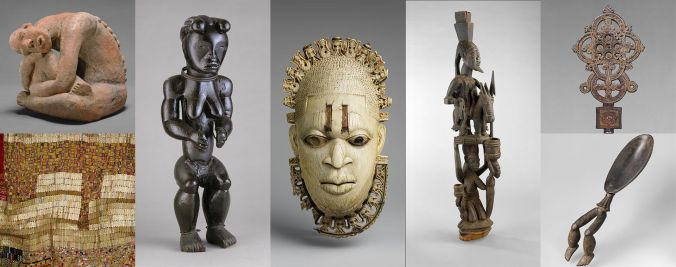
I was privileged to have been raised in a family who prized the arts, including works from cultures that were not our own. (We are of European ancestry.) Among the art in my childhood home was a significant collection of masks, statues, figurines and other objects from mostly West African cultures. My father, who acquired these pieces in the 1970s and ’80s through art dealers, has always taken pride in the idea that they were not “tourist art.” Most of the items date to the 19th and early 20th centuries.
I have come into possession of several of these items over the years, and always appreciated them for their artistic qualities. But as my understanding of the horrors of colonialism and the legacy of slavery expands, I question whether it’s ethical for me to display a Baule mask or a Yoruba dance wand — ceremonial items with deep spiritual and cultural significance. Knowing they were not created for a tourist market also leads me to believe that at some point in their history they were probably acquired via an unfair transaction.
What is my responsibility to the descendants of the people who created these objects? Some friends have suggested donation to a local museum that specializes in African art, but this would perpetuate the colonialist attitude that these objects don’t belong where they were created. Is it possible to repatriate them?
“The Ethicist,” who happens to be African himself, replied politely but curtly that,
1. There is no such obligation.
2. There is no basis to assume that the items were not sold legitimately by their African owners.
3. “I’ve heard it argued that anything acquired during the colonial period (as your possessions may have been) was unjustly expropriated — that the colonial context ruled out freely made choices, even outside circumstances of overt violence. The implication is that people who sold these objects were dupes of the buyer, ignoramuses unaware of the value of what they were selling, or else intimidated into making the sale.” His point: that assumption is itself unethical, arrogant, and unfair.
4. Her concept that there is something wrong with a white American owning African artifacts is bats. “Prizing cultural artifacts from around the globe bespeaks, at its best, a cosmopolitan sensibility — one that’s especially important in a world increasingly narrowed by nativism.”
My question is, “How do people get like this?” Are they weak-minded to begin with? Have the ever mastered critical thinking? What kind of support should our culture offer to those who are vulnerable to indoctrination aimed at making them permanently in a state of guilt over their “privilege,” “colonialism” and slavery?
 Ethics Alarms
Although there is no mention of the woman’s age, my presumption would be that she is a university graduate, and that would adequately answer the question, “How do people get like this?”
It takes a person strongly rooted in core values and logical thinking to resist four or more years of college indoctrination, even if they weren’t brainwashed in the public schools before their college years, as many seem to be.
Most African art I have seen in museums are objects used for fertility rites. I pray that those in her possession have lost their efficacy thus society will be better off if she did not reproduce.
It should be remembered that no European “trader enslaved any Africans. European and Arab traders bought/traded for them with other Africans who had already enslaved them. Look up The “Kingdom of Dahomey”. its bloodthirsty history is far too long for this post.
Jim’s comment is spot on. Apparently, everything is being redefined in our educational system to fit a narrative.
I am confused over this notion of colonialism. Conceptually the point of colonialism is to dominate another and extract wealth. That may have held in a mercantilist world but the wealth of western nations has been to subsidize these independently governed nations the end of WW1. Therefore, colonialism cannot occur under such circumstances.
This amusing that only western nations are accused of colonialism yet Erdoun of Turkey is trying to resurrect the Ottoman Empire and Muslim clerics speak of a world under Muslim theocratic rule. I don’t see them giving their wealth to raise the plight of their own poor and downtrodden.
You cannot argue against isolationism while simultaneously denying the right to influence others.
It appears to me that Muslims are pretty successfully colonizing Minnesota and Michigan. Apparently it’s not just a white thing.
“It appears to me that Muslims are pretty successfully colonizing Minnesota and Michigan.”
Heh! THAT will leave a mark!
PWS
Not to worry.
The Twin Cities have one of the largest Hmong populations in the country.
And we are attracting our fair share of Ukrainians.
And the Hispanics keep coming.
-Jut
I concur with Zora Neale Hurston.
Wonderful quote.
What are the odds that there wasn’t maybe a good dose of virtue signaling in the acquisition of that collection in the first place, and that attitude passed to the next generation?
“Look at how sophisticated and accepting of other cultures we are! Call Architectural Digest; they’ll want to do a piece on us.”
And just for fun, THIS is on a university website, but do you think any college programs now dare include this anti-colonization poem from early last century in their coursework?
(And what happened to our briefly available formatting tools?)
I am presently in Portugal. All the guides and historical quotations speak of the golden era of discovery. Yet to hear the word colonialism.
Hop over to Belgium and see if they say anything about the Congo.
https://www.britannica.com/biography/Leopold-II-king-of-Belgium