Hint: There isn’t one.
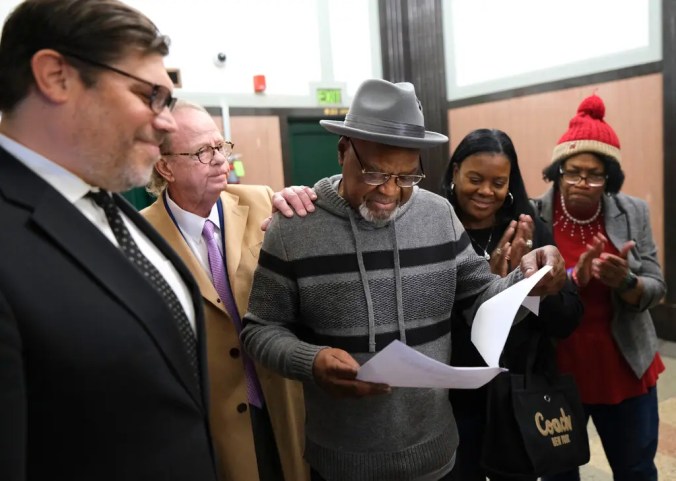
Glynn Simmons, 70, was convicted of murder in 1975. Yesterday he was exonerated in court after he had spent more than 48 years in prison. Well, on the plus side, he now holds the record for the longest time served by a wrongfully convicted inmate in the United States. That’s something, isn’t it?
Judge Amy Palumbo of Oklahoma County District Court declared Simmons innocent of the crime that had occurred during a liquor store robbery. As is often the case in such episodes, an eye witness got it wrong. As is also too often the case, it was determined that prosecutors withheld important evidence from the defense. It’s not all good news for Glynn: he was just diagnosed with cancer. The last time he was free, Simmons was 27 years old.
“Don’t let nobody tell you that it can’t happen, because it really can,” Simmons said a news conference after the ruling. Depressing but obviously true. The man’s life has been taken away from him. Those primarily responsible, a careless witness and unethical prosecutors, can’t be punished. It will take time for Simmons to get significant damages from the state, and time is what this justice system debacle robbed from him. There is no remedy.
No system is or can be perfect. The justice system has failed before and will fail again. That, however, does not mitigate the tragedy of Glynn Simmons’ ruined life. It only makes it more frustrating.
***
[Note: WordPress’s AI-recommended tags on this post; “Ben Simmons,” “NBA,” Brooklyn Nets”]
 Ethics Alarms
I once heard this quote.
“Then their descendants shall pay!”
What would be the downside of having no system?
Can we make prosecutorial misconduct a criminal offense with no statute of limitations?
Why bother when vigilantism is available?
As you know, I’ve written about that. It’s a lot like the police situation: prosecutors are viewed as the good guys, and they get a pass when they screw up, even when their misconduct is intentional. The fear is that harsh penalties for prosecutors will lead to risk aversion. I agree with you, though: some kind of criminal charges for deliberately seeding a false conviction seems needed.
Risk aversion? I can see a few risks.
1. Behaving unethically and getting punished. I don’t think we want to protect anyone from that risk.
2. Making a mistake and getting punished, or at least having to prove it was an accident. I don’t think some incentives for diligent adherence to proper procedure would go amiss. Maybe people are afraid that a mistake will be treated as though it was deliberate, but professional negligence when people’s lives are in the balance isn’t much less worthy of punishment, in my opinion.
3. Being framed by someone else. That’s always a risk with introducing penalties, and it can’t ever be completely eliminated. It might encourage thorough record-keeping, though.
Perhaps unethical prosecutors might simply become more diligent about covering their tracks, but they might think twice, and other people may be on the lookout for misconduct if they know it’s taken seriously.
Overall, I don’t see any compelling arguments against it, and lawyers balking at being held accountable for prosecuting people they know are innocent isn’t a good look. Am I missing something?
Yes. It’s an adversary system. While ideally no prosecution would ever be brought unless the state had a valid case that a defendant was guilty beyond a reasonable doubt, that ideal is undermined by political pressures, confirmation bias, and human errors in judgment. Right now the remedy for an unethical prosecution is civil penalties, sometimes firing, and very rarely, ethics sanctions. Criminal liability would rest on an awful lot of moral luck: the same acts by a prosecutor might bring criminal sanctions because a jury convicted because it was a bad jury—the same acts wouldn’t be criminal because a good jury wasn’t persuaded. What if the corrupt or negligent prosecutor’s case wouldn’t have prevailed if the defense lawyer were competent? If a defense lawyer tanks a case (like in the plot of “Cape Fear”) should that lawyer be criminally liable, or is malpractice and discipline the only legitimate remedies? Would a prosecutor who framed a guilty defendant—like, say, OJ–be criminally liable to the same extent as prosecutor whose misconduct sent an innocent man to prison—if in both cases that DA was convinced of guilt? Very, very rarely has it been shown that a prosecutor witheld exculpatory evidence to jail a defendant the prosecutor knew was innocent. In the case in the post, there is no way to tell after so many years what the prosecutor really thought. Then there’s the spectrum: framing a defendant, withholding evidence that is definitely Brady material, withholding evidence that the DA doesn’t qualify as Brady material but a court disagrees, a prosecutor bring a weak case that shouldn’t have been brought but a jury convicts anyway, a prosecutor bring a weak case that shouldn’t have been brought but a jury convicts anyway because the defense attorney was lazy, or inept, or didn’t try very hard because HE thought his client was guilty.
Too many vagaries and variables.
Who cares? Just resort to criminal prosecution and let the chips fall where they may?
This is an honest question I have had for awhile. We see all these FBI agents, prosecutors, and police officers who have been caught lying, fabricating evidence, etc. Why are they allowed to continue testifying in court? They are caught lying and fabricating evidence and they continue to do so for decades after being caught. Why doesn’t the court disqualify them from testifying?
I mean, it might result in the DOJ not having any attorneys or the FBI not having any agents who could testify in court, but wouldn’t that solve the problem eventually?
So the question is, why are prosecutors and police officers allowed to testify in court when they have been repeatedly caught lying and/or falsifying evidence? A lab that is caught falsifying results and is caught would have their results ruled inadmissible. Why are government employees allowed to repeatedly lie in court?
Vigilantism is the only moral and ethical solution. We have tried everything else, and the problem was not fixed.
what could go wrong with vigiliantism?
Then there’s the spectrum: murdering a customer, sending them out with equipment that failed a safety inspection, sending them out with old equipment that you can handle but a novice might struggle with, sending them out with intact equipment but they accidentally get themselves killed, sending them out with intact equipment but they get themselves killed through utter stupidity.
Too may vagaries and variables. I guess we can’t prosecute murder or criminal negligence.
Absolutely!
If justice can niot be restored within the law, it will be restored outside the law!
“No system is or can be perfect. The justice system has failed before and will fail again.”
This is nothing more than a false platitude. While I agree no system can be perfect, one principle reason our legal system will not improve is because the depth of judicial corruption by the judiciary is left to fester and rot to avoid accountability, no matter the wrongful harm to innocent defendants (criminal) and litigants (civil) alike.
Legislative action to correct the unfair, partial (biased) harm corrupt lawyers and judges knowingly cause could be a great start to make needed corrections to the system, but I’m convinced there are not enough honorable lawyers and judges willing to actually join efforts to “take action” and initiate legislative lobbying, and thus improving the system will not happen.
Personally, I am trying to effect accountability and change, but its awfully lonely out here. Jack, professionally and person know of what I speak, and I am forever grateful for the professional Ethics Opinions he penned quite a while ago on my behalf. Still, a host of judges deliberately ignored those words too …because those words represented truth.
*correction: Jack, professionally and personally knows of what I speak, and I am forever grateful for the professional Ethics Opinions he penned quite a while ago on my behalf.
If justice can not be achieved within the law, it can only be achieved outside the law!
I suggested a system, well I think it was suggested by Scalia, of fixing part of it. You aren’t going to stop the ‘prosecutors and police framing people’ problem until we install some punishments for that, and that isn’t likely. However, we can work to make sure it won’t take 48 years to fix the problem.
In a Supreme Court case, they were dealing with a person who was innocent, but who couldn’t prove any new evidence, couldn’t prove their rights had been violated in any way, etc. They were convicted, they just didn’t do it. Scalia (I think) pointed out that the court system really doesn’t have a good way to help people like this, actual innocence isn’t a defense. Of course, all the activists got mad at him instead of listening to the next sentence. The next sentence explained that situations like this were the reason executives have pardon powers.
So, I suggest a system of seeking out the wrongly convicted and issuing them ‘Actual Innocence Pardons’. This would require no new legislation or powers, executives already have the authority. All they would need to do is seek out and vet applicants who have been wrongly convicted. When candidates are approved, they don’t get a normal pardon that says they are forgiven for their crime, they get a pardon that states that they were never guilty in the first place. Of course, legally they are the same thing, but morally, they mean something very different to the recipient and to society.
I sent this suggestion to our governor years ago through someone I know who meets with the governor or criminal rehabilitation issues. I suggested that the Innocence Project would probably do the initial vetting and research on candidates for free. The governor could probably just ask them to send 10 good candidates to her committee each month for review and she could pardon 1 or 2 a month and put it on the news. It would cost the state next to nothing, it is the right thing to do, and it would look good politically. She passed. The new governor is nearing the end of his term. Perhaps it is time to send this proposal again.
I forgot the answer to the question. We can call them Glynn Simmons pardons.
From the cynical side, at least his descendants will not want for money!
It is getting to the point that, making prosecutors and police criminally liable won’t be any worse than the current system. Plus who brings charges against themselves? No damn one.
Then the only ethical and moral recourse is vigilantism, taking the law into our own hands.
They stopped teaching the idea of the social contract because of this. If you remember the social contract idea, we give up freedoms, and in return, the government provides services. One of these freedoms we give up is revenge. We give up our right for revenge and in turn, the government pledges to try to solve crimes and punish the criminals. Well, what happens when the government gives up there part of the bargain? Well, now you need to read the 2nd Amendment. Everyone is focused on the ‘the right of the people to keep and bear arms’ part. They gloss right over the we need well functioning militias part. Now you see why that is in there. Militias are a counter to a corrupt of nonfunctioning government. They also make society unstable, which is why they were deemphasized. Governments are becoming so dysfunctional, focusing on niche policies and ignoring their core responsibilities, that I can see a day soon when hundreds of armed men need to go into their city council meetings and say ‘no more’. I hope it doesn’t come to that, but it wouldn’t surprise me at this point.
It is sad that this very situation was addressed pretty well by G. Gordon Liddy when I was in college. I don’t remember who asked him to speak or why he was there, but he came and gave a very unpublicized, small talk at the U. of Michigan in 1991-1992. His talk was to the point and pointed out the problem and the eventual situation we are currently in.
Basically, Liddy said, governments exist to do a few essential functions. They need to provide security (police, justice system, fire departments), assure reliable water, sanitation services, roads, and power. That is it. Everything else is icing on the cake. However, the icing has become more important than the cake. Then essential services get cut first and the nonessential services don’t get cut at all. They cut police, they stop prosecuting criminals, but they fund welfare.
At best, as he pointed out, governments cut all services across the board, and this is wrong. If your personal income gets slashed, what do you do? Do you call up your mortgage company, the electric company, you car loan and say “we are only going to pay 80% this year’? No, you cut out cable, you stop eating out, you don’t buy new clothes unless you have to. You cut back on all travel that isn’t necessary. You pay the mortgage, the utilities, food, and car payments FIRST. Anything left over is used for the rest. The government needs to do that as well. When there is a budget crunch, police, fire, garbage, sewage, roads, and water are paid first. If there is nothing left over, it all goes, 100%. It is sad, but G. Gordon Liddy (of all people) is the only person I have ever heard state this simple idea.
I would like to know the downside of vigilante killings of officials abrogate the protections of those accused of crimes.
How can these officials claim the protection of the law when they break the very legal restraints on them that maintain the integrity and impartiality of criminal justice?
The downside is that it doesn’t stop with the killings of officials that violate their oath and the law. We already have the downside with the left trying to assassinate Supreme Court Justices, Rand Paul, etc (of course, in clownworld we only get the downside, not the upside). The only way it works out halfway decently in the end is if you have a bunch of vigilantes (a militia) who sweeps the old system out and establishes a new system. Say, eliminates the entire city government, then puts some ballot boxes in a field where everyone can see, has everyone come and vote in person, followed by publicly counting the ballots. Then, you establish the new government with those officials.