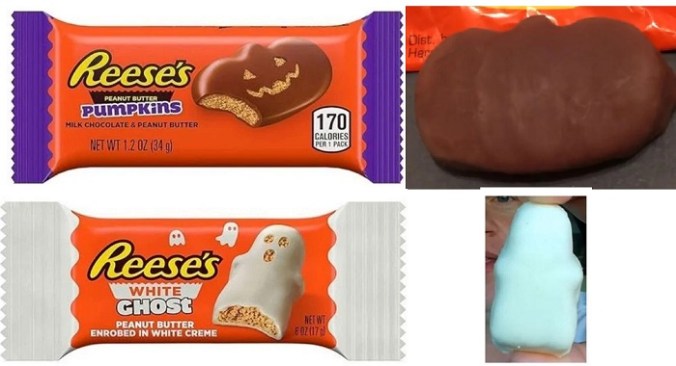
The Hershey company (in Hershey, Pa.) has been sued by Cynthia Kelly in the United States District Court for the Middle District of Florida on behalf of herself and everyone who purchased Reese’s Peanut Butter Cup Halloween candies advertised as pumpkins and white ghosts. The class action lawsuit seeks $5 million in damages and a court order requiring the company to change its advertising next year so purchasers won’t feel that they have been victimized by a bait-and-switch. It alleges that Hershey falsely advertised the seasonal candy as having “explicit carved” out designs, and there were no such carvings in the actual products.
Kelly’s complaint says that she purchased a bag of Reese’s Peanut Butter pumpkins for $4.49 at an Aldi’s last October 2023 because she was impressed by the artistic carvings depicted in the advertisements and the packaging, and would not have bought the candy if she knew that it was uncarved. And she wasn’t alone in this painful disappointment, as shown by comments on Hershey YouTube ads written by heart-broken candy-lovers:
- “Reese’s Halloween Candy LIED To Me!”
- “We got lied to after discovering that the detailed eyes of the Reese’s White Ghost on the product packaging was missing from the actual product.”
- “This is not a trick, this is not a treat… come on now Hershey’s…there’s no eyes, there’s no mouth, there’s no nose…[like the detailed face that] they promised on the packaging.”
- “Aww man, I thought it would have a face on it, its just a chocolate blob. That’s a little disappointing.”
Well, there is no question that the wrappers show the candy inside with carvings that don’t exist. Then again, M&Ms packages also show its candy with faces (also arms and legs), and I doubt that anyone is disappointed when they open the package. The false advertising complaint is legitimate, though it might be found that the package art is within the margins of puffery permitted in food packaging and not intended to deceive. The damages claim seems excessive, but you can’t assume there won’t be some monetary reward depending on the size of the class. Still since nobody who was shattered by the discovery that the pumpkin- shaped candy lacked faces can reasonably argue that they kept buying the candy after the first package was opened, so individual windfalls from even a successful suit are likely to be tiny.
The lawyer, however, will get a third of the damages, conceivably a million bucks or more, while Cynthia and the rest will have to be satisfied with a few dollars.
It is the kind of suit that burdens the civil justice system and that shouldn’t be brought. I don’t think an ethical lawyer should agree to represent the class. It is not a frivolous suit, however. Frivolous suits, which can get a lawyer in ethics trouble exist when there is no “basis in law and fact” for them. Even if no similar suits have been successful, if the case involves ” a good faith argument for an extension, modification or reversal of existing law,” it’s not officially unethical.
I do regard a Hail Mary suit like this as unethical in the layman sense: it’s trivial, silly, a waste of resources and the awards to the aggrieved are wildly out of whack with the legal fees. Stupid, in short.
Now watch a jury award the class millions of dollars…
 Ethics Alarms
Why don’t people simply return the product to the store if they are dissatisfied. I almost bet that the bag has some sort of guarantee of satisfaction or their money back.
This reminds me of those people who order a high priced meal, eat more than half of it and then complain demanding their money back.
The more I thought about this the more I came to believe that it is not only unethical it is frivolous as well. I am not disagreeing with Jack’s legal assessment, I am coming to think it was frivolous based on the idea that the consumers failed to avail themselves of the most basic of remedies which was to ask for a refund. This is not a case where downstream costs are incurred because the product failed to meet 100% of the consumer’s expectations and the consumer was forced to use the product to avoid added damages, or caused personal harm
Cases like this clog the court system. We currently have millions of people creating a backlog of asylum cases and a shortage of immigration judges in which some cases are scheduled for 2031 and beyond. One can argue that all of this type of class action cases should be deferred until all backlogs that have significant relevance to the broader society are adjudicated. These cases create unnecessary burdens on all of society when society must continue to shoulder the costs of those waiting to have their cases heard.
If a cause for legal action exists in mere disappointment in a purchased product that does not appear or perform as the packaging suggests, then I am due a few decades of compensation. I’d better research the firm that is handling this case.
I take back the comment I made in the Jeopardy post about when Satan officially takes control.
THIS lawsuit is that point…
Presumably, the customers are incensed that there is no bite mark already on the candy when they’ve unwrapped it. Reece’s, since time immortal, has always shown people creatively eating the bars.
After all, there’s no wrong way to eat a Reese’s.
Could the lawyers who handle a class-action lawsuit, themselves be sued for incompetently structuring the settlement?
There was a class-action suit against Harbor Freight, the discount tool chain, a few years back, with two or three different classes of plaintiffs. One class was customers who could verify their purchases with receipts & credit card records. They could select, when joining, to get a percentage of their purchases back as a check, or a larger amount back as a store credit. The last class was those who just signed an affidavit that they had bought something from HF during the stated period…no proof required. They would each get an equal share of whatever settlement funds were left after all others were covered.
It turned out that the funds remaining were enough to award the last class of unverified claimants about $300 each (if I remember correctly)…significantly more that the few $/person that typically might filter down in such suits. It also happened to be considerably more than many but those with the largest claims in the verified class received…the people who had truly shopped there, and spent the time and effort to scrounge through their records, sort and mark copies, and mail the whole pack of paperwork back in. (There was an online info/chat group following this.)
Of course, those plaintiffs were not at all happy with that outcome. There were questions on why the lawyers didn’t anticipate this possibility and structure it to favor the persons who had, in all likelihood, the better claims. Perhaps something like setting an amount for the last group to be no larger than, say, $50/ea, or the initial median award to the verified group, whichever was lower, and then pro-rating the balance after that back to the verified purchasers.
So, were the class-action lawyers incompetent; should they have been sued?