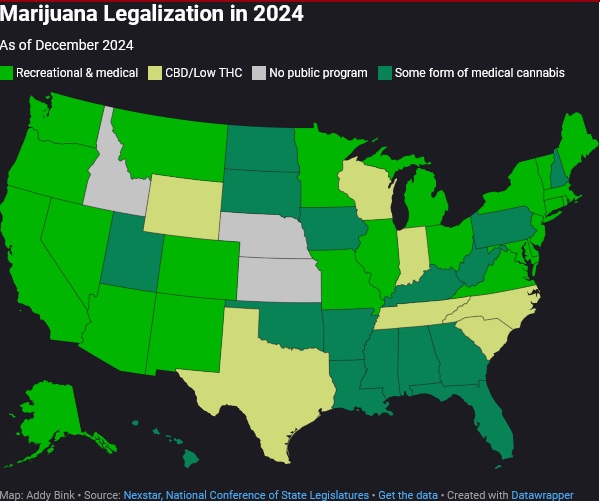
The status of marijuana in the U.S. is a mess, with the drug still being illegal under federal law and the states slowly sliding down the slippery slope to legalization, because they see revenue in it. The confusion is going to get worse before it gets better. Ohio was the only state to legalize marijuana for “recreational use” last year. The Kentucky General Assembly legalized medical marijuana this year, but patients will have to wait until 2025 for the program to kick in. Voters in Oklahoma rejected the legalization of recreational marijuana in last March, and Hoosiers voted against legal marijuana in Indiana in early April.
The Department of Health and Human Services sent its latest findings on marijuana to the Drug Enforcement Administration, recommending that it be reclassified as a Schedule III drug. That classification would mean that the substance has a “moderate to low potential for physical and psychological dependence.” However, I wouldn’t trust the now thoroughly woke HHS to do an unbiased study on the topic, since the most stoned American are progressives and Democrats. Throughout the last few years, there have been various studies suggesting that the drug is not as harmless as its proponents have been claiming it is, and there is enough evidence of heavy use of pot causing long-term cognitive problems to tell me that we still don’t know what lurks in the genie’s bottle.
This battle is lost, and was lost decades ago. The country is the worse for it. People will die because of it (and have); lives will be spent being less productive, the economy will be weaker, children will become early drug-users abusers, families will be disrupted, relationships harmed or destroyed and the population rendered dumber. For this cultural pathogen I blame too many people, organizations and institutions to count, as well as those who abused their influence on the culture, ranging from the music industry to Hollywood to pandering politicians.
And I blame every adult I see using the drug, whether it is a friend, a member of my family, or a character in a movie or TV drama. Every one of them falls in my estimation of their character. I blame every adult who ever used pot, even if they no longer do. Marijuana is a case study of “Everybody Does It” throttling responsible conduct with terrible consequences all around. It is a pattern that we are seeing repeated with other kinds of conduct that our society once regarded as wrongful without significant dissent and with the support of our laws, conduct that now is widely accepted as justifiable by large segments of the public. Illegal immigration, birth out of wedlock, racial preferences and shoplifting come to mind immediately, but there are others.
Because of all this, I have a visceral reaction of anger, disappointment and contempt for all the pot-users, past and present, around me. They have made this nation a worse place to live, less safe, less responsible, and less ethical.
This bias is not going away.
 Ethics Alarms
I am in complete agreement but for slightly different reasons. Our society has become addicted to immediate gratification. I want to feel good so I pop a pill or smoke something that will allow me to check out of the real world for awhile. This translates into I want everything now so I will “shop without money” aka looting. You disrespected me and I want to hurt you back now so I will shoot you. I want to have sex now so if pregnancy, occurs I want to end it now so I don’t have experience any pain in my life.
People who never or rarely experience pain can never develop empathy toward others. Those who claim to be empathetic to the plight of the “oppressed” are only posers who run from the first time they experience a cost to themselves.
That’s part of the reason I opposed recreational drug use from early in high school to this day. The whole idea of self-medication, “taking the edge off” and escaping into chemical bliss has seemed cowardly and destructive, always. And the fact that doing it required breaking the law was an equally powerful motivation.
I will say that I have no issue with drug makers using THC that is administered as an eye drop for glaucoma or in any of the typical drug delivery protocols for medical use via prescription.
What should concern all of us is that the State is encouraging the behavior for profits from taxes. The very same states that sued tobacco companies for selling a product that contained a drug to induce dependency which led to higher rates of cancer and heart disease have no qualms about encouraging the use of this product that could result in other health related problems.
If the state feels that the constituents want something that was deemed harmful in the past, without clear proof that the substance is not harmful the state should not become dependent on the tax revenue from its sale by making it permissible. Regulating distribution is not nearly as hypocritical.
Biases towards marijuana can vary widely due to our personal experiences and observations, here are mine.
1. I put the use/abuse of marijuana in the exact same category as the use/abuse of alcohol and I think they should be legally treated in the exact same manner in our society.
2. I tried marijuana a couple of times when I was in my teens and I don’t like the effects.
3. I’ve been drunk a few times in my life and I don’t like the effects.
4. I enjoy an alcoholic beverage once in a while but I make a choose not to drink enough to get drunk. I choose not to participate in the use of marijuana or any other drugs.
5. Throughout my life I’ve known many, many people that have used marijuana socially without abusing it or moving on to stronger drugs, I have no problem with this. These people are all around us.
6. Throughout my life I’ve known many, many people that have used alcohol socially without abusing it, I have no problem with this. These people are all around us.
7. I have known a couple of people that abused alcohol, marijuana and a few harder drugs, I have a real problem with their abuse. These people are few and far between.
I know there are those out there that disagree with this; but, it seems to me that the old phrase “everything in moderation” is fully appropriate for both alcohol and marijuana usage but it simply cannot be applied towards the harder drugs that can trigger an almost instant personally destructive chemical dependency. Based on personal observation, I don’t think marijuana is a stepping stone drug anymore than alcohol.
It seems to me that there will always be a small percentage of the population that are susceptible to becoming dependent on things like alcohol, marijuana and harder drugs and an even smaller percentage that become serious problem addicts. As the population grows the number of these people also grow, this is true for a wide variety of social problems.
Human beings having a full life and not searching for easy instant gratification ways to escape their lives would certainly help a great deal with curbing chemical dependency.
Rats, I just can’t seem to avoid typos no matter how many times I proof read.
YOU can’t!
My problem with this argument is that one can use alcohol without being impaired, and alcohol has many traditional, ceremonial, social and dining uses that do not involve getting drunk. The whole point of pot is to get impaired. There is no positive and productive use of the drug. It deserves no place in society, and society doesn’t need it or benefit from it in any way.
I’m in one of those moods today, so bear with me while I jump over the cliff and figuratively poke the bear. 😉
Jack Marshall wrote, “My problem with this argument is that one can use alcohol without being impaired…”
Honestly Jack, that entirely depends on how you choose to define “impaired”. Some choose to define impaired as any alcohol percentage in the bloodstream, I don’t define it that way and it appears that you don’t either.
Jack Marshall wrote, “alcohol has many traditional, ceremonial, social and dining uses that do not involve getting drunk.”
True, but isn’t that like a rationalization of sorts justifying the already socially acceptable alcohol. Isn’t it also true that pot doesn’t have these kinds of socially acceptable situations because it’s been socially shunned by our society. I’ve heard many arguments that Native Americans used pot in traditional, ceremonial and social settings.
Jack Marshall wrote, “The whole point of pot is to get impaired.”
I disagree. There are varying levels of “impaired” using pot just like there are for alcohol. I’ve personally witnessed the varying levels of impairment from both pot users and alcohol users. Your statement is very true for those that abuse pot and the exact same thing can be said for alcohol abusers.
Jack Marshall wrote, “There is no positive and productive use of the drug.”
Is that implying that there are positive and productive uses of alcohol and not that alcohol simply has socially acceptable uses?
Jack Marshall wrote, “It deserves no place in society…”
You’re welcome to that opinion just like the people that have the exact same opinion about alcohol. I grew up with a lot of anti-alcohol people.
Jack Marshall wrote, “society doesn’t need it or benefit from it in any way.”
I think that implies that society needs and benefits from alcohol use. Please explain this one.
I am puzzled that you would challenge the basic fact that alcoholic drinks taste good. People don’t drink fine wine to get drunk. One beer doesn’t impair any adult of normal size. Used responsibly, an alcoholic drink is a beverage, not medicine. Alcoholic beverages are staples of enjoyable dining for a large % of the population. Anyone who has tried to enjoy non-alcoholic beer could explain it. A beer or a glass of wine, a good bloody Mary or a martini with some food doesn’t impair anyone over 100 pounds and off medication.
Your argument that there are varying levels of pot impairment ducks the issue. If you smoke pot, your judgment and thinking are impaired, and you smoked to have it impaired. Impaired judgment is per se bad by definition. I would take the same position if there were stupid pills that could render one too dumb to realize all of the problems they had to deal with for a few hours.
Cigarettes and cigars: the experience of smoking them can be enjoyable. My mother smoked a single cigarette once a year as a special treat. Nevertheless, the harms of tobacco use so overwhelm any benefits that it would be a benefit to society to ban it, except that like alcohol, it is too far embedded in society. Now so is pot. It didn’t have to be that way. Right up to the Sixties, the social stigma and the law were sufficient to keep its abuse to a minimum…and any use of pot is abuse.
In contrast, nobody smokes pot because they like the taste. Nobody.
<<<<>>>>
Not to me, I am happy to say. I don’t really care for the taste of beer, and the hard liquor I’ve tried just tastes really nasty to me. I do like soft drinks (I’ve acculturated myself to enjoy diet Pepsi), and also coffee.
Regarding smoking — I was a fairly heavy smoker for about 45 years, and it was only through the grace of an injury that landed me in a skilled nursing facility for six weeks that I was able to quit.
But I’ll agree there actually can be enjoyable aspects to smoking. So I will assert. I can admire your mother for her one cigarette per year — but I would be terrified to try that lest I start up again (I was going to say readdicted, but I don’t think you ever totally lose the addiction).
To be an ex smoker now for six years has been a godsend. I can attest to some of the beneficial effects.
Marijuana? I did use it a wee bit in my younger days, but I could probably count the joints I’ve smoked with one hand. I’ve just never been attracted to that sort of impairment, nor the type you get from liquor. My family history has also shown me some of the perils of substance abuse.
Well, this is the part I intended to quote — somehow I managed to get my post in all italics.
“I am puzzled that you would challenge the basic fact that alcoholic drinks taste good.”
I have substantially the same experience as Steve, but for his minor experimentation with marijuana. I’m guessing we are close in age too. I agree with his view.
I don’t see the expanse of difference in marijuana use that you see, Jack, compared to alcohol, cigarettes or even coffee. I recognize there is abuse but am not convinced it is so pervasive it should govern decision making.
Alcohol in Western traditions has lots of presence but less so in other traditions where other things are used. There are many people who enjoy the act of smoking or the ritual of brewing a nice coffee that is not significantly different than having a single non impairing glass of wine with a nice meal. Yet one can be addicted to cigarettes or caffeine and have serious health effects that impact society. Less so with caffeine but still I see a matter of degree and not kind.
In a truly free society, shouldn’t the standard be that a product like THC should be available with moderate regulation but also with applicable rules established for bad behaviours?
I formed my opinions of escapism tools back in the 60s and haven’t changed since. I saw too many fellow students in college go off on their stoned trips, drunk binges, or free-love escapades, only to come down off the physical or chemically induced high to find their problems right where they left them – unresolved.
It seemed a stupid way to go through life.
I chose to abstain from all the “everybody does it” crap and instead took long walks where I could think through my options for any angst-provoking issue and devise a clear-headed way forward.
It was a far more productive and lasting use of my time and has served me well all the years since. Fortunately I’ve been able to pass that strategy onto my daughters.
The map depicting the different availability of marijuana – which ones allow recreational use vs requiring a prescription – is from December 2024. I can only guess why no one caught this error
I wish I had additional insight to offer here, but you all have covered things well. I am against legalizing marijuana, basically for the same reasons listed by Jack and the responders in agreement with him. Our son, who does not use marijuana at all, has thinking more in line with Steve W and JLo – legalize it, then tax the dickens out of it. He and I have discussed it a few times, but to this point we haven’t strayed from our respective camps.
There have been recent studies (some of them highlighted at EA) indicating the longer-term effects of pot are not nearly as benign as originally thought. For that reason alone, I think it’s a choice that’s fraught with peril to make a mind-altering drug available to a public which is largely uninformed and unwilling to do any research on a subject, but is constantly look for self-gratification and escape.
I realize that probably flies in the face of more libertarian ideals, but I would put this government intervention in the category of “promoting the general welfare”.
Parenthetically, I suppose one could make an argument that legalizing pot helps “insure domestic tranquility”, but I won’t make that case…
I don’t know if I have your ire or not. I shouldn’t have your ire because I’m someone who’s never used any marijuana or marijuana-based product. I should have your ire because I’m someone who voted for the first legalization in Colorado and continue to support legalization. To me, it comes down to whether we live in a nanny state or not, and the government has proven beyond a shred of doubt that they are incapable of being rational about marijuana. The medicinal benefits of products derived from marijuana can no longer be disputed, yet the federal government has yet to consider the proper scheduling of the drug. This is simply the logical result of bad government that was wielding too much power, denying medical development and options to its people, over incarcerating to build a prison economy, and diverting a cash crop economy to cartels of bad people.
Despite all of this, the people still had ready access to the drug. The charade is ended.
No ire here. You just articulated the standard libertarian argument against regulation of any consumable, which is exactly the point where libertarians lost me eons ago. Ron Paul wanted heroin to be legalized using the same argument. Part of government’s legitimate duty is to protect responsible citizens from irresponsible ones. I don’t want my kids to be distracted and harmed by peers who use drugs because their parents do; I don’t want to pay higher prices because companies are hampered by employees who are working at less than top efficiency because the are stoned some or all of the time; I don’t want to get less than trustworthy service fro supposed professionals who have knocked IQ points off their totals by toking up every day. Etc.
That the government tends to do a bad job at everything it tries to regulate is absolutely true, however.
I think Jack is correct that the battle was lost decades ago. I am partly to blame, and Jack would not respect my conduct during my youth. I squandered much time and opportunity.
When it comes to alcohol it is useful to recall the words of Increase Mather:
“Drink is in itself a good creature of God, and to be received with thankfulness, but the abuse of drink is from Satan, the wine is from God, but the Drunkard is from the Devil.”
–Increase Mather
https://www.azquotes.com/quote/592837
= – = – = – =
The marijuana I smoked in the early 1980s was weak compared to what’s available now. Back then it was a “convivial intoxicant”, potent enough to make you giddy and giggly. Back then it was easy enough to derail your life with it if you liked to smoke it regularly and keep the company of others who liked doing so.
The product is far more powerful now, and I long since stopped using it.
I once held in my hand a hip, chatty book from a peer counseling program for streetwise youth in San Francisco. The book was chatty, non-judgmental, full of the current slang and generally non-preachy. This was 20 years ago. The book summarized the risks of smoking marijuana thusly:
“It’s not exactly a motivational wonder drug.”
–charles w abbott
rochester NY
First reference to Increase Mather on Ethics Alarms.
The battle was lost when the culture pronounced pot “cool” and wealthy white yuppies and the pop culture elite embraced it because they were at little risk of either being arrested or letting the practice get out of hand.
I once taped the idiotic conversation of three (smart and articulate) college friends while they were stoned and played it back to them. They were horrified.
The Sixties have a lot to answer for.
As I free associate on the topic, so many thoughts pop into my head.
1. “Drugs win drug war.” –article from _The Onion_.
2. “There are no solutions, only tradeoffs.” –Thomas Sowell
3. James Q. Wilson’s article “Against the legalization of drugs.”
https://www.commentary.org/articles/james-wilson/against-the-legalization-of-drugs/
4. Fred Reed’s homespun commentary of 20 years ago, currently at Unz.com. To summarize, lots of people want drugs and will pay for them, using illegal markets if necessary. It became normalized for broad swaths of the population.
https://www.unz.com/freed/mom-drugs-and-apple-pie-211/
Fred Reed is a talented polemicist and loose cannon, a good prose stylist. Not safe for polite company. I think of his best essays often.
5. H. L. Mencken’s observation that sin is a dangerous thing and it must be left to the congenitally sinful who are sufficiently experienced to know when it is ok to pick it up and toy with it, and when it’s time to set it back down and leave it alone. Somewhere In his book review of “A good man gone wrong.” The whole essay can be found in a PDF file of _Mencken’s Chrestomathy_.
6. Nobel Laureate Czeslaw Milosz’s discussion of alcohol. Find it in _Milosz’s A B C s_. He notes that some of us benefit from drunkenness and then introspection after sobering up. To paraphrase, we are reminded that inside each one of us, the sober version, is a stupider version of ourself, just waiting to get out. As can be said of some of us who are mean drunks, “Instant asshole, just add alcohol!”
7. Generally speaking, I think part of the problem is a problem of technology, globalization, and marketing. We have enough trouble coping with alcohol, a substance known to most of the civilized world for millennia, where the use of alcohol is typically hemmed in by norms, taboos, laws, regulations, expectations, social disapproval for excess consumption and abuse–and it still takes a mighty toll.
Now, we have an endless assortment of new and stronger products. Wine distilled into brandy and malted grain distilled into whiskey, etc. Coca into cocaine and then into crack. Opium into morphine and then heroin and now we have synthetic fentanyl. USA now has 100k + fatalities in the USA each near of drug overdoses, currently most of which is fentanyl poisoning.
The demand for mind-altering substances is high. Business structures for wholesale transportation and retail marketing continue to innovate.
George Will made this general point in a short essay about drug policy and technical innovation repeatedly raising the potency and availability. We end up choosing between a legal system which makes dangerous substances widely available (taxed, regulated), harming members of the general public, and legal prohibition which results in a black market. In the illegal markets, the damage tends to be more concentrated in particular locations, neighborhoods, sub-cultures, demographics, criminal networks, etc. I cannot provide the citation offhand. Perhaps in his collection of essays _The leveling wind_, 1994.
Currently I work in a liquor store. We are highly regulated. We receive shipments of wine and hard liquor on a 30 day invoice, brought to us in trucks where the driver carries no weapon and will not accept cash payment. We obey the law. There are no Al Capone figures engaged in gangland wars over trucks full of vodka and tequila and cognac.
Rochester NY is a moderately large city, not in the top 50 of the USA by population. Every couple of years, if not more often, individuals here are murdered over thefts / robberies / commercial betrayals involving a pound or two or three or four of marijuana–or far less. Alcohol is a legal market. Marijuana is an illegal market–until recently. But wait–there’s more!
The decriminalization of marijuana in New York State does not seem to have fully resulted in a legal market in which force is no longer used to settle disputes. I still don’t understand the specifics. The murder of Rochester Police Officer Anthony Mazurkiewicz had something to do with which drug crew was going to sell drugs in Rochester.
https://www.cityofrochester.gov/OfficerLineofDutyDeath/
8. I understand Jack Marshall’s argument that society should demonstrate its disapproval of marijuana use by keeping it illegal. I see his point. I think the train left the station long ago. We are now at the point of education, awareness training, admonition, etc.
The article (and citation) I was looking for is this:
“The unintended consequences of unpalatable choices.” Op-ed column by George Will originally dated June 27th, 1993. It would have come out in the _Washington Post_ or in _Newsweek_, or perhaps both.
Reprinted as “The unintended consequences of unpalatable choices” in the book _The leveling wind: Politics, the culture, and other news, 1990-1994, p. 185-187. New York: Viking. 1994.
To repeat myself, the article sketches the tradeoffs between (1) legalizing dangerous recreational substances, which makes them more available and diffuses their impact more widely, and (2) keeping them illegal, which drives transactions into the black market, the illegal market.
(My discussion would add the following: Typical price theory analysis from microeconomic theory would predict that the illegal market will involve higher prices, worse quality, unpredictable quality (unknown and unpredictable dosages in the case of substances), violence used to settle business disputes, and the constant risk of criminal predation which can be prevented and moderated in the end only by the threat of violent retaliation.)
Getting back to the article, it mentions a conversation that reportedly occurred in 1969 in which Daniel Patrick Moynihan has returned from France, having just persuaded French leaders to smash the “French Connection” heroin syndicate. The other person in the dialogue is George Schultz, who is unimpressed.
Moynihan thinks this is big news. Schultz is bored, won’t look up from his paperwork.
Moynihan eventually figures out what Schultz is thinking, says
“I suppose you think that so long as there is a demand for drugs, there will continue to be a supply.”
Schultz replies, “You know, there’s hope for you yet.”
= – = – = – =
At any rate, I hope to quote the clergyman Increase Mather, former president of Harvard University, more frequently as time goes on.
Happy New Year to everyone, and especially to you, Jack Marshall.
—
charles w abbott
rochester NY