Attention should be paid.
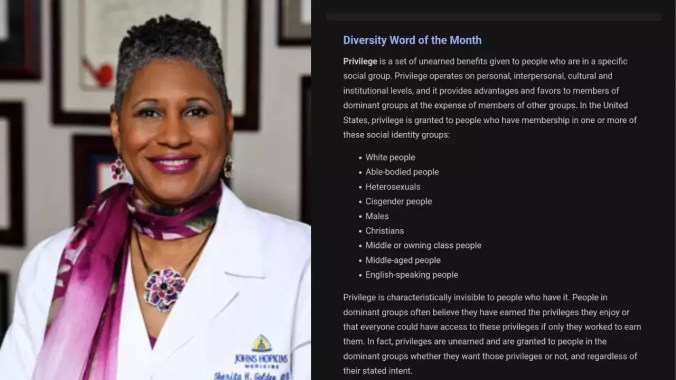
In the latest issue of the “Monthly Diversity Digest,” Dr. Sherita Hill Golden defined as her “Diversity Word of the Month” privilege as “a set of unearned benefits given to people who are in a specific social group.” “Given”? She went on to write that
“Privilege is characteristically invisible to people who have it. People in dominant groups often believe they have earned the privileges they enjoy or that everyone could have access to these privileges if only they worked to earn them. In fact, privileges are unearned and are granted to people in the dominant groups whether they want those privileges or not, and regardless of their stated intent.”
Golden then named these unfairly and unethically favored groups: “White people,” “Able-bodied people,” “Heterosexuals,” “Cisgender people,” “Males,” “Christians,” “Middle or owning class people,” “Middle-aged people,” and “English-speaking people.”
Hey! I’m nine for nine! (Okay, I guess I’m out of “Middle-aged” by now…).
This is exactly what the DEI cult believes, teaches, and wants to use various biased and prejudicial policies, practices and laws to address. Golden isn’t just some bigoted wacko: she’s a professor, a vice president, and the Chief Diversity Officer at Johns Hopkins Medicine. When her spot-on definition of her movement’s ideology hit social media, the reaction was predictable by anyone who doesn’t exist in Woke Bubbleworld. Elon Musk and Donald Trump, among others, pointed to her statements. The “ratio” of negative to positive responses was overwhelming. So, naturally, Golden claimed that she didn’t mean what she wrote:
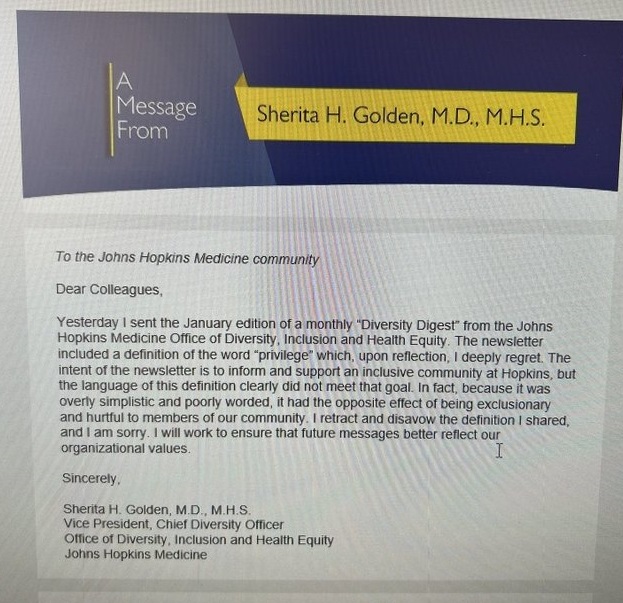
In fact, what she wrote is exactly what she meant, believes, and what motivates the DEI movement’s efforts. She was just a bit too honest, so she’s pleading Pazuzu, or something. Her language echoes the “That wasn’t who I am!” groveling when a celebrity lets a racial slur slip out or, like actress Susan Sarandon after she was caught siding with Hamas terrorists, when someone realizes that their true sentiments will have negative career consequences.
Organizations and corporations have allowed a bigoted and biased ideology promoting “good racism” and other illegal and unAmerican objectives to acquire destructive power and influence in our society, institutions and culture. As Elon Musk tweeted in response to Golden’s unfortunate attack of undiplomatic bigotry, “This must end.”
 Ethics Alarms
I am waiting for someone to take these people up on their dogma. These people try to punish people for their ‘privilege’. When they do, the ‘privileged people should demand her firing. I mean, if I am 8/9 for privilege and it is real, how is SHE going to discipline me? I am privileged and she is not. Get out of my way!
Oh, that won’t work? Then she is lying.
Not all White people are Hunter Biden.
Wait. She’s only a Vice President but Chief DIE officer? If she is Chief DIE officer, then some is Deputy DIE officer, ¿no? Why does Johns Hopkins even have hierarchical positions anyway? That means someone is less than or greater than someone else. Someone is subordinate to and superior to others. That can’t be right, ¿no?
But, yeah, her post was exactly what it meant – I wonder what her response would be to someone posting about “minority privilege” or “disadvantaged privilege.” Would she blow a gasket? I suspect she would.
jvb
jvb,
This was exactly my thought…at least I think it was if I was understanding what you wrote.
What about the children born to Michael Jordan? What about those born to LeBron James, or Mookie Betts, or President Barack Obama? Aren’t those children – and by extension their parents – “people of privilege”?
Don’t they have advantages and opportunities that even I, as a white Christian, could never hope to have?
You know what, Dr. Golden?…screw you, and screw your discriminatory dogma!!
Here is the part she didn’t mean. If you look at all the groups she lists that are ‘privileged’, about the only folks that are left out are women of color. Most black men, latinos, Asian men fall into one or more of those categories — males, heterosexuals, cisgender. Able-bodied people for heaven sakes — that 90+% of the country, I should think.
And, actually, most women of color are able-bodied so that means only disabled women of color don’t have privilege. At least according to her list. Which means it’s meaningless, in an objective viewpoint.
Do these people ever read what they’ve written? Duh, silly question, sorry.
You’re leaving out a couple of categories. I believe the list of the truly un(der)privileged would include only disabled, poor, young (or old?), non-white, non-Christian, transsexual lesbians who don’t speak English. I’m forced to admit that anyone fitting that demographic is likely to struggle in today’s society. There may even be one or two of them in our nation of about a third of a billion people.
Question: Why do none of these lists mention smart people, attractive people, motivated people, talented or ethical people? being born with above average intelligence is promising trait that can often overcome the disadvantages of the others. Has anyone ever called, say, Malcolm X or Christie Brown “privileged”?
Adding on to that, Jack, the absence of “two-parent family” is a telling absence.
Growing up in a two-parent household confers more benefits than most progressives dare admit.
-Jut
Add to that competent and responsible parenting. My father, who had a remarkable single mother raising him for most of his childhood, was always prickly about the single parent issue, but she was unusual and he was lucky.
No one here probably remembers, but I had such an argument with Chris (yes, that Chris) on these very boards long ago. All the factors you mentioned are MUCH more statistically significant in predicting success than the ones focused on by DEI nitwits.
I wanted her to explain who decides who is the dominant group. Do blacks in black communities have privileges their white counterparts do not in the black community? Exactly who is the dominate group in her office? I wonder how welcoming a club that caters to black clientele would be to other racial groups the wanted the club to change their music or product offerings to accommodate the new invading clientele. I do know that the issue of gentrification in housing is a significant issue in the black community as gentrification tends to dilute the homogeneity of the neighborhood.
There is no doubt that privileges accrue to the dominant group. The logical fallacy of privilege is that it relies on group dynamics of the entire population when in fact smaller concentrated groups can dominate a dispersed larger group.
Which demographic groups have the ability to claim a social offense against another demographic group. That is an unearned privilege that Golden fails to recognize in herself. She acknowledged that privilege in her diversity of the month memo when she labeled people with certain characteristics as privileged. Obviously, she identified virtually every member of the US population as well as a large number of global citizens when she listed English as a spoken language. However, the implication was that such a criteria does not extend to Blacks and ethnicities other than European, women, and others with various sexual proclivities. I have never heard white Europeans demand others stop appropriating their culture; it is quite the opposite.
This in itself is a privilege that cannot be ascribed to what she considers the dominant group. I had no problem with her definition until offered up the list of characteristics of people with privilege. At the point she cut her own throat.
When any organization appoints a wacko White hating bigot to one of those newly minted diversity czar positions, there can only be one end result. And they all know it, which is precisely why those types are the only ones they appoint.
It sounds like Golden is talking about “privilege” as it relates to the cognitive bias known as the fundamental attribution error: the tendency for people to ascribe other people’s failures to their character, and their own failures to circumstance (and vice versa for successes).
To address the fact that the list of privileges ends up encompassing most of humanity: the word “intersectionality” is supposed to acknowledge the various privileges that people can have or lack. What I think most people (outside this blog) fail to realize is that privilege is context-dependent: a trait that is an advantage in one context can be a disadvantage in another context.
There’s something vital that we’re missing, though: what are we expected to do in response to recognizing privilege or lack thereof?
Treat people with more kindness and respect? That’s definitely good.
Try and remove obstacles so that people can contribute and be rewarded without unnecessary struggle? I’d support that. (I keep unsuccessfully searching for a quote I remember where someone describes their “privilege” as a right that they want everyone to have, e.g. the right to have no reason to fear the police.)
Give people positions of status and authority that would otherwise go to the more privileged? That might not be so good. If affirmative action means lowering non-arbitrary standards, it’s just a bad idea. However, if it means investing in the education and development of people who would otherwise be at a disadvantage for superficial reasons, so that they can rise to meet those standards, then I would support it.
Overhaul institutions that put people at a disadvantage for superficial reasons? That could be good.
Arrange for each cultural community to have skilled, responsible people in positions of influence (official or unofficial) so they can develop the autonomy of the community and those within it? That sounds good as well.
The main reason people suggest silly responses to the existence of privilege is that most humans don’t understand how skills like large-scale responsibility work. They don’t know the sorts of decisions that have to be made and the situations that shape those decisions. They think being an authority is just wearing the bling and telling people what to do, and therefore anyone can do it, and therefore why not them?
There’s no clear picture of what a good decision process looks like, only decisions that people like or don’t like, which get labeled “good/smart” or “evil/stupid”. That’s why humans have trouble holding authorities accountable, and that in turn is why they wind up with so many incompetent and corrupt authority figures.
That’s my plan involves helping people define skills and effective decision-making processes: so that we can define clear standards for competence and help people learn to meet them.
Boy, you vanish for a week and then POW, knock a comment out of the park. I am kicking myself for not making the fundamental attribution error connection, but that’s exactly right. Comment of the Day. Thanks.
Excellent thoughts.
One question I would ask: could you dedicate a few sentences to what “disadvantage for superficial reasons” looks like? That seems murky.
Good question. When I think of a disadvantage for superficial reasons, I think of people who are denied opportunities to develop the skills and step up to the responsibilities that they have the most affinity for, because other people can’t immediately see their potential.
Sometimes people are subject to bias based on their gender, culture, or physical appearance. Sometimes people have good potential but lack the presentation skills to show it. Sometimes people are just born into circumstances that don’t allow them to pursue their talents, whether that’s poverty or just being born at the wrong time of year (credit to Freakonomics for pointing out the cumulative effect of coaches favoring the older students in each grade for training and sports team membership).
What we should be aiming for is giving everyone the opportunity to get good at contributing to society in a way they have some affinity for. People may not get their first picks of jobs, but they should not be denied the opportunity to try and become more valuable. (Of course, how society treats the least “valuable” is another issue.)
Does that make sense?
EC,
I appreciate the response and I’m wrestling with it. Thanks!
Extradimensional Cephalopod: “(I keep unsuccessfully searching for a quote I remember where someone describes their “privilege” as a right that they want everyone to have, e.g. the right to have no reason to fear the police.)”
Attribute it to me if you like; that is one of my critiques of the notion of privilege. In some instances, privilege is not part of an unearned advantage; it is part of an unwarranted disadvantage. I am not privileged by being treated the way everyone should be treated; someone else is “under-privileged” by not being treated the way one should be.
“Under-privileged”?
“Unprivileged”?
“Demoted”?
“Debased”?
We don’t really have a commensurate term to describe that.
So, people use privilege to describe any advantage that one person may have over another. Actually, common with leftists, we talk about groups, not individuals, and then ascribe a quality of the group to the individual. This is kind of an example of the logical fallacy of division. But, the problem is that individuals have, as comments above have noted, many qualities, some of which are more advantageous or disadvantageous than others (almost as if individuals are somehow unique). It is because of this that they had to come up with notions of “intersectionality” because it turns out that “privilege” is a concept that is inadequate when it comes to describing the world. (But, hey, Ptolemy needed epicycles and the equant to make sense of the universe.)
“Privilege” does not exist. “Privilege” is an attempt to describe phenomena and create a generalization about it.
-Jut
Privilege does exist, in the sense that some people have chance advantages in certain contexts, which they didn’t choose or expend effort to develop. For example, some people’s build gives them advantages in particular athletic competitions. Some people are more resilient to various environmental conditions. Some people have affinities for different problem-solving mindsets. Some people grow up in more hospitable environments which are conducive to learning.
Leftists do commit the fallacy of division and neglect the uniqueness of individuals. Based on their rhetoric, they also seem to deny that it’s possible to overcome disadvantages and deal with others as equals, unless those others handicap themselves deliberately or are deliberately suppressed.
If the pundits and politicians told people they could work together to solve their own problems, then they’d have to learn how to be useful. It’s the same reason pundits and politicians on the Right tell people that if a problem can’t be solved by hard work, people shouldn’t have to learn new skills and change their habits to deal with it.
Politician noises translate to, “I will validate your complacency. All your problems are caused by people you shouldn’t care about. Give me your support so I can stop them for you and you won’t have to change.” They’ve gotten so good at projecting this message that most people don’t actually know what constructive solutions look like, let alone how to negotiate and collaborate within and between communities in order to design and implement them. That’s what I’m fixing first in order to create meaningful change.
Some years ago when Prof. Arnold Kling still blogged at his askblog, before he moved over to a free substack, he posted on privilege and the whole comment thread spawned by his initial post may be worth reading.
The initial list of privilege that are not often mentioned, off the top of my head, I listed as these.
= – = – = – = BEGIN ABBOTT POST FROM 29 JULY 2019 = – = – = – =
“There is a stage in the development of sophistication that many people never *reach*.”
Here’s my list of variables (to add to Prof. Arnold’s).
* adequately high IQ
* good manners (often learned in the home)
* absence of speech impediment or annoying voice
* social competence–knowing what’s appropriate in any setting
* athletic gifts
* being raised through adolescence in a moderately functional neighborhood (not “ghetto”, for example–most families have biological father present, streets relatively safe, gangs not present or not omnipresent, no street drug open sales spots, social strata not dominated and disdained by the rest of society (not ghetto, not hillbilly, not migrant worker, not Black sharecropper in 1950s Mississippi. Self-reliant peckerwood probably ok.)
* ability to read adequately well
* good test taking ability
* not abused / neglected as child
* adequate health care / dental care / glasses if necessary
* adequate nutrition
* ability to follow directions
* good impulse control
* high frustration tolerance
* “concerted cultivation” of talents
* ability to speak the dominant language with no accent or almost no accent
* growing up in top quintile or higher of socio-economic hierarchy
* lack of susceptibility to addiction to alcohol, hard drugs
* not a member of disliked minority (this is hard to say, as some minority sects do well–Mormons here, Huguenots in France, Old Believers in Russia, list can be expanded. The Nigerian sociologist distinguished between(1) immigrants,(2) sect-like minorities, and (3) caste-like minorities in USA–John Ogbu.
* absence of fetal insult to development (virus, fetal alcohol, etc.)
* reading at grade level by 2d grade
* no florid ADHD, uncontrolled, in classroom settings
* conscientiousness.
Permit me to suggest a good essay on conscientiousness by Bruce Charlton:
“Reliable but dumb, or smart by slapdash” (2009) online at Medical Hypotheses blog
= – = – = – = END POST FROM 29 JULY 2019 = – = – = – =
Thanks to Prof. Arnold Kling’s diligence in maintaining his body of work, the entire post and comments can be found here:
https://www.arnoldkling.com/blog/thinking-about-privilege/
Thanks!
charles w abbott
rochester NY