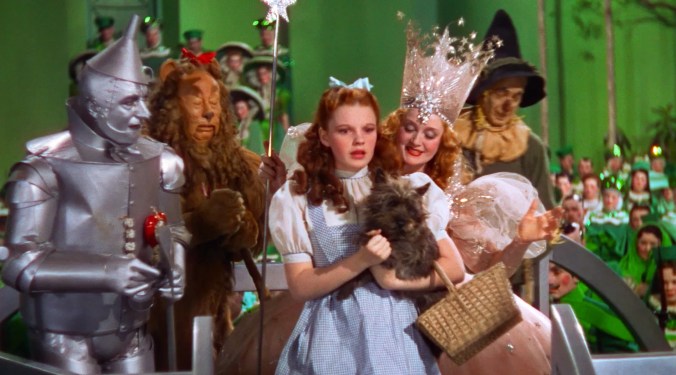
Here is news you have all been waiting for, I’m sure. Kenya Barris, the black film and television writer, producer and director, is best known as the creator of the ABC sitcom black-ish as well as for writing or directing a number of mediocre-to-terrible movies like “You People,” “Coming 2 America,” and the “updated” versions of “Shaft,” “White Men Can’t Jump,” “The Witches,” and “Cheaper by the Dozen.” Now he has announced that he will be writing and directing new versions of “The Wizard of Oz” and “It’s A Wonderful Life.”
In a recent interview Barris revealed that his screenplay for “The Wizard of Oz” is completed, with the new Dorothy being black and not in Kansas any more, but rather a girl who lives in the Bottoms, a huge apartment complex located in Inglewood, California. “The original ‘Wizard of Oz’ took place during the Great Depression and it was about self-reliance and what people were going through,” Barris said. “I think this is the perfect time to switch the characters and talk about what someone imagines their life could be. It’s ultimately a hero’s journey, someone thinks something’s better than where they’re at, and they go and realize that where they’re at is where they should be. I want people to be proud and happy about where they’re from. But I want the world to take a look at it and I hope that will come through.”
I’m so excited.
(I have watched the 1939 movie so many times I can replay it in my head, and it never occurred to me that the film was set in the Great Depression. You?)
Barris has previously said that his version won’t be a musical. Well, that’s not remaking the original “The Wizard of Oz,” then, is it? If your “remake” doesn’t have Dorothy singing “Somewhere Over the Rainbow” and the Munchkins singing “Ding-Dong, the Witch is Dead,” then its a different movie entirely. “My Fair Lady” without the songs is called “Pygmalion.”
Not content with that exercise in hubris, now Barris says the world needs a new, all-black version of “It’s A Wonderful Life,” and Paramount has contracted with him to create that too without even waiting to see how his black “Wizard of Oz” turns out. Surprise! His George Bailey will be black, or maybe just “blackish.” “It’s a guy who’s trying to help out his community and things are going to turn around on him. I think that’s the perfect story to tell for a person of color — Black or brown — to get into that because our communities have some issues and someone trying to help that community out. I think that’s the perfect vehicle to tell that story from,” Barris enthuses.
Funny, I thought Frank Capra’s classic was the perfect vehicle to tell that story from.
Let me begin with this Ethics Alarms boilerplate: if the films work, are entertaining and add something new and valuable to those stories, terrific. I’m all for it. We shall see.
Having gotten that out of the way…in writing about the Netflix horror series “The Fall of the House of Usher,” I alluded to a memorable if annoying speech given by the demon in the story who pretty much slaughters the whole cast. She gives a standard issue progressive/Marxist “if only you people spent money on the things we think you should spend money on” speech, ranting that if we didn’t spend so much on entertainment and sports (among other things), we could solve world hunger and poverty forever. The speech is hooey, but plans like Bariss’s make me wonder if the demon wasn’t on to something. There have got to be better ways to spend millions of dollars than on trying to remake perfect movies just so the casts can be “diverse.”
How often has a remake of any universally admired movie been anything but a bomb, a disappointment, a waste of money, or, at best, an exercise in “Why?” The latter, the best of the possible results, would be Spielberg’s woke “West Side Story.” Among the worst outcomes would be the recent attempts to remake “Ben-Hur” and “The Ten Commandments”—after I saw that one, I had to re-watch the whole nearly four hours of DeMille’s original just to wash it out of my brain.
The “Let’s make Yul Brenner’s character black and have a rainbow cast” remake of “The Magnificent Seven” misfired on all cylinders, and that was one of the better remake attempts with a classic Western. (Do NOT watch the Bing Crosby version of “Stagecoach.”) Turning great but cheesy old sci-fi movies into big budget special effects-fests starring Tom Cruise is one thing: turning Bedford Falls into Compton is something else entirely.
Mostly, these exercises in hubris and apartheid send a message that is divisive: we are now incapable of identifying with human beings unless they belong to our own race, nationality, sexual orientation and gender. Really? Have our tribes moved that far away from each other? Is this a mentality, world view and phenomenon that should be encouraged and pandered to by popular culture?
I recently watched “High Noon” again. It is a great ethics movie, even though it seems less like a real situation than like a “Twilight Zone” episode. Gary Cooper’s performance as the tortured, frightened, conflicted lawman determined to face the villains coming to kill him rather than to try to run away with his new bride looks better every time I see it. Would anything be gained by remaking the film with Mahershala Ali as Will Kane and and Coco Jones as his Quaker love interest (Grace Kelly in the original)?
I hope both remakes are wonderful, I sincerely do. If they are going to be divisive, they might as well be good. However, it would be much healthier for the culture to create new classics that everyone can identify with instead of endorsing the corrosive concept that we can only care about characters who “look like us.”
 Ethics Alarms
Wasn’t the “Wizard of Oz” already done with black actors? And “The Wiz” had music.
Yeah, I almost mentioned “The Wiz,” but nobody regarded it as a new “Wizard of Oz.” It was a movie of a hit Broadway show.
Well, there is where you are getting into semantics. One could say The Wiz was based upon a re-make of the Wizard of Oz.
Or, if all he is doing is making a movie adaption of Baum’s book and calling it the Wizard of Oz (or The Wonderful Wizard of Oz) can’t you call it a re-make if everyone is going to make the comparison anyway?
And how much can you change in a re-make before you can’t call it a re-make. I heard that the Psycho re-make was practically (if not totally) a shot-for-shot replication of the original.
I have recently had the chance to watch the original Jungle Book movie and the recent computer animated version. They are not the same movie, even though they have the same name and the same source material (though they draw on different parts of the source material (and some of the source material is excluded from both movies).
So, I am not sure that a re-make of the movie HAS to be a musical.
At the same time, you can only stray so far from the source material before you are really making a different movie. Notwithstanding numerous common plot points, Strange Brew was not named “Hamlet” for a reason. Same goes for Lion King. And, O, Brother, Where art Thou? Was not called the Odyssey.
Depending on what he actually does for the film, it might be better to say it was based on the Wizard of Oz (book or movie), but not a remake.
-Jut
“Not content with that exercise in hubris, now Barris says the world needs a new, all-black version of “It’s A Wonderful Life,” and Paramount has contracted with him to create that too without even waiting to see how his black “Wizard of Oz” turns out. Surprise! His George Bailey will be black, or maybe just “blackish.” “It’s a guy who’s trying to help out his community and things are going to turn around on him. I think that’s the perfect story to tell for a person of color — Black or brown — to get into that because our communities have some issues and someone trying to help that community out. I think that’s the perfect vehicle to tell that story from,” Barris enthuses.”
So, maybe Black George Bailey gets resentful because he’s constantly being asked to “give back” to his community and being taken advantage of because he runs a business. Nobody shows up at the end with a bunch of money to bail him out because he owed it to them anyway, right?
So he gets out of it (and Black Clarence gets his wings….wait a minute. What am I thinking? There’s no Heaven, angels or wings in Woke Hollywood) by, I dunno, the Post Office losing a bunch of bags of mail with money-stuffed cards in them.
After all, if he owes his community, then white people owe him.
And how will the bank have any mortgages on people’s property—what with all the red-lining in Bedford Stuyvesant Falls?
-Jut
AM Golden,
You’ve employed a lot of stereotypes in a single post about a movie that’s only JUST been announced. Hopefully, you don’t identify everyone in your life with similar racial adjectives.
“Hello, Black postman, do you have a letter froom Asian doctor or Mexican creditor?”
There’s already been at least one remake of It’s a Wonderful Life — a made-for-TV version with Marlo Thomas playing a gender-swapped version of the Jimmy Stewart role. I remember it as being godawful and utterly tone-deaf. For example, where Jimmy’s character threw himself wholeheartedly into the campaign to beat the Nazis in World War II, Marlo’s devoted herself to the anti-Vietnam War movement. These things are not remotely similar: one was almost universally approved by Americans and would be consistent with a character who was universally beloved in his community and the other was not.
Yes! I had forgotten that pathetic gender-flipped IAWL. I liked Marlo in her day, but that was awful.
Before I read the post, I looked at that photo above and thought — isn’t that a wonderfully diverse picture? There’s a tin man, a scarecrow, a lion, munchkins, a white girl, a witch, and a dog. How much more diverse can you get? And the film also has flying monkeys as well as a rather benign Ozish version of storm troopers.
———————
The Wizard of Oz was not written during the Great Depression. I don’t recall, there might have been a depression (or panic as they sometimes called them) when Baum first wrote his first book. Nonetheless, it was and is a wonderful book (and series) and great movie. There’s a reason it is still loved well over a century later.
The Witch is also a “person of color,” being green.
…now Barris says the world needs a new, all-black version of It’s A Wonderful Life,’…
The world also needs an all-Hispanic version of “It’s a Wonderful Life.”
The world also needs an all-Asian version of “It’s a Wonderful Life.”
The world also needs an all-Polynesian version of “It’s a Wonderful Life.”
The world also needs an all-Islamic version of “It’s a Wonderful Life.”
The world also needs an all-lesbian version of “It’s a Wonderful Life.”
The world also needs an all-transgender version of “It’s a Wonderful Life.”
The world also needs an all-gay version of “It’s a Wonderful Life.”
The world also needs an all-mentally-handicapped version of “It’s a Wonderful Life.”
The world also needs an all-physically-handicapped version of “It’s a Wonderful Life.”
The world also needs an all-narrated-by-black-actors cartoon version of “It’s a Wonderful Life.”
With its lack of originality and constant regurgitating of familiar stories, Hollywood is fast becoming the Hallmark Channel.
Cynical curriosity:
It’s a Wonderful Life-
Will the villian in the “all” black be white or Black? Who is opressing the good people?
The Wizard of Oz-
Will the wicked witch of the west still be green? Or, will he get really creative and pick a white color?
What if actors/actresses with very light-colored skin identify as having much darker skin? Wouldn’t they qualify for an “all-black” IAWL?
You’d think they would have learned their lesson after the blackified version of “A Wrinkle In Time” became one of the biggest box-office bombs ever in 2018. They didn’t though, probably at least partially because the top people in Hollywood don’t care that much about money, they already have more of that than you and I will ever see. They care about making others think like them and getting their view out there. If a movie fails, they really aren’t hurt by it. That’s why Disney and Amazon have been buying up the most well-liked and profitable intellectual properties and turning them to crap for the last five years.
Unfortunately, the idea of remaking something but replacing the lead with a Mary Sue woman or a magic minority while showing the original hero as a bitter, burnt-out old man well past his prime and out of place in a woke world has proven to be a one-trick pony whose one trick isn’t that interesting. It was one thing to have Robin Hood have a black Moorish friend who escaped from the Holy Land with him among his merry men (Robin Hood, Prince of Thieves) or to have Jack Ryan’s mentor Admiral James Greer played by a black man (Hunt for Red October) or have the hero of the movie be a black FBI agent (The Siege). The first is a believable twist on the legend and the latter two are perfectly ok and believable in a time when a black man chaired the Joint Chiefs. It certainly didn’t hurt that all of those parts were played by excellent actors (Morgan Freeman, James Earl Jones, Denzel Washington) who put acting first and identity second, at least in those parts. It also didn’t hurt that the latter two were at least good movies, admittedly Prince of Thieves was flawed (BUT also very successful).
On the other hand, making some of Peter Pan’s “Lost Boys” be lost GIRLS and Wendy a sword-swinging girl boss, or killing the original trio of heroes off as well as the iconic villain and putting a Mary Sue in their place, or pairing a gone-sour hero past his prime with a goddaughter who treats him as exasperatingly out of touch don’t work. None of those ideas really worked, and none were all that profitable. In fact the last one was a “flopbuster,” i.e. a big budget film with high hopes that is flawed from conception, raises a lot of yellow flags in pre-release buzz, and ultimately turns in a disappointing or in that case a dismal showing.
Still, none of the studios seem to give a damn. More than a few of these projects have met criticism with not just defensiveness but outright hostility. It really isn’t fair to kick someone who’s already been kicked repeatedly, but Lord of the Rings: Rings of Power faced a LOT of criticism both before it got off the ground and during its execution. I’m sorry, but the complete upending of the lore combined with the positively awful writing hiding behind accusations that criticism was either racist or sexist just didn’t do much for the fans or any viewers, 2/3 of which never finished the series. It remains to be seen whether they correct course in Season 2, which is supposed to hit sometime this year, we don’t know when and they have not dropped even a single vague hint. I’d be willing to bet that they didn’t, though, and Season 2 will be just more bitter Mary Sue/Karen sheroics, human heroes and elven male heroes who are either incompetent or corrupt, mysteries drawn out until they cease to matter, black elves and dwarves whose presence makes no sense, and plots that make no sense either. If that’s the case, I hope they pull the plug, there’s simply no sense throwing good money after bad.