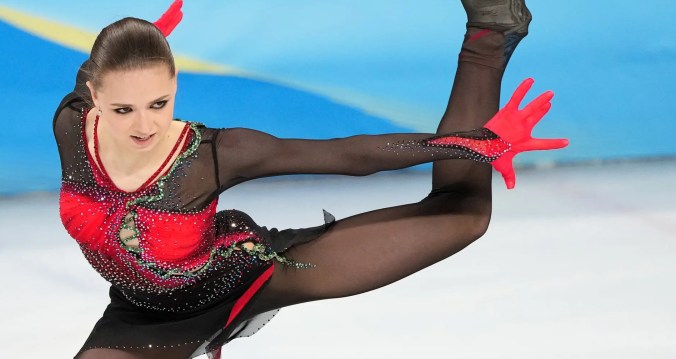
I’m thinking about establishing an organizational version of The Julie Principle. When an entity, company, organization or government has shown that its culture is sufficiently corrupt and unlikely to change for the better, maybe it’s a waste of time and ethical analysis to keep complaining about the inevitable misconduct. “Fish gotta swim, birds gotta fly.” Either just give up on trusting that entity, company, organization or government, or resolve to live with its flaws. Like Hollywood. The National Football League. Or, as in this ridiculous episode, the Olympics and Russia.
Kamila Valieva, the teenage Russian figure skating star, was banned from competition for four years yesterday by a three-member arbitration panel at the Swiss-based Court of Arbitration for Sport. The reason was her positive doping test that messed up the 2022 Beijing Winter Olympics beyond all reason, confusing everyone and keeping more than a dozen other athletes from receiving their medals.
Two years ago, expressing disgust at the incident, I explained it this way:
Fifteen-year-old Russian figure skater Kamila Valieva tested positive for trimetazidine, a banned substance that improves athletic performance, in the urine sample that Valieva submitted at the Russian national championship on Christmas. The drug, known as TMZ, is a heart medication that can increase endurance. But the result was not confirmed and relayed to Russian officials or to her for more than six weeks. Russia’s antidoping agency said it learned of the failed test on February 7. On that day, the teen led the Russians to a gold medal in the team event.
…She tested positive for a banned substance, and that should have stopped her from competing in the Olympics. It doesn’t matter why the test results were delayed (the Russians cheat, and have always cheated). It doesn’t matter whose fault it was. Valieva was ineligible, and whenever it was discovered that she was ineligible, the only fair and ethical response was to disqualify her. This also meant that her team would be disqualified, because a disqualified skater helped it win the team event.
Ethics can be hard, but this conclusion isn’t hard. It is obvious and irrefutable. Because she shouldn’t have been competing at all, and would not have been had either someone in Russia not cheated or was incredibly incompetent, the skater had no right to be skating, and any athlete or athlete who would have won had she not been illicitly permitted in the Games has been treated unfairly, robbed, cheated, pick your term.
That ought to have been the immediate decision. Instead, Olympic “arbitrators” (Arbitrators are supposed to have impeccable ethics alarms, and not the ethical instincts of Hillary Clinton. Who are these fools?) ruled that Valieva not only wouldn’t be disqualified but could continue competing, but that any medals in any event in which she places the top three will not be awarded. The question of who wins what medal, and whether Valieva wins any, will wait until after her doping case is definitively settled, which may take months.
It didn’t take “months.” It took two years. Now 17, Valieva was ordered to forfeit “any titles, awards, medals, profits, prizes and appearance money” earned after her positive doping sample was collected before the Olympics in December of 2021. Russia’s antidoping body initially cleared Valieva of wrongdoing on the theory that at 15, she could not be held responsible as a minor, and therefore a “protected person.” Brilliant. So minors can cheat even when they are competing against adults, as she was. Russia wouldn’t know an ethical value from a bowl of borscht. The CAS panel dismissed that rationalization, holding, “There is no basis under the rules to treat them any differently from an adult athlete.”
The arbitrators’ ruling means that Russia will be stripped of its first-place finish, giving the United States team that finished second the gold medal, with Japan now getting the silver and Canada, which finished fourth, getting the bronze. Neither skating’s governing body nor the I.O.C. would confirm any reallocation of any medals, or the timing for awarding them. Of course, most of the world won’t see the athletes getting the deferred honors, or even know about it.
The Olympics are corrupt, and international sports competitions generally are corrupt. I only followed the Beijing Olympics sufficiently to be aware of the ethics botches I was certain would occur, and was not disappointed.
 Ethics Alarms
Slightly unrelated but close enough to mention.
Most sports College to Pro to International are corrupt to some degree, there is to much money to be made to keep them clean. My Son watches College hockey and his team lost their (1st of 2 games) to a team they should have beaten, they lost 6-2. I told my son that they would win the next game, he asked how I knew. I explained that the odds on the first game were that his team would win, their loss meant the odds on the second game were that they would lose. Hence anyone who bet they would win the second game would profit nicely. They won the second game. I also explained it could have been luck but I’ve seen this pattern repeated often at the collegiate level. Not saying everyone is involved, honestly few well placed refs can skew a game. My point to him is when there is a lot of money involved in any process those who can control their profits will.
As absurd as this sounds already, I understand Canada does not get the bronze but that Russia gets it because only Kamila Valieva is disqualified. So says CNN, WaPo, etc.
I don’t see how that is absurd. As the other Russians have not failed a drug test then their scores still count and if their score are worse than USA and Japan but better than Canada then the bronze is what they get.
Don’t they add their scores together to get the team score? If so, it’s hard to fathom how Russia, missing one skater, could have a higher score than anyone.
Or do I totally not understand how team events work?
From the Olympic Games website.
“The figure skating team format at Beijing 2022
The team event consists of a qualification phase and a finals phase, broken into skating’s tradition short and free programmes.
In the qualification phase, a man, an ice dance couple, a pair and a woman will present their short programme to earn points for their nation – or “team.” The skater in first earns 10 points, second nine points, third eight points and so on.
It is then followed by the finals with the top five teams qualifying for the free skate, where a man, a pair, an ice dance couple and a woman perform their free programme. Nations are allowed to change up to two athletes (or teams) – if they have more than one in each discipline – between the short programme and the free skating.
Scoring works the same in the finals: The top skater or team earns 10 points, while the skater who places fifth is awarded six points.
The nation which earns most points in all events will be crowned Olympic champion.”
So basically when Valieva was disqualified, the second best Russian in each event had her points counted.
You wrote: “where a man, a pair, an ice dance couple and a woman perform their free programme. ”
So presumably that would be one in each of those categories for each nation. I presume that Valieva would be the woman skating for Russia. I wouldn’t think — I could be wrong — that there would be more than one woman skating for a given nation in the finals. Assuming that, then there would be no second best Russian in that event, and her score would just not be counted.
So they’d be left with the man, pair, and ice dance couple’s scores — a maximum of 30 points. So that point total would be good enough for 3rd place?
In theory, if Russia finished first in all four categories (10 points) and another nation finished second in all four (9 each), then it is possible for the other three nations to all tie with 30 points (each one having a 3rd, 4th, and 5th). That would — in theory — yield a four way tie for 3rd place. It also assumes that they simply vacated her 10 in that segment and didn’t move the other four skaters up a notch, which would mean there couldn’t be that four way tie.
My thinking may be off, but that is what I take away from the point system you’ve described. And remember, that starts from the assumption that every Russian skater is the best in his or her or their category.
And yes, I know no one told you there would be math in this blog. 🙂
I’m an arithmetic freak, so……sue me. 🙂