Morning Ethics Warm-Up, 1/22/24: On DEI, Madonna, Trans Golfers and Furries

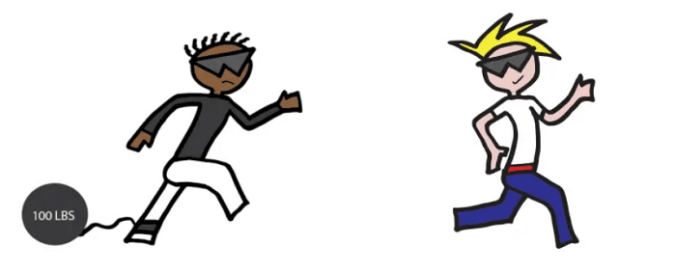
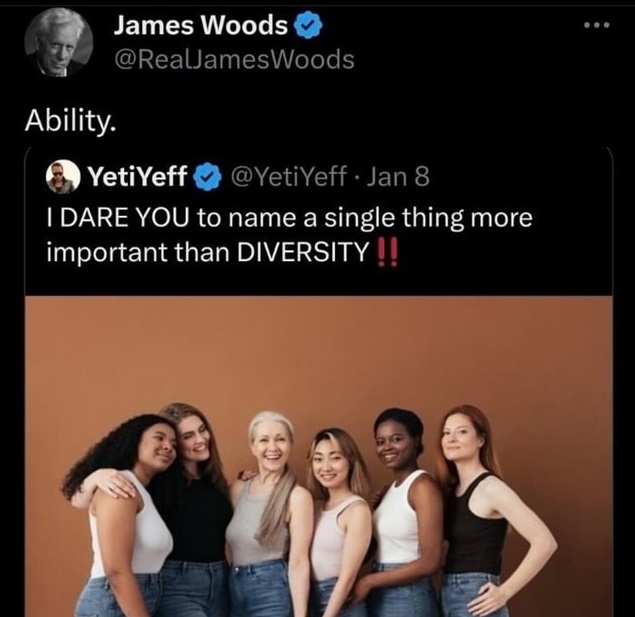
Actor James Woods, who mastered the art of playing slimy yet somehow charming villains and assholes before Jon Voight gave him solid competition for seven years on Showtime’s “Ray Donovan,” has been more or less blacklisted in Hollywood for his non-conforming conservative perspective and his lack of shyness about expressing them. He appears to tweet all day now, and “X” has become his podium. The exchange above doesn’t exactly qualify Woods for Ethics Hero status, but it was refreshing and deft nonetheless.

1. Speaking of the national scourge of DEI that has inflicted Claudine Gay, inept White House Press Secretary Karine Jean-Pierre, incompetent DOT Secretary Pete Buttigeig, lying DHS Secretary Alejandro N. Mayorkas, Vice-President Kamala Harris and so, so many more unqualified officials in important jobs on the nation, the New York Times readers gave the fading “Grey Lady” a jolt by reacting to “‘America Is Under Attack’: Inside the Anti-D.E.I. Crusade” by Nicholas Confessore with a mass Bronx cheer. The first five comments rated most highly:

  • “The New York Times presents this piece as some kind of Pentagon Papers-esque exposé. But I guarantee you that a majority of Americans – including probably most Democrats — believe that DEI/Anti Racism went too far post George Floyd and we need to get back to aiming for a color blind society.”

  • “I don’t agree on much with Elise Stefanik, but she is right about DEI. When a movement requires zealous adherence, will abide no decent, and actively persecuted dissenters, then that movement is an enemy of free speech and the active exchange of ideas, whether it comes from the right or the left.”

  • “This article makes the same assumption that the DEI movement does: opposing any aspect of the DEI program is an opposition to diversity and thus is racist itself. Why cant it be okay to think that the DEI program is the wrong approach to achieving diversity?”
  • “Getting rid of these DEI programs would be good for the US. We should get back to trying to be a meritocracy. Choose the best candidates, not the most diverse ones.” 
  • “This article attempts to discredit the view that DEI has gone too far by linking this view to politicians most readers will find distasteful. Yet the article avoids any discussion, analysis or statistics about the underlying question. It is undeniable that higher education is staffed by teachers and administrators that are far more progressive than the U.S. as a whole, that college courses are heavily tilted toward the progressive narrative, that administrators (including ‘the college presidents’) selectively protect free speech depending on the message, and that applicants’ race has been the determining factor for many students at elite universities. Many Americans think this progressive bias is wrong. The fact some unsavory characters may agree doesn’t negate the point.”

There is hope! (Pointer: Ann Althouse)
Continue reading

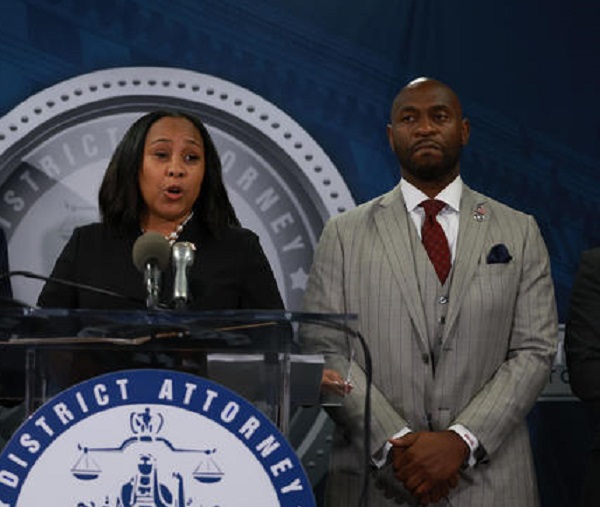
Your Fani Willis Fiasco Update…

1. I had a long conversation with a close friend who is a retired lifetime federal prosecutor. She really detests Donald Trump, to the extent that she said she was initially “excited” about the Georgia case against him because, as a state prosecution, it would not be vulnerable to a presidential pardon. Now she says she is thoroughly disgusted with Willis, whom she termed an “idiot” for…

  • Hiring a lawyer to work on the case who would be using the fruits of his job to pay for benefits to her, what she called the equivalent of a kickback;
  • Having an intimate relationship with such a lawyer, which not only calls into question the reasons he was hired, but also her independent judgment regarding the case generally, since if he and she are benefiting from the case continuing, she sould not apply the required “independent judgment” to determine how to pursue the case or even whether to pursue it;
  • Doing this despite knowing that it would be a high profile case under constant scrutiny, requiring “Caesar’s wife” level, squeaky-clean management on her part;
  • Immediately “playing the “race card” as soon as her conflicts were raised in the court filing, when she knew or should have known that the ethics complaints have substance;
  • Creating a textbook “appearance of impropriety,” which as a government lawyer Willis had to know was taboo.

At very least, she agreed, Nathan Wade should have withdrawn from the case (or been removed by Willis) as soon as this controversy arose. That he has not, she said, proves that Willis is conflicted and her judgment is not trustworthy. My freind says the Georgia case is likely done-for, and that its demise will increase public skepticism about the legitimacy of the other cases being pursued against Trump. She also opines that even if Willis somehow is able to stay at the helm of the case, she is clearly such an incompetent that she will botch it in some other way.

I concur with all of the above.

Continue reading

Comment of the Day: “’Ick or Ethics’ Ethics Quiz: The Robot Collaborator”

Here’s a fascinating Comment of the Day by John Paul, explaining his own experiences with ChatGpt relating to yesterday’s post, “’Ick or Ethics’ Ethics Quiz: The Robot Collaborator”:

***

Well if its a competition, and against the rules, I think its pretty easy to say yes its unethical.

However, to help out with just some simple problems, I see using an AI program as no different than asking an editor to go over your book. As someone who has messed around with AI on this particular level (mostly for help with grammar and syntax issues), I have concluded that its contributions are dubious at best, at least as far as the technology has advanced so far.

Consider the following: Here are two paragraphs I wrote for my book last night:

“Kesi stared at the back of the door for a long time. At some point, she lifted her hand to gingerly touch the spot that was starting to numb across her check. Its bite stung upon contact with her sweaty fingers and she reflexively drew it away, just to carefully guide it back again. For a brief moment she played this game of back and forth much like the younglings who would kick the ball in the yard, until she finally felt comfortable with feeling of leaving her hand to rest upon her face. When it finally found its place, the realization of what had just happened hit her just as quickly and suddenly as if Eliza slapped her.”

“Not once, not twice, but Eliza slapped her three times with enough force to send tears down her face. In the moment she might have been too confused to see what was going, but now she was forced to grapple with the weight of the truth that was settling in her chest. (Yes, I realize this isn’t the greatest prose, but it was 2am and I was tired).”

Here’s what ChatGPT suggested I do with those sections when correcting for issues:

Continue reading

The Elusive and Scary Rasmussen “Elites” Surveys [Updated and Link Fixed!]

Let me begin this frustrating post this way: I can’t locate the damn things. Allegedly, Rasmussen, the conservative-leaning polling organization, has conducted two separate surveys of the attitudes of 1,000 “members of the elites.” “The Elites” is a buzzword on the Right like “the walking dead”: Laura Ingraham, for one, uses the term constantly. These surveys, as I will show in a minute, apparently show that a small cabal of leftist, fascist lunatics with disproportionate power and influence in the U.S. have frightening beliefs and objectives. They also define “elites”: Americans having at least one postgraduate degree, household annual income of more than $150,000, and a residence in a zip code with more than 10,000 people per square mile. We are told this is approximately 1% of the total U.S. population. The results of the survey has been written about in alarming terms by the likes of the Wall Street Journal and Instapundit; it has prompted headlines like on Powerline’s “Are Our Elites Crazy?” post this morning, but nobody (that I can find) is revealing a link. (Powerline: “There is more at the link.” No link!) Since these apocalyptic surveys are purportedly by Rasmussen, I checked the Rasmussen site. No such survey is mentioned. I searched for “elites” on the site. Nada.

I have no idea, kid.

Now here is what various conservative sites are claiming that this mystery survey says: (From Powerline)

Continue reading

Stop Making Me Defend Donald Trump!

Talk about “Democrats pounce!”

Last week, former President Donald J. Trump was riffing, as is his wont, during a speech in New Hampshire. Going off on the January 6 committee, aka. the Star Chamber, Trump said at one point, “Nikki Haley was in charge of security. We offered her 10,000 people, soldiers, National Guards, whatever they want. They turned it down. They don’t want to talk about that.”

Yes, he had just been talking about Nikki Haley, his main competition in the New Hampshire primary, and the needle got stuck. Trump kept saying “Nikki Haley” when he was referring to Nancy Pelosi.

Continue reading

Two Ridiculously Easy Questions For “The Ethicist” Draw Me To The Woodchipper…

Am I wasting my time? How can so much of the public be so hopelessly incompetent at analyzing basic ethics issues?

Two back-to-back questions to Kwame Anthony Appiah, the philosophy prof who moonlights as the Times’ ethics advice columnist, have me wondering if its time to do something more useful, like, say, anything. Both questions involved what is ethical to write about. Both questions shouldn’t have to be asked by anyone whose judgment regarding right and wrong is superior to that of the Clintons, or Willie Sutton. Both were deemed interesting and controversial enough to be featured by “The Ethicist” as if substantial numbers of his readers are likely to be similarly puzzled by the alleged dilemmas they present.

Really? The first inquirer asked if it would be unethical for a writer to use the real life stories of alcoholics that she heard in her A.A. meetings without their consent, as long as she didn’t use their names….just their “profession, physical appearance, hobbies and other specifics.” Participating in Alcoholics Anonymous is conditioned on absolute confidentiality. The answer should be self-evident. Why isn’t it?

Continue reading

Ralph Petty, the Moonlighting Texas ADA, Strikes Again!

Back in 2021, an outrageous legal ethics scandal in Texas so disturbed me that I wrote virtually the same post about it twice, once in May and again in September, without realizing it until one of you reminded me. This time, however, I’m not repeating myself.

Former Texas attorney Weldon Ralph Petty Jr prosecuted defendants before Midland County judges as an assistant district attorney, while simultaneously working as a law clerk for some of the same judges, on occasion advising them regarding the criminal cases he was prosecuting. He did this for more than a decade, with the complicity of the judges and his colleagues. Finally another prosecutor blew the whistle on this unethical conduct, which even Fani Willis would recognize as a conflict of interest. Maybe.

Last month Petty, who was disbarred, appeared in the news again.

Continue reading

“Ick or Ethics” Ethics Quiz: The Robot Collaborator

As Jackie Gleason, aka. “The Great One,” used to say to begin his popular variety show on CBS (“Jackie Gleason? Who’s he?”), “And awaaaaay we GO!”

Rie Kudan, accepting the prestigious Akutagawa Prize for promising new Japanese writers, told the audience that her novel, “The Tokyo Tower of Sympathy,” was co-authored by ChatGPT and other AI programs. She revealed that her novel, which is about artificial intelligence, had approximately 5% of its dialogue composed by the popular bots and added by her “verbatim” to the text. “The Tokyo Tower of Sympathy” has met with unanimous raves by critics: “The work is flawless and it’s difficult to find any faults,” said Shuichi Yoshida, a member of the prize judging committee. “It is highly entertaining and interesting work that prompts debate about how to consider it.”

It seems clear that the author’s public admission (“I made active use of generative AI like ChatGPT in writing this book. I would say about five per cent of the book quoted verbatim the sentences generated by AI.”) was designed to fuel that debate.

I think we can all agree that this was shrewd on the author’s part. But is what she admitted to ethical?

Your Ethics Alarms Ethics Quiz of the Day is…

Is having an AI program write all or part of your book or novel ethical, or merely something that feels wrong right now that we’ll eventually accept?

Continue reading

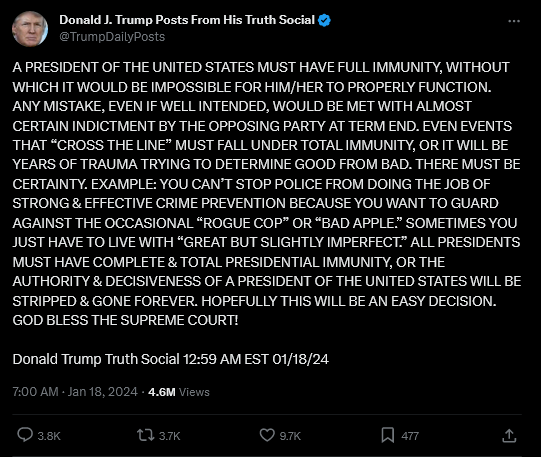
Ethics Quiz: Presidential Immunity

Is there anybody out there who wants to argue that complete Presidential immunity from criminal prosecution is a safe, necessary, responsible and civically practical policy? Hello?

I’m not even going to ask the question in the usual quiz form, other than to wonder who would agree Trump’s theory this other than a former President facing multiple partisan prosecutions of varying legitimacy designed to take him out of the next election, or an aspiring leader who endorses near dictatorial powers in a republic.

George Washington made it quite clear that the U.S. President isn’t a king; indeed, this may have been George’s most important among his many precedent-setting and self-imposed embellishments on the office. There have been Presidents who believed in treading carefully within a carefully moderated set of powers; there have been others, like Jackson, Lincoln, the Roosevelts and Nixon, who took the office in the other direction, sometimes to the point of defying laws as well as exploiting areas of Constitutional ambiguity.

Continue reading

Comment of the Day: “Oops! A Chief Diversity Officer Reveals The Real Biases Corrupting Her Field”

It is going to be interesting to see if the currently metastasizing DEI mania eventually collapses as its illiberal and destructive features become impossible to excuse or ignore. I assume it will eventually end up in history’s junk yard, and the sooner the better, but equally bad ideas have survived to cause decades of societal chaos.

The post about the diversity officer declaring “White people,” “Able-bodied people,” “Heterosexuals,” “Cisgender people,” “Males,” “Christians,” “Middle or owning class people,” “Middle-aged people,” and “English-speaking people” to be blights on efforts to build a just society (and then quickly disavowing her language as soon as she was called on it) provoked—is still provoking–many excellent comments, including the Comment of the Day by Extradimensional Cephalopod below. He (It? I don’t know EC’s preferred pronouns) shamed me by pointing out that the woke concept of “privilege” is a manifestation of the fundamental attribution error, which I haven’t discussed here for a long time. His Comment of the Day also provoked the Comment of the Day on a Comment Destined to Become a Comment of the Day by JutGory, who wrote,

Extradimensional Cephalopod: “(I keep unsuccessfully searching for a quote I remember where someone describes their “privilege” as a right that they want everyone to have, e.g. the right to have no reason to fear the police.)Attribute it to me if you like; that is one of my critiques of the notion of privilege. In some instances, privilege is not part of an unearned advantage; it is part of an unwarranted disadvantage. I am not privileged by being treated the way everyone should be treated; someone else is “under-privileged” by not being treated the way one should be.

“Under-privileged”?

“Unprivileged”?

“Demoted”?

“Debased”?

We don’t really have a commensurate term to describe that.So, people use privilege to describe any advantage that one person may have over another. Actually, common with leftists, we talk about groups, not individuals, and then ascribe a quality of the group to the individual. This is kind of an example of the logical fallacy of division. But, the problem is that individuals have, as comments above have noted, many qualities, some of which are more advantageous or disadvantageous than others (almost as if individuals are somehow unique). It is because of this that they had to come up with notions of “intersectionality” because it turns out that “privilege” is a concept that is inadequate when it comes to describing the world. (But, hey, Ptolemy needed epicycles and the equant to make sense of the universe.)

“Privilege” does not exist. “Privilege” is an attempt to describe phenomena and create a generalization about it.

Here is EC’s Comment of the Day on the post, “Comment of the Day: “Oops! A Chief Diversity Officer Reveals The Real Biases Corrupting Her Field”:

Continue reading