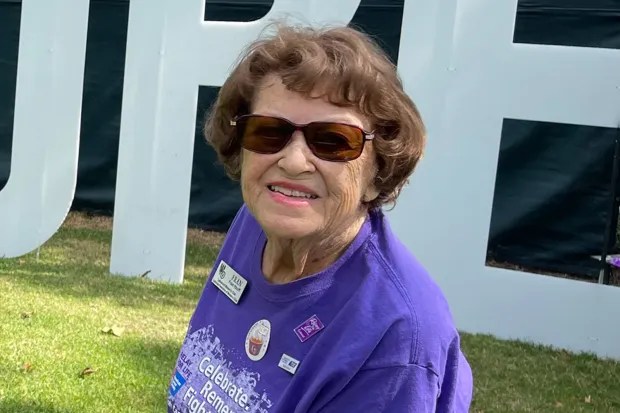
Here comes “The Saint’s Excuse”! The non-profit is furiously back-peddling after behaving cruelly, intolerantly, ungratefully and unforgivably toward the 90-year-old volunteer above. It will, of course, insist that it should be forgiven and trusted despite its smoking gun unethical conduct, and just watch: it will be, because of “all the good work it has done for a good cause.”
What prompted the kiss-off letter above was that 90-year-old Fran Itkoff, who had been an active volunteer for the the National Multiple Sclerosis Society for six decades (her husband perished of MS), had naively asked why names on documents she had received from the organization were accompanied by parenthetical pronouns. This, the Woke Nazis in command of the non-profit determined, marked her as hostile to its new “Diversity, Equity, and Inclusion guidelines” and thus unfit to work for the care and cure of the dread disease (which runs in my family, incidentally).
The episode was flagged on social media by the indispensable Libs of TikTok, and an interview exposing the debacle hit YouTube. The National NS Society’s immediate instinct was to circle the metaphorical wagons, denying that it treated the volunteer the way it had, and implying that a 90-year-old woman made others feel “unsafe” because she dared to ask why stupid and presumptuous pronoun preferences were suddenly “a thing.” The organization also cautioned staff and volunteers to keep mum about the incident.
It didn’t work. The MS Society was bombarded with declarations from donors that they would cut off the charity. News organizations were closing in, with a Fox News senior meteorologist who suffers from MS, Janice Dean, threatening to give the story nationwide exposure. Yesterday, the MS Society issued an annoying apology:
The National Multiple Sclerosis Society apologizes to our longtime, dedicated volunteer Fran Itkoff. Recently, we asked Fran to step down from her role as a group leader because of statements made that we viewed as not aligning with our recently implemented diversity, equity and inclusion policy. We realize now that we made a mistake, and we should have had more conversations with Fran before making this decision.
Over her 60 years of volunteer service, Fran has been a committed champion for our cause. We had an opportunity to work with her and support her as a self-help group volunteer leader, but as an organization, we fell short.
While we acted at the time with the best intentions, we did not have clear protocols in place. We should have spent more time with Fran to help her understand why, as an organization, we are dedicated to building a diverse and inclusive movement where everyone has equitable access to the care, connections, and support they need to live their best lives.
We apologized to Fran directly and reached out to her to find a way to continue to work together. In the spirit of continuous learning, we are focused on evaluating our processes and fortifying our learning to ensure our team members are equipped on the best ways to implement all of our policies. We want everyone to feel confident and supported in their roles. This work is a journey requiring commitment, accountability, transparency, and courage.
The National MS Society is a nonpartisan organization committed to one bold vision – a world free of MS. The support of our volunteers is essential to achieving our mission and ensuring people affected by MS can live their best lives. MS does not discriminate, and everyone who shares our vision of a world free of MS is welcome here.
That’s not a genuine apology. On the Apology Scale, it ranks as a fine example of the latest addition, “The Impossible Apology:”
“An inherently unbelievable apology for conduct or words so unethical and so extreme that nobody could possibly say or engage it accidentally or unintentionally. Such an apology for words or conduct of signature significance, indicating that the speaker or wrongdoer is unethical and untrustworthy because no individual who is ethical and trustworthy would behave in such a manner even once, is not merely cynical and a travesty, but insulting to its intended audience.”
The MS Society’s statement doesn’t admit that it was wrong to punish Fran for not comprehending the LGBTQ-mandated lock-step trope that has absolutely nothing to do with fighting multiple sclerosis. All it cops to is doing it the wrong way. The organization’s cruel and offensive conduct was a mistake, not because the Woke Nazis in charge of the group feel their revulsion at anyone so bold as to question self-evident crap was wrongful, but because they caught flack for the way they expressed it. They should have slowly and caringly explained to poor, out-of-touch Fran why she was a threat to the DEI addled staff because she didn’t grok why she (or anyone) should call single individuals by the plural “they.” Maybe the group should have sentenced her to a re-education camp.
Nowhere in the “apology” is an admission that the loyal volunteer did nothing wrong, only that her evident WrongThink wasn’t addressed according to “protocols.” Moreover, the letter defaults to Rationalization #13A, “The Road to Hell,” the sinister sub-rationalization to #13, The Saint’s Excuse:
This sub-rationalization to the Saint’s Excuse is related to its parent but arguably worse. Rationalization 13 is one of the really deadly rationalizations, the closest on the list to “The ends justified the means”:
The Saint’s Excuse is that the ends justify the means, because the “saint” has decided that the ends are worth any price—especially when that price will have to be paid by someone else.
But while the wielder of the Saint’s Excuse typically at least has a beneficial or valuable result to claim as justification for unethical and inexcusable acts, the desperate employers of 13A only have their alleged good intentions, which may be the product of emotion, misunderstanding, ignorance or stupidity. How a bad actor intended his unethical conduct to turn out is no mitigation at all. The underlying logic is that the wrongdoer isn’t a bad person, so the wrongful act shouldn’t be held against him or her as harshly as if he was. The logic is flawed (it is the same logic as in The King’s Pass, #11, which holds that societal valuable people would be held to lower standards of conduct than everyone else) and dangerous, encouraging the reckless not to consider the substance of a course of action, but only its motivations.
The Saint’s Excuse attempts to justify unethical actions that accomplish worthy goals The Road to Hell attempts to justify unethical conduct even when it does undeniable harm, just because it was undertaken with admirable intent.
The conclusion one is compelled to reach as a result of the treatment of Fran Itkoff and the leadership’s reaction to the blowback from it is that this organization is run by irresponsible and unethical individuals who are putting ideological conformity above the organization’s mission in their management decisions. That means the leadership cannot be trusted, that the organization cannot be trusted, and that donors need to send their contributions elsewhere, unless and until this toxic group of woke bullies is replaced.
I hope Fran answer’s the non-apology apology with a curt, “Bite me!”
 Ethics Alarms
“While we acted at the time with the best intentions, we did not have clear protocols in place. We should have spent more time with Fran to help her understand why, as an organization, we are dedicated to building a diverse and inclusive movement where everyone has equitable access to the care, connections, and support they need to live their best lives.
I don’t think Fran needs to understand those things. I think Fran’s work over the decades has demonstrated that she wants everyone with MS to have access to said care, connections and support. Fran just wanted to know why she was seeing emails from people with pronouns in parenthesis.
This was a no-brainer. Someone could have explained to her why people were doing it and been done with it. Instead, she was deemed politically unreliable for asking a question. If the deranged Woke want people to learn, they’d better be willing to allow a margin for learning. Asking a Question=Being Fired is not the way to do it, though it seems to be the prevailing wisdom.
Now, if Fran had understood and pushed back on the pronouns, I have no doubt the result would have been the same.
Why do we let the Left define the terms of communication.
Where are the English teachers. Gender as it relates to language has three choices: masculine, feminine and neuter. The non-binary would be neuter.
When I was in Jr High referring to a boy who was effeminate as she or her was considered a slur. The really masculine girls would take great offense if you referred to them as such and would rely on social norms that allowed them to be physically violent but males were prohibited fro fighting back.
Henceforth, I plan to use the term delusion affirming care. This is far more accurate linguistically than gender affirming care
”Delusion affirming care” I like that. Hope you don’t mind if I steal.
Same reaction/request here, Chris; it’s already entered onto my blotter…
PWS
This is the statue of Baphomet and Nazi-groups-on-Substack all over again.
Someday, when (hopefully) it becomes incredibly stupid to do things as juvenile as add pronouns after one’s name, some ninety-year-old leftover Wokester is going to receive documents containing names with no pronouns, then ask her superiors where they went. Would she like to be summarily fired for the inquiry as well?
Winds can blow both directions, so the Left better be awfully careful about the things for which it wishes.
Ms. Itkoff has a distinct advantage of being in at least two “protected” classes, women and the elderly. If she doesn’t work in an at-will state, I would think a phone call to a wrongful-termination-type lawyer may not be a bad idea.
I have several friends, most of them former students, who use they/them pronouns. As long as they (plural) don’t get into righteous dudgeon if I slip up and use the wrong pronoun known for someone I’d known for years as “she” instead of “they” (singular), I treat the situation in the same way I treat my colleague who prefers to be called by his middle name, or women who do or do not adopt their husband’s surname, or who do or do not abandon it after a divorce. As long as they (plural) are not hurting anyone else, I’ll refer to them in the manner they request.
It’s unclear to me whether this episode concerns a simple question from a nonagenarian about why some people provide pronouns or an insistence that she do so. If the former, then the simple explanation that some people prefer to provide that information would have been sufficient. If the latter, it’s a lot more problematic. (I say this having recently checked the “prefer not to say” button on a conference registration form.)
Either way, to say that the NMSS botched the job is rather like describing the average NBA center as “tallish.” The Venn diagram of people who insist on telling you their pronouns and of assholes does not, in fact, consist of concentric circles, but you’d never know that by the NMSS’s actions. Leaping to the conclusion that Ms. (Mrs.?) Itkoff is hostile to DEI initiatives simply for asking a question is the perfect storm of arrogance and stupidity.
I do confess to not understanding how insisting on labeling people furthers the cause of inclusion. But I do know you can’t spell “divide” without using the letters D, E, and I for 83% of the letters.
“But I do know you can’t spell “divide” without using the letters D, E, and I for 83% of the letters.”
I’ll give you 48 hours to copyright that, or I’m putting it on a t-shirt. Ok, it’s a BIT long…
Just shorten to “You can’t spell Divide without DEI” and you have a great T-shirt slogan. Since my wife designs and makes T-Shirts I think I might have her make one for me. Thanks for the idea!!
Curmie,
What I do not understand is using pronoun references when speaking to the person wanting to use one of the variants such as they/them xi/ xir etc. If I am addressing that individual there is no reason to use a pronoun reference. The references in such a case would be you, your, you’re or the individual’s name.
What is the problem with saying “that is John’s book” or “Sally and I went to x”. I do not believe I can find a case where a pronoun would be used directly in a conversation with the subject seeking not to be misgendered. The only pronoun that would come close is sir or madam/ma’am. In such a case if the person was dressed as a man or woman you could argue that the term used to refer to someone so attired would be appropriate.
If I were addressing a third party and used the word “they” to describe something associated with a single person the third party will think that more than one person is involved. Jane may go on vacation alone so saying they went on a vacation is grammatically incorrect and confusing and imprecise. Grammar rules are to prevent misunderstanding. Imagine, what could happen if legal documents follow no rules of grammar. A misplaced comma or modifier could change the outcome of a court decision or throw the legal world into chaos.
There are two possible reasons for these demands to be made: one, these people failed to learn proper grammar or are too lazy to use it; or, two the demand is to exert power over another. I really don’t know which is worse.
Au contraire. If I’m teaching a seminar and a student who uses they/them pronouns makes a comment, I can say “Stephanie makes a good point, but what they are overlooking is…” I could keep using Stephanie’s name, which would be really clunky, or I can be a jerk and insist on using a gendered pronoun, or I can be respectful of Stephanie’s wishes. There’s no ambiguity; no one is going to think I’m referring to multiple people.
The same would be true if I’m writing a recommendation for Stephanie. Again, I’m going to need to use a pronoun somewhere in those three or four paragraphs. Why not use the one they choose? Looked at another way, it could be taken as a signal to the recipient: if they (see what I did there?) have a problem with “they,” then both they and Stephanie will be happier apart than together.
Not to mention that we all use “they” in the singular all the time. The phone rings and I don’t get to it in time. ”If it’s important, they’ll call back,” quoth I. Only one person called; I know that, and the person I’m talking to knows that, too.
I don’t really see a problem.
The problem I see is manipulation, and I won’t play. It’s the same reason I won’t capitalize “black” or use “Latinx” and why I call the virus that came from the Wuhan province the Wuhan virus. It’s why I refuse to pay any attention when alleged authorities claim various words are suddenly racist when they aren’t, and why I believe the Redskins should have stayed Redskins, and why I won’t let “gender-affirming care” escape my lips. These are all power plays. A suddenly aspiring and dubiously empowered group decides to prove its primacy by dictating eccentric pronouns that we are obligated to use even if they don’t make sense, and if we don’t, we’re bigots and insensitive? Screw that! I’m never obligated to buy into someone else’s favored version of reality, and nobody has any business insisting that I do. If I want to call myself a kumquat, that’s my choice, but insisting that you agree that I’m a kumquat is presumptuous and oppressive, though it may make me feel good if I bend you to my will. People can’t force me to agree that they are beautiful or brilliant if they’re not: why is an individual wanting to be called “they” when he or she isn’t Siamese Twins any different?
(And come on, you know better than to cite the use of “they” to refer to an ambiguous identity as precedent. That doesn’t apply when the individual isn’t ambiguous, he, she or it just want to pretend to be.)
Nit: Is “Siamese Twins” singular?
Good question. To slightly paraphrase little Natalie Woods in “Miracle on 34th Street” when she mispronounces “humiliated” and is corrected on it, “I have never had the occasion to use the term before in that context”
Nit on the nit… Some say it’s racist and insist on ‘conjoined twins’. 😂
This, precisely.
I have struggled with finding suitable reason to cave and use “preferred” pronouns. I can conceive of numerous reasons to reject them: using such pronouns is manipulative; using them is forcing division; using them is an effort to force the world to conform to an individual, rather than the individual accepting reality; or if none of those, using them is an effort to bandaid over and thus ignore serious issues.
I’ve been considering that maybe being willing to use someone’s preferred pronouns could be a measure of meeting them where they are. In Catholic apologetics and evangelization, that is one of the best tactics in seeking conversion. Walk with someone. Get to know him. Understand his problems. Genuinely care about him, because conversion is not a game where one keeps track of points, but where one is selflessly concerned about this person’s salvation. Furthermore, St. Paul tells us in 1 Cor 9: “To the Jew, I become a Jew, to win over the Jew. To the Greek, I become a Greek, to win over the Greek. To the weak, I become weak, to win over the weak. I become all things to all people so that by all means I might save some.”
My protest at following St. Paul’s advice is that when someone insists on “preferred” pronouns, this person has already made any conversation a combat. He has taken common understanding, innocuous parlance, and made it a game where at any misstep he will cry foul, cry victim, and seek to dominate and destroy. Perhaps this is simply a terrible biased perception on my part, but I conclude this from the interactions I have seen, the self-righteous indignation at people who “misgender” or won’t provide their own “preferred” pronouns. Maybe this is a poor sample set, because the people who aren’t out to tear others down for misgendering are also not the ones who are outspoken and calling national attention to themselves. The problem, though, is if I have a limited amount of time and energy to devote on other people, then engaging people who insist on their nonstandard pronouns is a high-risk/low-reward situation, I would far prefer to spend my time and energy on someone else.
Still, why be stubborn? Why not be willing to take the risk, especially if what I claim is true, and that I’m to be selflessly concerned about this person’s wellbeing? And if I believe that this person is in a deep struggle and truly needs help, doesn’t that stress the need all the more to get to know him and risk missteps and being lambasted as a bigot and a hater (which, as a white, male, Catholic I obviously am already)? And isn’t this all the more pressing a concern, given the following point?
For individuals to take up “preferred” pronouns is a deconstruction of human bonds. We are not by nature individuals. We require, at least minimally, society. An individual needs a father and a mother to even exist, even if the parental action was one brief encounter never intended to generate progeny (except for the very fact of engaging in the very act intended for generating progeny). But even beyond that, we need society at a psychological level. Most people will literally go insane in isolation. But to live in society we have to be willing to give as well as take, else society breaks down. Preferred pronouns fracture the bonds of society. They represent a path of hyper-individualism that can only end with each individual existing in his own private world, furious because no one will enter his world where he is in complete control, and yet unwilling to give up any of his world to enter another’s.
So I am faced with my own biases and weaknesses, in which I think maybe I should engage with individuals, and perhaps at the level of their preferred pronouns, but am averse to doing so because I feel preferred pronouns should be rejected, and I’m not feeling capable of effectively engaging said individuals in the first place. ExtradimensionalCephalopod would say that I simply don’t have the tools in my toolkit to make such engagements possible and fruitful, and that maybe I need to understand that I’m trying to force said individuals into my world as much as they are trying to force me into theirs. I would argue that I’m asking them, fundamentally, to live in the real world, but I just noted above that taking that stance directly and from the beginning is not meeting the where they are at and walking with them. So, ultimately, I don’t do anything.
I’m not sure how to end this reflection. Is there a call to action that I should be heeding? Is there a request I’m making for greater elucidation? Am I hopeful that I’ve said something meaningful? I’m not sure. What I am sure about is that I don’t want to engage the world of preferred pronouns, and I dislike the fact that this has become an issue. But it is an issue, and whining about it accomplishes nothing.
COTD worthy
I can say “Stephanie makes a good point, but what they are overlooking is…”
That is incorrect grammar and teaches improper use of the word. When I taught at the college level I made a point to speak using perfect grammar. I cringe when I hear teachers use the word “lay” when “lie’ is the correct word, and how often do we hear ads that use “less” instead of “fewer”. Students model what they see and hear in the classroom so if we complain that students cannot write well enough, I suggest that one of the reasons is that we do not teach them proper language skills in the classroom or the media.
Personally I don’t believe that using a person’s name is clunky. In fact, I believe it is a modicum of respect by using their name instead of some term that makes them invisible.
I assure you that I am fully as much of a Grammar Nazi as you are. But language evolves, and in this context, I don’t think “they” is improper grammar. You are free to disagree.
I’d also note that I might say something like “I understand what Chris is saying, but I think ____ is wrong about this.” OMG, what pronoun do I use? Having never met you, and to the best of my recollection never having seen you referred to by gender, I don’t know whether “Chris” is your full first name, or if it’s short for “Christopher” or “Christine” or something else altogether. Maybe it’s a nickname that has nothing to do with your given name. (I once knew someone whose first name was Dean and middle name was Gerald; he called himself “Pete,” so that’s the name everyone used.) It seems to me that the appropriate thing to do would be a). ask or b). find a work-around that doesn’t misgender you. I suspect that if I called you “they,” you wouldn’t like it. So… what to do?
The “clunkiness” point refers to the repeated use of someone’s name in close proximity. But you knew that.
Curmie:
Let me address this point first.
“Having never met you, and to the best of my recollection never having seen you referred to by gender, I don’t know whether “Chris” is your full first name, or if it’s short for “Christopher” or “Christine” or something else altogether.”
Absolutely true and you proved Jack’s point that it is manipulative. You also do not know whether my correct pronoun reference is they/their, XI/Xir or one of the others that have been recently pushed into the lexicon. So why is it that if I use XI/Xir instead of they/their there is no issue of mis-gendering but using he/his or she her is subject to instant labeling of being a bigot? Using the person’s name is not clunky when you have no other frame of reference. And, it is no more clunky than using a pronoun repeatedly. To bastardize the language and its structure because someone wants to push an agenda is ludicrous and destructive to society overall. Not knowing is the reason to use the name. Using “they” instead will either reinforces improper usage to the ignorant or demonstrates a lack of language proficiency on the part of the speaker.
In your example you said,
“I understand what Chris is saying, but I think ____ is wrong about this.”
To make such a statement you are addressing another individual or group. What I am saying is that you cannot mis-gender a person in a conversation with that person.
Nonetheless, in a group setting it is just as easy to say “I understand what Chris is saying, but I think Chris is wrong about this.
If you are addressing me directly it would be I understand what you are saying, but I think you are is wrong about this.”
If I take your original sentence in insert “they” this is what you get,
“I understand what Chris is saying, but I think they is wrong about this.” (nails on the chalkboard here)
If gender is a social construct then it stands to reason that the so too is gender identity. But why was gender socially constructed in the first place? You cannot claim a gender identity without first acknowledging that genders have defined characteristics to aid in understanding. I cannot say a dog is a cat or a door is a window simply because I want to. I suppose I could but I would be misunderstood. The same is true if I said they are going on vacation when I am only referencing one person.
Imagine for a moment that this gets to the point where mis-gendering someone may not just get you fired but subject to civil litigation. Who will be willing to fill in the police reports. They robbed me (is this one or more people) they had a gun (was this a male or female). Explain how I am to evaluate this as an officer or a prosecutor?
Language may evolve but rules of grammar should not otherwise they are not rules just mere guidelines. Imagine an ENG 101 student turns in a term paper riddled with run on sentences and subjects that don’t agree with the verbs. Should a student be able to use the statement that language ‘evolves” so you cannot correct his or her paper.
I am more receptive to xi/xir then the use of they/their as evoluntionary language. These are new entrants to the lexicon and not screwing up the meaning and usage of existing well understood terms.
If Stephanie is not wrong about her sex/gender, how could she possibly be overlooking something in your discussion? If gender is malleable to whatever Stephanie wants it to be – and an educator see no need to correct it – why aren’t the facts of a seminar topic malleable? Stephanie’s missing of a particular point isn’t really in error, it’s just her perception of the seminar topic. Why would any educator see any need to address the oversight, correct it, or bend anyone’s thinking to the subject or point of the talk? If facts don’t matter to a teacher regarding gender, then why should the facts a teacher is trying to convey somehow matter more?
Joel makes a good point. Joel could have also pointed out that it is possible that the use of “they” suggests multiple people agree with a particular sentiment which insulates themselves from individual critique.
I don’t see a problem.
Here is one. From the NYT’s morning news digest of January 13th, reviewing the show “Sort Of”:
Even the nicest comedies have to end sometime, but three seasons seems too few for this mellow, finely observed series, which aired on the CBC and is now streaming on Max. Gentle, sardonic and imbued with the bittersweet tang of lived experience, the Toronto-set series stars Bilal Baig as Sabi, a queer, nonbinary Pakistani-Canadian nanny. This season finds Sabi wrestling with grief and mental health struggles as they step (in some very cute shoes) more fully into themselves.
Aside from certain sectors of academia, that last sentence might very well be in the running for greatest atrocity against English ever.
Any reason not to go with she/he/it?
We need some examples of good apologies. I think this one is a good one.
https://www.youtube.com/watch?v=JpL3XAft16U
The sheriff’s office arrested the wrong person. The sheriff held a press conference, admitted they made a mistake, that the wrongfully arrested man did nothing wrong, contacted the man’s employer to get him reinstated after he was fired for the arrest, and are reimbursing him for lost wages due to his mistaken arrest. I think this is a good apology. I don’t know if it was forced by a lawsuit or not, but it looks pretty good.