The Savory Fig, founded by Michelle Siriana, is a self-proclaimed vegan bakery in Patchogue, New York. Siriana makes and sells vegan scones, cinnamon rolls, cookies, and brownies, but also, amazingly enough, yummy gluten-free, vegan doughnuts. Vegan and gluten-freed doughnuts tend not to taste so good, for reasons you can guess if you’re familiar with how the fatty, buttery morsels are usually made; they also tend not to have the pleasant texture of the Krispy Kreme variety. Siriani’s doughnuts, however, are miraculous, fluffy and light with delectable icing.
Cindy Snacks, a vegan food market in Long Island, sold The savory Fig’s pastries and sometimes posted photos of the doughnuts on social media as part of its marketing strategy. In an Instagram post on March 3, the store’s proprietor revealed a scandal: an order they received from The Savory Fig contained the this doughnut …
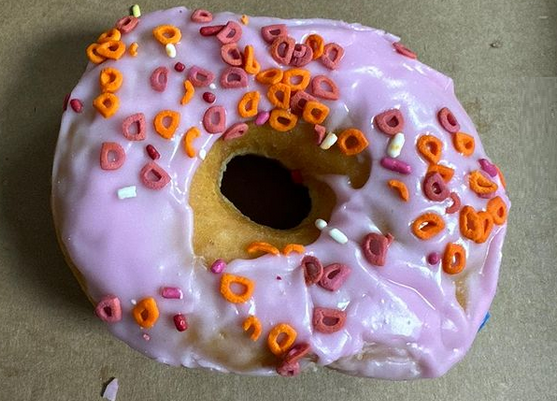
…with pink and orange, D-shaped sprinkles—D, as in “Dunkin’ Donuts.” Pink and orange, as in Dunkin Donuts. Concerned that the doughnuts she had been buying and selling as vegan and gluten-free were neither, the alarmed owner texted Siriana, “If these are Dunkin’ Donuts the ingredients could kill somebody as we have so many people with severe dairy allergies that shop here. I’m concerned with the donuts this week and am very nervous to put them out.”
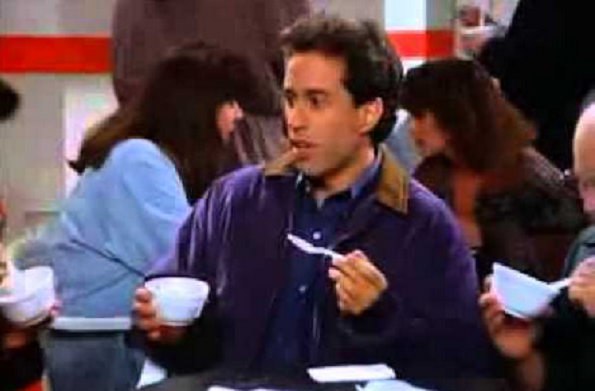
The Savory Fig swore on a stack of eclairs that they were not DD sprinkles (much as they seemed to be) and its pastries authentically gluten-free, but the owner of Cindy Snacks had the doughnuts tested, just like Elaine had the delicious allegedly fat-free yogurt tested that she believed was making her gain weight. And exactly as in that episode, the suspiciously delicious product was fake. The doughnuts were not, as advertised, gluten free, and the sprinkles were, in fact, from Dunkin’ Donuts.
Now it appears that all of the vegan and gluten free pastries Cindy Snacks had been selling from The Savory Fig were so delicious because they weren’t vegan and gluten free at all, full of flour, sugar and eggs. Who said, “When it’s too good to be true, it probably isn’t”?
The good faith vegan store has posted an update on Instagram stating that it contacted the Supervisor at the Division of Food Safety and Inspection from NY Agriculture and Markets and alerted the Suffolk County Department of Health. It may also take legal action against The Savory Fig, saying “We want to make it clear that we came forward with this information to keep our community of local vegans and those with food allergies safe from future harm. We want to keep people safe and call out wrongdoings when we see them. We feel confident we have done that as best we could.”
But I hear The Savory Fig makes great no-fat yogurt….
______________
Pointer: Curmie
 Ethics Alarms
Now that’s some serious chutzpah (wait, did I just find an appropriate word to describe George Santos?). There’s a special kind of audacity someone has to possess to think that Dunkin’ Donuts can be passed off as specialty pastries.
Societal gaslighting has become frightening. ”It isn’t what it is” should become our national motto when people are bold enough to think they can get away with such blatant fraud.
I bet the profit margin on those donuts is a lot better than actual vegan, gluten free donuts……
Know how you can guess that someone’s a vegan?
Don’t worry…they’ll tell you.
PWS
Where is Leticia James? Is she willing to have this firm disgorge its profits from real fraud?
The fact that no one apparently got seriously ill tells you all you need to know about the gluten-free crowd. In all my years, I have only met 1 person who truly had celiac disease. It only occurred in less than 1 in 1000 people at the time. I have numerous students every year complain about it, but when I tell them that they are allowed to get a waiver to have a breadmaker in the dorm to make their own gluten-free bread products, only 1 has done it. The rest have just complained about how the gluten affects them. If the affects are so minor that using a bread maker to avoid them isn’t worth the trouble, it isn’t that big of a deal. The diagnosis of celiac disease has risen 10x in the last decade or so, but I think that is from broadening the diagnosis, not a increasing number of people with the disease.
I suspect that people who actually have severe celiac disease don’t trust such trendy ‘gluten free’ bakeries because their disease IS serious and it isn’t worth the risk of something like this happeing.
Yes indeed—“gluten free” is now a woke signifier. People say they avoid gluten without having a clue what it is and what foods have it.
At the same time, there’s a LOT of moral luck involved in this case.
One food allergy death… and The Savory Fig is on the hook for manslaughter. Yes, a lot of people use “gluten-free” for status, etc.
But as someone who has relatives with food allergies, I can tell you, The Savory Fig was playing with fire.
This is true. While some companies use the ‘gluten free’ label as virtue signaling — putting it on foods that have never contained any sort of gluten — that doesn’t mean it can be a real problem.
People who have genuine, severe allergies can get deathly ill or worse in the blink of an eye.
One of our problems as a society is that we’ve made these types of things — such as celiac disease or peanut allergies — almost fashionable. But there is a world of difference between someone who might have a slight itch after eating a bag of peanuts and someone who eats a peanut and dies.
This company was indeed playing with fire, and they deserve to be shut down or at least sued to within an inch of their lives.
Celiac disease manifests in different ways for different people, and to different degrees. Perhaps people really did get “seriously ill,” just not in the ways those of us who don’t have the condition imagine. There are several common symptoms, and few people experience them all.
If a sufferer experiences the gastro-intestinal symptoms that most of us know about, that person might begin to wonder if that tasty donut wasn’t as gluten-free as it was advertised as being. But chronic fatigue and depression, for example, are also symptoms associated with the disease. It’s rather large leap from “I have no energy and I don’t want to go to work” to “I wonder if it was that donut I ate yesterday.”
It’s also possible, of course, that someone did get ill and either didn’t put two and two together or just stopped patronizing the Savory Fig and/or Cindy Snacks.
More to the point, the folks at the Savory Fig chose to make a few more bucks by endangering the lives (or at least the health) of their customers. Even if literally no one who bought one of those donuts really had celiac, no one at the Savory Fig knew that.
My nephew was diagnosed with the condition years ago, back before “gluten-free” was a term most of us had ever heard. He was a normal post-adolescent at the time, and he struggled with the thought of having to give up certain breakfast cereals or pizza on a Saturday night. He did what he needed to do, though. And in a bizarre way, the fact that the disease has become trendy has done him a service, as gluten-free options are now far more available in grocery stores and restaurants. They wouldn’t be if only the handful of people who really need them might buy them.
So there’s a silver lining to the pseudo-celiacs willingness to pay more for a less tasty option they don’t need. But only if what’s advertised is what’s delivered.
I know of one person with celiac disease, and I know personally one person with celiac disease and another two people with a severe gluten intolerance/allergy. These people puke blood when they eat gluten in a reasonable amount. I know of another two people who are allergic to milk. They have significant bone issues as well. I had a best friend in college who was allergic to everything under the sun and had to be very careful to only eat safe foods. She once thought she could actually order some food one night from a grill, after watching them closely, but the grill used peanut oil instead of olive oil, like she thought and she had to go to the hospital.
Because I know these people, I feel great compassion for those with real food allergies, gluten and lactose intolerance, and other real dietary concerns. However, there are so many people who pretend to have allergies who do not. The amazing prevalence of fakes makes it hard to remember that people really have true problems.
With fakes, the first casualties are charity and compassion. We see this throughout society. The Wuflu poisoned most of us against masks. Some people really do wear proper N-95 masks properly with latex gloves and immaculate sanitization procedures due to severe medical issues. However, the vast majority of people wear useless cloth or paper masks improperly while spreading germs about willy-nilly. So when I see someone in a mask, I assume that this person is as stupid as the last 457 people I saw.
We see this in the transgender realm as well. We know that there are people out there who truly suffer from a genetic or physical abnormality that makes them unable to truly determine their sex. However, because too many people are out there thinking that just because they don’t like what society says their sex should like, they need to have a false surgery that will never change what they are, and force others to acknowledge a fantasy that reality does not accept, we tend to overreact when something real comes up. The actual struggles of someone with Klinefelter syndrome get buried in reacting to men who claim to be women to harass and abuse women in domestic violence victims’ shelters, prisons, or just schools and pools.
In school environs, we worry about making sure that the minority kids get the help they need. But when every other helicopter mom out there gets her kid an autism or ADHD diagnosis, the money for helping kids with real problems instead of behavior issues from a parent unwilling to discipline soon disappears. The kids who actually need help can’t get it due to unavailability.
We used to, as a society, believe that we should cultivate virtue and deny vice. Now it appears that we embrace vice to pretend virtue. Part of this is that we have forgotten what virtue is. I believe that this is in part because virtue is hard. We should be disposed to give people the benefit of the doubt, which means understanding that they have failed in virtue, and there but by the grace of God go I. This is not a bad philosophy by itself, but when we combine it with our current ideology of separatism, we have many issues. When everyone is supposed to recognize where they stand on the privilege scale, and make sure they are on the right rung of an ever-changing escalator of privileged classes, the idea that one should react with compassion to someone’s lack of virtue in hard situations has deteriorated into demands that one excuse vice in easy ones.
Until society returns to celebrating virtue rather than signaling it, and condemning vice rather than approving it, I don’t see a return to an ethical society. If someone doesn’t do something…well, I’m someone, so I better start by working on my virtues.
COTD.
Yup!
All your thoughts here were fantastic, but I especially loved this quote. I will likely use it.
I hate when people are being scammed. Hate hate hate it.
But I will certainly enjoy the schadenfreude of vegans realizing that indeed, no, they hadn’t discovered vegan faux-food that actually tasted good and now have to return to their disgusting facsimiles.
At least the vegans were eating a bit healthier for a while.
The Savory Fig is fortunate that the vast majority people required to be gluten free do not have life-threatening reactions when they unknowingly eat it. If they were to pull that kind of crap with peanuts…or chocolate…or shellfish, the results could be deadly.
My wife eats gluten free, but not because she’s allergic to/intolerant of gluten. She has an allergy to wheat protein, and it’s just easier to eat gluten-free than it is to try and eliminate wheat protein.
As an aside, she’s also allergic to peanuts…and chocolate…and honey…and avocados…and strawberries…and…and…
Food shopping is a tedious chore, as we must read every ingredient on every product she plans to eat. She no longer eats at any restaurant (none, zero, nada, zilch), which means we don’t eat out, and she only on rare occasions will eat something an individual – even one well-versed with her allergies – offers to her. If she finds a new product that claims to meet all her restrictions, we take it home and she will try a tiny sample at home when I’m there with the epi-pen handy.
The danger is very real, and for The Savory Fig to play fast and loose with allergies is astounding.