
Oh yeah, this will improve public respect for law enforcement and the rule of law.
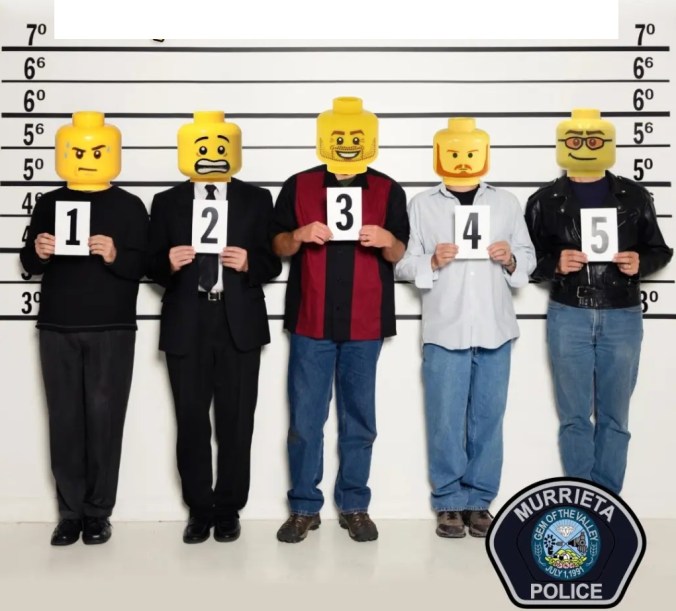
The Murrieta Police Department is posting hilarious arrest and lineup photos with suspects’ faces replaced by Lego heads. This is its response to a new California privacy law that forbids the posting of mug shots and other photos of individuals arrested for non-violent offenses. The law, signed by Gov. Gavin Newsom last September, went into effect on January 1 of this year. It also requires police departments to remove other mugshots from social media after 14 days….or replace them with Lego heads, I guess. So those risible images above are not gags or the product of a Babylon Bee wag. The police actually posted them.
This is unethical messaging, and if the police can’t figure that out, then they need to find another line of work. Those pictures make a mockery of law-breaking and criminal activity. Breaking the law isn’t supposed to be funny, trivial or a source of mirth, certainly not from law enforcement’s perspective.
The department explained that is just complying with the law, so “nothing to see here.” “The Murrieta Police Department prides itself in its transparency with the community, but also honors everyone’s rights & protections as afforded by law; even suspects,” it said in a post. “In order to share what is happening in Murrieta, we chose to cover the faces of suspects to protect their identity while still aligning with the new law.” Here’s a recent line-up photo:
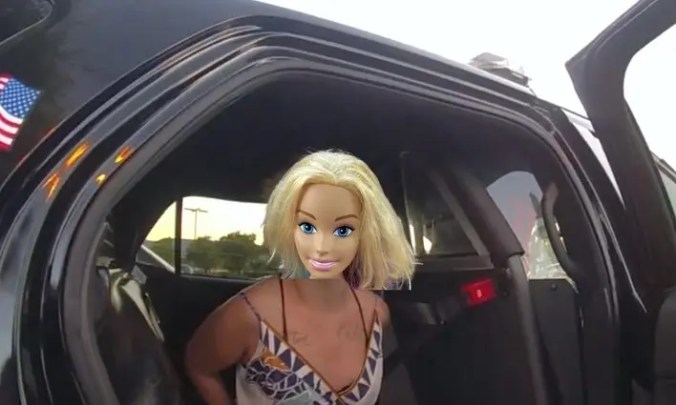
Right. This is the kind of stunt Abbie Hoffman would come up with to make fun of laws generally and to advocate anarchy. The photos make police look unserious and untrustworthy, while representing crime as something to giggle over. It is cultural incompetence, but this department was facetious about arrests even before Newsom’s latest brainstorm. For the last few years, the Marietta police used emojis, Barbie doll heads…
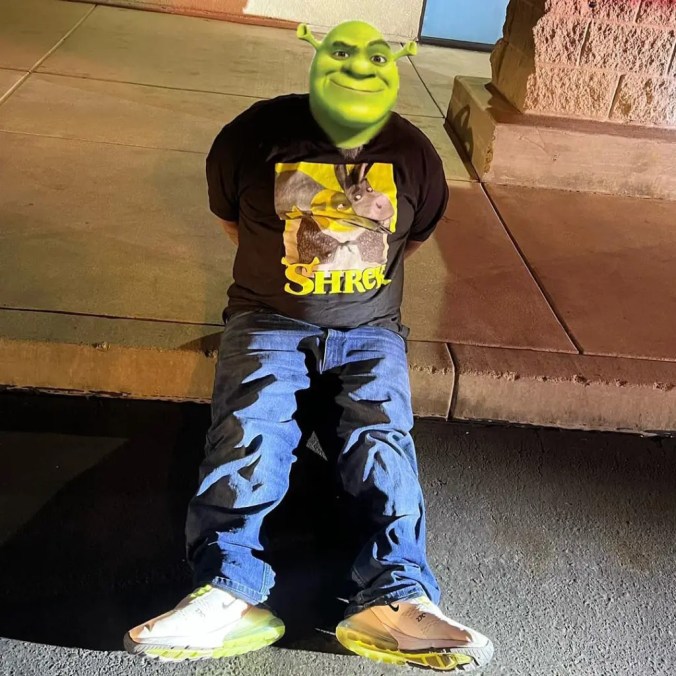
…. and “Shrek” character faces to obscure the identity of arrestees.
California is mutating into a an alien, addled, irresponsible culture at record speed. Making crime and arrests funny is the exact opposite of what a responsible law enforcement community should be seeking to do. No wonder stores all over the state are besieged with bold thieves who loot in broad daylight without fear or shame. After all, in California crimes that don’t kill or maim anyone aren’t really “crime crimes,” as Whoopie Goldberg might say on “The View.” The Marieta police don’t comprehend their mission. Why defund the police if they are so ethically ignorant that they treat lawbreaking as a joke?
I need to clarify here that I sympathize with privacy law. In fact, I would extend the protection to violent crimes as well. Mug shots and arrest photos shouldn’t be publicized and circulated to the public by police unless it serves the purpose of public safety, as when an alleged criminal is on the loose. With the wride distribution that social media and the web now provides, a mug shot, line-up photo or arrest shot has the effect of punishing someone before they have been found guilty. It inflicts shame, infamy and public enmity before due process and a fair trial has taken place. That’s one reason I admired Donald Trump for his defiant mug shot. The Angry Left’s criticism of his theatrical scowl was that he was mocking his arrest and treating it as a joke, which is his right. Law enforcement, however should never treat anyone’s arrest as a joke…like this:
____________________
Source: New York Post
 Ethics Alarms
We watch “On Patrol: Live” without fail, which airs on the REELZ channel for three hours each Friday/Saturday night. On this show, camera crews follow various law enforcement departments around the country in real time (minus the requisite 8-10 second delay)…so we get to watch things as they happen. At least two of the nine departments followed are in California.
I wonder how this law squares with cameras filming police encounters – many of which lead to actual arrests. Are these broadcasts considered equivalent to images? I assume not, since the cameras continue to roll, but I still ponder it.
I also wonder if this law – given the number of cell-phone videos and photos that are taken during police interactions and then posted on social media – will be a stepping stone to restricting what citizens can post. Could individuals’ content eventually be restricted/censored?
I doubt it. The law directs police policy. A law restricting citizen photography and circulating it would seen the be a pure 1A no-no.
Thanks for clarifying. I should have read the OP a bit more carefully.
I wonder if this is a case of malicious compliance–officials don’t like the requirements of the new law, so they comply in the manner most likely to get it reversed.
Possible. Except that they were goofing around before the law…