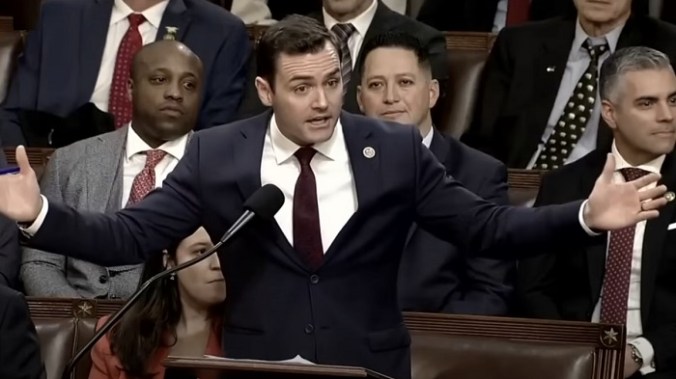
As Woody Allen did not say (but somebody did), “The world is run by those who show up.” Rep. Mike Gallagher promised to show up, but has announced that he won’t. This is unethical and a deliberate breach of professionalism, civic duty and integrity. He’s an ethics dunce, as well as a selfish jerk.
Gallagher is leaving to “cash in,” you see. The details of how and where are not definitively known, but Forbes has reported that its “sources” say that he is taking a job with a major defense tech contractor, Palantir. We presumably will find out for certain after he flees the coop—and the House these days really does resemble a coop—but all he has said is that he made the decision after “discussions with his family.” The discussions presumably were on the topic of whether the family would rather be rich or have Daddy working for the betterment of his constituency and the nation.
Gallagher could have announced that he was simply not running for re-election and would be leaving Congress after his term expires next year. Instead, he announced last month that he would quit on April 19. Not only does that mean that he will not complete the two years representing Wisconsin’s 8th Congressional District as he committed to dowhen he ran for re-election in 2020 (he was first sent to D.C. as a representative in 2016), it means that his constituents will have no representative in Congress for more than half a year. Wisconsin election law requires the governor to schedule a special election to fill the seat, but only if the vacancy occurs before the first Tuesday in April. That’s tomorrow.
Republicans and conservatives are furious with Gallagher because his exit leaves the GOP with a perilously thin majority after previous attrition. That’s between him and the party, but Gallagher’s first obligation is to the citizens who elected him believing that he was committed to public service and their interests. Absent a genuine emergency—“I really want to drive nicer car, belong to an expensive country club and wear expensive suits” is not a genuine emergency—quitting a job that one accepted with a specific tenure commitment is a serious breach of trust in any setting, but in the field of public service, it is despicable.
Ethics Alarms has discussed variants of this ethics issue in the past when members of Congress have switched party affiliation mid-term. That’s betrayal, and the only way to do it ethically is to resign and then seek election under the new party’s banner (and some politicians, notably former GOP Senator Phil Graham of Texas, have done just that). EA also declared Sarah Palin (Remember her?) an Ethics Dunce when she quit as Governor of Alaska to pursue a lucrative career as a celebrity talking head and worse.
Public service is, or is supposed to be, or once was a noble and admirable pursuit in which a citizen agreed to put other considerations aside in order to pursue the public good. In an elected office, a candidate pledges to an electorate that if it chooses him or her, that public servant will put personal considerations aside to serve their needs to the best of the public servant’s ability. Quitting in circumstances where a post cannot be quickly filled is the equivalent of staying in a job and sleeping all day, or just not showing up for work at all.
Rep. Gallagher could have mitigated the harm of his early exit by resigning and in time to be replaced in tomorrow’s election, and he wouldn’t even do that. He couldn’t serve ethically, and he wouldn’t quit serving ethically.
[Note: WordPress’s AI bot told me to tag this piece “Donald Trump.” Do you see any reference to Trump? Even bots are obsessed with the man…]
 Ethics Alarms
A former sheriff of my county, elected to a second four-year term in August of 1986, decided four months later to accept an appointment as state Commissioner of Safety. He tried to spin it as a great compliment to our county that he was selected; a “feather in our cap,” so to speak, rather than him simply jumping ship for a more prestigious and lucrative position. The people didn’t buy it, and when he returned to town eight years later he couldn’t have been elected as dog-catcher, if we still had a dog-catcher. He never held an another elected or appointed office and just a few years ago retired from his subsequent career as a (wait for it)…car salesman.
I truly loathe politicians who do this.
I believe this is part of the reason we get lousy people as our elected leaders. A couple of times, people have asked me why I don’t run for office. I replied that if I won, I would be financially ruined. Offices like state legislature often don’t pay very much. You need to be a lawyer or be self-employed in some business that you can go down to part-time during the legislative session. Even if I were to be elected to Congress or some position that pays well, what do I do when I leave? I would have to quit my job and that really means quitting my profession. What do I do after that? I don’t think I am mentally capable of just selling out and working as a lobbyist or to corruptly leverage whatever connections I made in government. I doubt I am capable of corruptly making such connections while in elected government. I really don’t want to start a new career 10 years out from retirement.
Because of this, elected office attracts people who are looking at it as a stepping stone to wealth. How many politicians go into high-paid commentator or consultant positions? How many get positions on corporate boards despite no qualifications other than ‘could influence the government’? Compare this to how many leave office and go back to being teachers, engineers, auto mechanics, etc.
Was this ever not a problem? The founders of the United States were wealthy landowners (plus Benjamin Franklin, Renaissance man).
I’m inclined to say we should reward people who do the important work of government, but we should also absolutely make sure we can hold them accountable for doing a good job using constructive skills.
I think we have a pool of potential officeholders that is too small, but I don’t know what a good solution would be. I think the only time I could serve an elected office would be after I was 60 years old or so. I have a 401k, so I don’t need to worry about seniority for a pension and that way I could just retire after office. I don’t think I could stand to serve for more than 4 years or so. However, I am not sure a government of 60+ year old people is a great idea.
If we could just have legislatures that were in session for 3 months of the year, that would help. We already have a bunch of laws. We could probably go years without a new one. It isn’t like we are a new country and we need laws against murder and theft. Having a shorter session would focus the legislature on important issues instead of passing laws just because they are there. It would also help candidates because it is a lot easier to get someone give you leave from your job for 3 months than 4 years. Many people could serve in office and then go back to their job, increasing the pool of capable people and minimizing the ‘need’ for such corruption.
In addition to financial realities, we really have a narrow group of people who are considered appropriate for elected office. A friend of mine was a minister who served in the legislature for awhile. I was at a party with a predominance of Democrats and his name came up. When I mentioned that he was a minister, they all became irate. They insisted that it was a conflict of interest to be a minister and a legislator. Because legislation may involve topics involving religion and religious morality, it was inappropriate for him to be in the legislature in their view. I countered that it was a conflict of interest for LAWYERS to be in the legislature because they were passing legislation that created a demand for more lawyers. That really didn’t go over well since the people declaring that ministers can’t be in the legislature were lawyers.
I say he WAS a minister because the church administration made an example of him. They offered him a position to coincide with him retiring from politics. He was worried and had them affirm this offer because the deadline to file for further political offices was soon. They reassured him that everything was fine, but soon after the filing deadline had passed, they rescinded the offer. That left him with no office and no job. He loved the church too much to sue them.
How much do you want to bet that this defense contractor will jettison him as soon as Hakim Jeffries gets the gavel as the Republican majority ceases to exist because of resignations.