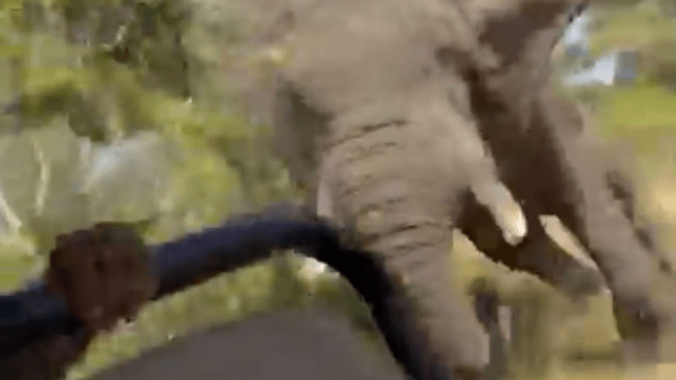
In the Zambia’s Kafue National Park, at 8,600 square miles one of Africa’s largest animal reserves, an 80-year-old American woman, doubtlessly filling out her bucket list, was killed when a bull elephant charged the truck containing her and five other tourists on a morning tour to see wild game up close. They got close, all right: That relative of Ethics Alarms favorite Jumbo upended the truck (above) and precipitated the woman’s demise. The other tourist were injured but survived.
The story was sent to me by commenter JutGory, who pronounced it an assumption of the risk by the deceased woman and the others, which it is provide the safari company was crystal clear about what the risks were. I wonder. This has been an obsession with me lately, as lawyers require consent and waivers from clients after what is supposed to be full disclosure and I am convinced that most of the time the supposedly “informed consent” and “knowing waivers” are anything but.
The reason is that lawyers have a difficult time explaining anything to non-lawyers who often—usually?—don’t comprehend the context or details of what they are supposed to understand before their waiver or consent is valid. When I ask clients if my impression is correct, they all acknowledge that it is. “They have no clue at all,” was how one lawyer put it….but they sign papers that says their waiver or consent is issued with a full understanding of what they have consented to.
Did the company tell all of the tourists, “OK, now listen carefully. Wild animals are unpredictable. An attack is unlikely, and we are trained to minimize the chances of one. However, when you go out into the wild, there is always a real chance that you might be seriously injured or killed. Now, do you understand? Are you willing to accept that risk?”
We have recently had a related discussion here about people taking life-threatening risks for compensation (I can’t locate the post right now). I know I am out of the mainstream with my seemingly cold position that people who die trying to climb Mt. Everest, cross the Atlantic in a canoe or skydiving deserve no sympathy. They risked their lives for purposes of a personal thrill or an imaginary accomplishment (reaching the summit of Everest does exactly nothing for humanity). I regard throwing any life away is unethical. An 80-year-old who isn’t planning on doing anything especially productive in the years remaining to her has a better argument for risking a trampling for the excitement of seeing a magnificent creature in the wild, but the tragic result is still not the fault of the elephant.
One of my favorite John Wayne movies is “Hatari!” a Howard Hawks comedy that just pleasantly sales along with minimal plot, Hawk’s typical lively dialogue, and great African wildlife sequences. The movie sends mixed messages about the dangers of the African plain: there is a bull elephant charge, but the stars of the movie are three orphan baby elephants who are too adorable for words, and who follow actress Elsa Martinelli around like puppies. The movie certainly makes the African safari component of ones’ bucket list irresistible, but we must remember that there is always a serious risk that instead of filling that bucket, you might end up kicking it.
 Ethics Alarms
By the way, I think the photo you posted was of another incident where non one was hurt and not directly related to this death. The attack that killed the woman was an attack from the side of the vehicle and rolled the vehicle sideways.
Here is the video of the Elephant attack…
Rats. There’s no good photo of the Zambia attack. But I just posted what there is….
Nature always wins in nature!. May she rest in peace, but there is no one to blame!
Regarding consent: as a retired anesthestist I have received consent from many folks after explaining risks and benefits. I am convinced that most really do not comprehend or simply zone out when you mention the possible negative outcomes for any procedure, especially death!
Deacondan
Like Michael’s comment below about a death risk for bowling, I would say that people needing anesthesia are in a completely different choice environment. Recreational activities have far different risk reward tradeoffs than when someone needs anesthesia. You could tell people about all the risks associated with what you are going to do but those risks are being weighed against not doing the primary medical procedure.
Someone with a necrotic limb that must be removed resulting from diabetes really cannot say ok take the limb off but don’t use anesthesia because it adds risk to the procedure. I wonder if those people zone out when the surgeon tells them the risks of the amputation relative to the risk of not amputating the necrotic limb.
Somethings are really outside the realm of rational choice.
People have refused anesthesia or the most benefical type of anesthesia. Once had a lady who refused both spinal and general anesthesia for a c-section. Insited the surgeon do the procedure under local anesthesia only, so she can “feel” the aby being born.
“there is always a serious risk that instead of filling that bucket, you might end up kicking it.” (bolds mine)
Congrats, Jack, Gut Laugh Leader Board Entry!
PWS
I scuba dive and sign waivers all the time. Every waiver explicitly states scuba diving is risky and can end in death. There are two primary reasons for dive accidents with the majority being divers diving beyond their capabilities, pushing safe limits and ignoring pre-dive briefings. To a lesser degree, accidents occur when boat/ dive operators are negligent in either rental equipment maintenance which includes air filling equipment or not giving accurate briefings.
Signing a waiver means little if you cannot know all the facts. Ultimately, one’s safety is their own responsibility no one can make you 100% informed with total understanding. Certain activities are inherently risky and participants should take full responsibility for such participation.
My waiver for bowling says the same thing. It states that bowling brings with it the risk of serious injury and/or death. Things like that reduce the usefulness of waivers because scuba diving and bowling are not in the same category of risk.
Its waivers like that that cause people to sign it without reading it.