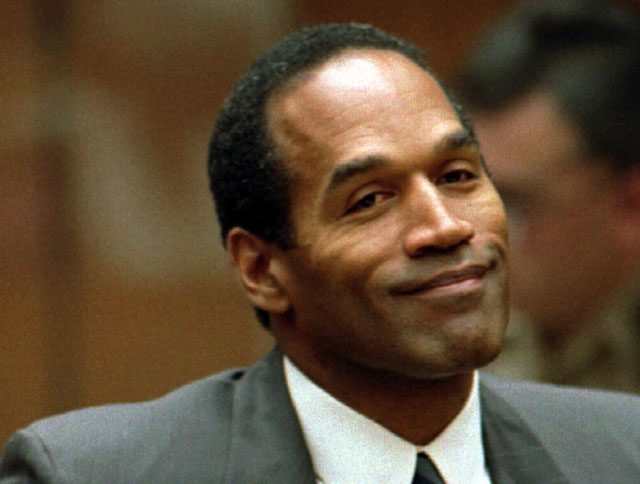
No.
Maybe I should just end the post with that single word, because it’s essentially all we need to know from an ethics perspective.
O.J. Simpson, who just died of prostate cancer at 76, was a bad man, a sociopath, one of the most vivid examples of the narcissist celebrity who believes the basic rules that the “little people” are bound to follow don’t apply to him. I keep reading that O.J. was “controversial.” There’s nothing controversial about a man who slaughters his ex-wife and her male friend at the doorstep of the home he and his victim once shared, with his children sleeping upstairs. Such a man is a villain, and deserves to be executed.
I just watched an interview on Fox News with a journalist friend of Simpson’s who got all choked up talking about “the O.J he knew” and said that Simpson’s legacy was “complicated,” as if he was talking about Franklin D. Roosevelt’s presidency. “Well, yes, he did some bad things like locking up Japanese-American citizens and selling out Eastern Europe to a brutal dictator, but on the other hand, he did save the nation from economic and spiritual collapse and the world from Hitler…” What ethical relativistic garbage. Simpson was a great college and professional football player, that’s all. There have been a lot of them, and none of the others murdered two innocent human beings and got away with it. Having a fortunate physical ability and success in sports has very little to do with one’s value to society andthe human race, or the content of one’s character. If anything, Simpson was overly rewarded for being able to run fast and dodge tacklers. Moreover, stardom made him into a monster, if he wasn’t one already. Bill Cosby’s legacy can legitimately be called “complicated,” as he was a public figure who contributed significantly and positively to the culture even as he was drugging and raping hundreds of women who trusted him. Virtually everything O.J. did to our culture was, in the end, destructive.
OK, he was funny in the “Naked Gun” movies, and he rescued a cat in “The Towering Inferno.”
“The only reason that we will care about O.J. Simpson 10 years after, 20 years after, is what it told us about race in this country,” said reliably wrong Jeffrey Toobin after the infamous trial. Really? What did it tell us, genius? That racial bias trumps justice and compassion? That a mostly black jury would rather free “someone who looks like them” than punish him for murdering his white wife? O.J.’s trial showed us so much more than that: like the fact that journeyman prosecutors chosen for their color and gender are at a disadvantage when opposed by defense attorneys who really know what they are doing. It showed us that typical jurors can easily be confused regarding technical evidence, such as DNA. It showed us that reasonable doubt can kill an almost slam-dunk conviction if prosecutors do something as stupid as the gloves fiasco, or presenting a racist cop as the state’s star witness.
O.J. gave us an example of how “bias makes us stupid” for all time, as his murders prompted polls showing that a majority of blacks believed he was innocent, because they wanted to believe that. The case showed us, again, how the cognitive dissonance scale makes popular celebrities nearly impossible to convict of serious crimes (Robert Blake was white, you know. So was Fatty Arbuckle.) It showed that we have a lot of incompetent judges in this country, and one of those can handicap the justice system in important cases.
The trial also demonstrated, if anyone had bothered to point it out, that there is nothing unethical about defense lawyers defending people they know are guilty (all of O.J.’s attorneys knew, because they weren’t stupid, star-struck, or gullible) because even monsters have the same rights as anyone else, unless they are Derek Chauvin or Donald Trump.
Meanwhile, O.J., by proving again that rich people and celebrities can get away with murder, also exacerbated racial divisions in this country, because the videos of blacks cheering and leaping for joy as a wife-beating knife-murderer was declared innocent were exactly as repulsive and divisive as films of Muslims cheering the fall of the Twin Towers. The O.J. trial, with its bizarre Ford Bronco chase prelude, launched reality TV, lowering the national IQ: another legacy for the Juice.
Has any vicious murderer lucky enough to get away with his crimes ever done anything as revolting and damning as Simpson’s “fictional memoir,” “If I Did It”? That alone should guarantee eternal residence in a particularly hot sub-division in Hell.
This is one example where there is no reason, much less an obligation, not to speak ill of the recently departed. to the contrary, there is an obligation to be absolutely unequivocal about the man’s villainy. I am certain what Grace would have said if I had been able to inform her that O.J. Simpson was dead.
“Good!”
 Ethics Alarms
death often begins the process of canonization for some. We have seen it before and its becoming more freuquent. People die at the hands of police in the midst of some criminal activity and we are inundated with pictures of his kindergarten cuteness. Victims of tragedies are lauded as heroes when then did nothing heroic, but die. I recall after 9/11 the NYT wrote bio-obituaries on the “heroes” who died. I was amazed that of the 3000 there was not one SOB. As an aside from my pint of view the only true heroes on 9/11 were the cops and firefighters that walked into the inferno to save others not those who just happened to be there when tragedy struck. There are merely victims.
I preside at many a funeral and all are saints in spite of thier sordid pasts.
“Every Saint Has A Past, And Every Sinner Has A Future.” O. Wilde
PWS
Wishful thinking, in Oscar’s case.
If I had a nickel for every obituary that left the bad stuff out, I’d be very rich indeed. It also seems that pretty much everyone killed in a battle with police was “just starting to turn his life around” when a police bullet took away that chance.
“everyone killed in a battle with police was ‘just starting to turn his life around’ when a police bullet took away that chance.“
A nickel for every time THAT‘s been said would make you even richer.
PWS
Well, we could always toast his departure. Know what we would drink?
OJ, with a slice! 🤣
John Wilkes Booth was buried in an unmarked grave in the dead of night.
Sulfuric acid was poured all over Leon Czolgocz’ body in his coffin to dissolve the body.
On the other hand, we have this scene because of OJ.
https://www.youtube.com/watch?v=XA62refAB2w
Almost 30 years later and it’s still true.
I’d say, more than the ascendancy of Saint Barack of Obama, the O.J. Simpson VERDICT marked the end of the Civil Rights Era and heralded the beginning of the current Black Lives Matter Era.
Its message might as well have been, “God Damn the United States of America, and God Damn white people.”
Clearly Jamaal Bowman saw that film.
In all fairness to Christopher Darden, he was only supposed to play a supporting role in the prosecution, but he was moved up when the more experienced William Hodgman (who prosecuted Charles Keating and was “outstanding prosecutor of the year”) collapsed due to stress-related illness and could not continue. He was in over his head, and afterwards was fired from the DA’s office while he was not in the office, and he was one of the last to be told.
According to him, DA Garcetti wasn’t in the office either, he was on vacation in Italy, told the Chief Assistant that Darden was history, and to tell Darden when he called in. Darden heard the rumor, then he called in, then he was told yup, you’re done. Then and only then did they put the termination letter in the mail in which the Chief Assistant wrote that he had spoken to Garcetti, and that the decision was final, he was terminated, then added in handwriting “Have a good life!”
Darden deserved better than that. Maybe he still deserved to be sacked, but he deserved to be told face to face.
Everyone deserves to be told face to face. And both prosecutors should have been fired, Marcia Clark perhaps even more than Darden. She was the genius who insisted that they call Mark Fuhman, and she also disregarded the jury consultants advice that black women would not be sympathetic with Nicole, indeed the opposite. I feel sorry for both of them, because the trial derailed their careers and their lives. But they still botched it.
Here is how I first learned of this.
https://www.instagram.com/p/C5oAT7SLrHB/?igsh=MzRlODBiNWFlZA==
Very little was written.
I thin Marcia Clark quit immediately, before she could be fired.
Isn’t there something about being incompetent being unethical that gets bandied about here fairly regularly. Marcia Clark is just a dope. Not Kamala Harris grade, but a dope.
How did the prosecution let OJ pull that glove stunt? He was wearing latex gloves beneath the gloves. Weren’t the gloves blood-encrusted and stiff and rendered less pliable than if they were in good condition. I’ve never understood OJ being allowed to ham it up like that. The guy was an actor, for God’s sake.
Johnny Cochran got under Darden’s skin by making cracks that impugned his “blackness,” and Darden lost his composure and blundered, which is exactly what Cochran intended.
“How did the prosecution let OJ pull that glove stunt?”
With hands which were…um…PLUMPED UP after allegedly being advised to quit taking his meds.
PWS
I’d forgotten that. Sheesh.
Agree, Jack, but….
Mark Furhman, taking the Fifth in chambers when asked if he planted evidence. (Just sayin’). Mark Furhman, using racial epithets and lying about it. (Eventually being convicted of perjury). Furhman has since written some interesting true crime books, two of which resulted in perpetrators being identified and convicted. The defense lawyers did a great job.
“The defense lawyers did a great job.”
An unintended consequence? Priming the pump for the…er…groundbreaking Kardashian X-Chromosomal Units…
PWS
I just had flashbacks to the “low-speed chase” and felt an almost uncontrollable urge to place my head through the wall.
Almost. Simpson’s not worth the effort, dead or alive.
I really do not understand why anyone is talking about him at all if he was such a miserable low life. Whether he is guilty or not of murder is immaterial; he was acquitted and if we say that he got away with murder we are saying the justice system is fatally flawed and should be scrapped for something else. I am not willing to go there.
Love him or hate him it makes no difference to me. It is only because of the allegation of murder do we find him a bad person. I don’t know him so I cannot judge him.
To me, the question is not whether we should talk badly about him it is whether we should say anything at all. Pounding on him after he is dead only hurts his family who have no guilt in the matter. If we cannot say anything positive it is usually better to say nothing at all.
Well, this comment brought me out the living room to my office. OJ killed Ron and Nicole. There is no genuine doubt, just technical reasonable doubt that was enough for a jury that didn’t want to convict him anyway to vote not guilty. Sure the justice system is flawed: human beings run it. There was DNA evidence found in OJ’s room and in his car—the jury was just dim enough to let a lawyer make them dizzy about remote chances that it was wrong.Cops planting evidence to frame OJ would have had to happen before they knew if OJ had an ironclad alibi; that defense theory never made any sense. The combination of Fuhrman and the glove gave the jury enough for confirmation bias, that’s all. There was never another suspect. OJ wrote that book: an innocent person doesn’t do that. The civil trial found by overwelming evidence—but not beyond a reasonable doubt!—that he did it. John Wilkes Booth was never found guilty in a court of law either: he just shot Lincoln in full view of a theater audience and jumped down to the stage—but he’s technically “innocent.” But not really. Same with OJ.
Today: “Juror from OJ Simpson trial speaks out. She admits that the jury thought OJ was guilty, but acquitted him as an act of revenge for the beating of Rodney King.”
Jack, That entire episode occurred in 1994 and I was preoccupied with trying to save a college education program for inmates that Joe Biden was determined to kill. I did not follow the trial with the same morbid fascination as the general public. In retrospect, I can too conclude he was probably guilty but that was not my point.
However, who are we hurting now by denigrating the man? Are they deserving of being constantly told their father was a monster. Just how far removed must one be to avoid being berated for reminded or constantly reminded of the sins of the father? I don’t think we should talk of him at all. Having him fade away in quiet ignominy does not cause hurt to anyone but him.
This was supposed to be in response to Jack’s reply
A dozen or so posts ago I commented how the past is a foreign country. How a nation 20 years ago can feel unrecognizable as the same nation in the present. The same goes for people. We each go through significant life changes, attitude changes, personality changes, habit changes, conduct changes, worldview changes that our 20 year old selves could be very different people from our 40 year old selves.
Like Brinkley, who attempted to assassinate Reagan to impress Jodie Foster almost 40 years ago – do I think he’s that person any more? Very likely not.
Would 70 year old OJ be likely to murder someone like 40 year old OJ did? I’d be willing, for the purpose of conversation to say probably not also. Though, unlike the foreignness of a nation merely 20 years ago, people, while changing significantly over the decades, don’t change as rapidly as they age – that is to say 60 year old guy is probably much more similar to himself at 40 than his 40 year old self is to his 20 year old self.
BUT – I do think that 70 year old OJ is probably not a murderer and the past is so far back it is somewhat odd seeing him harmless and quiet life *since the murder* as anything out of the ordinary.
Which why if we are to be a capital punishment nation, capital punishment should be carried out swiftly – because the victims of murder don’t get their extra 20 years or 40 years of life change – why should the murderer get his?
This is also one more point on why the “not guilty” verdict for OJ was a complete miscarriage of justice. I typically lean heavily on our system’s bias towards potential criminal penalties NOT being applied because State’s have historically misused their powers – every step in the process is designed to hamstring the state and give the accused an easier time to “get off the hook” so that when the State achieves a guilty verdict, odds are it’s accurate.
But OJ got off the hook and we get to see him in his 70s as a normal dottering elderly man who doesn’t seem out of the ordinary to other normal dottering elderly men completely dissonant with what he did in his 40s…
1. Except, Michael, about that little matter of the conviction for armed robbery, kidnapping, conspiracy and other charges that landed him in prison 14 years after his acquittal for murder
2. Hinckly was clinically insane, which places him is a different category entirely.
3. This does, you know, provide a theoretical escape for Adolf Eichmann,et. al.
4. Great and thought-provoking comment.
I’m actually saying the opposite. The guilty should be held account for their guilt. But there is dissonance there when decades go by and eventually you’re interacting with someone who could be a genuinely “changed person”.
That doesn’t mean they aren’t still guilty of murder just that there’s a natural dissonance that people would feel holding a “grandpa” to account when justice should have been meted out at the time of the crime.
Honestly, I don’t feel that dissonance at all. My experience, and I began believing this long ago, is that despite conventional wisdom, most people change very little. Even adulthood is less of a change than we would like to think. Definitely major life traumas and physical/mental maladies can make a major difference, but again—in general, grandpa may look different, but if he was an asshole, he’s probably the same asshole but more wrinkled. I recently spent an evening with seven good college friends, a group that included my surviving roommates.They not only appeared to be exactly the same, they even looked almost exactly the same.
I thought you might appreciate this one: https://www.facebook.com/share/p/uzQE27BRR346HpJr/?mibextid=oFDknk
“At least OJ can finally rest, knowing his wife’s killer is dead”