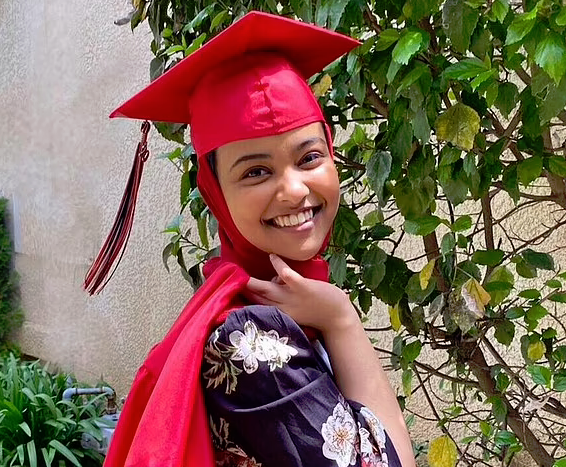
USC has banned this year’s graduating class valedictorian, Asna Tabassum, from Chino Hill, California, from making her speech during the university’s commencement ceremony. The justification: anti-Israel (or pro-Palestine…same thing, really) posts on Instagram, including thise calling for the “complete abolition” of Israel.
Asna is a Muslim, not that there’s anything wrong with that. USC officials chose her from nearly 100 student applicants who had GPAs of 3.98 or higher. It seemed like a good idea at the time: certainly in this age of enlightened DEI, the woke school wasn’t going to choose any icky white male. Tabassum majored in biomedical engineering with a minor in resistance to genocide—wait, what??? USC has a “resistance to genocide” major?
The USC Provost explained the decision thusly:

You can see the problem: Asna, who would have been heard by 65,000 people at the ceremony, has lost the honor and the opportunity to speak at her graduation because of the viewpoints she expressed on social media on her own behalf. Campus free speech watchdogs at the Foundation for Individual Rights and Expression (FIRE) are alarmed (that’s called a “FIRE alarm”). It concludes that the USC action is a validation of the heckler’s veto. Constitutional law expert Eugene Volokh agrees, writing in part as he quotes the letter above,
[T]his was likely a bad decision on USC’s part… behavior that gets rewarded gets repeated: If all it takes to cancel an event is that “discussion relating to [the event] has taken on an alarming tenor,” that just encourages people with all sorts of views on all sorts of issues to try to shut down speakers simply by producing more “alarming” chatter. And if there really were such serious threats that USC felt it had to shut down the event despite this risk, then USC should have at least expressly said that there were such serious threats, and stressed that it had called in law enforcement so that the threateners could be caught and punished.
I concur. It is finally getting established that what students write on social media cannot be the basis of adverse action by a school (college, high school, you name it) unless the post directly affects the institution and causes a disruption to the education process. I don’t see that here.
To take USC’s side for a nonce (“Stop Making Me Defend California!”), what is it supposed to do, exactly? Two major university presidents lost their jobs in part because they told Congress that students had a right to chant “from the river to the sea” in campus demonstrations, which is the equivalent of advocating the destruction of Israel as well as sending a hardy “Good work everybody!” message to Hamas for its October 7, 2023 terrorist attack on Israel. Students have a right to demonstrate on campus; they also have a right to express political views on social media. USC’s position is that students do not have a right to give a valedictorian speech, but that’s a legalistic point, not an ethical one. What’s going on here? What’s going on here is that a student who was chosen as valedictorian on the basis of her academic achievements (not because it is cool and trendy in DEI Land to have female Muslim “of color” in the role) has had the honor removed based on her opinions.
I view the ethics issue this way: USC has an obligation to ensure that its commencement is a positive, uplifting, positive experience for all participants. Colleges have a legitimate interest in making certain that speeches delivered at such ceremonial events are appropriate for the time, place, students, parents and purpose of the event.Student speakers should always be required to agree that their address will be appropriate, and also agree that if they violate their agreement with the school, there will be serious consequences. Student speakers should also recognize that selection as valedictorian is not an invitation to grandstand and use commencement ceremonies as platforms for political activism. Colleges should sufficiently educate graduated so they have that minimal understanding of such ethical values as respect, fairness, caring and responsibility, as well as trustworthiness.
Now back to the metaphorical other hand: I see no indication that Tabassum was asked to commit to delivering an appropriate speech and refused. There is also this: Why did USC choose a valedictorian who is not only a Muslim graduate —who has minored in “resistance to genocide”!— in the middle of the escalating Hamas-Israel War Ethics Train Wreck? What did administrators expect to happen?
Morons. This another petard hoisting. USC did this to itself, and is in ethics zugzwang.
 Ethics Alarms
OK, you are wrong about the valedictorian. The valedictorian is the person who makes the validictory speech, not the person with the highest GPA. No speech, no valedictorian. They can declare they won’t have a valedictorian, but they can’t have a valedictorian without the speech.
I didn’t say she had the highest GPA, or was chosen for that purpose. Valedictorians always are among the top performers–no school chooses C students to give the speech. What was I wrong about?
The valedictorian is the person who gives the speech. No speech, no valedictorian. You can’t have a valedictorian with no speech.
It would be like forcing a woman to abort her first child while awarding her ‘mother of the year’.
Who made that rule? If USC says our valedictorian isn’t allowed to speak but we’ll still call her that, what difference does it make? I really don’t get your point. Nobody cares about the “Hey, how do you have a valedictorian without a speech?” the issue is whether you can ethically mute one because you’re afraid of how other students will react.
I would note that FIRE and Professor Volokh also argued that now former UPenn President Liz Magill’s widely disparaged argument that context matters was indeed correct, writing that “if freedom of expression is to survive on American campuses — and for our nation’s vitality, it must — Magill’s original answer was right. Context does matter.” I agreed with them then; I agree with them now.
But the left threw context out the window years ago. Eg., try saying “Illegal alien” like the high school kid did in a classroom discussion seeking clarification. He was suspended for three days. Context shmontext.
“Context for me, but not for thee,” might as well be their policy.
https://www.carolinajournal.com/opinion/wake-up-call-student-suspended-for-saying-illegal-alien/
Gah… that event seems worth it’s own post almost, but I’m not sure if Jack’s skull can take the pressure.
Question: why does the writer say this isn’t a free speech issue? It most certainly is, and a slam dunk one at that.
I don’t think anyone seriously argued that context just doesn’t matter. Context always matters, and obviously so. A teacher reading certain passages from The Adventures of Huckleberry Finn out loud to a class is very different from that teacher using some of the slurs found in that book in a different context, i.e., yelling them at a student.
The disparagement of Magill’s words came from the fact that she was obviously simply obfuscating. I haven’t watched all of those clips, so it’s possible that there actually was a cogent defense made, but I don’t see how she could argue that there was a material difference in context between the language that Harvard and UPenn and other schools regularly policed vs the calls for genocide against Israel.
If you want to argue that the schools’ policies seem to be inconsistent, fine. If you want to say that Dr. Magill was insufficiently prepared and didn’t argue her case well, no argument.
But chanting a slogan does not intrinsically constitute a threat. Malcolm X and Martin Luther King meant different things by “we shall overcome,” which carries essentially the same denotative meaning as “from the river to the sea.” I don’t think we’d want to suppress the latter’s right to use that phrase simply because someone else meant something different. I wasn’t there on the UPenn campus. I don’t know if there was an immediate threat to students and faculty, which is the only legitimate criterion for suppressing what is otherwise protected speech, however distasteful the powers that be (or you or I) might find it. That determination would depend on context.
What I saw in those hearings was a grandstanding pol far more interested in enhancing her chances for a VP candidacy than in determining the truth. Hey, it worked for Kamala Harris!
Gotcha. Context does matter, and maybe I’m misunderstanding the criticism (or more likely, there’s as many reasons for the criticism of her statement as there are people criticizing her), but my criticism of her reflects what I said above. Why does Harvard or UPenn care about context when it’s their goat being gored but not when it’s conservatives who are being policed.
However, after a careful reading of your middle paragraph, I do heartily disagree that “we shall overcome” is substantively the same as “from the river to the sea.” And from that perspective, her argument does fall flat. If your party slogan is “we shall win the day” and my party slogan is “death to all who disagree,” I think you’d agree that one has a rightful place in public discourse and the other does not.
Chanting the latter wouldn’t necessarily be actionable from a legal standpoint, but Magill wasn’t arguing from a legal perspective but one of school policy.
Note that I said “denotatively.” ”Palestine shall be free” can hardly be described as denotatively threatening. It’s the connotative implications that are, or could be, different; that’s where the need for context arises.
Actually, to me, she came across as totally prepared.
Unfortunately what she was prepared for was to spout a few paragraphs of legal and bureaucratic gibberish in a monotone with a flat affect. It was as if she didn’t think we were smart enough to know that other kinds of speech on her campus were denied any 1st amendment or free speech protection and vigorously suppressed.
If she had talked like an actual human being instead of a robot, and actually tried to explain why they were not suppressing the demonstrations — she’d have been a lot better off (granted that assumes that Stefanik would’ve let her speak thusly at length).
Of course, that then leaves her open to the question “Well, why do you tolerate this speech when you’ve suppressed that speech?” That’s not a great look either, but at least it would leave the door open for some rational discussion of the issue.
Stefanik explicitly distinguished between essential free speech and the universities published code of conduct, which the chanting clearly violated. She did so with all three of the presidents.
I’m not so sure that the demonstrations themselves, abhorrent as they might be, don’t fall under the aegis of essential free speech. Harassment of Jewish students and actual threats are a whole different kettle of fish, though.
Yes, Stefanik was running ‘gotcha’ questions. Julie principle — it is what congresspeople, both Republicans and Democrats, do.
But I don’t think the presidents’ answers were glib — I think they were more akin to a hostage video. They needed to actually express some human expressions and feelings, and the lack of it just played into Stefanik’s questioning.
Diego,
Stefanik pressed on the obvious violation of the universities published code of conduct, which she read from if memory serves. She repeatedly verbalized how the demonstrations (and other on campus harassment of Jews) were clearly in violation but not enforced. It was the presidents mealy mouth responses to that fact that took them down, except for the MIT Prez. Essential free speech was irrelevant as was context. Imagine if the demonstrations and other on campus physical harassment were against blacks or LGBTQ people.
Jew hatred is real. Scapegoating Jews has been goosestepping throughout the collective consciousness of humans for thousands of years. Scapegoating is a fundamental psychological mechanism of how humans deal with that which they find uncomfortable within themselves.
I am not sure she was fired because of her statement. She was fired because she made UPenn look silly, unprofessional, and unprepared/unaware of what is happening in the world. She may have been correct that context matters, and that universities need a broad berth when it comes to academic and thought freedoms to encourage intellectual growth. She could have said that the remedy for bad speech is more speech. She didn’t say that. She looked glib, issuing platitudes and gibberish, making an Ivy League university look like a mail-in diploma mill.
jvb
“She was fired because she made UPenn look silly, unprofessional, and unprepared/unaware of what is happening in the world.”
Nope. She was fired because a fat-cat with an agenda threatened to withdraw a nine-figure donation if he didn’t get his way. Plutocracies run academia the same way they run everything else.
We shall overcome meant white people will be pushed into the sea?
i think the argument is that “from the river to the sea” is not explicitly calling for the eradication of the Jewish people; some using it may simply mean that they want to annex that land and make it a new nation.
Of course what those people would then do with all the Jewish people living there is a valid question. But that’s the beauty of plausible deniability, which is really what’s going on here.
Yes of course. Jews would be as welcome in the reconstructed Levant as they are everywhere else in the Middle East! Why, they’d be as welcome as people of color, gays and lesbians, transgenders and all other oppressed people of every stripe imaginable are in the Middle East. The Middle East is diverse and Woke. Praise Allah!
It’s my understanding Jews have been sytematically run out of all Middle Eastern countries in response to the 1949, 1967 and 1973 wars attacking Israel.
It sounds like the self-licking ice cream cone of DEI and maleducation as devolved to a self-inflciting wound. I would say let he speak but make sure the coffers are filled to pay for damages incured due to the micro and or macro agresessions inevitably will follow.