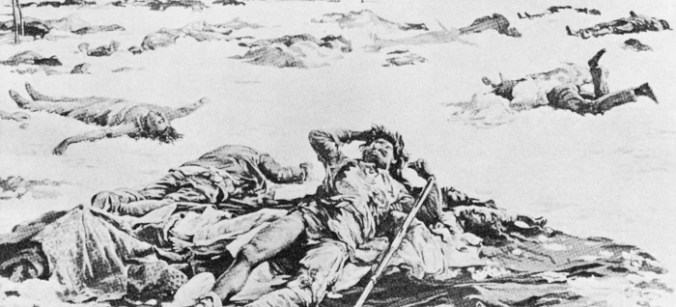
Once again, I thought a headline was a joke when I first read it:“Pentagon to review Medals of Honor awarded to soldiers for 1890 Wounded Knee actions.” The headline was at Stars and Stripes, though, not The Babylon Bee.
The reassessment was requested by Congress in 2022 on a day when it was feeling particularly woke and I guess had nothing better to worry about. Now Defense Secretary Lloyd Austin has ordered a “five-person panel of experts”—experts on what it was like to be in the cavalry in 1890, I guess?—to review the legitimacy of the Medals of Honor awarded to twenty U.S. soldiers for their actions during the 1890 Battle of Wounded Knee in South Dakota, eventually regarded as a massacre of Native Americans after Dee Brown’s best-selling account of the battle won acclaim and its own awards.
“The scope of the [panel’s] review is limited to reviewing each [Wounded Knee Creek Medal of Honor] awardee’s individual actions during this specific engagement on or about Dec. 29, 1890,” Austin wrote in a memo made public this week. The panel “may consider the context of the overall engagement as appropriate, including as necessary to understand each … recipient’s individual actions.”
The now infamous battle saw the U.S. Army’s 7th Cavalry kill or wound over 350 members of the Lakota tribe, with about half of those killed being women and children. 25 U.S. soldiers also died in the incident, which was not planned as a massacre or even a confrontation.
Your Ethics Alarms Ethics Quiz of the Day is…
Is it fair to revoke a soldier’s medal of valor under these circumstances?
On the “pro” side of the argument, we have this: the Battle of Wounded Knee, whatever the real details were (which are in some dispute, as Dee Brown’s version was openly a one-sided analysis intended to advance Native American rights), was just one chapter of a long, tragic saga in which Native Americans were slowly deprived of their culture, lifestyle, and too often, their lives as the United States expanded its territory. Giving any soldier a medal for participating in this particular horrible event is soaked with the “Ick Factor,” no doubt about it. When I think of Wounded Knee, I always picture the vivid portrayal of a similar Indian massacre in “Little Big Man.” That scene, which included a baby being shot in the face, gave me nightmares as a kid.
The ethics “con” side is more persuasive, however, in my view:
1. Wounded Knee was not like that “Little Big Man” scene, where the American soldiers arrived shooting, with orders to wipe out a peaceful encampment. The 7th Cavalry surrounded a group of Lakota led by Chief Big Foot to confiscate their firearms after an agreement that the weapons would be turned over peacefully. One Lakota brave resisted when he was told to surrender his gun. A soldier struggled with him as he tried to take it away, the gun went off, and then everyone started shooting. This is essentially how the killing at the Boston Massacre and the “Gunfight at the O.K. Corral” started: by accident.
2. How can any panel, even of “experts,” in 2024 fairly and accurately evaluate what happened during that chaos over a 130 years ago? Answer: it is impossible. And they know it’s impossible.
3. The Stars and Stripes article says that the criteria for awarding the medals appears to have been erratic and arbitrary. Welcome to the Army! My father, who was awarded several medals of valor, was brutally cynical about how such honors were determined based on his own experience. Sometimes the medals are awarded because the circumstances were indisputably remarkable, as with Desmond Doss. Often it depended on the officer making the recommendation, and, Dad said, having decorated men serving under an officer’s command was believed to advance that officer’s career in many cases. Veterans, like John Kerry, who made a big deal out of their medals, my father felt, often looked foolish. “Those who served in combat knew that whether a particular action resulted in an honor was often a matter of luck,” he said.
4. The exercise is pure virtue-signaling. It is also rigged from the start: is there any chance at all the panel will examine the record and announce, “We found that all of those medals for killing Native Americans were well-deserved”? Of course not.
This is another contrived exercise to say “We’re a horrible, racist nation and we’re sorry” to Native Americans. So some long dead soldiers and their families get metaphorically kicked in the teeth: it’s worth it to look sensitive, caring and woke. This is “presentism” in its purest form. Having looked at the events of over a century ago through the prism of 130 years of perspective, we will decide that we know better in hindsight how to handle events than our ancestors did who had to deal with them.
5. Then there is the reaction of my very Democratic sister, who said, when I asked her reaction, that there are presumably far more important things for the Defense Department to spend time, thought and money on than re-examining the Battle of Wounded Knee. They should just estimate what this boondoggle is going to cost and give the money to a Native American group rather than spending it to symbolically punish soldiers who were in the wrong place at the wrong time.
6. [ADDED] I meant to have this in the original post. The exercise seems like a very slippery slope. As commenter deacondan86 writes below in the comment that prompted this addition, “Do we empanel a group of experts to reevaluate the MOHs awarded during Vietnam? Do we disassemble the WALL?”
 Ethics Alarms
If the DOD is bound and determined to make people feel better about how the US government has responded to the Battle of Wounded Knee, your Democrat sister’s suggestion sounds far more efficient than spending time/money/staff effort on deciding whether or not to strip Medals of Honor away from long-dead soldiers.
Yeah, my sister is smart and analytical when her Trump Derangement hasn’t fevered her brain.
observation- the indians are taking it to the white man with their casinos.
observation- do we empanel a group of experts to revalaute the MOHs awarded during Viet nam. Do we disassemble the WALL.
As pointed out this is presentism riddled with wokism flavored with self-loathing.
ARGGHH! You reminded me of another “con’! I’m going to add it…
That’s a really good point. It’s one thing to award medals to deserving veterans who were overlooked (either deliberately or accidentally) as in the case of many WWII African Americans, but to review revoking medals because of the unpopularity of the action is a precedent we don’t want to set here.
Do we posthumously revoke Paul Tibbet’s Distinguished Service Cross because dropping the Bomb is now considered gauche by some people?
I realize most MOH recipients receive their awards posthumously, but what about those who were living and then were buried with their medals? Does the government mean to exhume the bodies and remove the medals from the bony necks?
I know that’s a bit extreme, but still…
I constantly second-guess decisions I make – and have made over the years – but that doesn’t mean I am required to undo the results of those decisions simply because I realize now I could have chosen better or done things differently back then.
What we should do is LEARN from what happened and vow to make every effort to do things differently in the future, rather than constantly try to go back, undo every evil, and effectively punish those who are now in no position to defend themselves and their actions.
I think I basically restated #4 using different words.
And I think your sister’s idea in #5 has merit. While it smacks of reparations – which I am totally against – the notion of earmarking money that’s going to be spent and spending it in a better way?…I can live with that.
3. And LBJ got a medal for teeny little flight and wore that thing every chance he could get.
In the insurance business, there’s a concept called an Incontestability Clause. Basically, the insurer cannot go back and void a policy for a misstatement on the application after a specific period of time. So, if I make a mistake on the application regarding my health and the company issues coverage, it has two years to contest it and terminate my coverage. After two years, they’re stuck with it.
I think that, after a certain period of time, these types of reviews are pointless. If the men were still alive, sure. But 130-plus years after the fact? It’s just virtue-signaling.
In the law we call that the statute of limitations. Stale claims are disfavored. It’s also a terrible idea to grant a “lookback” period for the sake of presentism. Of course that’s what you vote for if you vote for Harris…
Or if you voted for Leticia James/Kathy Hochul.
I guess statute of limitations are kind of like stare decisis — depends on whose ox you’re planning to gore.
Either void them all as an acknowledgement that it was an attempt to put lipstick on a pig for a populace that would probably not like reading about an event that would be seen as an unnecessarily excessive amount of bloodshed.
Or don’t void any of them.
The 2nd option makes more sense.
We just visited the Black Hills- with Mount Rushmore being an obligatory visit we made. Super neat.
At the base of Mount Rushmore off to the side, there was a fairly hefty Native American with a display of artifacts and a tepee.
He was discussing how he was an ambassador trying to bridge between “the two sides”.
The two sides of what? Last I checked there’s 330 million of “us” and less than 10 million of “you” (and of that 10 million, most are only “partly you”). Never mind “you” are actually Americans also.
If there are “sides”, one side has moved on my man. And frankly, based on the cars you drive, the food you eat and the Air Conditioning you enjoy, “your side” has moved on also.
So a soldier’s actions aren’t valorous if the battle shouldn’t have happened in the first place?
If we accept that a soldier’s place isn’t to make ethical judgments about the fight in which they’re being ordered to participate (as long as they’re not ordered to commit war crimes), then we can’t very well disqualify a soldier from honors when they do a good job of shooting someone who is considered an enemy combatant.
Medals of valor are honors for being a good soldier when a battle is already occurring. There are different awards issued for preventing violent conflict in the first place.
The awarding of the Medal of Honor has a less than consistent history. Many times, these errors were corrected, but not always. A total of 911 medals have been revoked since it was created during the Civil War. Of these, 864 of them were awarded to one unit, the 27th Maine Infantry. The 27th was mustered in for one year during the summer of 1862, and assigned to the defense of Washington, DC. The next year, a few days before their enlistment was up, the 27th was due to be sent back to Maine and mustered out. Instead, they were mistakenly attached to other commands being redeployed around the Capitol to defend against any attack from Lee’s army during the Gettysburg Campaign. When the assignment error was discovered, Lincoln and Stanton offered these troops the Medal of Honor if they would extend their enlistment. Only 300 of the 864 troops stayed behind in DC (extending their enlistment by four days) while the rest returned to Maine. However, all 864 members of the unit were awarded the MOH. Very few of the men, now mustered out and scattered to the winds, actually received a medal. By the time this error came to light (none of those 864 awarded the MOH met the criteria by even the 1863 standards) it was around 1891 and the erroneous awards were rescinded.
As far as the Wounded Knee MOH awards are concerned, they should be left alone, for all the reasons covered by Jack and the EA Commentariat. Nothing good can come from this modern-day meddling.
By the way, Russell Bonds’ excellent 2006 book “Stealing the General” details the awarding of the first Medals of Honor to members of Andrews’ Raiders, and covers the early history of the MOH generally.
If you really want to see stuff hit the fan, suggest that the DoD should go back and award MoH’s to deserving Confederates from that war. There are bound to as many Confederates who’d deserve the medal as were Union soldiers.
I am not actually suggesting this, but it makes more sense than what they’re doing with Wounded Knee.
I imagine one of the ideas behind the Medal of Honor was to encourage morale — don’t know if it was aimed at military or civilian. But as with the Vietnam war, national resolve was the key to winning the war and, fortunately, we had a president who understood that.