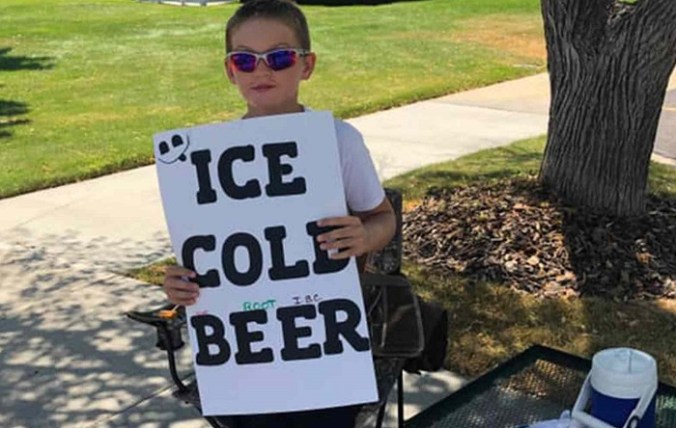
Police in Brigham City, Utah responded to complaints that a young boy was selling beer at a roadside stand. Sure enough, the kid had a sign at his makeshift stand that said “ICE COLD BEER.” But upon closer examination, the police found that “root” was in tiny print in front of the beer. The admiring police posted on Facebook, “He’s selling beer … ROOT BEER, that is. His marketing strategy has resulted in several calls to the BCPD, but apparently it’s paid off as business has been good.” Indeed. Business is booming, the boy told the fawning news media. “We had to buy another cooler.”
So the child has learned that bait-and-switch along with deceptive advertising not only works, but that he will be praised for it. I’m sure he can make the connection that deceit is also a useful and profitable strategy, and find lots of ways to exploit people’s trust to deceive them for his own benefit.
Yup, his family has the makings of a real little con artist there, and they’ll have the police and the news media to thank. Maybe he’ll end up in jail, or in Congress.
________________
Pointer: JutGory
 Ethics Alarms
I think this particular case is harmless. It’s not like he’s selling something bogus with his customers only finding out after they’ve paid. The point is get people’s attention. Once he has it, the deception ends.
Boy, I couldn’t disagree more. That’s how slippery slopes, ethics blindness and bad life habits start. “Fine print” tricks are behind the dastardly Disney defense in that wrongful death lawsuit. In terms of the ethical principle being violated, there’s little difference. The kid isn’t necessarily going to see the nuances between what he got away with and a Ponzi scheme.
I dunno, Jack. A bit of caveat emptor or logic/reason might prevent this whole kerfuffle. The public should, at minimum, know that a preteen should not/would not be selling alcohol – if it doesn’t, well, no amount of ethics or life training is going to solve that underlying problem.
The bait and switch only applies if there is an affirmative representation that the good or service being sold is not actually being sold: I buy a car and a five year bumper to bumper warranty, only to find out that it was a two year warranty limited to oil changes and shocks and struts warranty, or that warranty only covers manufacturer defects, not stuff that breaks down over time. Or, I vote for a candidate with one party affiliation only to learn later that said candidate is going to switch parties.
Here, there is no such misrepresentation. it is akin to the comedian who saunters on to the stage and yells, “SEX!” and then says, “well, now that I have your attention . . .” It is fairly obvious to anyone with an IQ above room temperature that a minor is not allowed to sell alcohol and anyone stopping by this ad hoc lemonade stand thinking they are going buy a tasty IPA should not be allowed out of his or her house.
More importantly, why the hell are neighbors wasting police/law enforcement resources on something like this? If they truly believed he was selling beer, and somehow got out of their house(s) to investigate, only to find out it was, in fact, root beer, then they should have scolded him and walked away. The police should track these informants down and give them a stern lesson on why the Stassi was a really, really bad thing.
jvb
If the “root” on the sign was microscopic, and a customer (who didn’t question why a kid is selling moonshine,) bought a glass, and…
“Hey, this is root beer!”
“Sorry, no refunds!”
…that would be unethical. But the way he had it, it would be obvious to whoever approached that “root” is on the sign (plus there’s the color and smell of the beverage), so I’m not seeing any real deception, just something on the level of this:
It made them stop and come up to the stand. That’s enough to make it an unethical tactic.
In Utah, no one is stopping to come up to the stand to buy a beer. They are stopping to come up to the stand to correct the child’s offense of selling beer in Mormon held Utah. With that mission in mind, each person who approaches the child leaves with their mission accomplished. Suddenly, he is no longer selling beer as they find out his product is root beer.
If the passing car did stop to buy real beer from a kid, well, they have been entrapped and shown to be unethical. Anyone knows in Utah that you can’t legally buy a roadside beer.
I am more concerned about the people who would believe that they could get an alcoholic beverage from a child.
However, Jack makes a good point that it is the lesson being learned is unethical and illegal if done by a real business. These lessons are later used as adults.
It is hard enough to keep the regulation zealots from shutting down lemonade stands. This gives them just more ammunition to do it. Utah, Illinois, and Texas had to pass laws to allow kids to sell lemonade without being harassed by city governments and HOA’s. Colorado had been debating it for years now.
I think a little local culture is in order. This is Utah. Latter Day Saints country. Everyone’s Mormon. No one drinks caffeine, never mind alcohol. No one driving by could have thought this was anything but a joke.
Somebody reported it to the police!
Utah’s not 100 percent Mormon!
I’ll bet the police chief goes to the same church as the parents of the kid. It’s goofy Mormon humor.
“Andy of Mayberry” stuff. You know, back when TV shows used to encourage ethical, humane behavior.
Are you kidding? If Opie played a trick like that, Andy would have handed him over to Barney.
Or, Barney would have gone bonkers and hauled Opie into the hoosegow in hand cuffs, and Andy would have sternly lectured Opie and made him give his ill-gotten gains to some charity, and Barney would be a little chastened. End.
Yes, Utah. If it appeared to passing motorists (or pedestrians) that beer was being sold they would have just passed on by. Right? So that a sign offering beer for sale drew a crowd does not appear to compute with it being done in a population that does not consume alcohol, might be the real story.
There’s a joke about Mormons (or Baptists, ymmv) not recognizing each other in a liquor store, and another about fishing. I don’t know how this fits with the cognitive dissonance scale, but its probably there someplace.
No, the joke is that in Utah, you are allowed to buy beer every 5th Monday between 1 and 1:15 PM if you are left handed…or you can join a private club.
Some of us do drink caffeine; it’s coffee and tea leaves specifically that are on the naughty list.