
I don’t set out to connect these posts; sometimes it just happens.
If you thought the board-poisoning chess player was obviously unethical, how about a hospital losing a piece of a patient’s skull?
Fernando Cluster was admitted to Emory University Hospital Midtown on September 30, 2022. He was diagnosed with an intracerebral hemorrhage, a type of stroke that causes bleeding in the brain. He needed a decompressive hemicraniectomy, which meant a 12 centimeter by 15 centimeter piece of his skull would be removed to allow his brain the space it needed to swell and heal during surgery.
The “bone flap” as it is called was supposed to be reattached during a procedure called a cranioplasty. But when the operation was scheduled to proceed on November 11, 2022, Fernando’s bone flap was missing. It must bve been around here somewhere; I swear I just saw it…boy, don’t you hate it when that happens? Once, my wife lost our tickets for a Paul McCartney concert…You know, this kind of thing can happen to anybody.
“Although we were informed yesterday by OR staff that Mr. Cluster’s bone flap was located and ready for replacement, it could not be found today when preparing for surgery,” a MyChart progress note from Neurosurgeon Matthew Agam, MD. read that day. “We inspected the freezer where bone flaps are stored and could not find a bone flap with Mr. Cluster’s patient identification. There were several bone flaps with incomplete or missing patient identification, but we could not be certain which if any of these belonged to Mr. Cluster.”
Easy come, easy go I guess!
So Mr. Cluster had to wait almost two weeks with part of his skull missing for a synthetic implant flap to be manufactured. After his rescheduled cranioplasty finally was completed—this is the best part—the hospital charged Cluster’s family $146,845.60, including the cost of replacing the missing piece of his skull.
You will not be surprised to learn that the family is suing.
Wouldn’t you think that a competent hospital administrator would at least make sure that the hospital’s handling of major botch like losing a piece of a patient’s skull wouldn’t result in headline and a photo like…
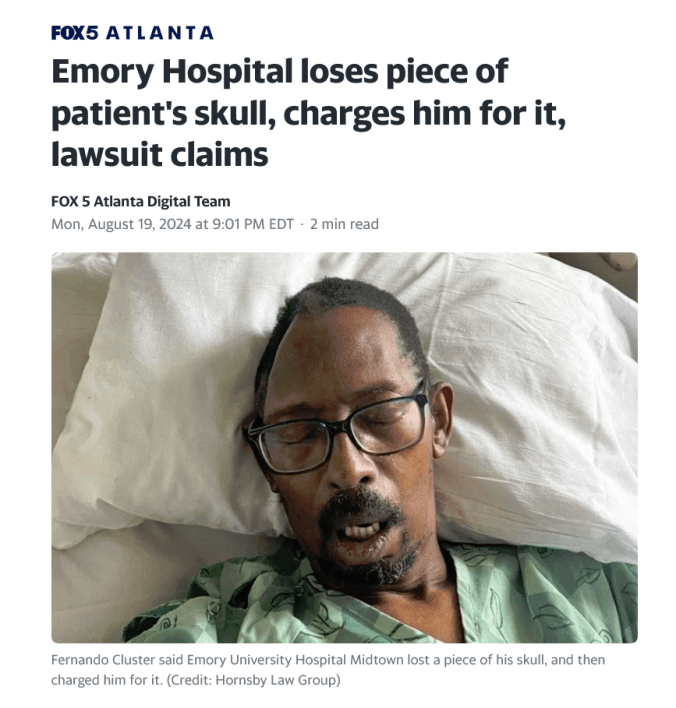
..that???
 Ethics Alarms
Fawlty Towers: Is this a piece of your brain? (youtube.com)
Lemme guess. The hospital will claim that the family will have to go through arbitration because the patient got a stitch a couple of years ago at the same hospital and the fine print said he couldn’t sue them, right?
Obviously the patient wasn’t the only one who needed his head examined…
Great. Now my head is missing pieces, too.
Granted, helping someone with a stroke is doubtless very stressful, but hospital checklists exist to make sure no step is overlooked. That bone flap shouldn’t have left the room without an ID tag. Any bets the hospital hasn’t charged patients for surgeries to remove tools left behind from previous surgeries?
The hospital should not have even billed insurance for fixing its own mistake; it should appear on the Explanation of Benefits as “Artificial bone flap fabrication ($X fee waived) – $0”.
Of course, the arbitrary and opaque nature of medical fees is another problem we need to deal with. It limits people’s ability to compare costs for different procedures and providers. Is manufacturing a bespoke bone flap really easier than DNA testing the bone flaps they already had so they knew who each one belonged to? Otherwise they’re going to have to do the same thing all over again when those other patients return to have their skulls restored.
Did they even try to fit( the shape should fit – it would be like one of those really hard puzzles with only one piece) any of the bone flaps in the inventory?
This is what I call “Junior High School Student Council” thinking. These are people who think they can just do whatever they want and people HAVE to do it because THEY are in charge!
A group at work came to me and said that I HAD to approve something because the procedure dictates that it required my approval! I told them that I wasn’t approving THAT and they informed me that I HAD to because it says that I am REQUIRED to approve it!
Wow… Your workplace has procedures?
At mine, they spin up a project, staff it with contractors with no skin in the success or failure, throw away all the existing procedures written in blood, sweat, and tears, and when the project is two-thirds done, they tell the people tasked with enforcing the procedures this had all happened.
Well, they wanted to OK a program were people would apply for a 6 month research leave based on the fact that they weren’t needed for anything HERE. So, it was basically a self-identified redundancy reduction program with a 6 month severance package.
Would anyone care to place a bet that when his restoration surgery was scheduled, they got him into the hospital before discovering that they had misplaced his skull — and then they charged him for that hospital stay as well?
My goodness.
We already knew that hospitals are run for the convenience of their staff, not their patients but even so.
One also has to wonder — is something like this just a routine occurrence at this hospital? Did it not occur to anyone to maybe notify the hospital administration? Is it just — another day, another missing organ?
I think it is a thing these days for some prospective surgical patients to be asked to donate blood in advance of their surgery (I’m not just making this up, am I?). Would you trust this hospital with a pint of your blood? That is not something where they can just whip up a substitute……
They can use blood-bank donor blood, but with the inherent (if generally low) risks of doing so.
Some surgeries are known to result in blood loss as an inherent part. The first liver transplants, for instance, hospitals had to halt all elective surgeries due the blood banked supply being needed for the surgery patient, as copious amounts were split onto the operating room floor during the transplant (I’d assume technology has improved the situation).
Having a supply of the patient’s own blood in advance of a surgery puts less pressure on the blood bank, and removes many of the risks of donor blood.