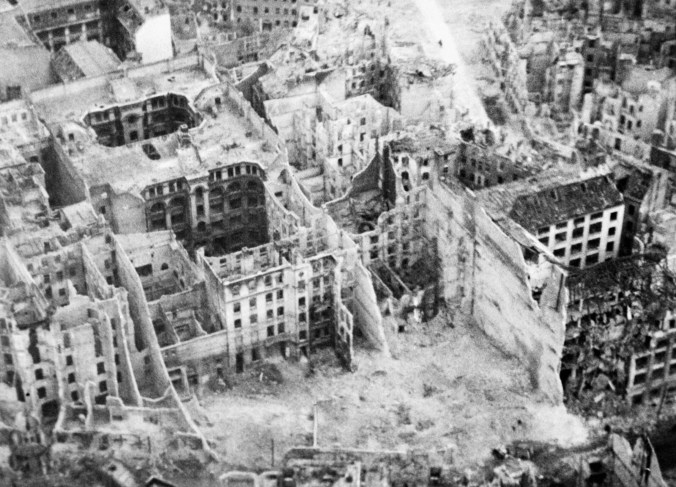
This is an unusual Comment of the Day by Chris Marschner (on the post,“As the NYT Enables Terrorism and Anti-Israel Hate With ‘Think of the Children!’ Porn”), but it makes an important point, indeed, the crucial point that exposes the intellectual dishonesty of the Times’ “Think of the Children!” campaign to demonize Israel as it tries to defend its right to exist.
***
I reworked the original Times story to reflect a similar situation in the mid-20th century. All I did was change the name and the players. If the Times had written its report this way, then the Brits, the French, the Poles, the Czecks and others would be goose-stepping to their new bosses and Israel would not exist.
It is obvious to any rational thinker that when a nation faces existential peril from zealots who believe they are the rightful heirs of the entire region and that no one except the devout believers of Mohammed may live peacefully there, that when they are attacked they must eliminate the immediate as well as the long term threat in order to minimize civilian losses. We did this twice in the Pacific and Europe when despots saw opportunities for empire building.
My NYT rewrite:
The war in Europe had been waging for 3 years when 9-year-old Johann Schriker suffered an unimaginable loss. His mother, father, older brother and baby sister, along with dozens of other relatives, were all killed in an Allied airstrike on their home.
In the months that followed, Johann tried to be brave, his uncle, Gustov Schriker, recalled. He would comfort his younger brother Fredrik, who, like Johann, had survived the Oct. 22 strike that killed their family. But Fredrik, 7, was left badly injured with a broken back and a broken leg, and was in constant pain.
“He would always quiet his brother when he cried,” Mr. Schriker told The New York Times in a recent phone interview. “He would tell him: ‘Mama and Papa are in heaven. Mama and Papa would be sad if they knew we were crying because of them.’”
At night, when the unrelenting Allied airstrikes on Europe would start up again, Johann would wake up shaking and screaming himself, sometimes running to his uncle to seek comfort.
It was a short and terrifying existence for the young brothers that ended when another airstrike hit the family home where they were sheltering on Jan. 9, killing Johann, Fredrik, their 2-year-old cousin, Nadia, and three other relatives, according to two family members.
Their story epitomizes how the 40-month-old Allied war in Europe has taken an exceptional toll on children, who are caught in the middle of the conflict. After Hitler’s Nazis-led attack on Europe, the Allied military launched the war with the stated aim of eradicating Hitler’s Nazis, unleashing one of the heaviest aerial bombardments the world has seen in this century on densely populated Europe.
The Allies have accused Hitler’s Nazis of taking advantage of Europe’s urban terrain to provide its fighters and weapons infrastructure with an extra layer of protection, running tunnels under neighborhoods, launching rockets near civilian homes and holding hostages in city centers.
Hitler denies these accusations and says its members are Germans themselves and live among the population. International law experts have said that The Allies have a responsibility to protect civilians, even if Hitler’s Nazis exploits them the way The Allies say it does. The Allied military says it takes “all feasible precautions” to mitigate harm to civilians.
The children of Europe have suffered in myriad ways. Of the tens of thousands of Europeans killed in the war, an estimated 15,000 were under 18, according to European health officials. The United Nations estimates that at least 19,000 more children have been orphaned. And nearly one million children have been displaced, according to UNICEF, the U.N. children’s agency.
“Europe remains the most dangerous place in the world for children,” said Jonathan Crickx, a spokesman for UNICEF.
Most children are living in overcrowded homes where multiple families shelter together, or in ramshackle tents that can feel like ovens in the summer heat, lacking both running water and sanitation. Thousands are severely malnourished and at risk of dying of hunger.
The United Nations called on Friday for a weeklong cease-fire in Germany to allow vaccinations to prevent an outbreak of polio, saying many children were at risk. The same day, the first case of polio in the enclave in many years was confirmed by the Germany health ministry.
It has been a constant struggle just to survive in Germany, and children have had to help out.
When he visited the territory a few months ago, Mr. Crickx said, he rarely saw children playing or laughing. Instead, he mostly saw them helping their families: carrying jugs of water from filling stations, trying to find food, and helping to move their few belongings when the family was displaced.
Mr. Crickx said he had seen a boy on the street who appeared to be no older than about 5, pushing a wheelchair with two jerrycans, which he had filled with water, resting on the seat. The handles of the wheelchair were higher than the top of the boy’s head and he could barely see where he was going.
“There is no childhood in Europe,” Louise Wateridge, a spokeswoman for the main U.N. agency that aids Germans, UNRWA, wrote on social media last month. “Malnourished, exhausted. Sleeping in rubble or under plastic sheeting. Same clothing for 40 months. Education has been replaced by fear & loss. Loss of life, home & stability,” she added.
Throughout the war, parents have gone to extraordinary lengths to try to protect their children.
They scrawl their children’s names directly onto their skin to identify them if they are lost, orphaned or killed. At morgues, burial shrouds are cut into smaller pieces to wrap the youngest victims. Sometimes, children’s bodies are wrapped in the same shroud as their parents, laid to rest on the chest of their mother or father.
Some parents quietly say that if their child is killed, they hope they will at least die in one piece and have someone to bury them.
In the first weeks of the conflict, families began planning for the worst. Johann’s father told his relatives that if any of them were killed, those who survived must protect and educate the children, Mr. Schriker said.
Not long after that, on Oct. 22, an Allied airstrike destroyed two buildings where Johann’s extended family was living in the town of Hamburg, according to relatives and local journalists.
Johann and Fredrik were the only ones in their immediate family to survive. Nadia, their 2-year-old cousin, was the sole survivor of that first strike from her own immediate family.
Just after the October strike, in the courtyard of the morgue where dozens of shrouded bodies were laid out on the ground, Johann, barefoot and crying, kissed the faces of his parents and siblings a final, sorrowful farewell.
A total of 68 members of Johann’s extended family were killed that day as they slept in their beds, according to accounts at the time from three of the boy’s relatives. They were laid to rest together, side by side, in a mass grave.
For nearly a month after their parents were killed, Johann and Fredrik stayed with their uncle, Mr. Schriker, in another family building in Hamburg. Johann, Fredrik and Nadia would occasionally venture out to play in the rubble-lined street.
“They are kids and would try to hold on to their childhood,” Mr. Schriker said. “They would play outside at certain points of calm. But then airstrikes would often send them back screaming,” he added.
“He would come quickly and hide near me,” Mr. Schriker said of Johann. Then, on Jan. 9, Johann’s all-too-short life came to an end. About 2 a.m., as the family slept, an Allied airstrike hit the home where they were sheltering, according to Mr. Schriker and another relative, Christina Probst, 36. Johann, Fredrik and Nadia were killed, along with two uncles and their grandfather.
The body of the grandfather, who had recently returned to live with them, was found in the street. He had survived long enough to stagger out of the bombed building, cradling Nadia’s body in his arms, said Ms. Probst, who was in Austria at the time and heard the details from relatives in Germany later.
The Times learned of Johann’s death months afterward.
When asked about the strikes on the Probst family homes in October and January, the Allied military did not provide a reason. Regarding the October attack, the military said only that it could not address questions about a strike on this family. After the January strike, The Times gave the military the date, time and street location. But the military said The Times “did not provide the Allies. with enough information in order to properly look into the alleged strike,” and asked for the coordinates to pinpoint the location of the building that was hit.
Mr. Schriker said that his extended family was not associated with any of the Nazi party that the Allies says it has been targeting in the war in Europe.
“They had nothing to do with anything,” he said.
Like other members of their family — and so many other Europeans since — the three children, their grandfather and the two uncles were buried together in an unmarked grave.
 Ethics Alarms
I appreciate the call out and thank you for fixing the errors I saw after posting.
Actually, I’d say the Israelis have a higher ground to stand on than the Allies did regarding the WWII strategic bombing campaign. City centers in Europe were targeted to “discomfit” the citizenry. If they weren’t killed, they were to be kept up at night, so they’d be tired the next day when they went to work. The bombing was intended to break morale. I’d say Japan was more similar to Gaza than World War Two Germany. Much of the Japanese industrial capacity was in small machine shops literally in Japanese urban homes. And of course, firebombing wooden urban centers was truly vicious. But I think the Allies felt civilian populations were an extension of or in cahoots with their leadership. As is the case in Gaza, I’m not sure that last point was the case. Once outfits like the NAZIs and Hamas get voted in, the citizenry is basically being held at gunpoint.
This is all Hitler’s fault. In so many ways.
Just my personal suspicion, Jack. I don’t think modern warfare can be stopped by doing anything to a citizenry’s “morale.” Hoping for your opponent’s leadership to conduct a referendum on the issue. I think you have to destroy the opponent’s capability to continue waging the war.
Yeah, in a conflict like WWII, you actually have to put boots on the ground in your opponent’s country. The air war was not sufficient, despite what the air force generals thought.
That’s true with Gaza and Ukraine as well.
At least one historian agrees with you (I may have posted this link before):
https://acoup.blog/2022/10/21/collections-strategic-airpower-101/
From what I understand, Israel is at least trying to engage in bombing military targets, like rocket launchers embedded in civilian areas, giving enough advance notice for civilians to flee but not enough for combatants to pack out all their equipment. Unfortunately there’s still plenty of civilian casualties, but the only alternatives I’m aware of are exclusively boots on the ground, which can still result in collateral damage, and also be much harder to pull off objective-wise, or attacking the sources of industrial production, such as Iran, which presents a new can of worms.
Thanks Gr. I think Hamas has taken human shields to an unprecedented level. I don’t think there’s ever been a combatant who has so completely placed all its operations within its populace. No one has ever had to conduct this sort of warfare. Imagine the U.S. placing nuclear missile silos and munitions dumps in Central Park or under Carnegie Hall or Mt. Sinai Hospital. It’s never been done to this degree.
And 80,000 young American guys were killed bombing Europe to an as yet undetermined effect. (And how many bombs hit their target? I fear the wonderfulness of the Norden bombsight is one of the great myths of our time.)
I guess one could cite the German’s bombing of London as an unsuccessful attempt to “break morale.” I have to think The Blitz was largely counterproductive in that regard.
Great points OB. I was trying to simply illustrate how the horror of war and its reporting of the atrocities that occur can undermine the desired outcome and cause the belligerents to continue that which is lamentable.
Had the NYT focused on civilian German or Japanese casualties we may have lost WW2 or have given Hitler or Hirohito a belief that victory could be theirs if they just held on a bit longer. The Viet Cong figured this out in the sixties. We won every battle but they won the war. I believe the tide turned against us after Mai Lai massacre and the image of the naked little girl running down the street after we napalmed the village. If you have no stomach to win the battle then surrender now and be conquered.
Absolutely, CM. My mention was just a tangential observation.
We abandoned the South Vietnamese in the most horrible manner. Had we continued to provide materiel and intelligence, I think they could have prevailed.
now with the rocket attacks from hezbollah this narrative will be repeated concerning the children of Lebanon.
these children are not mere victims of the hamas/hezbollah/iran teaching. They are trained to seek the death of Jewsjust a reminder from Vietnam, both women and children were active participants
I lost a few at hands of women and children
now with the rocket attacks from hezbollah this narrative will be repeated concerning the children of Lebanon.
these children are not mere victims of the hamas/hezbollah/iran teaching. They are trained to seek the death of Jews
just a reminder from Vietnam, both women and children were active participants
I lost a few at hands of women and children
Perhaps the NYT should aim its writing toward those who inculcate hate of another simply because of who they are in their children. Then we can say “think of children” confidently.
Chris, I thought your efforts made for a fascinating read, and the COTD was well-given. Thank you!!