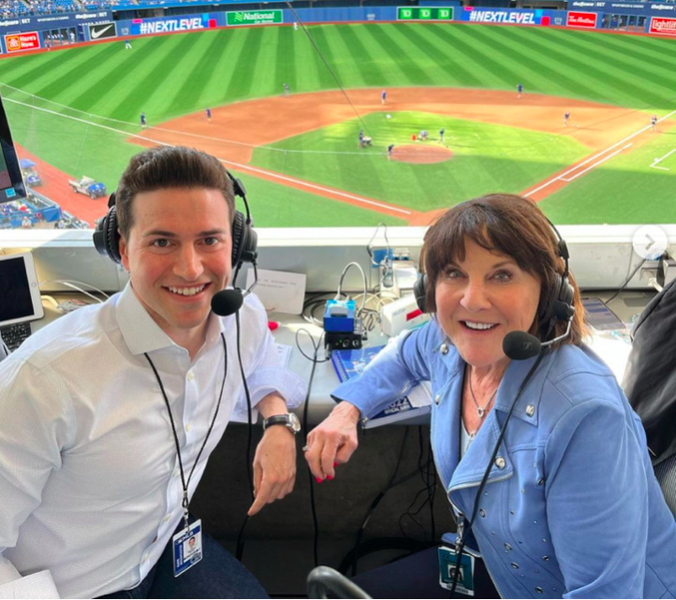
There is really no good excuse for this one, just reasons, but I’m trying, I really am.
Major League Baseball is making a concerted effort to get more women into the baseball broadcast booths for both radio and TV. I don’t know if this is a DEI-inspired initiative or just a rational response to a long-lasting gender prejudice. Either way, there is no reason why a woman who knows the game, has a pleasing voice and is an experienced broadcaster shouldn’t be doing play-by-play or color commentary.
I am not used to it, however; nobody is. Baseball games to loyal fans are the voices of Vin Scully, Earnie Harwell, Mel Allen, Curt Gowdy, Harry Carey, and the rest. It didn’t help that the first prominent national baseball female broadcaster was whoever the young softball star was who was put in a three-person ESPN Sunday Night Baseball booth next to Alex (yecchh!) Rodriguez several years ago. Cheatin’ A-Rod was terrible as always, but she was embarrassing: NOW should have petitioned to have her fired. She was cute, which I suspect was the major reason she got the job, but most of the time she was giggling or laughing. She set the cause of female baseball broadcasting back at least a decade.
As it happens, the longest-running female broadcaster is terrific, and I have always found her so: Susan Waldman (above), who has been the color commentator for New York Yankees radio broadcasts since 2005. Waldman makes sharp observations, is funny, has a rich, unique voice (she is an excellent singer), and never, ever, giggles.
The fact that there are no ex-major league players who are female and unlikely to be any surely limits the pool of women likely to land a baseball broadcasting job. The trailblazers, as is always the case, better be superb (unlike Gigglepuss), and there are not that many opportunities currently for women to gain experience, overcome bad vocal habits (like vocal fry) and to win biased fans like me over.
I find male announcers, newsreaders, radio hosts, actors, public speakers and even singers easier to listen to; I think men are less prone to speech pathologies, and I have felt that way as long as I can remember. I also recognize that this preference is partially, and perhaps completely, the result of a cultural attitude that may have no substantive justification at all. Some studies posit that lower voices have more authority than high, female voices because the latter evokes children. Okay…but there are plenty of women with rich speaking voices who don’t sound anything like a child.
So I’m rooting for women to successfully take their place in the “catbird seat” as Red Barber called it. Just don’t expect me to like it right away.
 Ethics Alarms
“I find male announcers, newsreaders, radio hosts, actors, public speakers and even singers easier to listen to…” Because they are. “I think men are less prone to speech pathologies…” Because they are.
I’m not sure why this is so and perhaps I should do some research before hitting the keyboard. Women seem prone to use voice affectations to get what they want, to cover insecurities, or to even position themselves when in a group of other women. The vocal fry drives me crazy and I have been tempted, many times, to tell a woman to knock if off, that she’s doing herself no favors.
I have a low voice for a woman and have often been told I have a voice for radio (which I suppose is better than being told I have a face for radio,) or asked if I do voice-over work. I’ve done a fair amount of narration. I’m aware that that my resonant voice is a gift of genetics and I’m grateful; however, I firmly believe that women (and men) can benefit from learning how to effectively use the voice they were given and, more importantly, how to drop bad habits. Yes, my low voice absolutely lends authority to what I say. It has served me well. Especially when I have no clue what I’m talking about.
Hey, call me so I can hear your voice! I have long advocated women taking vocal training, and offered to do it. I am trying to convince a bar association to let e coach speakers and litigators. Women go through their 20s often trying to sound girlish and using their head voice exclusively, then they find themselves at a disadvantage in management. Everyone has a head voice and a chest voice, and the trick is to learn the shift. (Elvis did! All of his early hits were using his head voice, then he shifted to using his chest voice almost exclusively—but he always had both.
It is insane that most women don’t bother to learn how to modulate their voices—it’s not hard, and it makes a huge difference in how they are perceived.
Funny you mention coaching. I was once asked if I would help a female attorney who was being chastised in court because her voice was too soft and hard to hear. Alas, I am not a vocal coach. While I might be able to hear the problem, I don’t necessarily know how to offer techniques that might help.
“(I’ve) often been told I have a voice for radio.”
Do tell…I’m told I have a <i><b>face</i></b> for radio…
PWS
Saying anything good about anything connected with the Yankees must have been painful for you, Jack. Have you heard Jenny Cavnar, hired this season to be the play-by-play lead for the Oakland A’s? You might want to find some examples of her work online. As someone who spent nearly 40 years at the business end of a microphone, including my own couple of seasons of college baseball play-by-play, I’d say I know something about the topic. And I’d say that, Iike Waldman in New York, Cavnar’s also very good in the role.
Yes, I have heard her and I agree: she’s excellent. I couldn’t think of her name or what team she worked for. Thanks.
Here is a funny youtube video that claims to be an example of vocal fry
Women play by play is fine. Women color commentators are not fine. Please don’t insult me by having a women’s softball player tell me how to hit a slider. Same with basketball. Doris Burke is the worst thing that’s ever happened to basketball announcing. I have to turn off the sound if she’s calling a game. Ann Meyers Drysdale is fine though. She respects the game. Doris Burke us just a know-nothing, New York jerk.
It depends on what kind of “color” you want. Before old players started taking over the role, “color” was simply comments, stories, details and stats that enhanced the broadcast. I could do that kind of “color” and do it damn well: Waldman is that kind of color-person. She knows the game and the team very well and her comments are interesting and well chosen. And shes better than 75% of the ex-players who have her job elsewhere.