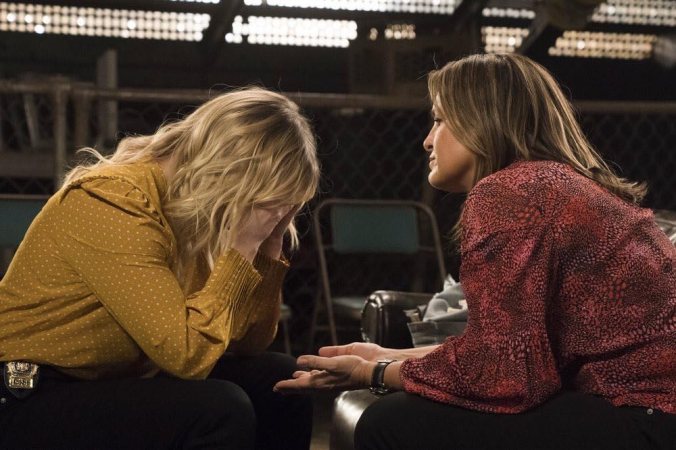
I got sick of “Law and Order: SVU” long ago, so this 2019 episode, from the 20th season (and it’s still going!) escaped my ethics radar until I reached it by accident this morning and had to watch the whole thing as an obligation to Ethics Alarms.
The episode titled “Part 33” is a perfect example of how popular culture is corrupting American values and ethics problem-solving skills with Hollywood’s constant propaganda opposing personal responsibility, the Rule of Law, and promoting emotion-based judgement rather than decisions based on fact and logic.
The plot of “Part 33” involves a woman who shot and killed her police officer husband. She has admitted this to the show’s detectives, mainly show star Mariska Hargitay’s Lieutenant Benson. She also has admitted that she was never physically abused, just terrified by him from years of psychological abuse. Prosecutor Peter Stone (he’s the sone of Ben Stone, from the original “Law and Order”) is seeking a murder verdict, but the arresting officers and Benson are shown arguing passionately about how they should frame their testimonies in court. Yes, the murder victim was a fellow cop, but wasn’t the wife the real victim?
What follows is a dizzying parade of appeals to emotion, feminist bias, rationalizations, contrived analogies, speculation, really bad arguments, and really, really bad law. The worst of these come from the mouth of Olivia Benson, the show’s alleged conscience. Hargitay is a passionate advocate forvictims of domestic abuse among other noble causes, and in this episode clearly enlisted the help of the writers—who essentially work for her, since she controls the series— to push her position on viewers. Yet the facts of the fictional case should not be seen as ambiguous: the wife is guilty.
1. She was not being beaten, raped or threatened with serious injury when she shot her husband.
2. Though she is described as terrified of her husband, she had sufficient freedom and autonomy to leave the marriage before she felt it necessary to murder him.
Benson and her colleagues imply that the law should make the woman’s situation a justification for self-defense, but this is obviously a untenable solution. A better solution: be careful whom you marry, and as soon as your spouse starts frightening you, follow the sage advice of the Amityville Horror House and “Get out!” No, it’s not easy, but shooting your husband instead isn’t an option, so that’s the only legal choice.
The cops debate lying on the witness stand to get the woman acquitted. Along the way, they display bias and conflicts of interest (Benson was held hostage at gunpoint in one series plot line, and falsely analogizes her terror with that of the killer wife; an arresting officer’s father has been physically abusive to her mother). They mouth touchy-feely nostrums: “Law without empathy doesn’t work” says Benson, thus mitigating illegal immigration, shoplifting, Black Lives Matter riots and all the other crimes woke Hollywood doesn’t think should be prosecuted. Another officer suggest that Benson should lie on the stand, as he cites an anecdote about him throwing back a magnificent trout that he had battled while fishing: “Anything that fights that hard to live deserves to be free.” (Actually, the fish had a legitimate self-defense claim whereas the wife did not; luckily, it didn’t have a gun.)
An ethically untrained and ignorant fan—that is, most of them— of the show would come away with the belief that lying under oath can be justified, that the ends justify the means, that women should be held to lesser standards of conduct than men, that the solution to dealing with laws you don’t like is to ignore them rather than to work to change them ,that bias is a valid justification for making decisions, and that rationalizations are ethical.
[I’m pausing right now to review the list and see how many of the rationalizations were evoked during “Part 33.” Excuse me…I’ll be back in a bit…]
OK…the count is 29 rationalizations alluded to or nicked in “Part 33”. I found several others that could have been used, but it was only an hour-long show.
Once, long ago, when most TV sets were still black-and-white, TV dramas and even sitcoms like “The Andy Griffith Show” conveyed sound ethical values and taught ethics problem-solving while tuning-up the public’s ethics alarms. Now popular entertainment mostly promotes chaos and situational ethics. Those that still follow the old model, like Tom Selleck’s pro-family, pro-faith, pro-law enforcement drama “Blue Bloods,” are rare and dwindling.
 Ethics Alarms
“SVU” was almost always too weird for my taste. And then even the original “Law & Order” went woke. Yuck.