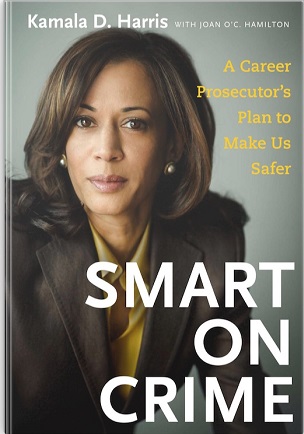
The basic story is here. Christopher Rufo, the same conservative writer and gadfly who exposed ex-Harvard President Claudine Gay’s serial plagiarism leading to her resignation, determined that “several passages” in Vice President Kamala Harris’ first book (2009’s “Smart on Crime: A Career Prosecutor’s Plan to Make Us Safer” with co-author Joan O’C Hamilton) were taken from Wikipedia and other sources without proper attribution.
Ethics Observations:
1. The passages flagged by Rufo on his Substack consist of about 500 words in an approximately 65,000-word, 200-page book. Apparently all of the unattributed sections are descriptions and sections relaying statistics, rather than substantive analysis or opinions. I have not read the book or checked Rufo’s analysis. The New York Times review of the relevant sections concluded that the 500 word lifts can be characterized that way.
2. Jonathan Bailey, a plagiarism consultant and the publisher of Plagiarism Today, was contacted by the Times. He opined that, given the length of the book, the plagiarism was technical rather than serious, and probably just carelessness rather than resulting from an intent to defraud. If the Times description is accurate, I agree. It’s carelessness, and quite probably a mistake made by others Harris employed to help her write the book. Books like Harris’s, quickly written as political PR, are frequently, I might even say usually, riddled with nuts-and-bolts copying like this. Harris is not a scholar, and the book should not be judged by the same standards as a scholarly work, where proper attribution is essential.
3. The New York Times headline is another “Republicans pounce” classic: “Conservative Activist Seizes on Passages From Harris Book.” In this case, however, that framing is arguably justified. There are so many substantive examples of Harris lying and cheating professionally, trying to make a scandal out of careless footnoting in a 15-year-old book is petty and distracts from more important examples of Harris’s phoniness.
4. Democrats being what they have become, the reflex response of Harris’s team was deny, deny, deny. Stupid, stupid, stupid. “This is a book that’s been out for 15 years, and the vice president clearly cited sources and statistics in footnotes and endnotes throughout,” said a campaign spokesman. Wrong! If Harris plagiarized, how long ago she did it is irrelevant. As a lawyer, Harris knowingly engaging in plagiarism would be an ethical violation. Moreover, obviously Harris didn’t cite sources and statistics in footnotes and endnotes “throughout”: she didn’t cite them in the sections Rufo flagged.
5. The ethical response would be: “The Vice-President regrets the error, which was a result of carelessness, and apologizes to those whose writing she inadvertently used without proper attribution.” Harris, however, is not ethical, and her staff seems to lack ethics alarms as well. It figures…
6. The Times, as is now its pattern, can’t report the story straight. It says, “Known for his work opposing diversity, equity and inclusion programs, Mr. Rufo, a senior fellow at the Manhattan Institute, a conservative think tank, published plagiarism accusations last year that helped lead to the resignation of Harvard’s president, Claudine Gay.” Rufo didn’t make “accusations,” he thoroughly documented clear plagiarism by Gay, who as the president of a major university and an alleged scholar, should not have indulged in even careless failures to properly attribute the writings of others.
7. The Times also writes, “Mr. Rufo, who describes himself as ‘leading the fight against the left-wing ideological regime,’ said he had not evaluated academic papers or books written by former President Donald J. Trump or his Republican running mate, Senator JD Vance of Ohio, because they did not fit into the group’s hypothesis, which Mr. Rufo described as the theory that “left-wing racialist ideology leads to academic corruption.” Pretty lame there, Christopher! Of course he should have placed Trump’s and Vance’s published works under the same scrutiny as he applied to Harris’s book.
8. Asking to be embarrassed, J.D. Vance tweeted, “Lmao Kamala didn’t even write her own book!” First of all, there’s no evidence that she didn’t write the book herself, though few politicians do write their own books. Apparently she used 500 words or so with crediting the sources. That’s not the same as not writing her own book.
9. Vance is spitting in the eye of fate. Now watch a computer program find that he had inadvertently included 500 words from Flannery O’Connor stories in “Hillbilly Elegy” without realizing it, the way George Harrison ripped of “He’s So Fine” when he wrote “My Sweet Lord.”
 Ethics Alarms
I think you gave a great summary of the situation, and I completely agree with it, including your thoughts on JD Vance. He’s a smart guy and very quick on his feet, but it would have been better to just leave this one alone. He has an Everest-sized amount of ammunition at his disposal, so there’s no need to waste time on a trifle. It’s a nothing-burger.
And we can be pretty sure Kamala Harris didn’t sleep with Wikipedia.
Brilliant last line!
ouch.
jvb
Applause (I refuse to use “kudos” having been mystified when it suddenly appeared in, and became ubiquitous in, Time Magazine [remember Time?] in the ‘sixties when it was deposited in our house as if it had arrived directly from The Creator) for the Flannery O’Connor mention. Hah! But I’m guessing Vance’s book was more contemporary Ohio and Kentucky than 1950s and ’60s more coastal, Milledgeville, Georgia. My personal favorite, “The Displaced Person.”
Does JD imagine that Donald Trump wrote his own books?
Exactly. Plagiarism, which is stolen content, is not the same as “not writing your own book.” Vance knows this, too.
A great number of politicians that write their own books have actually been the contributor of the material for someone else’s editing and word-smithing. In terms of effort, the font size used for Kamala Harris’ name and Ms. Hamilton’s name on the book cover could be reversed, since it’s likely that Harris provided content and Hamilton did the actual writing.
That’s not a knock on Harris, that’s just usually the process, though the VP might be something of a unicorn in that she’s almost incomprehensible even when speaking in her native tongue.
Again, Trump/Vance have ten thousand ways to Sunday to show that Harris/Walz are uniquely unqualified to serve in the Oval Office. This “plagiarism” doesn’t need to be one of them and hopefully, this dies a quick and quiet death.
Apparently there is a little more to this story, at least according to Rufo and Bailey. He’s saying the Times cherrypicked certain levels of plagiarism leaving off some of the more serious examples (he shared these on his Twitter account). Bailey has also come forward (Again on Twitter) and said he only reviewed what the Times gave him and not the examples Rufo provided.
geewhatasurprise….
I liked the fact that pointing out the plagiarism was considered racist.
I think the bigger ethics issue is these books themselves. Who buys these hastily and shoddily put together books? Have you ever purchased or read one? Remember when Hillary Clinton tried to do book signings and there were 10 or so people there? These books sell well, however. It seems that companies buy thousands or tens of thousands of copies. This, along with many speaking fees, just seem to be legalized bribery to me.
Newt Gingrich got in a lot of trouble with one of these book scams while he was Speaker. Few of such books have many genuine readers: they are mostly used as promotional give-aways u8nless they have genuine historical interest, like Bill Clinton’s post-Presidency book. Trump will make a fortune when he does one. Meanwhile, my little Darrow book, which is damn good if I do say so myself (mostly because of Darrow) has yet to make back the advance to me and my co-author, historian Ed Larson. (Have you bought YOUR copy of “The Essential Words and Writings of Clarence Darrow”? HMMMMMMMMMMMMMM???)
I wouldn’t be surprised if all of these things boil down to some form of laundering.
The Babylon Bee shoots…and scores!!…
https://babylonbee.com/news/kamala-harris-announces-new-original-book-the-art-of-the-deal