“European explorers ushered in a wave of devastation, violence, stealing land, and widespread disease.”
—Kamala Harris in 2021, pandering to the “America is a blight on the Earth and the world would have been better without it” bloc in the Democratic Party in a Columbus Day address.
Boy, what an idiot.
But to be fair to Kamala, I’m sure she would now say that she loves Columbus, and grew up in a middle class neighborhood.
What the European explorers ushered in was discovery, freedom from religious oppression, innovation, progress, and let’s just to cut to the chase, civilization. Had there been no United States, Harris and her relatives would probably be grease spots or serving as Nazi slaves today. But never mind, why should a basic comprehension of history, science and anthropology get it the way of a candidate for President of the United States vilifying the nation she aspires to lead? When does her campaign start handing out the “Make America Primitive Again” caps?
Glenn Reynolds wrote today in part,
“I recommend Samuel Eliot Morison’s Admiral of the Ocean Sea: A Life of Christopher Columbus which takes a somewhat different position. Here’s an excerpt:
“At the end of 1492 most men in Western Europe felt exceedingly gloomy about the future. Christian civilization appeared to be shrinking in area and dividing into hostile units as its sphere contracted. For over a century there had been no important advance in natural science and registration in the universities dwindled as the instruction they offered became increasingly jejune and lifeless. Institutions were decaying, well-meaning people were growing cynical or desperate, and many intelligent men, for want of something better to do, were endeavoring to escape the present through studying the pagan past. . . .Yet, even as the chroniclers of Nuremberg were correcting their proofs from Koberger’s press, a Spanish caravel named Nina scudded before a winter gale into Lisbon with news of a discovery that was to give old Europe another chance. In a few years we find the mental picture completely changed. Strong monarchs are stamping out privy conspiracy and rebellion; the Church, purged and chastened by the Protestant Reformation, puts her house in order; new ideas flare up throughout Italy, France, Germany and the northern nations; faith in God revives and the human spirit is renewed. The change is complete and startling: A new envisagement of the world has begun, and men are no longer sighing after the imaginary golden age that lay in the distant past, but speculating as to the golden age that might possibly lie in the oncoming future.
“Christopher Columbus belonged to an age that was past, yet he became the sign and symbol of this new age of hope, glory and accomplishment. His medieval faith impelled him to a modern solution: Expansion.”
Morison’s book is superb, and I recommend it highly as an antidote to the simplistic anti-occidental prejudice of today…”
Kamala Harris is an embarrassment.
 Ethics Alarms
“Given the comparative standards of medieval technology, contact between the Americas and Europe was only ever going to come from one direction. And although it is certain that if Columbus had not made his voyage, someone else would have done so soon afterward, the fact remains it was he who had the nerve, the plan, and the sheer good fortune to go forth and prosper. History does not have to be made by nice people; in fact our tour of the Middle Ages to this point probably demonstrates that it very rarely is. So whatever Columbus’s failings, his flaws, and his prejudices, which are assuredly even more out of step with twenty-first-century pieties than they were with those of his own time, he was – and remains – one of the most important figures in the whole of the Middle Ages. And from the moment he returned from the Caribbean, it was clear he had opened up a new age in human history.” ~ Dan Jones, Power and Thrones: A New History of the Middle Ages, page 534
“History does not have to be made by nice people”
Reminds me of the feminist quote justifying being a loud, obnoxious and embarrassing woman:
“History isn’t made by well behaved women”.
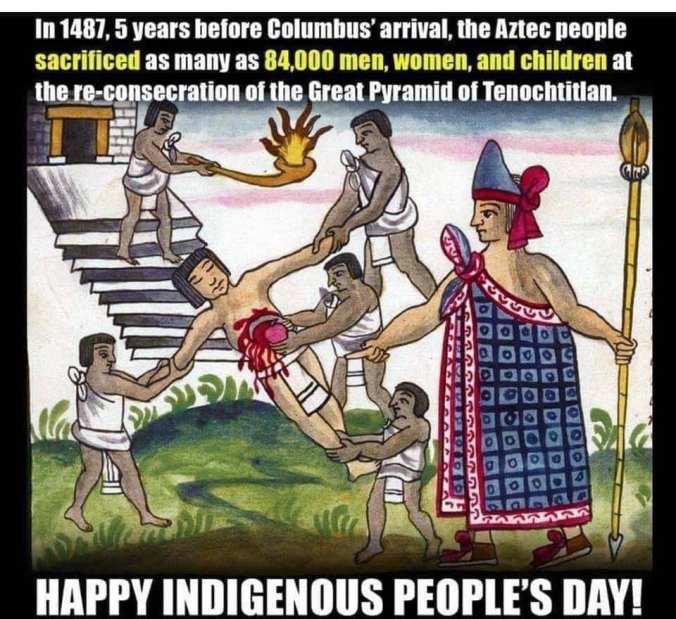
I was hoping that this would come up. The indigenous people of the Americas were not the peaceful, at one with nature, humans that inhabited the lands but instead exhibited the same, if not worse characteristics of all other people around the world. Kamala Harris is providing misinformation, or only part of the story of the indigenous people. For the life of me I am trying to figure out what we are honoring on Indigenous Peoples’s Day.
Warfare In Pre-Columbian North America – Canada.ca
Hochelaga around 1535 (Library and Archives Canada (C-10489))
Despite the myth that Aboriginals lived in happy harmony before the arrival of Europeans, war was central to the way of life of many First Nation cultures. Indeed, war was a persistent reality in all regions though, as Tom Holm has argued, it waxed in intensity, frequency and decisiveness. The causes were complex and often interrelated, springing from both individual and collective motivations and needs. At a personal level, young males often had strong incentives to participate in military operations, as brave exploits were a source of great prestige in most Aboriginal cultures. According to one Jesuit account from the 18th Century, ‘The only way to attract respect and public veneration among the Illinois is, as among the other Savages, to acquire a reputation as a skillful hunter, and particularly as a good warrior … it is what they call being a true man.’ Among west coast societies, the material goods and slaves acquired through raiding were important avenues to build up sufficient wealth to host potlatches and other give-away ceremonies. At a community level, warfare played a multifaceted role, and was waged for different reasons. Some conflicts were waged for economic and political goals, such as gaining access to resources or territory, exacting tribute from another nation or controlling trade routes. Revenge was a consistent motivating factor across North America, a factor that could lead to recurrent cycles of violence, often low intensity, which could last generations. Among the Iroquoian nations in the northeast, ‘mourning wars’ were practiced. Such conflicts involved raiding with the intent to capture prisoners, who were then adopted by bereaved families to replace family members who had died prematurely due to illness or war. Archaeological evidence confirms the prominent role of warfare in indigenous societies well before the arrival of permanent European settlers. As early as the year 1000, for example, Huron, Neutral, Petun and Iroquois villages were increasingly fortified by a timber palisade that could be nearly 10 metres in height, sometimes villages built a second or even third ring to protect them against attacks by enemy nations. Craig Keener has described how these structures became larger and more elaborate through to the 1500s, with logs as large as 24 inches in diameter being used to construct the multi-layered defences, an enormous investment in communal labour that the villagers would not have made had it not been deemed necessary.
While women played an important social and political role in indigenous societies, military activities were, like hunting, usually reserved for men. From a young age, boys were initiated into the use of weapons and were taught how to kill both animals and humans. The interrelationships between war and hunting were so close that warriors going to battle would sometimes say they were going ‘hunting for men.’
Some aspects of indigenous warfare shocked the European settlers. For example, the custom of scalping the enemy, which consisted in removing his hair by cutting off his scalp, scandalized many European observers. While some scholars have suggested that the Europeans themselves during first contact introduced this practice, it now appears certain that scalping existed well before colonization. In 1535, the explorer Jacques Cartier saw five scalps displayed in the village of Hochelaga. But while they acted indignant about the practice, the whites encouraged their allies to engage in it. In the 1630s, the British began offering a reward for the scalps of their enemies, the French followed suit in the 1680s. According to ethno-historians James Axtell and William Sturtevant, it was the Europeans (particularly the British settlers) who adopted the practice of scalping after contact with the Aboriginal peoples, prompted by the often attractive rewards paid by the colonial authorities.
Torturing prisoners was not uncommon among some indigenous cultures. According to an 18th Century account by the Jesuit Claude Allouez, who lived among the Illinois:
It is the height of glory [for a warrior] when he takes prisoners and brings them back alive. As soon as he arrives, the entire village gathers and lines up along the path the captives will take. The prisoners receive a cruel welcome: some tear out their fingernails, others cut off their fingers or ears, others beat them with sticks.
The torture was however highly ritualized and apparently its purpose was to calm the souls of people who had died violently. The prisoner was usually tied to a post and his fingernails were pulled out and various parts of his body were burned, often with a brand or red-hot metal tools. The idea was to prolong the agony for as long as possible so the captive could prove his courage and endurance. The torment usually ended at the stake, where the prisoner was finally immolated. In some cases, the victors ate the heart or part of the body of a prisoner they considered particularly courageous. The Jesuit Jean de Brébeuf, who lived among the Huron in the 1630s, explained the ritualised cannibalism in these terms: ‘if [the prisoner] was valiant, they tore out his heart, grilled it on coals and distributed pieces to the youths; they believe it gives them courage.’
Me: It is interesting that the vast majority of the inter-tribal warfare was conducted as mourning wars at the behest of the women of the tribe.
Native American Wars – Oxford Reference
Native American Wars: Warfare in Native American Societies
The significance of warfare varied tremendously among the hundreds of pre‐Columbian Native American societies, and its meanings and implications changed dramatically for all of them after European contact. Among the more densely populated Eastern Woodland cultures, warfare often served as a means of coping with grief and depopulation. Such conflict, commonly known as a “mourning war,” usually began at the behest of women who had lost a son or husband and desired the group’s male warriors to capture individuals from other groups who could replace those they had lost. Captives might help maintain a stable population or appease the grief of bereaved relatives: if the women of the tribe so demanded, captives would be ritually tortured, sometimes to death if the captive was deemed unfit for adoption into the tribe. Because the aim in warfare was to acquire captives, quick raids, as opposed to pitched battles, predominated. Warfare in Eastern Woodland cultures also allowed young males to acquire prestige or status through the demonstration of martial skill and courage. Conflicts among these groups thus stemmed as much from internal social reasons as from external relations with neighbors. Territory and commerce provided little impetus to fight.
The summary below exemplifies several rationalizations that have inculcated the belief that the indigenous people were without sin.
Summary: Slavery in Precontact America (Chapter 23) – The Cambridge World History of Slavery
This chapter describes the forms of enslavement that existed in the Americas prior to contact with the Old World. Scholars have long avoided the subject due to their concern that indigenous Americans are already too much associated with savagery. However, the time has come to gather together all that we know of the varied forms of coerced labor. The information only helps us to humanize and comprehend ancient Americans. In Mesoamerica and South America, agricultural states did demand contributions from communities of laboring people; but though these people were diempowered dependents, they were not slaves. The vast majority of those who really were enslaved were prisoners of war who were maintained as domestics, most of them women. We even have some sixteenth-century texts that reveal something of these women’s lives. Meanwhile, among the semi-sedentary peoples of North America, slavery likewise existed, as an effect of perennial warfare, but not nearly to the same extent as in the agricultural states to the south.
Had Europeans not set out to conquer new lands the indigenous people of the Americas would still be living in pre-historic conditions or at least be as impoverished as most African and some central American nations.
Europeans did exactly to the indigenous tribes what the indigenous tribes were doing to each other for 40,000 years. They were just better at it because they were more technologically advanced.
“European explorers ushered in a wave of devastation, violence, stealing land, and widespread disease.”
How does Kamala reconcile the above statement with her open borders stance? If I recall correctly a President who tried to limit the influx of people to prevent violence and widespread disease was deemed a xenophobic bigot and racist.
Yeah, you would think that obvious hypocrisy might occur to her or someone on her team.
I mean, how can they be opposed to European settlers arriving in the new world? Some poor members of a minority race show up on the shores of the continent seeking asylum from their oppressive society. What could be wrong with that?
Living as we do in Apache territory, I’m glad that particular raider and pillager specialist tribe was neutralized decades ago. They were truly non-discriminatory. They raided and pillaged anyone and everyone, regardless of their race, creed or color. Or tribe.
So funny that the anti-Columbus movement has been turned on its head as being ill advised for risking the Italian American vote. I think this post and the comments have done a nice job demonstrating we are all Italians (or Spanish Jews!) when it comes to Columbus’ significance in World History.