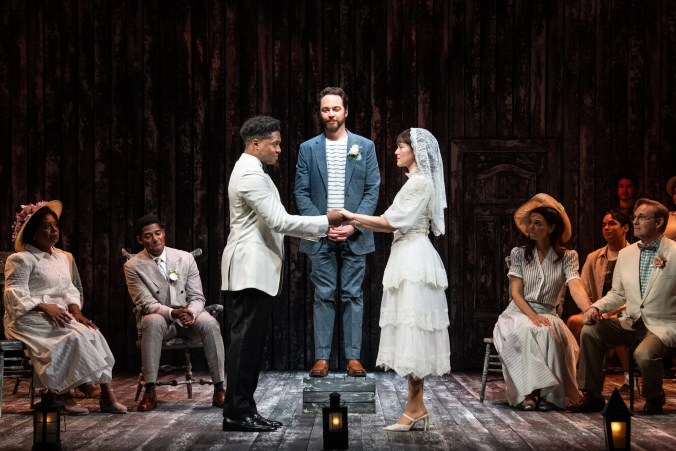
Yet another revival of Thornton Wilder’s “Our Town” has opened on Broadway. It’s a genuine classic: my late, lamented theater company devoted to classic American plays never produced it in 20 years because we were restricted to “forgotten and under-performed” shows, and though it has been 86 years since its debut, “Our Town” remains a standard part of the American repertory in colleges, community theaters and professional theaters.
Although the play is about life , love and death in a turn of the century New England town, the new production is multi-racial, indeed contriving a bi-racial romance, which was about as likely in 1901 New England as the arrival of a herd of centaurs. There are other aggressive updates to make the play “relevant” as well: anachronistic costumes, the suggestion of an interfaith wedding (more likely in the real setting of the play than centaurs, but not by much) with Freya Ridings 2017 hit “Lost Without You” being sung during that wedding. Regular readers here know my standard for assessing such directorial intrusions: if it works, it’s fine. However, I also recall an old theater mentor whose mantra was, “When presenting a classic, make sure that it will be appropriate for an audience member seeing it for the first time, and one who will see it for the last time.” These riffs by director Kenny Leon sound like the inspiration of someone who has seen “Our Town” too many times, but then, to be fair, I haven’t seen this production. The Times reviewer certainly liked it, [That’s a gift link!] but whether this was because of its wokeness or its genuine value as live theater only he could say.
What I am mostly interested in from a drama ethics perspective is the show’s gimmick of having various smells pumped into the theater, heliotrope in Act I, vanilla in Act II, and bacon in Act III. In a podcast, Leon said that he wanted to add scents because the Wilder concept is so spare: no sets, no props. He felt that the show needed additional sensory stimulation.
Really? The playwright’s purpose was to remove such distractions and focus on character and emotion; the third act reveals that what we all see during our lives as gray, everyday routine is really rich with the magic of life and human existence. Is the smell of bacon an enhancement of that message? Again: if it works, then the trick is jake with me.
And yet I heard a recent audience member on the Sirius-XM Broadway channel talking about seeing the production, and she commented that the bacon smell had her convinced that the theater shared a wall with restaurant kitchen, She spent minutes pondering where it was coming from, and became convinced that she was having an olfactory hallucination. That’s called “being taken out of the performance,” and if it was a common reaction to the unscripted smells in Grover’s Corner, it means that the stunt did not work.
 Ethics Alarms
I’m convinced there’s a whole world of opportunity here – scents are deeply connected to memory, and one of the most under-utilized senses to intentionally manipulate. That being said, it is uncommon to utilize, and so early attempts to do so well undoubtedly be ham- handed and unsubtle. Scent design by its very nature would need to be as subtle as lighting design – if the audience notices it, you’re doing it wrong. It’s a subtle manipulation, but audiences are paying to come in and be manipulated, so that’s ok. I would say that this is perhaps not the best play for it to be used in, and the fact that the audience was pulled out of the play by it means that it was not used successfully.
I would say that this is perhaps not the best play for it to be used in.
Bingo. I can think of lots of plays (and musicals) in which aromas would be enhancements.
I saw “Our Town” probably during college, done professionally, and within the last few years, done by the local high school. I have to say, I think it’s just awful. Thornton Wilder looking down on “small town” people. It might as well be titled, “The Deplorables.” How would that be for a woke update? What an insufferable prig he must have been.
There is, as my more self-consciously erudite colleagues might say, a lot to unpack here.
First off, yes, productions—mostly bad ones—of Our Town are more ubiquitous than zits on prom night. I’ve always thought the play was over-rated, even compared to some of Wilder’s other work: I really like The Skin of Our Teeth, and I enjoyed acting in the one-act The Long Christmas Dinner a couple of decades ago. But, although it’s trendy to disparage Our Town as a chestnut, I’ve never actually disliked it, either. Yes, maybe “never” is too strong: I certainly wasn’t a fan when I had to read it in a high school English class, but, like the plays of Chekhov, it’s better understood by adults. I’ve never seen a really great production of it, but I’m willing to grant that such a performance might indeed be riveting.
One of the biggest problems I’ve encountered in the handful of productions I have seen is that directors don’t want to do this play. They don’t want to be bound by Wilder’s minimalist aesthetic, which, like impressionism in painting, suggests a reality without attempting to recreate it literally. Some productions pay lip service to Wilder’s famous use of step-ladders to serve as second stories in houses, but still can’t resist throwing in innumerable props or realistic set pieces. I overheard one of the technicians for one production complaining about how difficult it was to surreptitiously get the screen set up for the projections. Projections? For Our Town? Uh, no.
Be it noted: I have often (read: “almost always”) done things differently than the original production. When I directed Macbeth a few years ago, I cast a black man in the title role and a woman as his wife; neither could have occurred in 1606 England. We used a lot of lighting and sound effects, including some music written in the 21st century. And so on.
The difference, though, is that Shakespeare wasn’t rejecting contemporary (to him) staging practices. All actors were white and male; you can’t do elaborate lighting effects for an afternoon performance at an outdoor theatre, etc. Wilder, on the other hand, specifically rejected illusionistic scenery and similar attempts to make the stage action more “real”: the standard practices of his day. Our Town is not realism, and it suffers if it’s treated as if it is.
That’s why, like Jack, I strongly suspect the use of smell is more ostentatious than helpful. When a playwright seeks to limit sensory impulses, you’re not really serving the mission if you want to add more. Of course, there are times in realism when adding the aroma of stale grease for a play set in a seedy diner or burning a little oregano to approximate the smell of marijuana can work to a production’s advantage. But Our Town is not merely not realism, it’s self-consciously anti-realism.
I am therefore relatively unconcerned with whether the audience is pulled out of the moment, at least briefly, by the use of lighting, sound, smell, or any other stimulus. (Can you tell I’ve been working on my Brecht lecture this morning?) I also have no complaint with casting non-white actors in a play ostensibly set in a place where such characters would not be present. On the other hand, casting for this production seems intended to make a statement that ultimately distracts from what Wilder had to say, which was very much about suggesting the universal by means of the very specific, indeed. As Jesse Green says in his review, we all “sooner or later wind up at Act III.” But the play gets its power from our ability to recognize precisely that universality, an effect intensified by the fact that in so many ways we are, all of us, different from the residents of Grover’s Corners in the first few years of the 20th century.
Along these lines, the review doesn’t say whether the actors used a rural New Hampshire dialect. The last time I saw Our Town, they didn’t, and it seemed wrong. At first, I thought it was my own parochialism—I’m a native New Hampshirite—but I soon realized that it was the actors’ failure to capture the rhythm of the speech, which Wilder captured quite well (for a Midwesterner, at least). But that’s a different matter…
Anyway, no, I don’t think I’d rush out to by a ticket to this production. If someone gave me a comp, though, and I was already in New York, my curiosity might just get the better of me.
Wonderful, helpful analysis Curmie, as usual.
I had the good fortune to be in Our Town With a community theater group to which I belonged. It was a great deal of fun to be in that play. There was actually some cast/audience Interaction that was hilarious.