
In a post three days ago, Ethics Alarms examined Christopher Rufo’s claim that Kamala Harris engaged in plagiarism in her first book, and concluded, based on the New York Times reportage, that unlike, for example, the substantial plagiarism indulged in by ex-Harvard president Claudine Gay, prompting her exit, Harris’s uncredited lifting and copying (in a book written with a co-writer, or maybe not written by Harris at all) was careless and accidental rather than deliberate.
Now another metaphorical shoe has dropped.
The Times claimed to show plagiarism expert Jonathan Bailey the passages Rufo cited as plagiarized. It reported that he ruled that the material taken without attribution “were not serious, given the size of the document.” Now Bailey writes that he was unaware of a full dossier with additional allegations.” That means that the Times gave readers the impression that he had seen all of the questionable sections when he had not.
Now that he has reviewed everything, Bailey’s conclusion is a bit different. He writes that he now believes that the “case is more serious than I commented to the New York Times.” And with that, we are thrust into a sick version of Johnny Carson’s launching pad quiz show, “Who Do You Trust?” I will not leave you in any unnecessary suspense : the answer is “Nobody.”
1. The Times absolutely gave the impression that it had Bailey look at all of the purported plagiarism in Harris’s book flagged by Rufo.
2. Bailey outed himself as a likely Axis ally by twisting facts to cover for the Times. After stating that he did not see the whole “dossier” when he commented to the Times (because the Times didn’t show it to him for reasons unknown), Bailey writes that although the selective plagiarism examples he received from the Times were not the complete group and he had not been made aware of that, leading “some to accuse the New York Times of withholding that information” from him, “the article clearly stated that it was my ‘initial reaction’ to those allegations, not a complete analysis. “
False. It did not “clearly state” that Bailey’s verdict was based on only a partial review of the material, only that his statement was his “initial reaction.” That “clearly” means “initial reaction” to what he was shown, not a reaction to only a portion of the passages at issue. Why is Bailey spinning for the Times? Your guess si as good asmine. Maybe he wants Harris to win. Matbe he likes being a Times contact and doesn’t want to criticize them. Either way, that deceit on his part makes his further opinions on this matter untrustworthy.
3. Rufo, on “X”, described Bailey’s article this way…
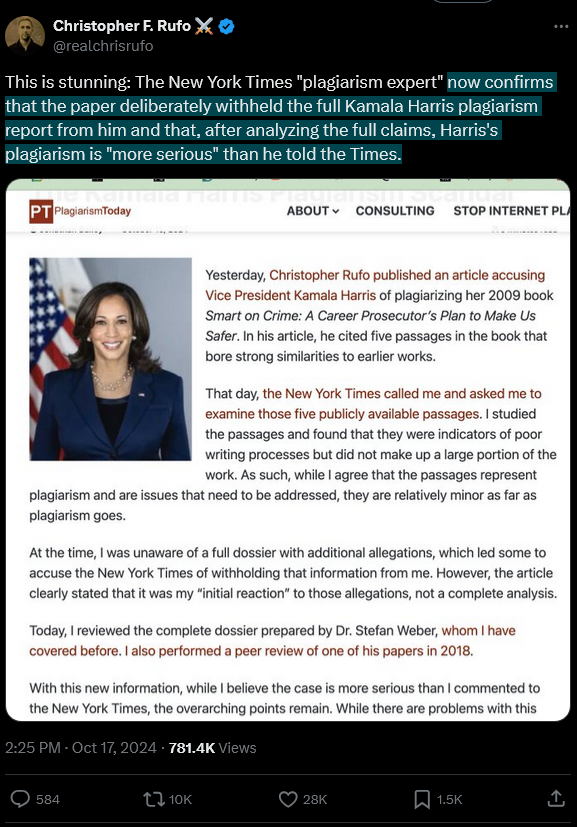
That is misleading to the point of being a lie. Bailey did not state that the Times “deliberately” withheld the whole dossier. Rufo also leaves out the part where Bailey says that while the additional passages make the plagiarism “more serious,” they didn’t change his over-all conclusion: “While there are problems with this work, the pattern points to sloppy writing habits, not a malicious intent to defraud.”
In sum, then:
- The Times misled their plagiarism expert and got him to say that Rufo’s accusations were nothing to make a “bid deal” over without seeing all the controversial passages.
- Bailey, the expert misrepresented the Times’ conduct and deceptive reporting.
- Rufo, the conservative gadfly, misled his readers regarding Bailey’s conclusion and findings.
- Harris, of course, is a walking, talking human lie in everything she does and says at this point.
How do engaged, interested citizens learn what is going on when all sides and all parties manipulate facts like this?
They don’t.
Simple as that.
 Ethics Alarms
At the end of the day, there’s a pyramid size pile of reasons not to trust Kamala Harris to be our next president that this plagiarism episode in its best or in its worst is a literal grain of sand compared to that pyramid.
Oh…and the Kamala Harris pyramid is an analogously tiny brick in an even larger pyramid of reasons that every…single…member of the democrat party should never be trusted with governance for the next 100 years.
Don’t be satisfied Republicans – while you’ll get my vote for many good reasons – you’re also building your own sphinx in the necropolis of American politics.
In any event, it just puts Harris further into the Claudine Gay cadre of over-promoted DEI frauds. These hacks just can’t pass up book deals.
And speaking of which, why have AOC, Tlaib, and all the other members of the Squad gone so silent and disappeared as the election is drawing to a close? The Dems don’t want their slip showing?
“In any event, it just puts Harris further into the Claudine Gay cadre of over-promoted DEI frauds.”
THERE it is!
PWS
No kidding. I had to wrestle myself to the floor not to mock a Facebook friend who wrote that complaints that Harris didn’t answer Baier’s questions were false. “She answered them very well: you just didn’t agree with the answers.” I guess from now on “But Trump is terrible!” is considered a substantive answer to all questions about anything. (Of course, in Jeopardy it would have to be in the form of a question…)
Generously assuming a net 19 minute duration, Harris mentioned Trump 25 times in that short interview; 1.31 per minute for those scoring at home.
PWS
So was there a quota? Perhaps an over/under in Las Vegas?
Was there a fund raising multiple based on how many times she uttered “Trump” (maybe extra points for “But Trump”.
Inquiring minds want to know.
Assuming Baier spoke half the time, (IMO it was more than half) a more accurate figure would be 2.62 Trump mentions per minute
I am going to need some clarification on this as it it appears in conflict with an earlier passage:
Jack:
Initially stated : Now that he has reviewed everything, Bailey’s conclusion is a bit different. He writes that he now believes that the “case is more serious than I commented to the New York Times.” This suggests that it was more serious and would change his conclusions.
A few paragraphs later: That is misleading to the point of being a lie. Bailey did not state that the Times “deliberately” withheld the whole dossier. Rufo also leaves out the part where Bailey says that while the additional passages make the plagiarism “more serious,” they didn’t change his over-all conclusion: “While there are problems with this work, the pattern points to sloppy writing habits, not a malicious intent to defraud.”
If I parse the word deliberately to its literal definition such that the Times, through considered analysis chose to only give Bailey enough to have him reach an innocuous conclusion then I agree that the word is misleading.
If on the other hand we define deliberately more figuratively such that it means that they chose to give just part of the dossier for “whatever reason” it was still a deliberate choice but without malign intent.
The other element is that there seems to be a criticism of the Times for misleading the reader in the first statement and then criticizes Rufo for leaving out exactly what was left out of the first statement above.
I am not trying to nit pick I just don’t follow the line of thought. Call me dense. As for your closing thought I have never trusted any writer, journalist or talk show personality to give my honest assessments of anything. Everyone has their individual biases, grudges or some other thing that skews their interpretation of events. Rufo, the Times, the Post(s) and especially foreign media have to be considered with an open mind that is tempered with an understanding that each is trying to influence you and not to just inform you.
At the end of the day is there any reason to think that this book by Harris was of any consequence to anyone making decisions related to criminal justice. Most of these books by political contenders, at any level, are just ego trips to claim they have been “published” and/or to serve as a vehicle to disguise contributions. Hunter’s paintings are of similar use.
No.