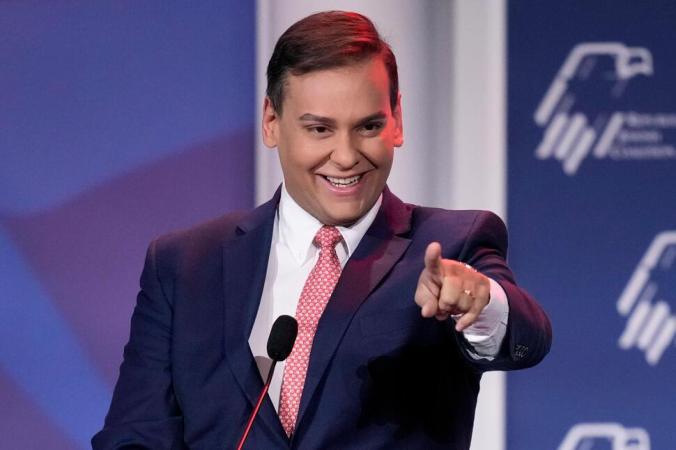
When I was writing the predecessor to Ethics Alarms, The ethics Scoreboard, I would issue “The Dirty Dozen,” a compendium of the most unethical candidates for elected office every two years. For the first election cycle in Ethics Alarms’ history, I posted on “The Untrustworthy Twenty” and thereafter, I don’t remember why, discontinued the tradition. Sloth? Hopelessness? I just forgot?
After George Santos (above) slimed his way into Congress in 2022 after lying about virtually everything, however, I resolved to resuscitate the project as depressing as it might be. In that old post (2010) I began,
“Trust is the connective tissue that holds societies together: it can be strengthened by demonstrations of ethical values like integrity, loyalty, honesty, civility, responsibility, competence, and courage, and weakened by proof of unethical traits like fecklessness, dishonesty, lack of independent judgment, selfishness, lack of diligence, greed and cowardice. For decades, the American public’s trust in its elected representatives and governmental institutions—and other critical institutions like the news media and the legal system—has been in steep decline. This is not because of some inexplicable public fad or the poisoning of public perceptions by an unholy alliance of the pop culture and Fox news. The decline in trust has occurred because a significant proportion of America’s elected leaders have not been trustworthy, and the reason this has been true is that American voters have thus far refused to make proof of ethical values their main priority in electing them. Because politicians know this, they feel empowered to engage in corruption, self-enrichment and deception in the confidence that partisan supporters will vote for them anyway, as long as they mouth the same policy positions and deliver their quota of pork, earmarks, and government contracts. This, of course, does not benefit of country in the long run, but weakens it. It also creates an increasingly arrogant and power-obsessed political class to which ethical values are like Halloween costumes, donned at regular intervals to disguise who they really are. The core principles of the democratic process do not matter to many of these people, and they don’t see why they should matter.”
Isn’t itreassuring to know that things haven’t changed in 14 years? In fact, they have: they are much worse. I could easily compile an unethical 50, or 100. The two most untrustworthy major party candidates for President of the United States ever to face off in a Presidential election are on the ballot tomorrow, to succeed a a strong competitor for Worst President Ever who has made such a mess of the office and our traditional Presidential election process that the political system may never recover. In that 2010 post, I wrote,
“Public trust cannot keep declining indefinitely, you know. Eventually, a government that cannot be trusted will collapse. Just as addressing America’s fiscal crisis will take hard measures and sacrifice, addressing its equally dangerous crisis in trust requires sacrifice too. It will require voters to establish the principle that being “effective,” experienced or having the “right” policy positions will not be enough to justify electing or re-electing individuals who are demonstrably trustworthy. Voters must establish untrustworthiness as absolutely disqualifying a candidate for election to public office. Any ethical, honest candidate with integrity must be seen as per se preferable to a corrupt, dishonest or unethical candidate, regardless of past achievements or policy views.”
I still believe that, despite being forced to vote for an untrustworthy candidate in this election because a cruel or sadistic god has chosen to make him the only available option to combat an organized and relentless effort to unmake the United States as it was envisioned by its Founders.
In that post, I offered a list of factors that do not justify determining that a candidate is necessarily untrustworthy:
- Isolated verbal gaffes that are plausibly innocent mistakes.
- Unsubstantiated accusations, rumors or suppositions.
- Embarrassing private photos that pre-date the candidate’s political career.
- Any conduct, statement or opinion that was not a crime or that did not cause genuine harm occurring in college or more than two decades ago.
- Reversals in policy positions or actions inconsistent with campaign promises, that can reasonable be attributed to changed circumstances, new perspective, justifiable political strategy, or a good faith change in opinion.
- Mere associations or friendships with individuals who have shady or questionable reputations.
- Almost anything said in a private conversation that has been recorded or allegedly overheard, other than criminal conspiracies and admissions of corruption.
- Any inappropriate action or comment for which the candidate apologizes freely, spontaneously, credibly and sincerely.
- Representations of unpopular or unsavory clients in a candidate’s legal career.
- Misconduct by the candidate’s family members that had not been denied, covered up, or enabled by the candidate.
What kind of conduct does show that a candidate is too untrustworthy to elect? The Ethics Alarms “Untrustworthy Twenty” should make that pretty clear.
I’ll reveal these in Part II.
In the meantime, nominations are welcome.
_____________________________________
 Ethics Alarms