48 thoughts on “Pop Ethics Quiz! What Is The Ethical Response To An Adult Who Posts This Fatuous Meme…”
It is a little disheartening that the younger generation interprets “free” in that context to mean “with no immediate financial cost” as opposed to “experiencing freedom”, but it might be because American freedom died at some point.
I’ve never quite been able to square the circle on how you consider yourselves free… Your citizens do not have the same level of freedom that most of the developed world does. You have criminalized more actions, you incarcerate more people, and you put them in for-profit prisons where their labor is exploited. Sure… You can carry different kinds of guns, but what’s the point in having them when you’re so in love with the taste of boot?
The last time we had this discussion, Zoltar Witherspoon was complaining bitterly about being blocked from interacting with the personal Facebook account of a school board member with whom he was having a hissy fit, because he was purposefully misinterpreting her and refusing to engage with what she was saying, and she got sick of him calling her names. Her threatened to sue her, as I recall… Not sure how that worked out.
The point I made was that the most common charge against students arrested out of school was “resisting arrest”, and at some point we should ask ourselves things like: What level of bad behavior should rise to the level where there ought to be an arrest made for the student to resist?
Because if we weren’t arresting students for being disruptive, perhaps we wouldn’t then be saddling secondary students with juvenile records for secondary charges.
The response to that was: “Well the kids shouldn’t be disruptive, and then the kids shouldn’t resist arrest!”
Which… Is probably true. “Probably” because “disruptive” seems to mean different things to different people, so your mileage may vary, but for the sake of argument, I can grant that and still make my point:
If instead of saddling 10-year-olds with juvenile records and incarcerating them, being disruptive and resisting arrests were being treated as capital offenses, I have to assume that the people in the “just don’t break laws” crowd wouldn’t be suggesting the 10-year-olds ought to die because they resisted arrest.
I expect that they’d say “of course kids that are disruptive don’t deserve the death penalty, that is gross and disproportionate. I expect that because I believe you to be rational, thinking human beings, and this seems obvious. Please don’t prove me wrong.
Following that though, if you believe that punishments ought to be proportionate, then there are limits to the “fuck around, find out” school of judicial punishment, and we ought to be able to ask where those lines are.
Because “American Freedom” proponents seem to get caught in this trap, where they seem to believe that everyone should have freedom, at least until they break a law, and then all bets are off.
Which seems like a very bootlicking mindset, if you never question whether the law ought to exist. Instead of shutting down and saying truisms like “don’t break the law and you won’t be punished” we should ask questions, like:
-Should the behavior be illegal? -If so, should it be criminal? -If so, are the fines/incarceration times reasonable?
And if the answer is No… Then the problem isn’t merely that the person broke the law, is it?
Society (the people) determined which activities are legal, and which are not. Ensuing penalties, either monetary or incarceration (at both state and federal levels), are also defined, with both upper and lower limits.
How the people set these laws and the limits of penalty associated with breaking the laws is by electing people to represent them. It’s the foundation of the country, the legal system, and freedoms. It’s not perfect, no system is. The fundamental idea is to not allow the government carte blanche. Americans don’t want “our betters” deciding what’s best for us.
Many Americans retain the sense of skepticism and distrust of the government the founders had. A recent example is the pandemic. How often did we hear the concern over the non-compliance of Americans? Why, millions weren’t getting vaccinated! People lost their jobs and businesses because they didn’t want to bend to suspicious (at best) science. Even when the government offered money to be vaccinated, millions still did not. Freedom isn’t just about not being imprisoned physically, it’s a mental state of not submitting, thinking independently, and standing up for what you believe in.
Society (the people) determined which activities are legal, and which are not.
I’m skeptical that the people, if asked, would support all the laws as written, but really… Who cares?
The question wasn’t whether the petty tyranny of the American judicial system was come to democratically, it’s whether people living happily under it can rationally call themselves free.
I didn’t bring it up though. You think I did because you’re so sure that America is obviously more free than other nations that you can’t even engage with my point: That you aren’t.
It doesn’t matter if your people were to directly vote for the laws, my point would be the same: You have those laws on the books.
Honestly, I didn’t think so many people would give up the argument, agree with me, and then defend the process by which the laws came to be.
Maybe “check your taxes?” or “check your individual rights?” or my dad’s favorite “name the last five European medical breakthroughs?” You could also ask them how many French roasted in their apartments while the officials were all on vacation down the Mediterranean coast. There’s also the joke about French rifles for sale that have never been fired and only been dropped once. I mean, this is like shooting fish in a barrel.
Ok, now shave your head, swear to have no more sex so that you don’t infest the earth with more idiots, and then get on the first plane out of the country you despise.
That’s barely germane. I do appreciate your demonstration that the word “need” is subjective and vacuous unless it’s used in the context of a specific purpose (e.g. “if you intend to accompish X, you need Y.”)
However, for that very reason, the conversation isn’t about what people “need,” but about what minimum standards of compensation people are willing to accept in exchange for their efforts, and how much people think society should invest in people in order that people have what they need in order to build lives for themselves and contribute more useful skills to their communities and to society.
As opposed to the American system, where… who decides what level of healthcare you receive? How is that working out for you?
The point of contention isn’t that healthcare systems like the one in Canada are perfect–it’s that they’re better than the one in the United States. What would you say to support the idea that the United States healthcare system is better?
Personally, I think we can do better than both models. I only have experience with the United States healthcare system, and I’m not terribly impressed with its diligence or transparency.
The US has a care on demand model of health care. If you go to the emergency room with a broken leg, you get an x-ray, and either a boot or a cast, even if you cannot pay.
In some other countries, you get an appointment. My friend broke her leg while living in Canada with her Canadian husband. She was issued crutches at the hospital, and an appointment to see a Dr in 6 weeks. At which time, they had to re-break and set her leg, and then she was casted. Unfortunately, her healing time was longer due to the re-break, not to mention the 6 week wait to see someone about her leg. That for me is a fine example of how our health care system is better.
I’m not saying our system is without flaws. Costs are crazy, red tape is an issue, and the ACA is a crumbling mess.
Until we have some sort of proof the government can do a good job with engineering a functioning health care system, I’d rather keep what we have.
That is entirely fair. Lousy emergency care is an excellent example of a tradeoff that we prefer not to make. I’d rather keep what we have while we come up with something better and implement it effectively as well.
The ethical response is to stop thinking in black and white. Maybe they’re not completely right, but are they completely wrong? You think something they said is inaccurate or otherwise wrong in a way that causes a problem. Why is that? What’s the error? What’s the problem the error causes?
Now what is the problem that they see that they are criticizing? Do you think it’s not a problem, or do you think it’s a problem that calls for a different solution from what what they are implying?
Or do you think it’s a problem that people just need to deal with? In my experience, most political conflict is based on people disagreeing about which problems other people should “just deal with,” without trying to figure out ways to help people deal with those problems.
Yes, they are completely wrong. Freedom and getting government paid handouts and entitlements are unrelated, and, arguably, contradictory. Freedom(liberty) means doing what you choose with your own money that you earn, not having to turn it over to the government to decide what to so with it in their infinite wisdom. Taxes pay for specific government activities that cannot be performed individually: national defense, law enforcement, transportation infrastructure, utilities. Giving government power to do more with citizens’ money isn’t more freedom, but less. Individual programs that violate this principle can be justified (like Social Security and Medicare), but they also are slippery slopes if they are nor recognized as exceptions.
My buddy says his big issue is income inequality, that a few people make way too much and a bunch of people make way too little so some of that money of the way too rich should be taken from them and given to the way too poor. Of course, he always assumes he’s not too rich. But who decides who’s too rich and who’s too poor? Those will be the people in power in his utopia. And those people with that power will enrich themselves. See, eg., Soviet Russia, Cuba, China, North Korea, Venezuela. Heck, see, eg., the Obamas and the Clintons and the Pelosis and the Warrens.
You have to understand where they’re coming from before you can comment on things like this. It’s cheap and easy to just say that the youngs are wrong because they don’t understand, but really… You don’t understand.
The problem isn’t inequality, you could have quadrillionaires living on Uranus and it wouldn’t matter so much if the upcoming generation could at least maintain the standard of living their parents had. The problem is that they will not, and it has nothing to do with effort or spending habits, or the number of hours worked.
They could work 10 hours a day, seven days a week, at $15 an hour, save every penny after paying deductions, taxes, rent, utilities and food, and still not be able to even make a down payment on a home.
And let’s be real: Their parent’s generation did not have to work that hard.
The same people who bought their homes in 1980 for $30,000 and a wheel of cheese are sitting back smugly in homes now worth half a million dollars watching kids try to wrangle 10% down payments and pretend that something is wrong with them.
Real numbers:
1980 Average Salary: $12,500 Average Home Price: $47,200 (3.78x)
2024 Average Salary: $62,000 Average Home Price: $501,100 (8.08x)
They’re looking for handouts because the system is genuinely stacked against them. Homeownership is a pipe dream for the average zoomer, without a significant amount of generational wealth from a family willing to help.
This isn’t a problem you can cure by forgoing Netflix subscriptions and avocado toast.
And I focused on homes because everything stems from home ownership, your ability to leverage borrowing and build equity is fundamental to financial health.
They wouldn’t be looking for handouts if they could actually afford things.
They wouldn’t be so disengaged if they saw a path to success.
If it’s one kid, they’re an idiot.
If it’s a friend group, they’re coincidentally idiots together.
But If it’s an entire generation, there’s something seriously wrong.
But having different challenges because of problems and new developments and conditions has nothing to do with “freedom,” which is the issue. The US standard of living is still ridiculously high in comparison with almost anywhere else. Are you talking about housing? That’s a problem of relatively recent vintage: that meme didn’t mention it at all. There are ways to address the high cost in housing that don’t involve the government buying homes or subsidizing rent while everyone’s taxes go up.
Meanwhile building generational wealth was once a shared societal value. Freedom also means the freedom to be selfish and stupid—and to accept the consequences of those choices.
“Different Challenges” in that context is a euphemism. Home ownership is not a “challenge” to these kids any more than a 20 meter high jump is to me: It is a functional impossibility without intervention.
And again… Home ownership is so far outside these kids expectation window that they don’t even think about it as a possibility. Health care? That’s possible. Some PTO? Might be in the cards. Owning a home? Silly talk.
You can’t build a whole, responsible adult this way. You can’t look at symptoms and ignore the cause. We have presented an entire generation of kids with a life trajectory fundamentally more broken then the one we faced, and are surprised that they aren’t behaving the same as we did.
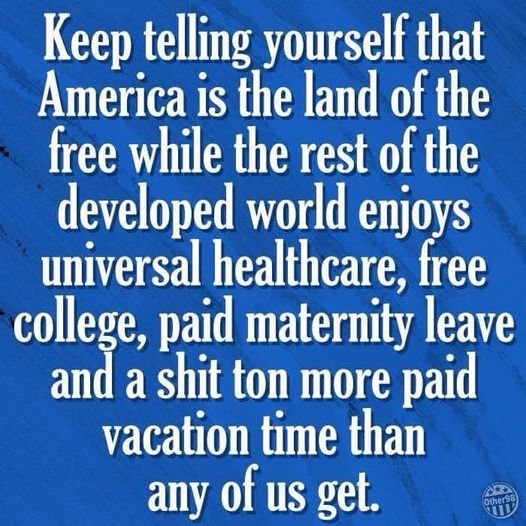
This however is, perhaps inadvertently, spot on:
Freedom also means the freedom to be selfish and stupid—and to accept the consequences of those choices.
I acknowledge in advance that I may be interpreting the meaning of the graphic more intelligently than the original poster meant it, but I refuse to ignore a valid point just because it may not have been the one someone intended to make.
I’m not interpreting this graphic as saying “America isn’t free because it doesn’t have these things.”
I’m interpreting it as saying “Conservatives keep using ‘freedom’ as an excuse to leave poor people to rot in an economy that they can barely afford to participate in, let alone take responsibility for.”
It’s not an assertion that security is worth giving up freedom. It’s an accusation of people saying that freedom requires being economically insecure in these particular ways.
“Freedom also means the freedom to be selfish and stupid—and to accept the consequences of those choices.”
That sounds like the sort of thing a Christian would say, that all hardship is brought on ourselves and if we’re virtuous then we will prosper. Any hardship that’s not brought on ourselves doesn’t exist, or is a necessary sacrifice for keeping the system going so that we can be “free” and, on average (mean, not median), prosperous.
Conservatives seldom acknowledge that in addition to freedom from government control, people also want freedom from corporate control. People don’t want corporations to crowd out small businesses. People don’t want corporations to set all the terms for employment.
You can’t keep glossing over real problems that people face and the forces that create those problems, just because you don’t like the ideas that they suggest for solving those problems. Give them a break; they’re only human. You’re smart; come up with something better for them to ask for.
Yes, that’s what I’ve been saying. Freedom isn’t at stake here. The issue is costs. People are dealing with insurmountable costs, because of government spending and because of powerful businesses. Regardless of whether things were better in the past or not, people see that things could be better than they are now. They want to work to improve their situations, but the paths to do so are often unrealistic or will only carry a limited number of people at once, whether inherently or artificially. Just because people don’t have great ideas for fixing problems doesn’t mean that you can just dismiss the problems themselves.
If you think that free college is a foolish idea, that’s fine. I think you may very well be right. I expressed my feelings on the issue in response to Demeter. The trap is to say that because free college a foolish idea, we can therefore conclude that the people suggesting it are the source of their own problems and we need not spend any effort figuring out better policies.
I would be happy to leave prosperity to the economy and conflict to the government. The thing is, poverty causes conflict. When people are desperate, it’s difficult for them to trust other people and vice versa. To prevent conflict, the government has an interest in keeping people from becoming desperate. People can still be uncomfortable if they don’t work to better their situation, but sometimes they need someone else to pull them out of desperate. I consider that a good investment.
It IS a problem at least in part caused by that universal rule “One generation’s luxuries becomes the next generation’s necessities.”
I don’t know about you, but I grew up (in the late 80s to 90s) sharing a bedroom in a house that was about 300 sq ft per person. Even now, driving back to my parents’ neighborhood is interesting. The average home size is probably 1,500 sq ft except for the ones that have been demoed and rebuilt or otherwise added on to.
So I looked up some numbers. Average home size in 1984 was about 1,700 sq ft, and in 2024 it’s about 2,500. I just checked on Zillow in my area, which is probably pretty average for the United States, and homes under $350k are plentiful but small (compared to my standards), at usually somewhere between 1400 to 1800 sq ft. Not small compared to the standards of 40 years ago, though. I would expect that better materials, more stringent building codes, and higher expectations for the quality and quantity of appliances probably plays a big role in increased costs as well.
Yes, 2021 was a bad year for people who didn’t own a home already, but it’s not nearly the insurmountable obstacle you lay out. I started my career in the aughts as a professional making $50k and buying a $250k home. I know for a fact that recent grads in my field are starting out between $65-90k, which would put a $400k home within reach. Not a 3,000 sq ft home in a nice neighborhood, but that’s not where I started either.
Yes, 2021 was a bad year for people who didn’t own a home already, but it’s not nearly the insurmountable obstacle you lay out. I started my career in the aughts as a professional making $50k and buying a $250k home. I know for a fact that recent grads in my field are starting out between $65-90k, which would put a $400k home within reach. Not a 3,000 sq ft home in a nice neighborhood, but that’s not where I started either.
Cheese-wheelery.
There’s levels of out-of-touchedness to this…
Not everyone is going to go to post-secondary education, and you shouldn’t have to to be able to buy a home. People used to be able to work entry level positions and buy homes, and arguments like this focus on the ever narrowing avenue where it might be technically possible to succeed if only the person we’re talking about did an ever more narrow series of feats.
I don’t care what worked for you. This isn’t about you. The lion’s share of an entire generation gave up on the American dream, it can’t possible be blamed on how they weren’t all like you.
But just to try to drive this home. If you were born 20 years later and did the exact same things, you probably couldn’t buy a home either.
Off the top – The only thing giving housing inflation a run for it’s money is the cost of an education. I have no idea what your degree was, but look up what it would cost to get it now, I think the average inflation between 2000 and 2020 is like, and the difference is probably about 200%.
But let’s ignore that. Let’s pretend that not only did you graduate, but you somehow graduated without any student debt. Let’s pretend that you had managed to save up the $80,000 down payment required to get an uninsured mortgage. Let’s even say that you were able to secure a good interest rate by today’s standards and you were able to get that $90,000/year job.
I picked Texas because there aren’t any state income taxes, but there are still Federal ones and FICA. Your $90,000 salary is immediately reduced to $71,000.
The cost of mortgaging a $400,000 home in Texas over 30 years, fixed at 6% interest and an $80,000 down payment is $2,600 a month or $31,200 a year.
Property Tax rates in the Lone Star state are 1.6% or $6400.
Transportation is $1000/month. Food is $500/month. Utilities are $500/month. Health Insurance is $600/month. Homeowner’s Insurance is $250/month.
Total is $2850/month or $34,200/year.
$90,000 became $71,000 after income taxes, which became $39,800 after mortgage payments, which became $33,400 after property taxes, which became $(800.00) after transportation, food, utilities, health insurance and homeowners insurance.
If you had $80,000 in cash after graduating, with no student debt, no dependents, no phone, no cable, no clothes, no entertainment, didn’t contribute to a pension, and cut your own hair… You’d only have to figure out how to cut $800 from my schedule to break even.
But most people won’t have $80,000 laying around after graduating. Most won’t even have $20,000. Most people will have about $100,000 in debt for a degree, less if you live with your parents. Most people have a phone. The mortgage rate is actually 7.3% right now, and you probably won’t get that as a first time home buyer. Most people wear clothes. Most people get haircuts. Some people want to watch TV. Some people want to go out on a date.
But maybe I’m missing something, the complexities of American health insurance elude me, maybe it’s baked into FICA, maybe I overestimated a number somewhere, maybe your home is within walking distance of work, or even better: You work from home!
Fine. It’s possible, but I built a lot of conservative assumptions into some of my top-line numbers. So let’s say that reality asserts itself…
The cost of mortgaging a $400,000 home in Texas over 30 years, fixed at 7.3% interest and an $20,000 down payment is $3500 a month or $42,000 a year.
Unfortunately, your 5% down was not enough to forgo the mortgage insurance requirement, so you have to pay an additional 1% ($4000/year) in insurance costs.
And those pesky student loans… $50,000 over 10 years? at 6%? $550/month or $6600.00 year.
Great news though: Property taxes are the exact same, at $6400.
So…. $90,000 less 19,000 in income taxes and FICA, $42,000 in mortgage, $4000 in mortgage insurance, $6600 in student loan financing, and $6400 in property taxes…. Is $12,000.
I just went back and looked at my taxes and withholdings when I was making $90K. Total fed was $5,900, state was $0 (I lived in NV), and FICA was $7.5k. I had a wife and child, and maybe the tax benefits of having a wife and child make up the extra costs of them, but I severely doubt it. I don’t know how significantly that would change with Trump’s tax changes and don’t care enough to figure it out, but I believe most people with children are better off under his plan than I was back then. But the point is that I’d either have a much better tax position than you’re positing OR I’d buy a much smaller house with no family and/or sublet it and reduce my housing costs significantly.
Plus, your math is off on the mortgage for some reason. A $320,000 loan (20% down) at 6% would be $1,900 a month, $2,200 a month if you can put down only 5%. Add in insurance and escrow and it’s probably $2,600 a month, maybe $2,800 a month with mortgage insurance. If you’re finding significantly higher numbers (like Texas’ horrible property taxes) then live somewhere cheaper. I’ve lived in 3 perfectly good states where my property taxes never exceeded $3k per year.
So $77K after taxes and $35k in mortgage (including home insurance and property taxes) leaves about $42k for everything else. Again, all I can go off of is my own experience, but utilities should be more in the $150 per month range, transportation in the $400 per month range, and your health insurance is horrible. My health insurance isn’t great and I’m insuring a whole family for just under $3k per year. I’m sure I’m missing some important categories, but I’m getting about $1,250 in monthly necessities or $15k per year, leaving $27k for those student loans.
But people don’t want to live like this. They think they should be able to live in San Francisco, or have a car payment of $1000 a month, or whatever makes their lives so much more expensive than mine. And they think the system is broken because they can’t, and that their parents had a much easier time than they did. Maybe their parents did have an easier time, but it was with a significantly reduced quality of living.
I had a wife and child, and maybe the tax benefits of having a wife and child make up the extra costs of them, but I severely doubt it.
It would… When you file jointly, it doubles your minimum tax exemption, a dependant adds something to it too. I don’t know why you would dig back in your old records to be wrong when you can just Google the calculator.
Plus, your math is off on the mortgage for some reason. A $320,000 loan (20% down) at 6% would be $1,900 a month, $2,200 a month if you can put down only 5%.
Good catch: The calculator I used is here. They actually included the property taxes in the amount, which means I double counted it.
Texas’ horrible property taxes
I mean…. Some people live in New York where they pay 8.8% in State income tax. Some places have municipal taxes. I picked a red state assuming that the fees would be generally low.
but utilities should be more in the $150 per month range
Gas, Electricity and Water? $150? For a $400,000 home? I’m skeptical.
But it’s irrelevant.
Let’s use your numbers: That situation is predicated on a person making $90,000 a year, which is two standard deviation over normal, fresh out of uni. It requires them to have $20,000 in cash. This is not a normal experience.
The constant face palming and *sigh*ing is annoying, especially considering you’re using random websites with no regard to their reliability or methodologies to argue with someone who actually lives in the United States (and who almost definitely knows the tax laws better than you).
Yes, my taxes were lower because of my dependents. I acknowledged that. But was my life cheaper than without them? Not likely. Which is exactly what I said.
“I mean…. Some people live in New York where they pay 8.8% in State income tax.”
And my example, even without 5% down and with a high state income tax, left plenty of room to save for a down payment on a real home.
You’re way off on transportation, health care costs, utilities (I’ll admit I was thinking of only gas and electric. With water, sewer, Internet, etc., you’re likely more in the $250-300 range), to the degree that even a moderately more expensive house (and you don’t seem to want to acknowledge that a very big chunk, probably at least 60%+ of the inflation in home prices, is due to a significantly higher quality/size of homes) doesn’t come anywhere close to precluding the American Dream.
Now, kids who have no perspective, who live on Reddit, think they should be able to afford a $40k car, live in a high cost area, buy a nice home, and eat out whenever they feel like it. THEY probably feel like the American Dream is dead, because they don’t know that their parents had crap: one crap car, a tiny house with no garage, laminate countertops, cheap appliances, and a swamp cooler. They almost never ate out or went world traveling or splurged on a fancy purchase. And this was after 10 years of working full time.
This absolutely was the standard in a solidly middle class family in the 1980s. The standard of living has increased so much since then that what I just described seems downright third world.
So someone who didn’t go to college, doesn’t have $20k saved up, and doesn’t earn $90k at age 22, what are they to do? Exactly what they would have done 40 years ago. Either save for many years to buy a home (which has always been the norm), buy a condo, rent to roommates, or go live in podunk Iowa. That hasn’t changed in the last 5 years, and I don’t imagine it ever will. Only 30% of 25 year-olds own their own home right now. Millennials, at that same age, had lower levels of home ownership at 28% and Gen Xers were at 27%. Boomers were slightly higher at 32%. The vast majority of people buy a home in their late 20s to early 30s, and so far that hasn’t changed.
I sighed (and that’s literally the only time I’ve done that this year, asshole) because not only are you absolutely wrong, but you seem like the kind of person who likes to argue for the sake of arguing…. And don’t get me wrong, I’m often right there…. But you are obviously so far out of your depth that I’m experiencing empathetic embarrassment on your behalf, even though you don’t feel any.
There is a housing affordability crisis. No one is confused by this. It is obviously effecting the upcoming generation more than it effects anyone else, and whether or not you decide to admit that you’re a cheese-wheeler, you are.
People in your generation did not have to work as hard as people in this generation will have to to own a home. Mathematically. Objectively. Unambiguously. And if you want to bury your head in the sand and break out your 20 year old tax filings to try to disprove literally every economic forum in America… Go ham.
I never said it wasn’t harder to own a home today than it was 20 years ago. What I said was that it’s not nearly as insurmountable as the young’uns are saying, and that much of the difficulty comes from an increase in the quality of today’s standard of living, rather than a failure of markets or society.
“And if you want to bury your head in the sand and break out your 20 year old tax filings to try to disprove literally every economic forum in America…”
Just like with the comment about my tax situation, you seem to be misreading what I wrote. I never claimed that dependents might not lower my tax bill, and I am not disproving your assertion that homes are more expensive than they were before. I am disproving your hypothetical calculation (which you admitted you lack direct knowledge about). You claim that the American Dream is dead and that home ownership is out of reach for an entire generation. That is not what every economic forum in America thinks and is obviously false–ownership levels remain similar to prior generations.
But you ignore my claims you can’t argue with and instead attack me. I’m not sure why you’re getting so antagonistic, or on what basis you think I’m out of my depth, but you’re welcome to your opinions.
So, as Junkmail has mentioned, you do have some flaws in your math.
I am a tax professional, so I have a good knowledge of the US tax code. A married couple with a child, making $90k will have a federal tax bill, including FICA and Medicare, in the neighborhood of $13800 per year. If you’re paying off student loans, that would lower your tax bill perhaps $500.
Mortgage calculator: $320k at 6% per year is about $1900. $380k at 7.3% per year is about $2600.
My monthly homeowner’s insurance, for a 2100 square foot house with a full basement, is about $160 per month. If we had a $400k house, I’d assume it would be cheaper.
The other items in your budget we could quibble about. What would matter is where your priority might be. If your priority is to own your own house, you may get a cheaper car, you may economize on food or entertainment, etc. If your priority is having the very best car, you may economize on housing and rent. There are options.
Yes, I agree that there is a housing shortage here. I was interested to read the article Jack referenced to get an idea of what is causing it and what has helped drive prices up. It was not a surprise that zoning and other government regulation are a major component.
We’ve become much more of a risk averse society. One of the consequences of that is that things in general cost more and take longer to make. That and we’ve become a lot more credential demanding, which also tends to drive up costs and make services scarcer.
However you calculate the numbers, and whatever they end up being, people here who really want something will tend to shape their lives to achieve those goals. People who don’t have goals will tend not to achieve them.
Yeah…. I didn’t even try to be particularly accurate because my expertise is Canadian tax, my assumption was that it wouldn’t matter because it wouldn’t even be close.
Remember: All of that math was predicated on a person making $90k a year, with at least $20k in their pocket. For most people, starting out, they’d be lucky to make half that and not already be in debt.
We shouldn’t have to squint and say: “Yeah, if an entire generation does everything right, gets an education, is financially literate, and is perfectly responsible there are possible avenues to home ownership.”
Because that wasn’t the deal a generation ago.
I’m sorry if my responses came off as antagonistic, Humble Talent. They were not meant to be.
The point of my exercise was to show that someone in a very good spot ($90k starting salary and a healthy down payment) has a whole lot of wiggle room–to the tune of $20-$27k per year with more realistic expenses.
Someone who doesn’t have $20k and a more average salary doesn’t have that wiggle room. They may not even be able to afford a nice home. And with housing prices jumping in 2021, it has become even harder. But they could almost definitely afford a house, just not the one they think they deserve. The problem is multifaceted, and the zoomers who claim the sky is falling are wrong. Much of the housing crisis is caused by an abundance of larger, nicer homes. So when they look at homes in their budget, which were very much the average home 40 years ago but are very subpar by today’s standards, they are shocked. They look at their parents’ homes and cars and wonder when society changed to make that impossible for them, not realizing it took their parents 20+ years to get there.
And that’s likely why home ownership stats have changed. The same type of person who bought a home at 25 years old 60 years ago will still find a way to buy a home today. I wouldn’t be surprised if the stats start to trend slightly downward in the next few years, as the marginal home buyers are priced out. But we also have a huge glut of boomers who are now in their 70s and will soon be vacating their homes.
You’re asking the wrong question. The question isn’t “is there a problem and who needs to fix it” the question is: are they just a bunch of complainers who do nothing to contribute or are they trying? Just like in Atlas Shrugged. Are they relying on everyone else to provide their own basic needs for them? Do they feel they are entitled to these things for free without any effort?
One more point is this country is actually more inclined to personal autonomy. We are not historically a society that limits personal choices, even self destructive ones. When people’s personal choices create poor results, they suddenly want everyone else to “do something” on their behalf. That list reeks of people who think they’re owed something just for existing. Hand up, not hand out, if you know what I mean. The “gee it must be nice” folks who wish they had that classic car their neighbor spent every weekend in the garage for years fixing up instead of having a 6 pack and watching the game.
Which is better, in your opinion? To let everyone go to college for free and pay for it in perpetuity with increased taxes or to pay for your own self with a commitment of Time or money. Don’t kid yourself, absolutely nothing is “free” it’s just how the cost is distributed and what about people who start a business or work in trades instead? Do they get like compensation? No. It’s a personal choice to attend college. My kid just got accepted to art school. She has a scholarship. Ie the college sees some form of potential. I think the first issue is we need to verify there is an actual problem. Besides, have you ever had or been around teens? What do they generally value more? The thing they got for “free” or what was earned by them? Even the kids where their parents pay for it, many of them see the cost in time and money their parents pay. Or are you saying poor kids can’t earn scholarships or find a way to pay for their college?
Speaking for myself, I would prefer publicly funded education through high school that taught people what they needed to know to be mature, capable adults (unless community organizations would like to take on part of that role; no, I don’t trust human parents to be well-rounded or well-adjusted enough to handle that all by themselves. I’ve met humans.) Any specialized education after that could be paid for with scholarships, loans, and/or part-time jobs if we can deflate the cost of education a bit. How does that sound? I’m working to get humanity to the point where they can be trusted to handle public education.
 Ethics Alarms
It is a little disheartening that the younger generation interprets “free” in that context to mean “with no immediate financial cost” as opposed to “experiencing freedom”, but it might be because American freedom died at some point.
I’ve never quite been able to square the circle on how you consider yourselves free… Your citizens do not have the same level of freedom that most of the developed world does. You have criminalized more actions, you incarcerate more people, and you put them in for-profit prisons where their labor is exploited. Sure… You can carry different kinds of guns, but what’s the point in having them when you’re so in love with the taste of boot?
Comment of the Day, if one that I regard as a hanging curve over the center of the plate…
I’m ready!
For preparation:
The last time we had this discussion, Zoltar Witherspoon was complaining bitterly about being blocked from interacting with the personal Facebook account of a school board member with whom he was having a hissy fit, because he was purposefully misinterpreting her and refusing to engage with what she was saying, and she got sick of him calling her names. Her threatened to sue her, as I recall… Not sure how that worked out.
The point I made was that the most common charge against students arrested out of school was “resisting arrest”, and at some point we should ask ourselves things like: What level of bad behavior should rise to the level where there ought to be an arrest made for the student to resist?
Because if we weren’t arresting students for being disruptive, perhaps we wouldn’t then be saddling secondary students with juvenile records for secondary charges.
The response to that was: “Well the kids shouldn’t be disruptive, and then the kids shouldn’t resist arrest!”
Which… Is probably true. “Probably” because “disruptive” seems to mean different things to different people, so your mileage may vary, but for the sake of argument, I can grant that and still make my point:
If instead of saddling 10-year-olds with juvenile records and incarcerating them, being disruptive and resisting arrests were being treated as capital offenses, I have to assume that the people in the “just don’t break laws” crowd wouldn’t be suggesting the 10-year-olds ought to die because they resisted arrest.
I expect that they’d say “of course kids that are disruptive don’t deserve the death penalty, that is gross and disproportionate. I expect that because I believe you to be rational, thinking human beings, and this seems obvious. Please don’t prove me wrong.
Following that though, if you believe that punishments ought to be proportionate, then there are limits to the “fuck around, find out” school of judicial punishment, and we ought to be able to ask where those lines are.
Because “American Freedom” proponents seem to get caught in this trap, where they seem to believe that everyone should have freedom, at least until they break a law, and then all bets are off.
Which seems like a very bootlicking mindset, if you never question whether the law ought to exist. Instead of shutting down and saying truisms like “don’t break the law and you won’t be punished” we should ask questions, like:
-Should the behavior be illegal?
-If so, should it be criminal?
-If so, are the fines/incarceration times reasonable?
And if the answer is No… Then the problem isn’t merely that the person broke the law, is it?
Society (the people) determined which activities are legal, and which are not. Ensuing penalties, either monetary or incarceration (at both state and federal levels), are also defined, with both upper and lower limits.
How the people set these laws and the limits of penalty associated with breaking the laws is by electing people to represent them. It’s the foundation of the country, the legal system, and freedoms. It’s not perfect, no system is. The fundamental idea is to not allow the government carte blanche. Americans don’t want “our betters” deciding what’s best for us.
Many Americans retain the sense of skepticism and distrust of the government the founders had. A recent example is the pandemic. How often did we hear the concern over the non-compliance of Americans? Why, millions weren’t getting vaccinated! People lost their jobs and businesses because they didn’t want to bend to suspicious (at best) science. Even when the government offered money to be vaccinated, millions still did not. Freedom isn’t just about not being imprisoned physically, it’s a mental state of not submitting, thinking independently, and standing up for what you believe in.
Society (the people) determined which activities are legal, and which are not.
I’m skeptical that the people, if asked, would support all the laws as written, but really… Who cares?
The question wasn’t whether the petty tyranny of the American judicial system was come to democratically, it’s whether people living happily under it can rationally call themselves free.
Who cares? You brought it up, so I assumed you cared.
Is your premise that the only free people are those who can run amuck? Being free means freedom to choose, not freedom from consequences.
I didn’t bring it up though. You think I did because you’re so sure that America is obviously more free than other nations that you can’t even engage with my point: That you aren’t.
It doesn’t matter if your people were to directly vote for the laws, my point would be the same: You have those laws on the books.
Honestly, I didn’t think so many people would give up the argument, agree with me, and then defend the process by which the laws came to be.
Maybe “check your taxes?” or “check your individual rights?” or my dad’s favorite “name the last five European medical breakthroughs?” You could also ask them how many French roasted in their apartments while the officials were all on vacation down the Mediterranean coast. There’s also the joke about French rifles for sale that have never been fired and only been dropped once. I mean, this is like shooting fish in a barrel.
Ok, shave your head, promise to have no sex so that you don’t breed more idiots, and get the hell out of Dodge…the first plane out of the country!
Ok, now shave your head, swear to have no more sex so that you don’t infest the earth with more idiots, and then get on the first plane out of the country you despise.
In this country, there used to be a state like that. In this state:
You got all the food you needed for free.
You got all the housing you needed for free.
You got all the healthcare you needed for free.
You got all the education you needed for free.
You got all the time off you needed.
You got all the maternity leave you needed.
You were guaranteed a job for as long as you could work.
This state was the state of slavery.
That’s barely germane. I do appreciate your demonstration that the word “need” is subjective and vacuous unless it’s used in the context of a specific purpose (e.g. “if you intend to accompish X, you need Y.”)
However, for that very reason, the conversation isn’t about what people “need,” but about what minimum standards of compensation people are willing to accept in exchange for their efforts, and how much people think society should invest in people in order that people have what they need in order to build lives for themselves and contribute more useful skills to their communities and to society.
Once you let 1 entity provide all of those things for you, you will get whatever THEY decide you need, not what YOU think you deserve.
Over 4% of Canadian deaths are now at the hands of the Canadian government because THEY decide what healthcare you need.
As opposed to the American system, where… who decides what level of healthcare you receive? How is that working out for you?
The point of contention isn’t that healthcare systems like the one in Canada are perfect–it’s that they’re better than the one in the United States. What would you say to support the idea that the United States healthcare system is better?
Personally, I think we can do better than both models. I only have experience with the United States healthcare system, and I’m not terribly impressed with its diligence or transparency.
The US has a care on demand model of health care. If you go to the emergency room with a broken leg, you get an x-ray, and either a boot or a cast, even if you cannot pay.
In some other countries, you get an appointment. My friend broke her leg while living in Canada with her Canadian husband. She was issued crutches at the hospital, and an appointment to see a Dr in 6 weeks. At which time, they had to re-break and set her leg, and then she was casted. Unfortunately, her healing time was longer due to the re-break, not to mention the 6 week wait to see someone about her leg. That for me is a fine example of how our health care system is better.
I’m not saying our system is without flaws. Costs are crazy, red tape is an issue, and the ACA is a crumbling mess.
Until we have some sort of proof the government can do a good job with engineering a functioning health care system, I’d rather keep what we have.
That is entirely fair. Lousy emergency care is an excellent example of a tradeoff that we prefer not to make. I’d rather keep what we have while we come up with something better and implement it effectively as well.
The ethical response is to stop thinking in black and white. Maybe they’re not completely right, but are they completely wrong? You think something they said is inaccurate or otherwise wrong in a way that causes a problem. Why is that? What’s the error? What’s the problem the error causes?
Now what is the problem that they see that they are criticizing? Do you think it’s not a problem, or do you think it’s a problem that calls for a different solution from what what they are implying?
Or do you think it’s a problem that people just need to deal with? In my experience, most political conflict is based on people disagreeing about which problems other people should “just deal with,” without trying to figure out ways to help people deal with those problems.
Yes, they are completely wrong. Freedom and getting government paid handouts and entitlements are unrelated, and, arguably, contradictory. Freedom(liberty) means doing what you choose with your own money that you earn, not having to turn it over to the government to decide what to so with it in their infinite wisdom. Taxes pay for specific government activities that cannot be performed individually: national defense, law enforcement, transportation infrastructure, utilities. Giving government power to do more with citizens’ money isn’t more freedom, but less. Individual programs that violate this principle can be justified (like Social Security and Medicare), but they also are slippery slopes if they are nor recognized as exceptions.
My buddy says his big issue is income inequality, that a few people make way too much and a bunch of people make way too little so some of that money of the way too rich should be taken from them and given to the way too poor. Of course, he always assumes he’s not too rich. But who decides who’s too rich and who’s too poor? Those will be the people in power in his utopia. And those people with that power will enrich themselves. See, eg., Soviet Russia, Cuba, China, North Korea, Venezuela. Heck, see, eg., the Obamas and the Clintons and the Pelosis and the Warrens.
You have to understand where they’re coming from before you can comment on things like this. It’s cheap and easy to just say that the youngs are wrong because they don’t understand, but really… You don’t understand.
The problem isn’t inequality, you could have quadrillionaires living on Uranus and it wouldn’t matter so much if the upcoming generation could at least maintain the standard of living their parents had. The problem is that they will not, and it has nothing to do with effort or spending habits, or the number of hours worked.
They could work 10 hours a day, seven days a week, at $15 an hour, save every penny after paying deductions, taxes, rent, utilities and food, and still not be able to even make a down payment on a home.
And let’s be real: Their parent’s generation did not have to work that hard.
The same people who bought their homes in 1980 for $30,000 and a wheel of cheese are sitting back smugly in homes now worth half a million dollars watching kids try to wrangle 10% down payments and pretend that something is wrong with them.
Real numbers:
1980
Average Salary: $12,500
Average Home Price: $47,200 (3.78x)
2024
Average Salary: $62,000
Average Home Price: $501,100 (8.08x)
They’re looking for handouts because the system is genuinely stacked against them. Homeownership is a pipe dream for the average zoomer, without a significant amount of generational wealth from a family willing to help.
This isn’t a problem you can cure by forgoing Netflix subscriptions and avocado toast.
And I focused on homes because everything stems from home ownership, your ability to leverage borrowing and build equity is fundamental to financial health.
They wouldn’t be looking for handouts if they could actually afford things.
They wouldn’t be so disengaged if they saw a path to success.
If it’s one kid, they’re an idiot.
If it’s a friend group, they’re coincidentally idiots together.
But If it’s an entire generation, there’s something seriously wrong.
But having different challenges because of problems and new developments and conditions has nothing to do with “freedom,” which is the issue. The US standard of living is still ridiculously high in comparison with almost anywhere else. Are you talking about housing? That’s a problem of relatively recent vintage: that meme didn’t mention it at all. There are ways to address the high cost in housing that don’t involve the government buying homes or subsidizing rent while everyone’s taxes go up.
Meanwhile building generational wealth was once a shared societal value. Freedom also means the freedom to be selfish and stupid—and to accept the consequences of those choices.
“Different Challenges” in that context is a euphemism. Home ownership is not a “challenge” to these kids any more than a 20 meter high jump is to me: It is a functional impossibility without intervention.
And again… Home ownership is so far outside these kids expectation window that they don’t even think about it as a possibility. Health care? That’s possible. Some PTO? Might be in the cards. Owning a home? Silly talk.
You can’t build a whole, responsible adult this way. You can’t look at symptoms and ignore the cause. We have presented an entire generation of kids with a life trajectory fundamentally more broken then the one we faced, and are surprised that they aren’t behaving the same as we did.
This however is, perhaps inadvertently, spot on:
Freedom also means the freedom to be selfish and stupid—and to accept the consequences of those choices.
How do those consequences feel, boomers?
Not inadvertent at all.
Also: This, regarding the housing problem: https://www.harvardmagazine.com/2024/11/housing-affordability-crisis-boston-zoning-reforms-2024
I acknowledge in advance that I may be interpreting the meaning of the graphic more intelligently than the original poster meant it, but I refuse to ignore a valid point just because it may not have been the one someone intended to make.
I’m not interpreting this graphic as saying “America isn’t free because it doesn’t have these things.”
I’m interpreting it as saying “Conservatives keep using ‘freedom’ as an excuse to leave poor people to rot in an economy that they can barely afford to participate in, let alone take responsibility for.”
It’s not an assertion that security is worth giving up freedom. It’s an accusation of people saying that freedom requires being economically insecure in these particular ways.
“Freedom also means the freedom to be selfish and stupid—and to accept the consequences of those choices.”
That sounds like the sort of thing a Christian would say, that all hardship is brought on ourselves and if we’re virtuous then we will prosper. Any hardship that’s not brought on ourselves doesn’t exist, or is a necessary sacrifice for keeping the system going so that we can be “free” and, on average (mean, not median), prosperous.
Conservatives seldom acknowledge that in addition to freedom from government control, people also want freedom from corporate control. People don’t want corporations to crowd out small businesses. People don’t want corporations to set all the terms for employment.
You can’t keep glossing over real problems that people face and the forces that create those problems, just because you don’t like the ideas that they suggest for solving those problems. Give them a break; they’re only human. You’re smart; come up with something better for them to ask for.
A good place to start would be getting the terms right. “Freedom” is not the issue at hand.
Yes, that’s what I’ve been saying. Freedom isn’t at stake here. The issue is costs. People are dealing with insurmountable costs, because of government spending and because of powerful businesses. Regardless of whether things were better in the past or not, people see that things could be better than they are now. They want to work to improve their situations, but the paths to do so are often unrealistic or will only carry a limited number of people at once, whether inherently or artificially. Just because people don’t have great ideas for fixing problems doesn’t mean that you can just dismiss the problems themselves.
If you think that free college is a foolish idea, that’s fine. I think you may very well be right. I expressed my feelings on the issue in response to Demeter. The trap is to say that because free college a foolish idea, we can therefore conclude that the people suggesting it are the source of their own problems and we need not spend any effort figuring out better policies.
I would be happy to leave prosperity to the economy and conflict to the government. The thing is, poverty causes conflict. When people are desperate, it’s difficult for them to trust other people and vice versa. To prevent conflict, the government has an interest in keeping people from becoming desperate. People can still be uncomfortable if they don’t work to better their situation, but sometimes they need someone else to pull them out of desperate. I consider that a good investment.
It IS a problem at least in part caused by that universal rule “One generation’s luxuries becomes the next generation’s necessities.”
I don’t know about you, but I grew up (in the late 80s to 90s) sharing a bedroom in a house that was about 300 sq ft per person. Even now, driving back to my parents’ neighborhood is interesting. The average home size is probably 1,500 sq ft except for the ones that have been demoed and rebuilt or otherwise added on to.
So I looked up some numbers. Average home size in 1984 was about 1,700 sq ft, and in 2024 it’s about 2,500. I just checked on Zillow in my area, which is probably pretty average for the United States, and homes under $350k are plentiful but small (compared to my standards), at usually somewhere between 1400 to 1800 sq ft. Not small compared to the standards of 40 years ago, though. I would expect that better materials, more stringent building codes, and higher expectations for the quality and quantity of appliances probably plays a big role in increased costs as well.
Yes, 2021 was a bad year for people who didn’t own a home already, but it’s not nearly the insurmountable obstacle you lay out. I started my career in the aughts as a professional making $50k and buying a $250k home. I know for a fact that recent grads in my field are starting out between $65-90k, which would put a $400k home within reach. Not a 3,000 sq ft home in a nice neighborhood, but that’s not where I started either.
Yes, 2021 was a bad year for people who didn’t own a home already, but it’s not nearly the insurmountable obstacle you lay out. I started my career in the aughts as a professional making $50k and buying a $250k home. I know for a fact that recent grads in my field are starting out between $65-90k, which would put a $400k home within reach. Not a 3,000 sq ft home in a nice neighborhood, but that’s not where I started either.
Cheese-wheelery.
There’s levels of out-of-touchedness to this…
Not everyone is going to go to post-secondary education, and you shouldn’t have to to be able to buy a home. People used to be able to work entry level positions and buy homes, and arguments like this focus on the ever narrowing avenue where it might be technically possible to succeed if only the person we’re talking about did an ever more narrow series of feats.
I don’t care what worked for you. This isn’t about you. The lion’s share of an entire generation gave up on the American dream, it can’t possible be blamed on how they weren’t all like you.
But just to try to drive this home. If you were born 20 years later and did the exact same things, you probably couldn’t buy a home either.
Off the top – The only thing giving housing inflation a run for it’s money is the cost of an education. I have no idea what your degree was, but look up what it would cost to get it now, I think the average inflation between 2000 and 2020 is like, and the difference is probably about 200%.
But let’s ignore that. Let’s pretend that not only did you graduate, but you somehow graduated without any student debt. Let’s pretend that you had managed to save up the $80,000 down payment required to get an uninsured mortgage. Let’s even say that you were able to secure a good interest rate by today’s standards and you were able to get that $90,000/year job.
I picked Texas because there aren’t any state income taxes, but there are still Federal ones and FICA. Your $90,000 salary is immediately reduced to $71,000.
The cost of mortgaging a $400,000 home in Texas over 30 years, fixed at 6% interest and an $80,000 down payment is $2,600 a month or $31,200 a year.
Property Tax rates in the Lone Star state are 1.6% or $6400.
Costs to follow from here
The average monthly cost of:
Transportation is $1000/month.
Food is $500/month.
Utilities are $500/month.
Health Insurance is $600/month.
Homeowner’s Insurance is $250/month.
Total is $2850/month or $34,200/year.
$90,000 became
$71,000 after income taxes, which became
$39,800 after mortgage payments, which became
$33,400 after property taxes, which became
$(800.00) after transportation, food, utilities, health insurance and homeowners insurance.
If you had $80,000 in cash after graduating, with no student debt, no dependents, no phone, no cable, no clothes, no entertainment, didn’t contribute to a pension, and cut your own hair… You’d only have to figure out how to cut $800 from my schedule to break even.
But most people won’t have $80,000 laying around after graduating. Most won’t even have $20,000. Most people will have about $100,000 in debt for a degree, less if you live with your parents. Most people have a phone. The mortgage rate is actually 7.3% right now, and you probably won’t get that as a first time home buyer. Most people wear clothes. Most people get haircuts. Some people want to watch TV. Some people want to go out on a date.
But maybe I’m missing something, the complexities of American health insurance elude me, maybe it’s baked into FICA, maybe I overestimated a number somewhere, maybe your home is within walking distance of work, or even better: You work from home!
Fine. It’s possible, but I built a lot of conservative assumptions into some of my top-line numbers. So let’s say that reality asserts itself…
The cost of mortgaging a $400,000 home in Texas over 30 years, fixed at 7.3% interest and an $20,000 down payment is $3500 a month or $42,000 a year.
Unfortunately, your 5% down was not enough to forgo the mortgage insurance requirement, so you have to pay an additional 1% ($4000/year) in insurance costs.
And those pesky student loans… $50,000 over 10 years? at 6%? $550/month or $6600.00 year.
Great news though: Property taxes are the exact same, at $6400.
So…. $90,000 less 19,000 in income taxes and FICA, $42,000 in mortgage, $4000 in mortgage insurance, $6600 in student loan financing, and $6400 in property taxes…. Is $12,000.
$12,000 for… Everything else.
Nitpick away at my incidentals.
Your experience no longer exists.
I just went back and looked at my taxes and withholdings when I was making $90K. Total fed was $5,900, state was $0 (I lived in NV), and FICA was $7.5k. I had a wife and child, and maybe the tax benefits of having a wife and child make up the extra costs of them, but I severely doubt it. I don’t know how significantly that would change with Trump’s tax changes and don’t care enough to figure it out, but I believe most people with children are better off under his plan than I was back then. But the point is that I’d either have a much better tax position than you’re positing OR I’d buy a much smaller house with no family and/or sublet it and reduce my housing costs significantly.
Plus, your math is off on the mortgage for some reason. A $320,000 loan (20% down) at 6% would be $1,900 a month, $2,200 a month if you can put down only 5%. Add in insurance and escrow and it’s probably $2,600 a month, maybe $2,800 a month with mortgage insurance. If you’re finding significantly higher numbers (like Texas’ horrible property taxes) then live somewhere cheaper. I’ve lived in 3 perfectly good states where my property taxes never exceeded $3k per year.
So $77K after taxes and $35k in mortgage (including home insurance and property taxes) leaves about $42k for everything else. Again, all I can go off of is my own experience, but utilities should be more in the $150 per month range, transportation in the $400 per month range, and your health insurance is horrible. My health insurance isn’t great and I’m insuring a whole family for just under $3k per year. I’m sure I’m missing some important categories, but I’m getting about $1,250 in monthly necessities or $15k per year, leaving $27k for those student loans.
But people don’t want to live like this. They think they should be able to live in San Francisco, or have a car payment of $1000 a month, or whatever makes their lives so much more expensive than mine. And they think the system is broken because they can’t, and that their parents had a much easier time than they did. Maybe their parents did have an easier time, but it was with a significantly reduced quality of living.
*sigh*
I had a wife and child, and maybe the tax benefits of having a wife and child make up the extra costs of them, but I severely doubt it.
It would… When you file jointly, it doubles your minimum tax exemption, a dependant adds something to it too. I don’t know why you would dig back in your old records to be wrong when you can just Google the calculator.
Plus, your math is off on the mortgage for some reason. A $320,000 loan (20% down) at 6% would be $1,900 a month, $2,200 a month if you can put down only 5%.
Good catch: The calculator I used is here. They actually included the property taxes in the amount, which means I double counted it.
Texas’ horrible property taxes
I mean…. Some people live in New York where they pay 8.8% in State income tax. Some places have municipal taxes. I picked a red state assuming that the fees would be generally low.
but utilities should be more in the $150 per month range
Gas, Electricity and Water? $150? For a $400,000 home? I’m skeptical.
But it’s irrelevant.
Let’s use your numbers: That situation is predicated on a person making $90,000 a year, which is two standard deviation over normal, fresh out of uni. It requires them to have $20,000 in cash. This is not a normal experience.
The constant face palming and *sigh*ing is annoying, especially considering you’re using random websites with no regard to their reliability or methodologies to argue with someone who actually lives in the United States (and who almost definitely knows the tax laws better than you).
Yes, my taxes were lower because of my dependents. I acknowledged that. But was my life cheaper than without them? Not likely. Which is exactly what I said.
“I mean…. Some people live in New York where they pay 8.8% in State income tax.”
And my example, even without 5% down and with a high state income tax, left plenty of room to save for a down payment on a real home.
You’re way off on transportation, health care costs, utilities (I’ll admit I was thinking of only gas and electric. With water, sewer, Internet, etc., you’re likely more in the $250-300 range), to the degree that even a moderately more expensive house (and you don’t seem to want to acknowledge that a very big chunk, probably at least 60%+ of the inflation in home prices, is due to a significantly higher quality/size of homes) doesn’t come anywhere close to precluding the American Dream.
Now, kids who have no perspective, who live on Reddit, think they should be able to afford a $40k car, live in a high cost area, buy a nice home, and eat out whenever they feel like it. THEY probably feel like the American Dream is dead, because they don’t know that their parents had crap: one crap car, a tiny house with no garage, laminate countertops, cheap appliances, and a swamp cooler. They almost never ate out or went world traveling or splurged on a fancy purchase. And this was after 10 years of working full time.
This absolutely was the standard in a solidly middle class family in the 1980s. The standard of living has increased so much since then that what I just described seems downright third world.
So someone who didn’t go to college, doesn’t have $20k saved up, and doesn’t earn $90k at age 22, what are they to do? Exactly what they would have done 40 years ago. Either save for many years to buy a home (which has always been the norm), buy a condo, rent to roommates, or go live in podunk Iowa. That hasn’t changed in the last 5 years, and I don’t imagine it ever will. Only 30% of 25 year-olds own their own home right now. Millennials, at that same age, had lower levels of home ownership at 28% and Gen Xers were at 27%. Boomers were slightly higher at 32%. The vast majority of people buy a home in their late 20s to early 30s, and so far that hasn’t changed.
I sighed (and that’s literally the only time I’ve done that this year, asshole) because not only are you absolutely wrong, but you seem like the kind of person who likes to argue for the sake of arguing…. And don’t get me wrong, I’m often right there…. But you are obviously so far out of your depth that I’m experiencing empathetic embarrassment on your behalf, even though you don’t feel any.
There is a housing affordability crisis. No one is confused by this. It is obviously effecting the upcoming generation more than it effects anyone else, and whether or not you decide to admit that you’re a cheese-wheeler, you are.
People in your generation did not have to work as hard as people in this generation will have to to own a home. Mathematically. Objectively. Unambiguously. And if you want to bury your head in the sand and break out your 20 year old tax filings to try to disprove literally every economic forum in America… Go ham.
I never said it wasn’t harder to own a home today than it was 20 years ago. What I said was that it’s not nearly as insurmountable as the young’uns are saying, and that much of the difficulty comes from an increase in the quality of today’s standard of living, rather than a failure of markets or society.
“And if you want to bury your head in the sand and break out your 20 year old tax filings to try to disprove literally every economic forum in America…”
Just like with the comment about my tax situation, you seem to be misreading what I wrote. I never claimed that dependents might not lower my tax bill, and I am not disproving your assertion that homes are more expensive than they were before. I am disproving your hypothetical calculation (which you admitted you lack direct knowledge about). You claim that the American Dream is dead and that home ownership is out of reach for an entire generation. That is not what every economic forum in America thinks and is obviously false–ownership levels remain similar to prior generations.
But you ignore my claims you can’t argue with and instead attack me. I’m not sure why you’re getting so antagonistic, or on what basis you think I’m out of my depth, but you’re welcome to your opinions.
So, as Junkmail has mentioned, you do have some flaws in your math.
I am a tax professional, so I have a good knowledge of the US tax code. A married couple with a child, making $90k will have a federal tax bill, including FICA and Medicare, in the neighborhood of $13800 per year. If you’re paying off student loans, that would lower your tax bill perhaps $500.
Mortgage calculator: $320k at 6% per year is about $1900. $380k at 7.3% per year is about $2600.
My monthly homeowner’s insurance, for a 2100 square foot house with a full basement, is about $160 per month. If we had a $400k house, I’d assume it would be cheaper.
The other items in your budget we could quibble about. What would matter is where your priority might be. If your priority is to own your own house, you may get a cheaper car, you may economize on food or entertainment, etc. If your priority is having the very best car, you may economize on housing and rent. There are options.
Yes, I agree that there is a housing shortage here. I was interested to read the article Jack referenced to get an idea of what is causing it and what has helped drive prices up. It was not a surprise that zoning and other government regulation are a major component.
We’ve become much more of a risk averse society. One of the consequences of that is that things in general cost more and take longer to make. That and we’ve become a lot more credential demanding, which also tends to drive up costs and make services scarcer.
However you calculate the numbers, and whatever they end up being, people here who really want something will tend to shape their lives to achieve those goals. People who don’t have goals will tend not to achieve them.
Yeah…. I didn’t even try to be particularly accurate because my expertise is Canadian tax, my assumption was that it wouldn’t matter because it wouldn’t even be close.
Remember: All of that math was predicated on a person making $90k a year, with at least $20k in their pocket. For most people, starting out, they’d be lucky to make half that and not already be in debt.
We shouldn’t have to squint and say: “Yeah, if an entire generation does everything right, gets an education, is financially literate, and is perfectly responsible there are possible avenues to home ownership.”
Because that wasn’t the deal a generation ago.
I’m sorry if my responses came off as antagonistic, Humble Talent. They were not meant to be.
The point of my exercise was to show that someone in a very good spot ($90k starting salary and a healthy down payment) has a whole lot of wiggle room–to the tune of $20-$27k per year with more realistic expenses.
Someone who doesn’t have $20k and a more average salary doesn’t have that wiggle room. They may not even be able to afford a nice home. And with housing prices jumping in 2021, it has become even harder. But they could almost definitely afford a house, just not the one they think they deserve. The problem is multifaceted, and the zoomers who claim the sky is falling are wrong. Much of the housing crisis is caused by an abundance of larger, nicer homes. So when they look at homes in their budget, which were very much the average home 40 years ago but are very subpar by today’s standards, they are shocked. They look at their parents’ homes and cars and wonder when society changed to make that impossible for them, not realizing it took their parents 20+ years to get there.
And that’s likely why home ownership stats have changed. The same type of person who bought a home at 25 years old 60 years ago will still find a way to buy a home today. I wouldn’t be surprised if the stats start to trend slightly downward in the next few years, as the marginal home buyers are priced out. But we also have a huge glut of boomers who are now in their 70s and will soon be vacating their homes.
You’re asking the wrong question. The question isn’t “is there a problem and who needs to fix it” the question is: are they just a bunch of complainers who do nothing to contribute or are they trying? Just like in Atlas Shrugged. Are they relying on everyone else to provide their own basic needs for them? Do they feel they are entitled to these things for free without any effort?
One more point is this country is actually more inclined to personal autonomy. We are not historically a society that limits personal choices, even self destructive ones. When people’s personal choices create poor results, they suddenly want everyone else to “do something” on their behalf. That list reeks of people who think they’re owed something just for existing. Hand up, not hand out, if you know what I mean. The “gee it must be nice” folks who wish they had that classic car their neighbor spent every weekend in the garage for years fixing up instead of having a 6 pack and watching the game.
Visit some of these countries.
The premise is false.
West Point, an American college, is free.
Free, unless you attach a cost to your 5 year active duty service obligation.
Which is better, in your opinion? To let everyone go to college for free and pay for it in perpetuity with increased taxes or to pay for your own self with a commitment of Time or money. Don’t kid yourself, absolutely nothing is “free” it’s just how the cost is distributed and what about people who start a business or work in trades instead? Do they get like compensation? No. It’s a personal choice to attend college. My kid just got accepted to art school. She has a scholarship. Ie the college sees some form of potential. I think the first issue is we need to verify there is an actual problem. Besides, have you ever had or been around teens? What do they generally value more? The thing they got for “free” or what was earned by them? Even the kids where their parents pay for it, many of them see the cost in time and money their parents pay. Or are you saying poor kids can’t earn scholarships or find a way to pay for their college?
Speaking for myself, I would prefer publicly funded education through high school that taught people what they needed to know to be mature, capable adults (unless community organizations would like to take on part of that role; no, I don’t trust human parents to be well-rounded or well-adjusted enough to handle that all by themselves. I’ve met humans.) Any specialized education after that could be paid for with scholarships, loans, and/or part-time jobs if we can deflate the cost of education a bit. How does that sound? I’m working to get humanity to the point where they can be trusted to handle public education.
Free (frē) adverb/adjective/noun:
At _The_Expense_Of_Others.
PWS
Free 1. Able to act at will; not under compulsion or restraint. 2. Having personal rights or liberty; not enslaved or confined.
a government large enough to give you everything you want is large enough to take everything you have
eisenhower/Truman???
farm animals may be in better health than wild versions, but they tend to die younger.
“I don’t think freedom means what you think it means”
inego Montana
EC, how do you have a dialog with Barbarians who don’t speak your language and are not even willing to acknowledge your rights?
you don’t you either submit or die. Your style is based on civilization, which requires all the sides to agree to that.