Gregory Maguire’s “Wicked: The Life and Times of the Wicked Witch of the West” became a critical and financial success by merging the Frank L. Baum children’s series with contemporary issues and values, notably discrimination, prejudice, the abuse of power, and corruption. The still-running Broadway musical “Wicked” softened the preaching and propaganda a bit, but it has come back with full force in the movie adaptation now playing at inflated prices in theater near you. (I purchased a box of Junior Mints and regular size coke. They cost 15 bucks.)
In the novel and the musical, the witch-to-be is born green, leading to a life of being the victim of hate and discrimination. The movie cast not just a black woman in the role, but one with pronounced African features (in contrast to, say, Halle Berry) making it nearly impossible not to experience the plot as a thinly veiled Critical Race Theory brief. Though there are black actors and actresses in Oz here and there, only the white characters are seen to be repulsed or frightened by Elphaba (Maguire gave her a name), because the director correctly calculated that in his film, the character is as much black as green. We see her rejected and cast aside (to be raised by a bear) by her father the moment he sees her skin shade, so it is clear where this is going: Elphaba is going to be forced to fight against the cruel culture that rejected her. Thus we know that she is a personification of the Black Lives Matter riots within the first ten minutes of the movie.
Just as early in the movie we know we are in the grip of sensitive wokism obsessions when we we find ourselves in Munchkinland and the Munchkins pretty much look like anyone you know. The movie “Wicked” is obsessed with, the 1939 classic “The Wizard of Oz,” had the Munchkins played by the Singer Midgets, a little people performing group. In the Baum book that started it all, they are described as being about the same size as Dorothy, who is about 10, but one way or the other, we know the Munchkins are small. Ah, but Disney’s endlessly delayed “Snow White” movie got into trouble after the most famous acting dwarf, Peter Dinklage, declared that the whole idea of portraying the Little People of the familiar fairy tale was offensive, so Disney eliminated the dwarfs entirely. That was also attacked by Little People activists—erasing them, you know. Similarly, Peter Jackson got in trouble for using computer magic to make a full size actor look like he was a a yard or so tall in the “Lord of the Rings series.” So “Wicked” director Jon M. Chu punted and just made the Muchkins normal size and boring. And that wasn’t all: to make sure Dinklage didn’t find some reason to take shots at his movie, the Little Actor was hired to provide the voice of a talking goat.
This is DEI at its silliest. The film gets credit for hiring an “under-represented minority” who was personally responsible for the film not hiring many more members of the same minority. Furthermore, while I like Dinklage (who became famous in “Game of Thrones”) as much as anybody, the only reason he’s a star is because he’s so short. Sure, he plays lawyers, doctors, gangsters, but no matter what he plays, he plays it as a dwarf. That’s the only thing that distinguishes him from hundreds of other equally able actors. It makes no sense at all to hire Peter Dinklage as a voice actor. His unique feature can add nothing to such a gig. The film took away another talented vocal actor’s job so it could be “inclusive” and hire a dwarf for his voice alone.
After we leave the tall Munchkins, we learn that Elphaba has a “differently-abed” sister in a wheelchair, so we have to endure a tangential sub-plot about “abled” people condescending to her. Every male in the movie without exception is a pig, a villain, a liar, a bigot, or an asshole, which is nicely aligned with the current zeitgeist of the Democratic Party. Animal rights also raises its furry head: talking animals in Oz are mysteriously disappearing—a reference to Jews under the Nazis?—and are being forced out of their jobs as teachers and professionals. Moreover, something is taking away their ability to speak. A goat professor at the Hogwarts-y school Elphaba and Glinda attend as students is dragged away by the Oz Gestapo (Goatstapo?), and none of his students (except Elphie) speak out, because they are not goats.
It turns out that Oz is in the grip of authoritarianism fueled by a cult of personality centered on the Wizard himself. He and his minions tell Elphaba, whom the Wizard wants to recruit to help him rule over the little people (but not the Little People since there are no Lit…well, I went into that), that their totalitarianism is benign because everybody just “wants to feel safe.”
Wait, where have I heard that before?
Last week I wrote about this comment on a New York Times story about the film, and apparently many have made similar observations:

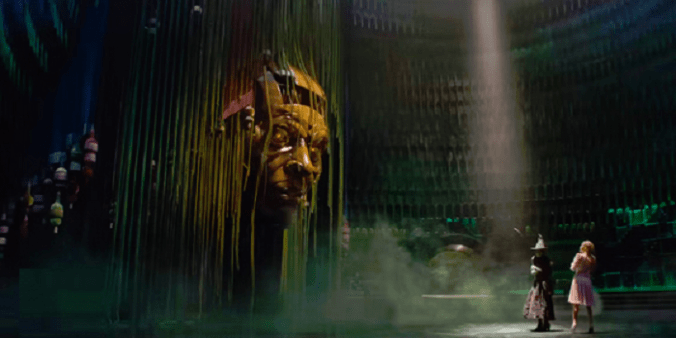
The amazing thing is that while I’m sure this interpretation was the filmmakers’ intent, when the dastardly conspiracy to crush liberty in Oz is revealed, it reminded me of the Biden Administration and the Axis of Unethical Conduct’s fondness for totalitarianism. The Wizard of Oz is a phony who maintains his support with the manufactured reputation that he is all-powerful and sharp as a tack (you can see his fake public face above), but he’s really a blithering fool—who does that remind you of? His crew is secretly censoring the talking animals who speak the truth, like the Biden administration got social media to censor conservatives. It uses the universities to indoctrinate the young: which party does that sound like? When Elphaba rebels and opposes the Wizard, the Wizard’s mouthpieces declare her an enemy and a danger to Oz…you know, like this:

Just try to picture Jeff Goldblum rather than Joe. I know it’s hard.
But now that I’ve seen the film, I don’t think anyone who hadn’t already been addled by the “Trump is Hitler” campaign would find “Wicked” a warning about Trump and the Republicans. That the director, writers and the rest couldn’t see that the film’s symbolism cuts both ways shows how biased, and therefore stupid, the Hollywood woke are.
If “Wicked” was intended to be as politically pointed as all signs indicate it was, projection defeated the plan, not that I wanted to be thinking about politics during a kid’s fantasy movie. There is no way to avoid it, however, because the film is so ham-handed in its messaging.
 Ethics Alarms
Jack: The film took away another talented vocal actor’s job so it could be “inclusive” and hire a dwarf for his voice alone.
are the new diversity rules for Oscar consideration in effect yet?
that could explain a lot.
-Jut
They are!
To argue Dinklage not always playing a dwarf, in Rememory he plays a private detective and dwarfism is only used to get uncomfortable camera angles.
But he still is playing the roles as a dwarf detective. How could he not? It’s like saying that John Wayne didn’t play a character as a tall guy.
Well, after that analysis I am really interested in watching the movie. Now I am torn… Go watch it, thus funding it and encouraging more like it. Or, wait 10 years like I do for everything else to stream for free on Amazon Prime.
I was expecting more nuance in this review.
“Every male in the movie without exception is a pig, a villain, a liar, a bigot, or an asshole…”
The vast majority of the characters are flawed, and the vast majority of the background characters are shallow and unsympathetic. Elphaba and her sister might be the only ones who (at least in this film) neither deceive others nor habitually act selfish, and I’m not even 100% sure about that. Fiyero and Boq have some notable flaws but still manage to be kind and respectful. Also, Doctor Dillamond the goat professor is male, and he seems just fine.
“It makes no sense at all to hire Peter Dinklage as a voice actor. His unique feature can add nothing to such a gig.”
I agree that in this particular movie his casting was probably in part to garner social credit for the movie, but why are you assuming that he couldn’t be hired on the basis of his voice? He played Bolivar Trask in at least one X-Men movie (Days of Future Past) as an extremist scientist who could have been played by anyone and who doesn’t have dwarfism in the comics, so I doubt Dinklage was hired for a gimmick in that one. Just because someone has a noticeable trait doesn’t mean they can only play characters that revolve around that trait; that’s the point.
I also agree that it’s a bad idea to unilaterally decide for thousands of people that hiring them for certain roles is offensive. I’m under the impression that acting can often by exploitative regardless of someone’s appearance. Everyone will just have to decide for themselves how desperate they are to participate in show business. That said, it’s unethical to take advantage of desperation to make people do things that they otherwise would never do (although where that line is may be subjective). Regarding the effects of films on public perception of groups, if the public doesn’t understand the difference between a real human with dwarfism (I cannot fathom why anyone thought “little person” would sound less demeaning than every alternative in use) and a member of a fairytale race, that’s a separate problem that needs addressing.
It sounds like what you’re saying is the message of the movie works just fine to inadvertently indict the favored political party of the people who made it. That sounds like a mark of good art to me: the underlying principles in the message transcend the intentions of the messengers.
This was my first time seeing this story. I thought the acting was great, the singing was great, the visuals were great (except the rubber clothes worn by the Hammerheads dancing in the fountain looked rather cheap), the humor was great, and the songs themselves were… good. I feel the melodies lose momentum in places and don’t finish some of the things they start. The lyrics leave a bit to be desired for me on a number of levels, with a few exceptions (I thought Popular was clever).
I think “flawed” is avoiding calling a spade a spade. The Prince is shallow and two-faced. The tall Munchkin who leads on Elphaba’s sister while making goo-goo eyes elsewhere is a rat. The Wizard is a villain. Elphaba’s father is a cruel bigot. Then there’s that jerk who hangs out with the fat girl, right out of “Mean Girls.”
I’ll give you the goat.
Dinklage is automatically a gimmick: it’s not traditional casting unless his part calls for a dwarf. Casting him as Cyrano was brilliant. And in lesser productions, his name alone has value to the “Game of Thrones” set. In “Wicked,” his name wasn’t going to sell a single ticket. Sure, he can play the goat fine, but so can hundreds of other actors, just as well, maybe better, and cheaper.
I didn’t find any nuance in the movie: my word was “ham-handed.” It made it impossible for me to get out my stage director mindset. The direction of the crowds and extras was particularly weak. After Elphaba was a fixture on campus, why was everyone still acting like she was a leper? And the assembled students were just mugging constantly.
Movie musicals get like this because the directors and writer want them to be both musicals and dramas at the same time. You have to pick one. Until literally the final number, the songs were secondary to the dialogue, and the dialogue wasn’t that shrp.
I cannot forgive the rhyme “Nessa/ I confessa.” Ever.
I should point out that the more one knows about musicals, the less one is likely to be able to enjoy them. That makes me in the category of an almost impossible audience member. I’ve directed dozens of musicals professional, independently and with amateur and student groups. I know the genre’s history and all of its tricks. I’ve also performed in a lot of them. Normal people are just impressed with what musical performers can do, and a reasonably decent production is sensory heaven for them. Most reviewers aren’t competent to review them, and they tend to gush over things that may not even be that good.
So I know I am going to be far more critical than the vast majority of “Wicked Watchers” will be, and its clear that someone like me isn’t even on the radar of the film-makers.
Alright, so you don’t like any of the male characters. My point is that the female characters are just as bad, except for the protagonist, maybe her sister, and her childhood nursemaid (the bear). The protagonist happens to be female. If the protagonist were male and every other character were unlikeable, we wouldn’t be talking about sexism.
If you happen to know of actors who are better at voicing goats, are cheaper to hire than Peter Dinklage, and were available at the time of recording, then that’s fine. I think name recognition counts as an asset; otherwise we could criticize many movies for hiring big-name actors instead of less well-known actors who could theoretically have done just as good a job for cheaper. The producers and the viewers know what they’re getting.
I get the impression that your default assumption is that it’s impossible for Peter Dinklage to play a character whose dwarfism is irrelevant to the plot, and by extension there’s no point in hiring him for voice acting unless people are supposed to know the character is voiced by someone with dwarfism.
Real humans with dwarfism can participate in activities where their dwarfism is irrelevant. Why wouldn’t we expect the occasional fictional character to reflect that?
When I said nuance, I didn’t mean nuance provided by the movie, but nuance in your review, acknowledging what the movie did well as well as what it did poorly, and highlighting potentially ambiguous aspects of it.
I concur that there were places where the dialogue wasn’t as sharp as I would have hoped. The jokes often landed for me, though.
I’m fairly certain the rhyme was “Nessa / I confess, a / reason…”–as in “I confess, a reason…” It did sound awkward. The songs paused in weird places and lost momentum.
I don’t like how Defying Gravity uses self-rhymes. (Even “take a message back from me” sounds just a bit off, and it rhymes with “free”, but “me” ended the previous line, so it sticks out in my head as repetitive.) It’s rare that a song can get away with unintentional repetition to my ear, and that one doesn’t. It sounds like it wants to have more varied lyrics. The structure is mostly nonexistent, as well. It sets up at least three phrases as potential themes to be repeated, and then just drops the majority of them. I want to like the song, but it could be so much stronger and more solid.
1. But its a chickflick—“Wicked” always has been an anti-patriarchy rant. The hero could have been male, but it wasn’t, and for a reason. Two-Zero in admirable characters is still a shutout.
2. I can name equally talented voice actors that I know personally—that how many there are. Do you think there is a single person in the nation who will go see “Wicked” because Peter Dinklage is the voice of the goat? He wasn’t mentioned in the movie’ promotion and none of the reviews I’ve read mention him. Sure, it might have been innocent casting choice and not DEI nonsense. What are the odds.
3. What it did well was (mostly) the sets, production design, costumes and casting Jeff Goldloom. What it did poorly or pedestrianly was everything else: the script (you weren’t driven crazy by the “Oz-talk” like “horribilifous” and dumb words like that? ), the pacing, the bloat, turning a single stage show into two loooong movies. The adaptation! Much of it made no sense: in the book and musical the school is like Hogwarts, a sorcery school. The “special sorcery seminar” that had a single teacher who would only take on one student made no sense. The two characters from “Mean Girls” were jarring and gratuitous: they aren’t in the musical. In the musical the goat professor isn’t arrested in front of the students—why would they do that? In the musical, Elphie meets the Prince because he goes to the school too, not in a superfluous meeting in the woods…with a talking horse! (Wait, I thought all of the talking animals were disappearing from OZ!), etc.. Continuing the list: the choreography, the rest of the casting, the direction, the music, and the lyrics. AND the woke indoctrination for kids…OOO, zoos are bad! Boys are bad. Whites are bad. Society is bad. Power is racist and fascist. Only female leaders can be good. Little People can’t be shown in movies, it exploits their disability.
I don’t call projection and lack of self awareness “nuance.” This is politics at a googoo-gahgah level.
And we see where this is going:Elphaba’s sister also becomes a Wicked Witch because racism and discrimination make it justifiable for victims “of color” or otherwise “othered” to be angry and destructive—you know, like Joy Reid and Kamala.
As for humor—before Goldbloom got some legit laughs by his Goldbloomisms (he’s like Bill Murray in that way), I didn’t find nearly as much genuine humor as in the better Indiana Jones movies. I laughed out loud at the insanely over-the-top production numbers, but I was laughing at the movie, not with it. How many times can anyone laugh at Glinda’s narcissism? The heroine, Elphaba, is completely humorless.
Yes, the lyrics are sloppy or obvious, without nuance, in fact. I don’t recall that Sondheim ever stooped to criticize Schwartz, but he presumed to knock Moss Hart, W.S. Gilbert and Dorothy Fields, all of whom were better than he was—I think Schwartz lyrics would have made him stroke out.
1. The hero isn’t male because the narrative is about the untold story of the “Wicked Witch of the West.” You sound like the people you complain about, who insist that traditional casting is bigoted. In this case, the source material is that Elphaba is female. If someone insisted that she be rewritten as male, that would be changing the story to, presumably, fit someone’s agenda. The book the musical was based on was about taking the female villain of The Wizard of Oz and reimagining the story from her perspective with her as a good person. If you object to that, fine, but the same thing has been done for many different villains before and since.
2. “Equally talented” means that there’s no reason one of them should have gotten the part over Dinklage, and if any specific one of them got the part, it would be equally “unlikely.” Someone had to get the part, and if Dinklage is not mentioned in the promotion or reviews, then there’s no reason to think it’s intended as a gimmick. I concede it might have been to ensure he didn’t condemn the casting on some ill-conceived basis.
3. I mostly agree. I also think that much of this is a matter of taste. The results could be a lot better in the film and the musical it’s based on, but just because they didn’t manage that doesn’t mean they were wrong to make the effort as well as they knew how. There’s ethics and then there’s snobbery. I still found the film enjoyable.
1. I don’t object to that at all. The point, which you seem to be determine to miss, is that basis for the inflated popularity of the novel and the musical was its appeal, deliberate, to woke values and anointed villains. The story could have been told showing an admirable, sensitive, respectful male, just as “Get Out” didn’t have to have all evil white people. It didn’t. That was no accident.
2. So you think, with all the many vocal artists of note and with name value (Mark Hammill is a voice actor who can use the work), the producers just happened to pick the only major actor whose claim to fame is that he’s a dwarf, in a movie that chose to make the Little People in Oz disappear. Ok. I sure don’t.
3. Well, sure, that’s fine, and taste is subjective and beyond argument. That’s why my favorite reviewer of all time used to write things like, “People who like movies like this will like this one.” The vast, vast majority of audiences will like “Wicked.” I’m happy for them, and the film-makers, who will make a bundle.
They would have liked it more if it was 30-60 minutes shorter. Peter Jackson’s “King Kong,” a better movie, had the same problem.
2.
Those are all good points, and I think you may very well be right about them.
Wait…what have you done with the real Extradimensional Cephalopod?
Sort of off-topic, but were any patrons of the movie in costume? We saw the musical a few years back (at the Fox Theater in Atlanta…almost anything is worth seeing at the Fox), and a fair number of the audience were tricked-out in varying bits of “Oz” gear. Most common was young girls with witch costumes or at least hats.
No, none in costume. But two teenage girls wouldn’t shut up for most of the film.
were they Lauren Boeberts kids? Asking for a friend. Not Afriend
Probably.
The very first scene Elphaba shows up in the very first people to be visually discussed by her are all people of color. So I find it very interesting that this article says the complete opposite to favor it’s narrative that the white people are supposedly the only ones discussed by her because she’s black. This article is full of crap. Do they even watch the movie?
Did you even read the article you criticized, or do you just not get the central (and widely accepted) allegory of the “Wicked” musical and movie? See, in the movie’s universe, Green is the new Black, and all of other skin shades are the equivalent of “White.” Get it yet? Or still too subtle for you?
Wow, you’re really trying to push this narrative aren’t you?