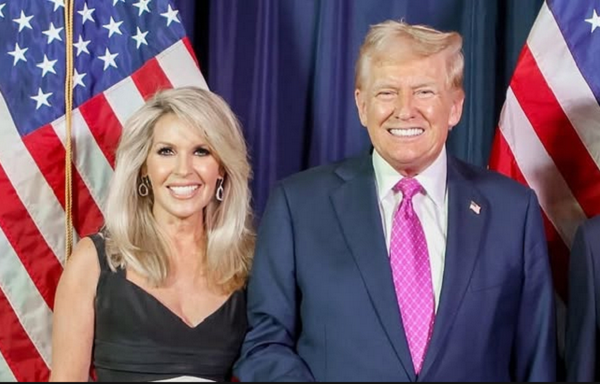
President-elect Trump today nominated Monica Crowley to be “Ambassador, Assistant Secretary of State, and Chief of Protocol,” a position that will coordinate and oversee U.S.-hosted events of note such as America’s 250th Independence Day anniversary in 2026; the FIFA World Cup in 2026 and the Olympic Games in Los Angeles in 2028. The position requires Senate confirmation. In reporting the nomination, The Hill described Crowley as “a former Fox News contributor,” which is deceitful and a cheap shot: she was that, but her experience is much more varied than that would suggest, and Crowley has legitimate credentials for that job—more, in fact, than many other recent nominations announced by Trump.
Crowley also, however, is a serial plagiarist, and her latest assignment from Trump—the previous one was in 2019, when then-President Trump announced Crowley’s appointment as Assistant Secretary for Public Affairs in the Treasury Department—is another canary dying in the ethics mine.
This latest announcement flashed me back to an excellent post by Andrew Bailey on his Plagiarism Today Blog. Its title: “Monica Crowley and the Death of the Plagiarism Scandal.” Before the start of the first Trump Presidency in December of 2016, Crowley was appointed senior director of strategic communications for the National Security Council. She withdrew after multiple allegations of plagiarism in her past, not only in a book, but also on her PhD. dissertation at Columbia. HarperCollins announced that it would stop sales of the book. Columbia, after an investigation, found evidence of plagiarism in the dissertation but allowed Crowley to go back and correct the text, announcing that parts included without proper attribution did not amount to “serious academic misconduct.”
For her part, Crowley denied the charges, and insisted that the whole “scandal” was a manufactured political hit job. The “hit man,” Andrew Kaczynski at CNN, reported the plagiarism in Crowley’s 2012 book “What The (Bleep) Just Happened,” and has repeatedly pointed out that Crowley never rebutted his facts. CNN’s analysis of Crowley’s dissertation uncovered thousands of uncredited lifts from other sources.
Before Crowley withdrew her name from the National security Council job, Bailey wrote that her nomination pointed to “a shift in the way plagiarism is viewed and [that]it’s become very clear that shift means plagiarism is no longer the career-ender that it once was. In fact, for some, plagiarism isn’t even a speedbump on their way to the top.” Indeed, the dual plagiarism scandal didn’t prevent Crowley from getting another job in that Trump administration and now one in this administration.
Crowley even had a history of plagiarism between her PhD. dissertation and the book. In 1999, she authored an article for the Wall Street Journal on the 25th anniversary of Nixon’s resignation. Slate found suspicious similarities between that article and a 1988 one by Paul Johnson in Commentary magazine, though Crowley insisted it was a coincidence because she never read the Johnson piece.
Bailey wrote in 2017, “[T]he rise in the number of plagiarism scandals, especially those of questionable importance, have hurt the gravity of the allegation while the political and journalism climates have made it far less of a transgression. Couple that with widespread ghostwriting and you have an atmosphere that’s ripe to devalue plagiarism as an ethical failing.” Yet evidence of plagiarism should be a career-ender in any field that dares to call itself a profession, meaning that members of that profession must be trusted.
Plagiarism is cheating. It is misrepresentation, stealing and lying, and positions of public trust should not be entrusted to cheaters, thieves and liars.
In his essay, now seven years old, Bailey listed the developments he believed had devalued the taint of plagiarism. Note that this was written before AI chatbots entered the game:
- Plagiarism Scandals/Stories Became More Common: Plagiarism detection software is ubiquitous, easy to use and, in many cases, cheap. Finding and detecting basic plagiarism is easy and, in a time where everything is written down, it’s trivial to find cases of plagiarism. That’s led to a rise in plagiarism allegations, which has made them seem more common, producing an air of “Everyone does it” even if that’s far from the truth.
- False or Borderline Stories Spread Quickly: Stories [of falsely accused] plagiarism scandals poisoned the well by attracting large amounts of attention to scandals that just weren’t there…ma[king] it seem more common and like all plagiarism stories are the same, trivial.
- Political Rhetoric: Calling someone a plagiarist is tantamount to calling them a liar and a fraud. However, in today’s political climate, liar and fraud are two of the more tame insults. In a year that talked about putting candidates in jail and sexual assault, “plagiarist” doesn’t even register as an insult.
- Desperate Times for Journalism: For journalists, these are trying times. Newspapers are cutting back and asking reporters to do more with less. That, by itself, leads to more plagiarism. The more common a misstep is, the easier it is to forgive. That’s especially true when publications are desperate to increase revenue, meaning that a reporter with a proven track record for making money can have their transgressions overlooked, including plagiarism.
- Whose Text Is It Anyway?: [T]he stated author of the piece may not have written it. The opaque writing process of many authors makes it difficult to know just who to assign blame to, making many of the stories seem blameless.
The latter phenomenon was evident in the plagiarism allegations over one of Kamala Harris’s books during the campaign. Also since Bailey’s piece was written, we had the ugly spectacle of the president off Harvard, Claudine Gay, exposed in a plagiarism scandal. It combined with her epic incompetence in her testimony on the Hill regarding anti-Semitism at Harvard to force Gay to relinquish her “historic” selection, but she was allowed to keep her tenured position on the faculty with its seven figure salary. And, naturally, the narrative embedded by her supporters, defenders and enablers is that the plagiarism allegations were racially motivated.
So it is that Trump feels comfortable nominating a proven plagiarist for a position in his administration for the third time. He would be among the last people I would expect to be concerned about a little matter like stealing someone else’s words and work.
Bailey’s conclusion is more true now than when he wrote it:
“Plagiarism, as a scandal, isn’t what it used to be.”
“To be clear, most people do find plagiarism offensive and do think less of plagiarists. The problem is that it’s now very low on the list of things that impact ones perception, especially when looking at a political candidate. But part of the problem is that a plagiarism accusation, by itself, is fairly meaningless. All accusations are given the same gravity, regardless of evidence, and how one views the story is often more impacted by their politics than the facts. In that environment, there’s no way plagiarism can be taken very seriously and its no surprise that it was so quickly dismissed. While the new allegations may have a bigger impact, the fact remains that the first was swatted away with little consequence. It would have taken two incidents, one in academia, to change the arc of the story at all. Because, in the end, that’s what plagiarism has become in many circles, a minor distraction that can be either ignored or apologized away.”
“Sadly, without radical change, that’s what it will likely remain for some time, even as interest in the topic itself continues to grow.”
 Ethics Alarms
You know I’d really hoped Trump would be smart enough to appoint intelligent, qualified people who have integrity. I suppose it was too much.
Yeah, baby steps. First, unethical, unqualified appointees who won’t stab him in the back…
I wonder what the probability is of very similar wording can take place to communicate a similar analysis. As a student writing papers I was challenged by faculty to be succinct in my writing. I was also told not to string a bunch of quotes together. This creates problems for writers. There are very few new ideas in my field of Economics that are generated by students or even other “Economists”. As a result I believe it is quite possible to create a perception of plagiarism without even doing so.
At some point in time, there has to be few other words in combination that are completely different that will convey the exact same meaning. This is not meant to be a defense of plagiarists but simply an observation. For example, how many different ways can a writer develop a paragraph on “Determinants of Demand”. There just are not that many ways to explain why numbers of buyers, prices of related goods, income, etc. cause a demand curve to shift right or left. I bet I could pick up a number of different texts, written by different authors and the text would be virtually identical in ideas, words and sequence.
I do find it laughable when the media run with stories of plagiarism when they do the same daily in the words each uses to juice up the stories. Oh, I forgot they are merely using the talking points given to them by their favorite political operatives.
Perhaps, as time passes and more things are written on similar topics the likelihood of similar word patterns will emerge leading us to believe it was copied.
This is merely something to consider.
Hey, when a plagiarism scandal isn’t enough to prevent you (twenty years later) from being elected as Vice-President and then later as President, then it’s clear enough that no one cares about plagiarism anymore.
–Dwayne