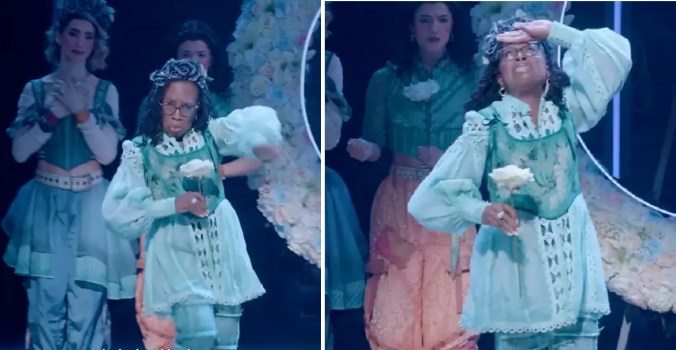
“Here come de judge!”
Above are some examples of SCOTUS Justice Ketanji Brown Jackson making a spectacle of herself in her Broadway turn last weekend in the musical “& Juliet,” a LGBTQ adaptation of William Shakespeare’s “Romeo & Juliet.” Jackson portrayed Queen Mab, described as a “she/her” character on a production poster, in two scenes written especially for her. “I just also think it’s very important to remind people that justices are human beings, that we have dreams, and that we are public servants,” Jackson told“CBS Mornings” prior to the performance. One of her dreams was apparently to be an actress, long ago. (She made the right choice going into law.)
Except that judges, and especially Supreme Court justices, don’t have the option of doing whatever they feel like or dream about, as least if they are conservative justices. All of the criticism of the Roberts Court in the past few years has been over alleged ethical violations by the Justices making up the 6-3 conservative majority. The Justices appointed by Democrats Obama and Biden are, of course, as pure as Ivory Soap. And yet…
CANON I of the Code of Conduct for the Federal Judiciary states that “An independent and honorable judiciary is indispensable to justice in our society. A judge should maintain and enforce high standards of conduct and should personally observe those standards, so that the integrity and independence of the judiciary may be preserved. The provisions of this Code should be construed and applied to further that objective.” The commentary to this Canon adds, “Deference to the judgments and rulings of courts depends on public confidence in the integrity and independence of judges. The integrity and independence of judges depend in turn on their acting without fear or favor. …Adherence to this responsibility helps to maintain public confidence in the impartiality of the judiciary. Conversely, violation of this Code diminishes public confidence in the judiciary and injures our system of government under law.”
A judge choosing to appear on stage in a musical extolling various non-traditional sexual and romantic relationships, while also surrendering the dignity of her high office because she sees the play as a “wonderful story of female empowerment and women’s ability to do what they want to do” does not meet “high standards of conduct” that will reassure the public regarding her independence.
CANON II states in part: “A judge…should act at all times in a manner that promotes public confidence in the integrity and impartiality of the judiciary…. A judge should neither lend the prestige of the judicial office to advance the private interests of the judge or others nor convey or permit others to convey the impression that they are in a special position to influence. The comments add, in part, ” A judge must avoid all impropriety and appearance of impropriety. This prohibition applies to both professional and personal conduct. A judge must expect to be the subject of constant public scrutiny and accept freely and willingly restrictions that might be viewed as burdensome by the ordinary citizen.”
Jackson, without question, lended her prestige to promote a commercial theatrical production. The news media has stated that Jackson’s appearance in a Broadway play was “historic”: no sitting judge had ever done that before.
There is a reason for that.
Canon IV states in part: “A judge may engage in extrajudicial activities, including law-related pursuits and civic, charitable, educational, religious, social, financial, fiduciary, and governmental activities, and may speak, write, lecture, and teach on both law-related and nonlegal subjects. However, a judge should not participate in extrajudicial activities that detract from the dignity of the judge’s office.”
See the photos above.
Canon V is titled, “A Judge Should Refrain From Political Activity.”
There is a strong, if not necessarily rebuttable, argument that appearing in what the New York Post called a “queer” musical is a political activity.
Of course, as everyone knows by now, the Supreme Court is accountable only to itself for alleged ethical breaches by its members. However, is there any question whether an appearance on Broadway by Justices Alito, Kavanaugh or Thomas in a Broadway play with conservative themes (if there were such things) wouldn’t be instantly condemned as raising at least “an appearance of impropriety” by the same journalists cheering on Justice Jackson’s Big Broadway Adventure?
The ethics verdict here is that Justice Jackson showed terrible judgment by indulging this “dream.” It’s not a huge deal, but respect and trust often dies from a thousand cuts. I believe it is unethical for a President to use his name and office to hawk perfume, and for the same reason, I believe it is unethical for Supreme Court Justices to appear in public theatrical performances. If you disagree, then explain to me how Jackson singing a song—badly–on “America’s Got Talent” because she always dreamed of being a singer would be acceptable to you.
 Ethics Alarms
I might humorously take issue with that sentiment. Even if Justice Brown Jackson had the acting ability of a thermos, she’s probably more adept at acting than interpreting the Constitution.
Anyways, I do agree that SCOTUS justices should refrain from these kinds of shenanigans, particularly as it pertains to Canons IV and V. A musical – though considered art – does not bring dignity to the high Court. This one one step – how big a step might be a matter of opinion – above Sarah Palin performing in that Halloween-style singing show.
However, I do not think what she’s doing on-stage compares to or mitigates what Justice Thomas has done in bringing suspicion and even condemnation on the Court. His actions and obvious appearances of impropriety are on a completely different level.
But let’s say Justice Brown Jackson is an accomplished violin player. Would it be dignified for her to be playing in the orchestra pit of “& Juliet”?
Oh, Thomas should resign. Jackson’s conduct is unprofessional and degrading; Thomas’s is indefensible. SCOTUS Justices, however, should be role models, and beyond reproach
There are many things wrong with Jackson’s silly indulgence, among them that she set herself up to look like a fool. Is she were a professional caliber violinist and did a charity solo for the Philadelphia Philharmonic and could do it well, that would breach none of the ethics canons.
“But let’s say Justice Brown Jackson is an accomplished violin player. Would it be dignified for her to be playing in the orchestra pit of ‘& Juliet’?”
The performance isn’t the issue – if Justice Brown Jackson had appeared in a performance of “Sound of Music” and simply played the role as written, no one would raise an eyebrow.
Here, though, the musical is modern interpretation of “Romeo and Juliet” with decidedly modern, political overtones on issues that will present themselves to the Supreme Court. Appearing in this performance would have a direct impact on the neutrality and objectivity of SCOTUS.
jvb
jvb,
That kind of makes sense. Maybe I was questioning whether “visibility” in the performance held greater weight than “participation.”
I appreciate your feedback.
I was going to send you a link to this: glad you saw it.
I remember attending a CLE by judges. They spoke about the roles judges play in cases (or something like that; it was more informative than my description).
This one judge whom I did not particularly like (or dislike, for that matter), spoke about how lonely it is to be a judge. She could not take her girls out to sell girl scout cookies, it was hard to volunteer for things, and everyone called her Judge all the time (unless they were colleagues from before her nomination to the Bench). She talked about how she liked being a lawyer and liked relating to lawyers, and how becoming a judge interfered with her ability to do that. The seriousness with which she took her position made an impact on me.
Justice Brown Jackson is one of her “superiors.”
-Jut
She had allready achieved her dream as an actress. When she appeared before thee Judiciary committee for her appointment she began her act that should would be a competent, intelligent, member of the court. However, like the Wizard of Oz, the curtian was open to reveal her inadequacy when she could not define what a woman is.