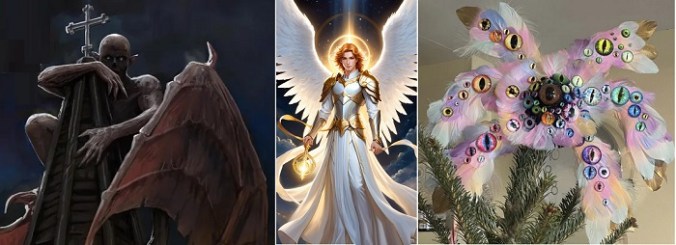
Above you will see three interpretations of what angels—you know, those benign, heavenly creatures we hear on high and observe, “Hark! They sing!,” the celestial guardians like the funny little old man who shows Jimmy Stewart that he’s really led a wonderful life, the kind of immortal being that appeared to Mary to tell her she was going to bear the Son of God, you know, those things?—really look like. The version on the left is from the Mike Flanagan horror series “Midnight Mass.” It’s a scary angel, but not as scary as the ones that show up in Robert and Michelle King’s scary TV series “Evil,” which look like this…
 Yikes.
The version of Gabriel in the center is pretty much how I had been taught and told and shown how angels look for most of my life, and I assumed that was how they are represented in the Bible. Now, this is at least partially my own fault for not knowing the Bible better than I do, but when artists, churches, Sunday school teachers, movies, tree ornaments, Christmas cards and children’s books all show angels as friendly-looking Scandinavians with big, white, fluffy wings, I think I can be excused for assuming that there is at least as much authority for those representations as there is for anything else in the Bible—-an assertion to which Carnac the Magnificent (oh, look it up, ye of pop culture deficit!) would say to me, “You are wrong, Ethics Breath!”
For at least according to some Bible scholars, it is the image on the far right that is the closest to accurate.
About 7 in 10 U.S. adults say they believe in angels, according to a poll by The Associated Press-NORC Center for Public Affairs Research conducted last year, but I wonder what the number would be if they had been told that angels look like that. Rev. Kira Austin-Young, associate rector of the Episcopal Church of St. Mary the Virgin in San Francisco, says that angels aren’t often described in the Bible, but both Revelations and some of the books of the prophets in the Old Testament describe things around the throne of God that look more like whatever that is in the third photo.
“Some of them have six wings with eyes covering the wings,” she told the Associated Press, and others have multiple animal heads. “I think one of the delightful things about the Bible and the Scripture is just kind of how bizarre it can be and just how kind of out there it can be,” she enthused.
I think she has a different concept of “delightful” than most people. The Bible is “out there” in many respects, but that’s really “out there.”
Esther Hamori, a professor of Hebrew Bible at Union Theological Seminary, told the AP that she approves of the “biblically accurate angels” trend. “It shows that people are thinking about ways in which the Bible contains far stranger things than what’s often taught,”she says. Hamori is the author of “God’s Monsters: Vengeful Spirits, Deadly Angels, Hybrid Creatures, and Divine Hitmen of the Bible.” “The biblical heavens are filled with weird, frightening figures. In the Bible, God has an entourage of monsters,” she says.
Great.
And so it came to pass that Austin-Young had her puppet-maker husband, Michael Schupbach, design and construct a biblically accurate angel to top their Christmas tree this year. That’s the result above.
I am only half serious about this, but half is still more than nothing. The story of Christmas and Christianity would have been a much tougher sell over the centuries if churches, missionaries, evangelists and proselytizers had to explain why Mary didn’t run screaming into the desert when that thing on the right showed up and started talking to her. If that’s really a biblically accurate angel, and especially if some of God’s entourage includes multi-headed, animal-human mutants, I also owe a lot of other cultures and religions an apology, as I have frequently thought, “How could so many people worship gods with animals heads, multiple arms, horns and worse? Talk about gullible!”
Apparently we’ve been lied to because those in charge of leading us to The Light didn’t think we could handle the truth. In my case, they were right.
 Ethics Alarms
There are as many kinds of angels as there are people who believe in them, I think. Supposedly there are nine orders, as it were, of angels, arranged into three hierarchies. The seraphim, the highest of all, are the personal attendants of God, and are six-winged, but you really don’t see much of them because they cover their faces with two wings, their feet with two, and use the last two to actually fly. Their name means “the burning ones” so they most likely glow or have a fiery quality to them. The Cherubim, which are the next, are the ones described in the Book of Ezekiel in a vision that would put most acid trips to shame as having four faces: man, ox, lion and eagle, and having also wings and hooves of brass (the four faces later become symbols of the four evangelists). The Ophanim are the ones described as covered in eyes and sort of like that image on the right.
Archangels and Angels are actually the lowest two orders of the hierarchy, and, at least according to the Bible, look mostly like men, except with a shining quality to them. They can take on whatever appearance they want, however, in the real world, and that’s why the Captain of the Host of the Lord in the Book of Joshua and Raphael in the Book of Tobit can look like basically ordinary men, and Gabriel, another Angel, could take on a more conventional form to converse with Mary.
The idea of angels looking like perfect virginal women with wings dates back to the high Victorian era, when images like that were in vogue, as you will see if you look at the Albert memorial in Hyde Park, which is the pinnacle of that particular taste. The reason a lot of them look Scandinavian is that the blonde, blue-eyed look was considered the pinnacle of beauty in humanity then. It’s just art and religious literature in the end, and you’re empowered to think of angels as looking however you want them to look.
We could have a very interesting discussion here, I know we count at least two religious scholars among us.
Like climate science and the pandemic, then, this is another area that is simplified, watered down and misrepresented by authorities so the Little People can absorb it. And as in that instance, it’s unethical.
I basically echo Steve here. The more abstract angels were created for a specific purpose, and are usually shown in the Bible as the closest to God. They don’t usually interact with humanity. The angel with four faces, for instance, guards the Throne of God, and has four faces so he can see in all directions simultaneously.
However, Angels such as the traditional depiction of Michael, Gabriel, and Raphael are in fact Biblical. It would be deceptive to say otherwise that the multiwinged or multifaced are “biblically accurate” while implying the traditional depiction is inaccurate, except tongue in cheek. Many Old Testament depictions has Angels appearing as ordinary men, before revealing their splender. The angels tasked with communicating with man have a physical appearance appropriate for the task.
We get hints about angels from the Scripture. We get some description, including the stranger ones in Ezekiel 6 and Revelation 4. But only four angels are named in the Bible: two good (Michael and Gabriel) and two evil (Lucifer – who was likely a Cherubim – and Abaddon). In the study of Revelation our group just completed, we stuck to the traditional interpretation of the angelic descriptions in Scripture: unless there was legitimate to do otherwise, we took the text literally as written. So the angels with six wings and those with eyes all over (even on the wings)?…we took those as literal descriptions of what the writers saw.
But there are other places in the Scripture where angelic encounters are those that seem to have a more human look. Abraham’s encounter in Genesis 18 (with two angels and the pre-Incarnate Christ), Lot’s encounter in the next chapter, Joshua’s in Joshua 5, Daniel’s encounters in his book, and of course, those of Mary and Joseph. Those accounts don’t seem to be of the “stranger” angelic creatures, though there is little doubt the angels were a presence of great power that sometimes inspired great fear (think of the shepherds at Christ’s birth).
Angels are not human, though it seems from Scripture they can look human if necessary. The Bible says Satan often appears as an angel of light, so that angel has at least a neutral appearance – and is probably quite attractive.
I have often considered a Biblical study of angels – our group has discussed doing that – but to this point I haven’t. I have several books on the subject, but have yet to read them. Angels are an interesting secondary study, but the Bible’s story is Jesus: his work in Creation, his delivery of the law when humankind fell, and his ultimate fulfillment of the law by coming as our savior.
I hope others that have studied this in greater depth chime in.
Joel,
Ah, as Steve-O said, there is Raphael in Tobit, but I’m sure it would be fun to then digress into the canonicity of the Deuterocanonicals. But Azazel is mentioned in Leviticus, and from extra-biblical sources we know that Azazel was considered to be one of the fallen angels (cf the Book of Enoch).
Angels are spiritual beings, which means they have no material components that are inherent to their nature. They can interact with matter, and can even form for themselves bodies that can be seen and touched. These bodies can even eat and copulate. In Genesis, when we have written that the Sons of God took for wives the daughters of men, from which spring the Nephilim, the ancient Hebrew tradition is that these spiritual beings actually procreated with humans, which created a race of giants. This was a sin, and just before the flood, supposedly, God arranged for the Nephilim to go on a bloody rampage and kill each other off, while their angelic parents were bound in the netherworld and could only helplessly watch while their offspring slaughtered each other. (The thought that the text actually equates the Sons of God with the line of Seth and the daughters of men as the line of Cain is a MUCH later development.)
Many of the bizarre descriptions we have of angels come from apocalyptic literature, such as Daniel and Revelation, in which the narrator is describing a vision they had of heaven. The visions are not meant to be literal physical descriptions of what is in heaven, but use the descriptions as ways of concretizing the otherworldly experience into some the reader stands a chance of relating to. It is of note that often when an angel appears it causes fear and trembling because it is that awesome a being. It is so awesome a presence that it tempts mere mortals to worship it as though it were God.
St. Thomas Aquinas speaks of every angel being its own species, meaning while we can divide them into 9 choirs (as Steve-O mentioned above), each angel is a unique creation. Of course that differs from we humans, who are all one species. Aquinas believed that there are more angels than the sum total of all of mankind from the beginning of time to the end of time, which makes sense if there is a unique guardian angel for each human person (though theologians argue on whether one angel could guard several people, or if an angel would be “reassigned” after his charge moved on to his final reward). But there are also angels for each nation (cf Daniel, when the “prince of Persia” delayed Gabriel), for each church (note the letters in Revelation are addressed to the “angels” of each church), for each of the stellar bodies, and I think if you follow Aquinas’ reasoning further, an angel for each subatomic particle out there. So if we have this vast array of angels, it stands to reason that there would be, for all practical purposes, and unlimited way they could represent themselves to us.
Ryan,
Thanks! The Nephilim are a fascinating study and I’ve done a bit of reading/video watching on them. If you haven’t seen any of (the late) Chuck Missler’s work in that arena, it’s interesting and available on YouTube. I can’t find the reference to Azazel, though the name is familiar.
I know we’re starting to drift a bit from Jack’s OP, so I won’t push this any further except for a final question…can you point me to the specific “Azazel” chapter/verse in Leviticus?
Joel,
The context is the instructions for the Day of Atonement, which you’ll find in Leviticus 16. The verses containing the reference to Azazel are Lev 16:7-10: “Taking the two male goats and setting them before the LORD at the entrance of the tent of meeting, he shall cast lots to determine which one is for the LORD and which for Azazel. The goat that is determined by lot for the LORD, Aaron shall present and offer up as a purification offering. But the goad determined by lot for Azazel he shall place before the LORD alive, so that with it he may make atonement by sending it off to Azazel in the desert (NAB).”
More generally, the high priest was to take two sacrificial goats, one to slaughter and use for the people’s purification. The other, he prayed over and transferred the sins of the people to it. It was then released into the wild, where it “returned” to Azazel. In extra-biblical material, we learn that some Hebrew traditions held that Azazel was a leader in the revolt against God, and was chained in the wilderness for his transgressions. The sins of the people of God would then be the fruit of Azazel’s work, and by sending the goat into the wilderness, this was returning to Azazel what he had wrought.
What is very interesting is that later development, certainly in Second Temple Judaism, the goat for Azazel was handed over to a Gentile to lead into the wilderness. There’s a direct correlation to this practice and to Jesus’ Passion. In the Garden of Gethsemane, Jesus was troubled unto death, so troubled that he sweated blood. But since Jesus was to bear the sins of mankind to the cross, there’s a tradition that as High Priest, he was doing as the Aaronic High Priest would do in transferring the sins of the people to himself, who was also the sacrificial victim. And then the Jews took Jesus and handed him over to a Gentile, namely Pilate, who then gave Jesus over the Praetorian to lead out of the city. (Pilate also declared of Jesus, “I find no fault in him”, which is a direct parallel to taking the Passover Lamb, inspecting it for seven days, and then sacrificing it after it had been ascertained that it had no flaws…)
Back to the topic of angels, one of the things we should be aware of is that over time, our language has shifted to referring to all these spiritual beings as “angels,” whereas in ancient times they were called by many different names, with those names being oriented toward their functions. As mentioned elsewhere, angel means “messenger”. But there were other spiritual beings called Watchers (again, reference to the Book of Enoch), whose role was to watch over mankind. I can’t remember other categories off the top of my head, but this gives rise to the nine choirs of angels because of the particular roles they play, e.g. the reference to Seraphim, or the burned ones, who are called thus because of their proximity to God. So when we read scripture, we shouldn’t be caught up in our modern usage of the term angel, when we’ve made it a much broader category than that which the scripture authors utilized.
Angelology is something I find fascinating. Tradition holds that there are nine choirs of angels. We start with the Seraphim, then the Cherubim. Following those are, in order: Thrones, Dominions, Virtues, Powers, Principalities, Archangels, and finally Angels. Typically, only the lowest four choirs interact with humans, and even then, most interactions are in the angels only.
Now, the Bible describes 3 named good angels, and two distinct choirs of angels with specific descriptions, while attributing many activities to the generic angelic. Michael, Gabriel, and Raphael are all archangels. Lucifer, before falling, was one of the highest of the angels, perhaps a Cherub or Seraph (but beaten by an archangel, one of the lowest, which, in consideration of all the massively cool theology that this goes into, is one of the things I like best in angelology, but is unimportant here). However, many times in the bible, angels interact with humans, unknown to humans. In addition, Catholic and Orthodox theology both hold to the concept of Guardian Angels, who are almost never seen. It is also classically held, for most of a millennia, that each angel is its own unique, for lack of a better word, species.
Now, the six-winged thing on the far right is considered as accurate of depiction of a seraph as we’re probably going to get in popular depiction, and as Steve-O said, cherubim are also unlikely to be palatable to our eyes. We also have some evidence in the Bible of some of the people spoken to by the angels as feeling fear, awe, and at least overwhelmed. Others do not even know it. Because angels have little in the way of description in the choirs that interact with humans, any romantic description of an angel may be accurate, as long as we are not trying to say Seraph or Cherub. Please note that the modern idea of cherubs (fat baby angels) is not remotely the same as the traditional Cherubim, and is not considered particularly accurate for an angel, but makes for a really cool and cute picture. Not all artists are particularly interested in theological accuracy. They want to make a point or a dollar, and are rarely interested in literal accuracy in any case. In addition, while we of this century are very literal and want literal accuracy in most dimensions, older cultures often focused less on the literal and more on the figurative. This led to entire genres of literature that focus on a figurative truth taught in non-literal format.
There is nothing to say that you were taught incorrectly, as far as you were taught. I believe you have said in the past that your family was not strongly religious and you were not very strongly catechized at an older age. My ten-year-old daughter, who has benefited from my interest in angels despite her young age, is aware of the differences at a basic level and would recognize the Seraph above. She managed to floor her choir director who didn’t even know that there was an ordering of angels, despite a Catholic school education, as a lot of angelology is found in the later years. My eight-year-old is not so aware, and the younger kids, even less so. Actual religious education, usually taking many more years than just a couple years of Sunday school, has been lacking in our society for a very long time. Pope Leo XIII, in the 1890’s, spoke out about the failing education in both the secular and religious realms. This is less a case of your being taught a lie as it is that your education was never taken to that next level. Just as no one has lied to a child about the physics that require calculus to understand, angelology is hardly basic Sunday School fare, especially for Protestants, as the choirs of angels tend to be more of a Catholic topic. Even as an Orthodox child, you would not likely have covered these topics until late teen/adulthood in the best of circumstances.
An unclothed , winged human infant is usually referred to in art as a putto. How that got mixed up with the Cherubim, who are supposed to be the second most powerful angels, I do not know.
I think “Cherebim” just sound like something cute that you “cherish”. Simply a matter of false homophobes.
I took a class on Angels in Sunday School about 30 years ago. The teacher made clear that angels are not babies or the spirits/ghosts of babies. This appears to be a case where artistic license has come into play.
I prefer my angels to look like Michael Landon, Roma Downey, and Della Reese. Maybe even John Travolta.
I’ve heard of the multi-winged, multi-eyed angels before, but I can’t imagine Lot’s neighbors wanting bad-acid-trip angels over Lot’s daughters.
Better yet, Cary Grant in “The Bishop’s Wife.” Now THAT’S a good-lookin’ angel!
The story of Christmas and Christianity would have been a much tougher sell over the centuries if churches, missionaries, evangelists and proselytizers had to explain why Mary didn’t run screaming into the desert when that thing on the right showed up and started talking to her.
It doesn’t hurt to point out that Mary was afraid. Gabriel specifically told her, “Fear not.” In a similar fashion, the shepherds were terrified when the angel announced to them the tidings that the Christ had been born, and then angel likewise told them, “Fear not.” The typical reaction to the presence of angels has been awe and trembling, and the angels frequently have to settle the frightened humans down before delivering a message.
Keep in mind that the ancient world was much more at home with the prospect of dealing with spiritual beings. We struggle greatly in our modern era that has been greatly influenced with materialism, the notion that the only things that exist are material and can be observed through the senses (perhaps aided by powerful tools). We also struggle with our literalistic way of reading Scripture, because we’ve become so technical-manual-oriented that we struggle with imaginative descriptions and depictions that are not meant to be taken literally, but as a figurative way of conveying deeper truths. On the other hand, the various idols crafted of ancient gods also reveals the human imagination trying to convey something about those supposed deities, trying to capture their super-humanness in a recognizable fashion. For example, depicting a fertility goddess with many breasts, rather than two, is meant to convey the goddess’ power of fecundity, not her unbelievable back problems or the need for custom-made bras…
Of course then we can get into fish-tailed sea deities, cephalophoric (head carrying) saints and other divine figures, and the bright (often but not always blue) coloring and multiplicity of limbs and eyes common in Hinduism and some branches of Buddhism. How much of it is supposed to be literal and how much symbolic depends on who you ask.
Which means nobody knows, though many think they know. If they don’t know, then they are unethical to present theories as fact.
I’m not a Biblical scholar. I don’t know Ancient Hebrew or Greek. I have spent this last years reading The Revelation. If I may add my two cents to this.
I’ve heard about that multiple-eyed creature being referred to as an angel. Maybe it is. But…the Bible doesn’t call it an angel. Not a single translation that I can tell and I’ve looked up many different translations of the Bible. It’s called a beast, a creature, a living being, an animal, but not an angel. Meanwhile, in those same translations, the word angel is used consistently for scenes in which angels turns up (for example, in Mary’s visit) throughout the Bible.
I think the creatures before the throne never ceasing to praise God in Revelation 4 are something different. If they were angels, John would have called them angels. After all, he uses the word angel throughout the rest of the book.
That is an interesting note. One thought is that “Angel” is an office of messenger (etymologically related to “Evangelist”). Only the “beasts” that deliver messages to humanity thus would be Angels. Those in Relocation not so-called would have other jobs.
I also suspect John the narrator calls them “Living Creatures” to emphasize that though powerful and awesome inspiring, they are still beings created by God, and souls given life by the Holy Spirit.
Good thoughts, AM, and you indirectly pointed out an error in my response above. Those were “creatures” in Rev 4 that I described as “angels”. Good catch! The sources I consulted in our Revelation study were slightly mixed on the creatures, but the overall opinion was that they were angelic. So I’ll say the same thing here that I would have said in our study: the consensus – from those that know much more than I – is that they’re angelic, but we’re not 100% sure…and we won’t be dogmatic about it. FYI, my sources outside of scripture included LaHaye, Pentecost, Leon Morris, Kelley, Jeffress, and a bit of my grandfather’s Pulpit Commentaries.
Anyways, the responses in this thread have been MOST interesting. Thank you all for sharing your insights.
Mein Gott in Himmel! Is there any topic about which the EA commentariat does not contain a broad and deep wealth of expertise? Angels?
I think my favorite form of angel is from Ralph Stanley’s singing of and “angel band” in a blue grass lyric.
I can live with four guys playing bass, guitar, fiddle and banjo respectively where the bass player also drives the bus.