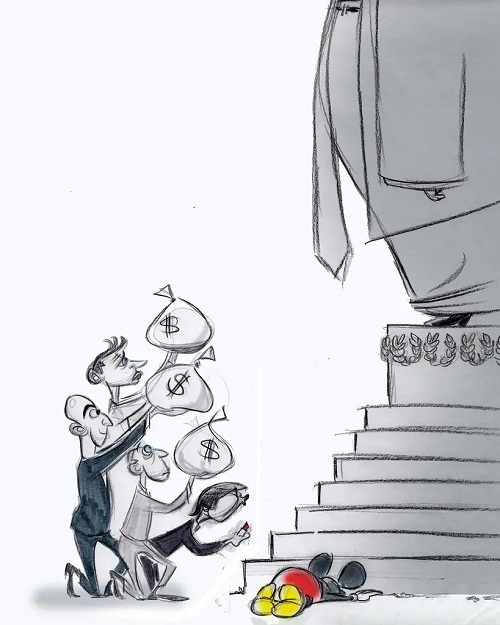
Ann Telnaes, “a Pulitzer Prize-winning cartoonist” (So what?) for The Washington Post, announced that she was resigning after editors rejected a cartoon depicting WaPo’s owner, Jeff Bezos, genuflecting toward a statue of President-elect Donald J. Trump.
On her substack, Telnaes called the newspaper’s decision to kill her cartoon a “game changer” that was “dangerous for a free press.”
Riiight. The cartoon shows Jeff Bezos and other media figures prostrating themselves to Trump, which is not only untrue, it’s juvenile. That cartoon could have been published in a middle school newspaper. The Post has had a succession of knee-jerk, shrill progressive scolds as political cartoonists in an unbroken line since the partisan-biased Herb Block was also a “Pulitzer Prize winner”—- you know, like the Post was for its false reporting on the Russian Collusion hoax. Like Nikole Hannah-Jones and the New York Times were Pulitzered for creating the anti-America propaganda screed called “The 1619 Project.”
Ethics Alarms has long maintained that political cartoons don’t warrant presence on editorial pages because 90% of them or more communicate grade-school level political sophistication through the jaundiced eyes of artists lacking education, perspective and critical thinking skills. That drawing above illustrates the Ethics Alarms position nicely.
Telnaes is throwing a hissy-fit because she isn’t allowed to publish an obnoxious and simple-minded cartoon—it also isn’t remotely funny—attacking her employer with a cheap shot. The Trump-Deranged, progressives and Democrats on the Post—that is, 98% of the staff, were triggered because Bezos chose not to have his paper endorse Kamala Harris, the worst candidate a major party has run for President since, oh, maybe Horace Greeley in 1872, except that Horace was smarter than Kamala and he never waffled on his positions, which were a matter of record.
It would be a different if the cartoon the artist is so determined to see promoted was interesting, trenchant, original or clever, but it isn’t. The baseball equivalent would be a .216 hitting player quitting his team because the manager chose to leave him off the line-up card.
 Ethics Alarms
She was probably already halfway there when Bezos, who probably saw the writing on the wall, decided not to endorse a candidate he knew was going to lose and lose badly. Most of the media, especially on the opinion side and especially among cartoonists, think it’s the media’s DUTY to attack the GOP candidates and those who support them. This cartoon is the written equivalent of Stephen Colbert calling Trump a “pricktator” and saying that the only thing his mouth was good for was being Putin’s cockholster, although without the homophobia. Let’s get this straight, she was going to publish a crudely drawn version of her boss genuflecting and offering money to a ridiculously fat statue of Donald Trump and her boss took poorly to the idea. She resigns in a rage. Now she can flood her substack with this unoriginal crap. Sounds like a win for both the Post and the public.
Again, my question is “How do previously sane people get this way?”
She was not sane, that’s why. I supect she has always been nuts.
jvb
The issue, of course, is not the quality of Telnaes’s work–which I agree is simplistic, but that’s pretty par for the course in her field, where she’s clearly respected. The issue is a newspaper owner’s interference with editorial decisions. Buying a newspaper to silence criticism of your own corporate interests is unethical. If by chance this is not an example of such–that Bezos did not directly demand such a thing, or his demand was strictly aesthetic–the appearance of such an impropriety is unethical.
1. It’s a rotten cartoon with nothing interesting or remarkable to say.
2. That she’s respected in a cheesy field is just an appeal to authority, and a weak authority at that.
3. Bezos didn’t interfere with several opinion pieces by his woke and unprofessional staff taking issue with his blocking an embarrassing endorsement of a terrible candidate (or, if you prefer, two terrible candidates). To assume that he would block this goo-goo gah-gah level satire for personal reasons is unwarranted.
4. If you’re saying that an amateurish and sub-par political cartoon should be published only because it criticized Bezos when otherwise it would have been found lacking on a basic quality basis, that makes no sense whatsoever.
5. Criticizing your employer is only ethical if that’s your job, like, say, Brian Stelter, the CNN news media watchdog who somehow never had anything bad to say about CNN. Criticizing your employer’s owner ad hominem deliberately creates a conflict of interest for that owner, particular when it’s unfair criticism. What has Bezos (or Disney, for that matter) done that constitutes grovelling to Trump?
6. I get it: in Woke World not ruthlessly opposing and attacking Trump is capitulating to him.
You’re just making up these “rules.” The owner-publisher has every right to make newspaper policy, and many, if not all, do. I think Bezos’s mistake was letting her resign when she should have been fired for bias and incompetence. There’s no appearance of impropriety at all, mainly because 1) there’s no such ethical standard in journalism and 2) the Post violates that standard, if there was one, every day.
Political cartooning is part of the opinion page. Firing someone from the opinion page for “bias” makes not a hoot of sense. As for incompetence, she’s lauded in a field you find ridiculous. That’s not incompetence.
The standard for journalism is editorial independence, beholden to no one’s interest, most of all whomever is paying for it. If Bezos were ethical, he should support constant mockery of his own corporate interests, to demonstrate that he is supporting journalism rather than purchasing a mouthpiece.
The Post, like all newspapers, fails to live up to these ethical standards on a consistent basis, as every other institution or individual fails to live up to ethical standards. That is why they are standards, and their accompanying failures should be noted.
Incidentally, this is well dramatized in Citizen Kane, in which Jedidiah (Joseph Cotten) passes out while writing a negative review of Kane’s wife’s operatic performance. Kane (Orson Welles), the owner of the paper, finishes the negative review for him, demonstrating the integrity a newspaper should exhibit. Then, he fires Jedidiah, demonstrating the privileges of ownership.
1. Again, if it’s an opinion worthy of a third grader, it doesn’t belong on an opinion page.
2. There literally are no great political cartoonists with legitimate national reputations. She’s esteemed by her own fading, arcahic field. Big whoop. What was the last memorable political cartoon you saw? The genre is dying, and should be: she a good example.
3. Talk about hills to die on: You know that was a weak cartoon. The New Yorker has been infamous for dinging the cartoons of some of the greatest cartoonists who ever picked up a pen. And this hack throws a fit when THAT cartoon is rejected?
4. Bezos, first and foremost, should not support amateurish products on what was supposed to be a professional newspaper.
5. Wells is in part a version of Hearst, who ran an infamously unethical newspaper.
Incidentally, sports cartoons also used to be a thing, and eventually died out. Political cartoons are just taking a little longer, but the quality has sunk to such an abysmal level that the end is near. Good.
“[A] newspaper’s editorial decisions should not be interfered with by the owner. … The owner is free to fire his editorial staff and appoint a new one he finds more suitable, but he shouldn’t interfere with their decisions, either.”
On what planet is that the case?
Call me crazy, but isn’t “Citizen Kane” an (overwrought) indictment of yellow journalism? It’s one of my favorites. I point to it whenever newspaper and television people get all out of joint when they’re not regarded as noble descendants of Edward R. Murrow. The news business has always been a seedy, greedy, for-profit enterprise which annoyingly masquerades as something noble. It’s not. And it’s never had a golden age. It’s always been peopled by ink-stained wretches engaging in a nasty business.
John Hinderaker also makes some trenchant points which I never had to reach because my verdict is that’s it’s a crap cartoon and a responsible editor wouldn’t print it. He writes in part,
“[The cartoonist’s compliant] is a classic instance of the self-importance of liberal journalists. First of all, her complaint makes no sense: the fact that we have a free press means the Post was free either to run the cartoon or not run it, at its discretion.
But let’s assume the Post declined to run the cartoon because it criticized Bezos. (The paper denies that.) So what? There are hundreds if not thousands of newspapers, any of which were free to run the cartoon. And online viewership dwarfs newspaper readership; because the Post didn’t run it, the cartoon has gotten vastly more exposure than it otherwise would have. I see nothing wrong with a newspaper deciding not to mock its owner, if that is what happened. But, in any event, the impact on a “free press” is zero…She wrote,
“The billionaire tech moguls have contributed millions of dollars to Trump’s inauguration fund as they scramble to build ties with the incoming administration” .
Hinderaker: “Oh, please. How much money have these same moguls contributed to Democrats, in various ways? What do you think is the ratio of Democratic to Republican contributions? Ten to one? Fifty to one? A hundred to one? Has Telnaes drawn any cartoons of “tech barons” offering bags of money to Joe Biden, Kamala Harris, Nancy Pelosi or Chuck Schumer?”
She wrote, “The cartoon also showed Mickey Mouse prostrate before Trump, a reference to the decision by ABC News, which is owned by Disney, to pay $15 million to settle a defamation lawsuit brought by the president-elect.”
Hinderaker (and me, if I had known that was her “logic”): “Yes, because George Stephanopoulos falsely and repeatedly said on-air that Trump was “found liable for rape” in the Jean Carroll case. The jury found the opposite. In my view, ABC should have paid more. I take it that Ms. Telnaes disagrees, and wanted ABC to battle to the death to defend its lie and to continue smearing Trump.”
Hackhackhackhackhack.
Jack: “my verdict is that’s it’s a crap cartoon and a responsible editor wouldn’t print it. ”
Agreed. It is not clever. It is not insightful. It is not funny.
I don’t have the problem with editorial cartoons that you do, but their relevance is going the way of all print media.
I think a big problem with the left is that the standard for comedy is diminished. When Orange Man Bad is the only requirement for a punchline, this sort of cartoon gives Colbert a run for his money.
if she did not quit, and she was not fired for thumbing her nose at WaPo, she could have simply been fired for incompetence.
this comic is something I could have come up with and I have. Neither a Pulitzer Prize nor the ability to draw.
-Jut
Even as a little kid, I thought “Senator Snort” was hilarious.
1. As I said—and you don’t tell ME what is “the last time,” because I am the “owner” here— a newspaper owner has every right to decide what is fit to print, and in this case, the Post denies that the owner made that decision anyway.
2. Satire, like anything else, has minimal standards. Lame satire, unfair satire, and pure partisan animus masquerading as satire, which this is, have no business in a newspaper with standards.
3. The Post has been the unethical mouthpiece of the Obama and Biden administrations. The “fear” was that Bezos might cause it to, The Horror, actually be an objective news source. So far, he hasn’t managed to do that.
4. Contributing to an inauguration event is not supposed to be a partisan act, and isn’t. Wealth citizens and corporations have always contributed, except in 2016, when they joined in a virtual boycott of Trump’s nascent Presidency. If that’s her beef, she’s just broadcasting her Trump Derangement, and by defending her, so you appear to be. The cartoonist didn’t treat contributors to the Biden inauguration as groveling.
You indeed have the right and opportunity to talk about this for as long as you want. I meant it was the last time for me to make the point that any aesthetic or political objections to the cartoon have no bearing on the actual ethical issue, which is the interference by a newspaper’s owner with the editorial decisions of the paper. That you call yourself an “owner” of your blog is actually a strong analogy. The actual owners of this platform provide a space for the editorial judgment of individual bloggers. If they interfered with your decisions over what to talk about–aside from anything actually illegal–that would be unethical. It’s a direct parallel.
Not quite a direct parallel, IMHO. The owners of WordPress didn’t hire our host to put up his blog, nor do they pay him anything. A slightly better comparison would be a paper company shipping paper out to anyone publishing a magazine or newspaper. That’s what I regard the likes of WordPress, Twitter, Facebook, etc. to be, which is why they should err on the side of less censorship than more of it.
Actual publishers, on the other hand, whether they are running an online or a paper publication, have not only the right but the duty to curate the content that goes under their name, that they expect people to subscribe or pay to see. If it doesn’t fit their quality standards, or match the publication’s mission, then it get’s rejected. I get what you are saying regarding the appearance of impropriety, but the appearance of impropriety isn’t the only standard to go by.
Not the only standard, but an important one, surely, in a field embodying freedom of expression. It’s surprising that a blogger who often finds platforms who have excluded his posts (Facebook, for example) would not find anything amiss when an owner interferes with his newspaper’s editorial board.
Sounds like a paid social media Washington Post employee’s comment to me! A pretty exhaustive collection of talking points generated by a PR firm and distributed to its minions for distribution.
Funny how paid trolls have been scarce to the point of non-existent (and underfunded?) since the election. Obviously, the Post is still in the guerilla social media game.
Yep, you nailed it. Bezos is paying me to criticize Bezos on a low-profile blog.
No, you probably do it for free since you apparently get some kind of enjoyment out of butting heads with those who don’t agree with you. There’s really no excuse for this low level of cartooning other than anger, hatred, and bitterness. That line about Facebook was hitting below the belt and could be seen as a personal attack. You aren’t really adding anything to this discussion, Ditch, so I’d suggest you ditch this forum.
I doubt the manual says, “When you overplay your hand and make it obvious you’re spouting talking points for your employer, admit you’re just being paid to make us look good in the eyes of idiots.”
You’re not working for Bezos, you’re working for the Post. Clearly, Bezos has virtually no control over his vanity project.
Wow. What a terrible analogy.
I realized that I really have to shoot down one of your particularly crummy analogies, because it cuts against your argument, not for it. You write, “Political cartoons are broad satire, by definition and construction. They are similar to the comic images you often use to illustrate your posts–that is, broad exaggerations that do not convey the complexity of any issue, and are not meant to.” But, you see, those broad illustrations merely accent the real points, which are usually explicated in essays of 600-1000 words (or more). For me to rely only on the blunt, broad graphics that introduce each post would be irresponsible, intellectually dishonest and juvenile—like the rejected cartoon.
So what she is saying, in essence, and what people who are supporting her are saying is that Shipley is lying. That it was Bezos who made the decision and not the editor involved.
That is certainly a possibility — Wapo is not known for its rectitude. However, I would just remind everyone that Telnaes is not the only person working for the Post who doesn’t like Trump. In fact do we know of any Trump supporters at all who work for the paper, especially in the editorial department?
The idea that it was rejected because it was anti-Trump seems rather unlikely to me.
A person has to be pretty seriously Trump deranged to look at that comic and immediately see the line drawing on the right is a representation of Trump. And of course, the tie goes down to his knees, his hand are small, as are his feet. All Trump deranged obsessions. I think it’s just bad cartooning and justifies the piece being rejected. And who are the other supplicants beside Bezos and Mickey Mouse? Have they been well enough rendered to be identified as specific people? Bad artwork. Or maybe it’s aimed at the Trump deranged so it only needs to be intelligible to them.
One of the reasons I believe political cartoons to be archaic and worthess as well as juvenile is that cartoonist largely express their sentiments by what essentially visual ad hominem attacks. Herblock drew Nixon as if he was a serial killer. Drawing Trump like he’s William Howard Taft fat is like 4th graders drawing unflattering pictures of the unpopular kid in school.
Was Herblock the guy who drew Nixon with terminal five o’clock shadow? I’m not surprised that those who hate Trump draw him like he’s Jabba the Hutt, it’s just too easy for those with lazy imaginations. That said, drawing George W. Bush like a gnome with huge ears wasn’t exactly funny either, and wasn’t even based on fact. Bush the younger is actually just shy of 6 feet tall, but he spent a lot of time in 2004 next to the 6’5″ John Kerry, leading to him being depicted as shorter than normal.
Yep, and I’d just thought of our host’s post on the guy:
https://ethicsalarms.com/2016/11/17/flashback-when-even-herb-block-was-gracious-to-the-president-elect-he-hated/
Hey, who wrote that essay? It’s pretty damn good! Its ending: “Herb Block understood that being a tough critic and liberal activist, and being a responsible citizen and patriot were not incompatible. All you need is some self-restraint, basic ethical values, and that, as Pete Seeger sang, there is a time for every season. After elections is a time to be Americans.”
And soon after that post, the Axis proved that it had no self-restraint or ethical values, refusing to even give Donald Trump the basic respect the Left gave Richard Nixon.
Kerry’s only 6’4″, same height as Lincoln, but he still would have been tied for tallest President—and dumbest—if he had been elected..
Indeed, it’s terribly drawn. I thought the statue was a GOP elephant in my side vision.
in defense of political cartooning, the assignments of the ass and elephant as mascots is significant.
We used to have two political cartoonists weigh in here, one right-leaning, the other left-leaning. I don’t know where King Kool went, but the Left-leaning cartoonist, progressive blogger “Ampersand,” is still doing his thing. A typical cartoon now up on his site pretends that there is no difference between illegal immigration and immigration, and contains serial misrepresentations and intellectual dishonesty, whether this can be blamed on the cartoonist or the fact that he exists in a progressive bubble, I don’t know. But his cartoons exemplify what’s fatally wrong with the genre.
See?
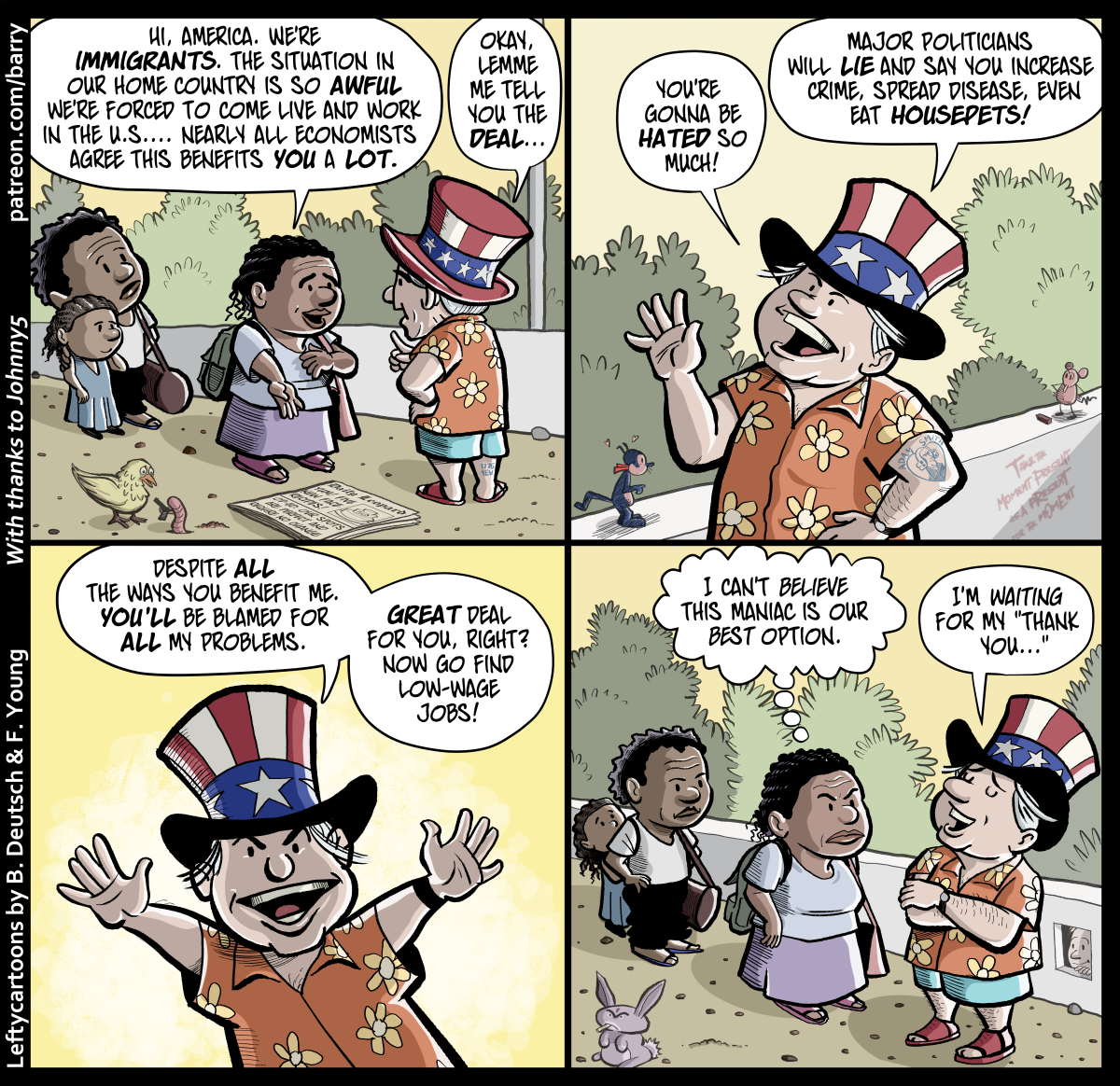
Agreed that one is terrible. Very rough generalizations.
The heading comic of this article is much more profound and better representative of what political cartooning can be: https://baylyblog.com/blog/2013/06/story-behind-cartoona-fond-farewell-chuck-asay
Often enough, this blog, for me, causes ethical conflict. Here, a political figure, who insults my intelligence whenever I encounter her political cartoons, now is castigated for doing the right thing, albeit muddying the waters along the way.In my two careers spanning some 50 years, I have had three instances of severe disagreement with my boss. In one, I was fired. In retrospect, he did the right thing. The next, my boss pretty much acted as if it didn’t happen. The third, I was ready to drop my keys on the boss’s desk when the boss backed down.Telnaes has dropped the keys. Is that part of the story over? We don’t know, because the Post may be trying to bring her back.The political bias, the quality of her drawings, the Pulitzer, all are irrelevant. The central ethical issue is choosing the right course of action when faced with an irresolvable dispute with your boss. If you have principles that you adhere to, you walk. She did.We can pick (without knowing) just what we believe about the actual circumstances. At this point, I think that neither Telnaes nor The Post are being completely honest. But, based on what we do know, she made the right choice.She did it poorly, confusing her freedom to opine and the WAPO’s freedom to print. But, she was right to walk.
Right to walk perhaps, but not for the reasons she cited: that the Post was threatening “free speech.” By her lights, if the Post doesn’t print any crap presented to it, then it’s suppressing speech. She’s an idiot. Glenn Greenwald quit his own organization when it blocked his Haunter laptop story, but do you think throwing a fit because your editors said, “This is crummy work, do better” is an “irresolvable dispute with your boss”?
I’ll generally tolerate, and even at least partially enjoy, an editorial cartoon which is either funny or well-executed. This one was neither (Never heard of Telnaes…I can see why, now).
I’m guessing the lower figure (not Mickey) is meant to be Patrick Soon-Shiong. owner of the LA Times. Perhaps the editors thought her depiction looked a bit too much like a “squinty-eyed asian” caricature to let through.
In any case, pretty sure “insulting the boss at work” is not 1A protected speech.
I’ll straight-up explain why *I* think it’s a bad cartoon.
–Dwayne
I’m sorry…I’m a bit late to the game on this one.
As far as I know, Bezos hasn’t offered up money to Trump, nor has any other left-wing newspaper owner…except for ABC/Disney, which stood to potentially lose far more than the $15m settlement had the case gone to court. In that case, Mickey should be standing there, wiping the sweat from his brow and heaving a sigh of relief.
So somehow the money being offered by Bezos is equivalent to a campaign contribution to Trump…received when WaPo refused to endorse the historically-bad team of Harris/Walz?!? Are the others in the photo caricatures of the heads of other papers that didn’t endorse Harris, thereby making financial contribution to Trump? Or are these all pending lawsuits against the papers and ABC/Disney was the first to fall?
Yeah, it’s hard to really get a sense of what she lampooning, other than her boss. It’s a dumb cartoon that seems completely incongruous to actual events. Gary Larson was far more easily deciphered than this, and some of his work is OUT there.
For all the screaming by Democrats about traditionally left-leaning institutions finally sort of committing to “playing nice” with Donald Trump (and time will tell about the seriousness of these commitments), they are refusing to see what, I (and many others) have been commenting on since 2016-2020. These is all signs of a periodic political realignment the country goes through.
Obama was the signal. Trump I the catalyst. Biden the reaction. Now Trump II is the sign that it is…believe it not…on the settling down phase of the realignment. Democrats would do themselves well to capitalize on their loss.
I mentioned when the GOP lost in 2020, regardless of how questionable the presidential loss was, the GOP had a chance to really experiment with it’s voting coalition and party platform from a position of security. I didn’t think they would do a very good job, but they apparently did, though I think they could have done better (but of course they’re always operating in a left-wing media environment). They came out of the 2020-2024 doldrums with a refreshed coalition that had many more components traditionally lacking.
Now, the Democrats are in the doldrums. Will they take this chance to re-invent themselves and shuffle off old policy demands and attitudes that were important to the previous alignment-cycle and figure out what current concerns align with their value-set? Or will they go back into insurgency mode?
I don’t know. We won’t know until 2028 or 2032 when the realignment wraps up.
But the fact that so many institutions that were rabidly and openly engaging in anti-Trump action are now obviously attempting to rein themselves in an “play nice” is a sign that at least at the market-level, they recognize a the new face of the culture isn’t tolerant of GOP hate. It’s up to the institutions on the political-level to adjust as well.