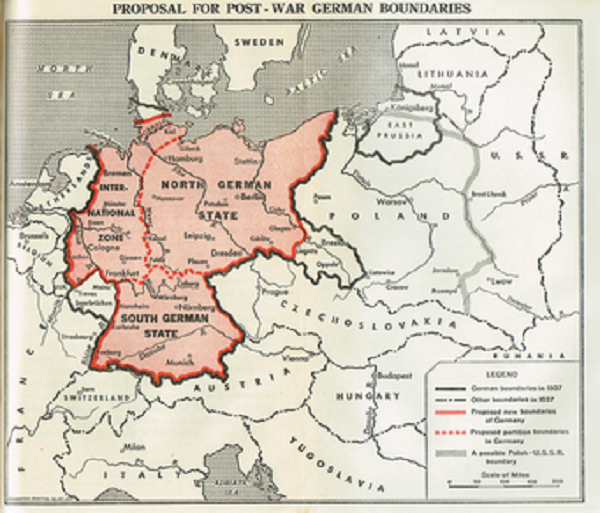
As I have mentioned here many times, there is no way around ranking Franklin Roosevelt as one of our top five Presidents: his handling of World War II from the U.S. perspective and his leadership during the Great Depression, which didn’t so much fix the economic problems as raise the public’s faith in our system of government when it easily could have collapsed, are so important and momentous that all of his missteps and blunders pale by comparison. Nevertheless there were many of these, some quite damning.
I only recently learned about one of them that I somehow had missed all these years—probably because our historians have been and are still overwhelmingly left-biased and inclined towards hagiography where FDR is concerned.
Henry Morgenthau Jr. was Roosevelt’s Secretary of the Treasury from 1934 until FDR’s death. He was a trusted advisor whose scope of interest and influence far exceeded the usual territory of his office. In 1944, Morgenthau got far over his metaphorical skis and proposed a scheme for the post-war world, specifically, as he said, “I want to make Germany so impotent that she cannot forge the tools of war – another world war.”
You know, because that strategy worked out so well the first time, after World War I…
In essence, “The Morganthau Plan” as it was called aimed to treat Germany as Rome treated Carthage. The Treasury Secretary proposed it in a memorandum to the President called “Suggested Post-Surrender Program for Germany.”
It had three sections. First was the mandatory demilitarization of Germany to a draconian extent. Not only was the nation and population to be be disarmed, all kinds of industry that could contribute to future military power were to be destroyed and prohibited as soon as Germany surrendered. The Allies would remove all factories and equipment within six months of the war’s end and destroy those that couldn’t be removed. After that, Germany’s industrial hub the Ruhr would become international territory, with the United Nations managing it. France would take over the Saar and territories near the Moselle and Rhine. Poland would receive part of East Prussia and southern Silesia.Austria would return to its pre-1938 borders.
Defeated Germany would be divided into two separate states: Württemberg, Baden and Bavaria would be South Germany, while Saxony, Thuringia and Prussia would be renamed North Germany. Both Germanys, explained Morganthau, would become nation of farmers without armies or heavy industry.
This, of course, would have been disastrous. Not only would Germany no longer be capable of providing resistance to the expansion-minded USSR, its crushed and demoralized population of serfs would be easy targets for communism. Incredibly, Roosevelt still signed off on the plan, though historians have claimed he did so when he wasn’t paying attention, or something. There’s nothing quite like condemning a whole country to living in the 16th Century as an afterthought. Roosevelt even talked Churchill into backing the plan too, by promising additional financial aid.
The Morgenthau Plan was unveiled at the Second Quebec Conference in 1944. After the conference, The New York Times described the plan in its September 21, 1944 paper, and Goebbels got busy using it to justify the extermination of Jews. After all, Morganthau was Jewish, so his plan was evidence of the international Jewish conspiracy to destroy Germany. In fact, the Morganthau Plan was probably even worse than the Germans were told. Some economists have concluded that nearly 25 million Germans could have starved if Morganthau’s program had been enacted.
Fortunately for the Germans and everybody else, a better plan embodying almost an exact opposite philosophy was but into action instead. That one was known as the Marshall Plan, devised by Secretaray of State George Marshall. It was adopted after FDR died and Harry Truman became President. In July of 1945, Truman signed Directive 1779 providing economic aid to Germany. Morgenthau ” resigned”as Secretary of the Treasury that same month (Truman fired him). The Marshall Plan stabilized Germany and allowed the nation to rebuild while ensuring that it would become an ally of the West and not harbor the intense bitterness and anger that enabled Hitler’s rise.
Still, it was a close call…too close.
 Ethics Alarms
FDR was also the closest to a dictator we nearly came.
FDR really was a dictator. Imagine if he had been healthy. FDR was going to keep running and getting elected until he dropped. He was 63 when he died in 1945: if he had lived to 80, that would have been four more terms, ’48, ’52, ’56, 60, with him dying in office in 1962.
If it hadn’t been for the Supreme Court, the NRA would have allowed him to become the fascist dictator he wanted to be and bring the US into the ‘modern age’ of corporatism, like Italy.
Michael West,
I made that statement on Facebook (probably in response to claims that Trump was a dictator) and my “friends” on the left found the notion simply unbelievable.
-Jut
Moral luck seems to favor this nation.
I remember this one from high school, essentially it was designed to turn Germany into a “potato patch.” At the time, I figured why not, sometimes it just sucks to be Nazis. The idea was quickly junked when it became obvious what the Soviets were going to do and did do. However, the demilitarization of West Germany led to lax security which in turn led to the murderous attack on the 1972 Olympics which made the country look pretty impotent. Germany did not even have a military Special Forces unit until the war on terror, when the KSK was created, which by its name sounds ominous and reminiscent of Nazis. The joke was when the North Atlantic treaty was signed later it was designed to keep the Americans in, the Soviets out, and the Germans down.
Japan, on the other hand, wrote a completely pacifist Constitution after World War II in which the right of waging war was renounced forever and the maintenance of military forces was prohibited. To this day, the Japanese “self-defense forces” are considered civil servants and not military forces. The Japanese are okay with this, and don’t want the Constitution changed, because it might mean the diversion of finances and their standard of living might drop.
Germany was frankly lucky after World War i, when Woodrow Wilson’s idea was that people’s should be allowed to go their own way based on language and culture. Of the central powers, and it was the only major nation that survived largely intact, while Austria-Hungary and the Ottoman Empire were dismembered. Of course this later gave them the argument that they could take back the German speaking Sudetenland from Czechoslovakia, which led to Neville Chamberlain’s embarrassment at Munich.
For the last few years Germany has been ruled by the semi-socialist parties that promise everything and do really nothing about contributing to defense or even the national welfare. It shouldn’t be forgotten that a few years ago Russia was denying Germany fuel, and the Germans were cutting huge amounts of firewood in the hopes of surviving the winter without the conflict in Ukraine interfering too much with their standard of living. Now the latest semi-socialist government has collapsed and they have some problems. Margaret Thatcher said it best in her heyday, the problem with socialism is that eventually you run out of other people’s money.
The left is frankly in trouble everywhere. Justin Trudeau, former darling of the left, has tendered his resignation as prime minister of Canada probably about 4 years after he should have. There is simply no excuse for the tyranny he put into practice during the trucker protest, where he was going to suspend all licenses belonging to the protesters and freeze their bank accounts. Jacinda Adern, former prime minister of New Zealand who concealed tyranny behind “the politics of kindness” resigned in disgrace without finishing her current term. Things simply don’t bode well for the left in the world right now. As you pointed out, the mask is off and everyone knows the left for what it is.
And I thought that I went to a relatively good high school! We learned next to nothing about World War II in history classes, certainly not details like the Morgenthau Plan. Fortunately, my father made sure we knew about the war from his perspective, and guided us to programs like “The World at War,” which still holds up, and “The Twentieth Century.” Even though I studied the Presidents and read several books about FDR, this episode was either largely passed over or I wasn’t paying attention.
It also reflects well on Truman, and elevates him a bit on my Presidents scale. Harry makes me think of the memorable scene in “Mississippi Burning,” when Gene Hackman’s FBI superior puts a gun to his jaw and threatens to shoot him if he doesn’t calm down. Hackman asks another agent if he thinks his boss (Willem DaFoe) would have shot him, and hears, “Absolutely.” “He’s a ballsy little bastard isn’t he?” Hack,am says.
That was Harry Truman: a balsy little bastard who ended up in the perfect moment in history where his particular skills and character were most needed.
Ah, yes, the Morgenthau Plan. The problem, of course, was that bias makes you stupid. Morgenthau was understandably upset with the Nazis and that influenced his thinking. FDR hated the Prussian aristocracy which he blamed for the war despite Nazism being a product of Bavaria (its birth was in Munich and its party rally took place in Nuremberg) and didn’t care if the Soviets confiscated the landed estates in their zone. We can also recognize that FDR was not his best in 1944 – his health problems sometimes caused long Bidenesque pauses and facial expressions – so it is certainly possible that he was more pliable than he might have been when in full health.
Germany can thank Harry Truman who was smart enough to put together a fact-finding mission that included former President Herbert Hoover who returned with a report that stated, “there is the illusion that the New Germany left after the annexations can be reduced to a ‘pastoral state.’ It cannot be done unless we exterminate or move 25,000,000 people out of it.”
The reality of the Cold War was grasped by then so Truman dispensed with the Morgenthau Plan and got rid of Morgenthau himself. Under Hoover’s suggestion, a school meals program was instituted in Germany so that German children wouldn’t starve – an initiative that made their desperate parents far more amenable to trying democracy.
Hoover was also instrumental in organizing and carrying out relief efforts after World War I that helped to save millions in Europe from starvation after the war. If memory serves, it was his name and reputation that persuaded the Soviets to allow similar relief efforts after their civil war that also save large numbers of Soviet citizens from a similar fate.
The world wars were brutal on the European people, both during and after the wars. Modern day isolationists could do worse than to reflect that it was American help after both wars that kept continental Europe from becoming a gigantic death camp. Hoover was a major player in that effort.
Amazing the way U.S. industrial might, and 80,000 dead airmen, demolished Europe and then the U.S. rebuilt Europe.
I think another of Roosevelt’s blunders was conditioning U.S. military aid to Britain upon Churchill’s agreeing to dismantle the empire was catastrophic. As someone has said, I think the third world’s endless problems have resulted not from too much colonialism, but from too little.
You could be right, but that was not just FDR. There were a lot of Americans who were suspicious of Churchill and Britain’s empire and colonial ambitions.
They were concerned that a lot of British viewpoints and arguments were designed to prop up the empire, if not expand it, rather than simply aiming towards victory over the Nazis. They were also concerned that British support for the second front was tepid because 1)British reluctance to take losses (a measure of truth there) and 2)The British wanted a periphery approach to shore up their empire.
Of course the Brits thought the Yanks naive, inexperienced, and reckless — also a measure of truth there.
This was where the genius of Eisenhower came into play. Even though he shared some of the anti-colonial attitudes, he had a special knack for getting the multiple sides to work together (for the most part). Consider that that included not only Britain and the United States, but Canada, France, South Africa, Poland — both their armed forces and public opinion. And placate Stalin as much as he could.
I also suspect these anti-colonial feelings came into play in the Suez crisis of 1956 — it makes sense that Eisenhower would see it as an attempt to recover part of their empires.
I’m loving the history lessons I get here. This is the first I’ve heard of the Morganthau Plan. Thank you!!