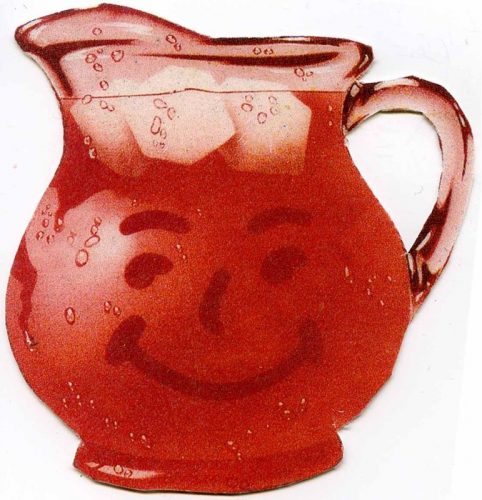
The Daily Mail headline is beyond stupid—-“People are only just realizing the dark origin of ‘drinking the Kool-Aid’ phrase”—-but sharp-eyed commenter Other Bill was quite astute to draw it to my attention (Thanks, OB) with an email this morning.
Apparently several historically and culturally illiterate whipper-snappers on social media expressed surprise at the “dark origin” of the common phrase “he (or she) drank the Kool-Aid” to describe someone who has been gulled into believing something false or dangerous. Yet this gap in the younger generations’ knowledge shouldn’t be surprising. Oh, there was a movie about the horrible incident and it is one of the best examples of the dangers of cults. But the Jonestown mass suicide of the 918 American followers of cult leader Jim Jones in Guyana occurred almost 50 years ago, in 1978. As unusual and shocking as it was, the poisoned powered drink massacre is not the kind of event likely to be covered in history courses: schools barely cover World War I. How would someone under the age of 50 come to know about the event?
“Drank the Kool-Aid” is a particularly good example of the little fragments of history, literature, religion and culture that are scattered hither and yon in our cliches, metaphors, idoms and imagery. It even has a place in Ethics Alarms yore: an esteemed contributor here exited the comment wars with the accusation that I “drank the Kool-Aid” regarding claims that the Trump-Russian collusion investigation was a contrived “Get Trump” operation. (It was he, not I, who had gulped the deadly drink down, ironically, just a different flavor. Grape, I think….)
What an individual’s ignorance of the origins of a phrase like “drinking the Kool-Aid” signifies is not a failure of the school system—not that there aren’t plenty of those—but of parenting. Intellectual curiosity has to be nurtured and taught, and, not surprisingly, parents who lack this key feature of critical thinking pass on the crippling handicap to their offspring.
All a parent has to say to a child is what my parents constantly told me: “When you hear a name, phrase or reference that you don’t understand or know what it refers to, look it up.” This is easier now than it was when I was a child: then my only resources were the library, the dictionary and one of the outdated encyclopedias my father got for free when he worked at Sears and Roebuck.
I remember a life-changing experience when I was about 8 and I heard someone on TV refer to a “Trojan horse.” I asked my mother what kind of horse a Trojan horse was; the only breed of horse I was familiar with was the Palomino, because Roy Rogers rode one. (That was Trigger, of course.)
“Well, let’s look it up!” said my mom, the former Eleanor Coulouris, who knew her Greek history and mythology well. I sat next to her on our sofa as she paged through Webster’s Dictionary. I had to read each entry out loud, and every one sparked more questions and another search. “Trojan Horse” led to “Trojan War” and “Odysseus (Ulysses),” then “Paris” (so THAT’s where the city got its name!) and “Greek Gods.” Next we were on to “Achilles”—Ah-HA! The Achilles tendon!—Zeus, Hera, Aphrodite (or Venus—Hey, that’s where the name of those colored pencils came from!) Hades, Poseidon…Mom and I were on that sofa for over an hour. Then she drove me to the library, where I took out Olivia Coolidge’s collection of Greek Myths. A lifetime interest was born. When the space program began, and all my friends assumed the “Mercury” project was named after the planet, I set them straight.
The examples of some random phrase sending me on a quest that ended in fascinating places, stories, events, and life lessons are legion. I heard Curt Gowdy, the Red Sox broadcaster, call a fly ball a “can of corn” and asked my father what it meant. He told me about country stores and what shopping was like before supermarkets. I heard Abe Lincoln referred to as “Honest Abe,” and my father explained how Presidents were supposed to be especially honest. It began with the first President, George Washington, and was locked-in by a made-up story about him chopping down a cherry tree. George really was unusually honest; Abe less so, but the point was that there was mythology surrounding the public expectations of leaders in America, and it was important to keep facts and legends distinct while understanding that each has a purpose.
The lessons of Jonestown are many and important, but a child won’t learn them unless he or she has the intellectual curiosity to inquire why people talk about “dinking the Kool-Aid” in a negative context. Is there something wrong with Kool-Aid? (The drink used at Jonestown wasn’t Kool-Aid, but a cheap imitation.) Developing the habit of tracking down those breadcrumbs in our language and rhetoric that relate to historical and cultural events not only makes us more productive citizens, better companions, responsible parents and more competent human beings, it might also save our lives.
 Ethics Alarms
Long ago and far away. I took a course that covered lexicology and etymology. It inlcuded not only English but the origins and meanings of Latin and Greek prefixes and suffixes. My teacher of Latin was reenowned Vatican Latinist, Reginald Foster, who presented tje language not as a process of tedious memorization . Rather he armed us witha dictionary and classic literature ranging form bawdy latin poems to the text of Cicero and Augustine.
Language is learned from a culture, not from rules and lists.
The cheap imitation was Flavor Ade.
Also, I recently watched, and highly recommend, an (IMO) excellent documentary CULT MASSACRE: One Day In Jonestown
PWS
Yes, I saw the Flavor Aid packets in a Jonestown documentary a few years ago (Jim Jones was a Hoosier and began his ministry on Indianapolis’ south side) and have decried the slander of Kool-Aid ever since.
wasn’t Flavor aid second cousin to Favor Flav the rapper
Flavor Aid was well known as a cheaper alternative to Kool-Aid, but due to Kool-Aid commercials as well as it being easier to say than “Flavor Aid.”
My favorite idioms, with interesting historical meaning, are “to paint the town red” from 1837 where the Marquis of Waterford and his friends were out drinking and stole red paint then went on a rampage through town, painting doors, windows, and other things red, and “read them the riot act” from the 1714 British “Riot Act” which had to be read out loud to rioters and if they failed to disperse within the hour, then any level of force may be used to disperse them with impunity.
Great one! (And I’m embarrassed to say, one I never read about before, in part because I haven’t encountered that phase very often.) Fascinating.
Well, Jack. You certainly knocked that hanging curveball out of the park, metaphorically speaking, of course.
I’ve always been mystified by “suck’s” admission into what one would have once considered to be civilized society. Clearly, “you suck,” or “it sucks” is grounded on the slang term for fellatio, as in “you suck a dick.” At a minimum, I find it cringeworthy if not incredibly offensive. And no, I’m not buying it derives from “you suck eggs,” as in an egg-sucking dog.” I think it was my generation as teenagers in the ‘sixties who introduced “suck” into the lexicon. I think it’s safe to say I was there at the birth of this monstrosity.
Another one, less prevalent and more hilarious. Someone very near and dear to my heart says she is “putzing around.” Clearly, she means to say she’s “puttering around.” “Putz” is Yiddish for “penis” or “dick.” I don’t think she means to say she’s “dicking around.” But who knows, maybe “dicking around” is fine these days.
Bet.
Jack over here slapping truth bombs from a rig I bet is in desperate need of a glow up. Now that it’s high-key, we be out here spilling tea, but we better skrrt before the basics show up. So, I’ll be ghosting this chat before someone decides to cancel me.
No cap.
That’s skibidi.
I was nine years old in 1978, but still remember all the news of Guyana, Jonestown, and the decisions there that birthed the famous phrase. I can vaguely remember the helicopter photos taken, with large numbers of dead bodies lying on the ground.
I didn’t know until many years later that members of the cult had killed a Congressman at the nearby airport…well, I didn’t know a great many of the salient details until much later.
Subsequent generations lose so much when they lose not only their knowledge, but even their sense, of history.
Funny thing, when I decided to end my this-day-in-history writing, I considered two alternative paths: 1) book reviews or 2) the origins of these common phrases we say without a second thought. In the end, I chose neither.
“In the end, I chose neither.”
I like the sound of that, Joel.
Now, is this coming out because of Jones’ connection to Jimmy Carter? I have seen several mentions of the link between the Carter’s (especially Rosalyn) and Jim Jones in recent weeks (such as that she spoke from Jone’s pulpit). She wasn’t the only one. Willie Brown and LA mayor Moscone seems to have gone to bat for Jones and gotten him appointed to a California State Commission (sounds familiar). Ralph Nader seems to have aided Jones as well. Jim Jones was an avowed Communist and leftist darling of the Democratic Party. We wouldn’t want anyone to know about the connection between the Democratic Party and ‘drink the Kool Aid’, would we?
I think I am going to try coining a new term… an applesauce cocktail… drinking the applesauce or applesauce cocktail. Does anyone know what the reference of applesauce cocktail is to?
Regarding “dicking around”.
In voogue now in the dating scene is the question, What is your body count?
English is my second language. I learned most of it by reading English books and looking up each word I did not understand.
And I learned to speak conversational English pretty good when I met all these English speaking people (from US, UK, Canada, Australia, etc.) doing their Grand Tour “on five dollar a day”.
Currently I use chatgtp for looking up unknown names, expressions, etc.The prompt I use goes something like, Explore the phrase …..
For instance, the prompt Explore the phrase, drinking the Kool-Aid gave the following result,
====>
The phrase “drinking the Kool-Aid” is an idiom with a complex and tragic history, often used to describe blind or unquestioning loyalty, conformity, or acceptance of an idea. Here’s an exploration of its origins, usage, and implications:
Origins of the Phrase
The phrase originates from the tragic events of the Jonestown Massacre in 1978.
Modern Usage
The phrase is typically used metaphorically in various contexts:
Cultural and Linguistic Analysis
Criticism and Sensitivity
Given its tragic origin, some argue the phrase is inappropriate or disrespectful, especially when used lightly. Others view it as a stark reminder of the dangers of manipulation and fanaticism.
Modern Reinterpretations
Key Takeaways
While “drinking the Kool-Aid” is a powerful metaphor for conformity and unquestioning belief, its historical weight should not be overlooked. When using the phrase, sensitivity to its origins and audience is essential.
“While “drinking the Kool-Aid” is a powerful metaphor for conformity and unquestioning belief, its historical weight should not be overlooked. When using the phrase, sensitivity to its origins and audience is essential.”
For example, never use the phrase in the presence of the giant,smiling pitcher of Kool-Aid with the arms and little feet….
Jack, you wrote,
The Kool-Aid Man was introduced in 1954 as a mascot for Kool-Aid. Originally called the “Pitcher Man,” the character evolved into the anthropomorphic, smiling pitcher we know today.
It inspired me to write the following song (text) based on the song The Pusher by Steppenwolf.
This one is for you Jack.
——
The Pitcher
You know I’ve drank a lot of Coke
O’ Lord, I’ve snacked a lot of chips
But I never touched nothin’
That my spirit could kill
You know, I’ve seen a lot of people walkin’ ’round
Biased thoughts on their minds
But the pitcher don’t care
Ah, if you live a life of lies
Let’s block, the pitcher
Let’s block, I say the pitcher
I said let’s block
Let’s block the pitcher man
You know the blogger, the blogger is a man
With some real truth in his pen
Oh but the pitcher is a monster
Good God, he’s not an ethical man
The blogger for a nickel
Lord, will give you lots of insights
Ah, but the pitcher ruin your thinking
Lord, he’ll leave your
He’ll leave your mind to scream
Let’s block, the pitcher
Let’s block, let’s block the pitcher
I said let’s block
Jack, let’s block the pitcher man
[Guitar Solo]
Well, now if I were the moderator of this blog
You know, I’d declare total war on the pitcher man
I’d block him if he posts, and I’d mock him if he’d cry
Yes, I’d kill him with my ethics and my memes and my wit
Let’s block, oh, the pitcher
Let’s block the pitcher
I said let’s block
Let’s block the pitcher man…
Thank you! Started my day right, which has not been happening very often lately….