I must confess that one reason for this post is to entice one of Ethics Alarms’ stars, the perceptive and sharp metaphorical-penned Mrs. Q, into commenting, since she is our resident canine authority (among other things).
The New York Times recently published a feature [Gift link!]about a new fad among dog-owners: multi-colored buttons one can lay out on one’s floor. The buttons can be set to emit the dog-owner’s voice saying a single word like OUTSIDE, WATER, PLAY, FRIEND, AFRAID, WALK, BALL and so on. Dogs learn to step on the buttons to emit the desired word…
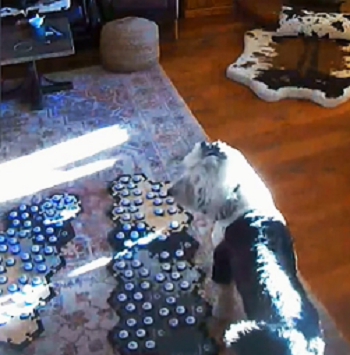
Voilà! Talking dogs.
Well, maybe. Researchers disagree whether the dogs are really using the buttons to communicate or just giving a Skinnerian response when they figure out that, for example, pressing a particular button will result in a treat. Dogs using the buttons are all over YouTube and other platforms on the web: that’s Bunny the Sheepadoodle above, who supposedly makes complex remarks and even existential ones, like “DOG WHY?”
Federico Rossano, an associate professor of cognitive science at the University of California, has been performing extensive studies on this phenomenon. “Right now, several thousand people who are doing this to their pets, and I think we should try to take it seriously,” he tells the Times. “Is this good? Is it bad? What would it tell us about these animals’ minds?”
From an ethical standpoint, I don’t see how the practice can be fairly called bad. Dogs like to please, and any kinds of benign stimulation and interaction with their human companions makes them happy: they like attention. Rossano’s research shows that the dogs, on average, recognize certain common words and press certain two-word phrases non-randomly, so they aren’t mindlessly pushing buttons. But we already knew they were smart enough to do that.
Some dogs can learn a thousand or more words. Heck, I knew one, an incredibly ugly Malamute-Airedale mix named String, that belonged to a friend. There is evidence that there are so-called “gifted-word-learner dogs” that can learn the names of hundreds of objects without training and can remember these words years later. But as the Mexicans in “The Treasure of the Sierra Madre” might say, “Buttons? They don’t need no stinkin’ buttons!”
Alexandra Horowitz, the head of a dog-cognition lab at Barnard College, expresses misgivings to the Times about the entire exercise.“Dogs already do so much to accommodate our lives. They’re on our schedule. They have to ask us if they want to urinate. They socialize on our schedule. They walk where we want to walk on a leash. Ostensibly, the interest in having dogs is that they’re another species. There’s something unknown about them, and that’s wonderful. Why do we lean into forcing them to wear clothes and speak our language?”
I agree with this analysis. With Spuds, my fascinating (and this year, sanity-saving) pit bull mix, I see my job as learning to understand his language. He had a miserable life before Grace and I adopted him. He deserves to feel cared for, safe, loved and to have some sense of autonomy. The buttons, it seems to me, are just impediments to humans learning how to understand their dogs.
Dogs use their eyes, body language, tongues, ears, tail, barks, whines and squeaks, to express their needs and wants. They show disappointment, anticipation, frustration, anger, fear and excitement. These demonstrations are diverting enough, and dogs are persistent and demanding. The last thing I need is to have Spuds banging on a button that keeps shouting “PLAY! PLAY! PLAY!” Based on what I’ve seen, he’d do it, too.
 Ethics Alarms
I can’t resist:
A man is passing a house when he sees, “Talking dog for sale – $10.” Well he obviously doesn’t believe the dog can talk, but he decides to check it out. He knocks on the door, and the owner tells him to go around back to see the dog.
The man goes around back and seeing the dog on the lawn, says, “So you’re a talking dog, eh?”
“Indeed I am,” responds the dog, much to the man’s surprise. “You might recognize me from NPR where I have several podcasts. Radio is an easier place to make a living as a talking dog.”
“Hold on,” the man says, “You’re a talking dog who makes media for NPR?”
“Not only that,” says the dog, “I do all my own research. In fact, some of the research for my science podcasts has been used in the books of Stephen Hawking. He thanked me personally for my contributions to science.”
“You knew Stephen Hawking?”
“Sure! Obama introduced us when I was working in the White House!”
The man is astounded and goes inside to talk to the owner. “Why are you selling this incredible dog for only $10?”
The owner replies, “Because he’s a goddamn liar.”
Now THAT was effin’ funny, and is going into my permanent archives!
PWS
Yes. A classic. Thanks, Fred.
The related joke.
A man walks into a bar. He tells the bartender he doesn’t have any money, but asks if he can get a drink for free if he can show the bartender something he has never seen before. The bartender says ‘OK’. The man pulls out a small piano, a hamster, and a frog. The hamster begins to play the piano and the frog begins to sing. The bartender says “That is amazing”. Would you sell them? The man replied, I will sell you the frog for $100, but I can’t part with the hamster. The bartender hands over the $100, then asks “Why won’t you sell the hamster?” The man replies, “Where will I ever find another hamster who can play the piano and is also a ventriloquist?”
I’ll keep the one about the “12 Inch Pianist” to myself…
PWS
OK, if we’re going down this route…
The first talking dog joke I ever heard was a national beer ad performed by Mike Nichols and Elaine May. In the New England area it advertised Narragansett Lager Beer with that straight from the barrel taste, light but not TOO light. Hi, Neighbor! Have a ‘Gansett!” The animated ad had a man walk with his dog into a bar and say to the bartender, “Hi Neighbor! I’d like a Narragansett beer, please, the brew with with that straight from the barrel taste, light but not TOO light! And one for my dog here, too.” “Wait,” says the bartender. “Of course I’ll give you a cool, refreshing Narragansett Lager Beer with that straight from the barrel taste, light but not TOO light. It’s New England’s favorite beer! But I can’t serve a dog.” “Ah, the man says, but this is a special dog. He can talk! I tell you what: I’ll show you. Rover, what’s over a house?” The dog says…“Rrrrrr…rrrrr...Roof!” “Okay,” says the man, now let him have a ‘Gansett.” “Not so fast,” says the barkeeper. “Still not convinced> OK…Rover, when I’m playing golf, and I hit the ball too hard, where does it go?” The dog growls, “Rrrrrrr…rrrrr…Rough!” “Hold it right there,” the bartender says, still skeptical. “Let me ask him something.” “Sure!” says the man. “Go ahead!”
“Rover,” the bartender begins,”Who is the only American President to serve more than the terms in office?”
The dog hesitates, then growls. “Rrrrrrrr….Rrrrrrr…Rrrrrrr…COOLIDGE?????”
Dogs never cease to amaze. Our last to dachshunds could recognize our car by its exhaust note when it was hundreds of feet away from our house. One of them could identify the sound of my rubber soled shoes on the sidewalk outside our apartment as I approach after having been out of town for a week and would howl in anticipation of my getting to the front door. They would listen for the walk sound for the blind at intersections and proceed when the tone sounded well before I had even realized what the sound meant. Our son’s great German pointer mix would lick our faces from the back seat when we were coming to a stop at the interstate exit on our way to our weekend house where he’d have the run of the golf course. He’d also make a squealing noise when we were about to turn onto our son’s street when returning him after a trip. Upon arrival, he’d run into the house and hide for fear we’d take him away from his family too soon on another trip. Dogs are simply uncanny.
My wife said Bailey would go and sit by the door, usually about 45 seconds before I walked in the door after work. We are convinced she knew the sound of the car, but we lived in an apartment complex, so neighbors were always coming and going. But apparently, she was able to pick out our car from the others.
I can’t believe how much I still think about Bailey, two and a half years out. I really miss that dog…
Mrs. OB and I are off dogs after about most of our fifty plus years together. Somehow, it’s not debilitating having to put them down when you’re younger. At this point, it’s just not something I’m up for ever having to do again.
Great Sam Kinison routine I can’t find online: He talks at some length in that smarmy, ironic tone about how great dogs are before dropping one of his screams: “AND THEN THEY DIE!”
One week from tomorrow, it’ll be six (6) years since our Dear Golden Girl (Hannah “Hurley” Loduha-Schlecht) departed; I’ll never stop missing her.
PWS
Grace and I had huge, gentle, soulful, sweet English Mastiff bitch named Patience. Somehow, she learned the term “bad guys,” which meant strangers near the house who we didn’t know. When we heard noise outside and asked Patience, “Bad guys, Patience?” She would raise her head, curl her lip, and give a low growl and the hair rose on her back. If we said, “Those are bad guys!” she would run to the window, look out and start barking at the intruders. And if we said, “Get those bad guys!” she would go to the door and scratch.
Not an expert, but as an experiment I got one of the Staples “Easy” gimmick buttons for my old dog and taught her to push it when she wanted to go outside. Worked fine, ran out of battery but she still used that when she wanted to go potty. It was a very simple thing, and she could of course still go poke me (like in the middle of the night when she was sick and I was sleeping) to go outside. I don’t know how complicated you could actually go with the button system, but for simple requests, it was simple, entertaining and endearing.
I adopted my very “strong willed” but very loved border terrier almost ten years ago.
First thought that comes to my mind:
Why would she need these “buttons” when she already trained a human (me) to know exactly what she wants. She went from the streets to living the good life with relatively little effort to train her human in order to get whatever she wants!
I can only imagine her thinking…“Buttons!!? Who has time for buttons! Out of my way! I’m going on another walk!”
We got these doggy doorbells for Xena so she could touch it when she wanted to go outside.
She could not figure it out, but our blind cat, Pepper would hit the thing every 5 seconds to get in and out until we finally unplugged the damn thing.
-Jut
Cats!
One of the two cats we had when our kids were growing up was really crafty. Matty. Our bedroom closet had a ceiling light that came on when you pulled either of the two hinged doors into the closet. Most mornings, Matty would reach under the door and pull it open, turning on the light and casting a beam right into our eyes in bed. Ultimately, Mrs. OB put a stop to that by packing a water pistol under her pillow and soaking Matty when he pulled that stunt.
Lord Remington Winchester Burger, The First, Esquire, Dog of Letters, read the study and simply said, “Idiots. Of course we have an expansive vocabulary and broad learning skills. Why you silly humans think you are the height of evolution is beyond me. I mean, check it out: Every last need in the Maslovian Hierarchy of Needs is met. I have food, shelter, cookies, chew toys, health care, attention, exercise, and affection. Thankfully, you don’t make me wear those stupid outfits. But, do you see me fretting over the Dow Jones Industrial Average or BitCoin values? Do I lose sleep at night worrying about whether the mortgage is paid or if my car is going to start in the morning? Hell no! I eat, sleep, romp around the house, bark at falling leaves (simply to amuse you) and attack the cat. What more is there to life?”
jvb
Since I’ve gone from dog care provider to professional dog trainer, I’ve had a lot of opportunities to study the behavior of both dogs and humans who own dogs.
This may sound a bit mystical but dogs and our relationship to them has elements that will always be mysterious to us. If we humans can barely understand each other and we speak the same particular language, then this increases many times over with dogs. I don’t see this as a deficit to human and canine communication but a wonderful benefit for the sake of our modern way of owning pets.
Make no mistake, we OWN our pets, no matter the perceived pampering a pet dog may receive or if they live in a $25 million dollar home, they are still not free to go where they want and do what they want when they want. But then again, the same in a way could be said for us humans.
Ethology is the study of animals and one of my courses presented an interesting statistic. 80% of canines around the world live outside. This means a mere 20% live in the highly domesticated milieu of being owned within a home or dwelling. The way I’ve come to think about pet dogs is like this:
Dogs are animals first, captives second, pets third. And in that order.
Many of the calls I get from potential clients is, though it’s never directly said, “could you make my dog act like a fur covered robot baby that doesn’t act like a dog?” or something like that. I don’t feel antagonism toward these people because they are only going with what they were reinforced to believe and perform. For some it’s that their previous dog was “perfect.” Other’s want a playmate for their child or other dog, a companion when going to outdoor cafes, a guard to protect, a balm for the hole in their soul. From the time we were little kids and had doggy stuffed animals, we have been taught that this is an acceptable way to think of and treat dogs. My job is literally to bridge the reality between dogs being animals and humans’ societal expectations around dogs.
The buttons may be awesome for some dogs. I think the whole endeavor is for humans, but I’d like to see serious and hopefully unbiased research on this topic. My one issue is that we humans already don’t listen to what dogs are saying most of the time or really understand them as a species. The more we project onto dogs our human ways of understanding, the less we “hear” them. All my clients get a complementary lesson on canine body language. I do this because when we take the time to study dog bodies and behaviors, we can thwart many scenes of reactivity before they go too far. 77% of dog bites to kids happen by a family or friends’ dog. The two reasons the bites occur is because of a lack of supervision and a lack of knowing dog body signs before a bite happens.
And who gets the blame? The dog. Who is then rehomed as a potential bite risk, or euthanized. So much for loving dogs.
If you have a dog that loves the buttons that’s fine. I’d just suggest making sure you’ve taken the time to learn and speak their language too. Our dogs are always speaking, if only we’d listen.