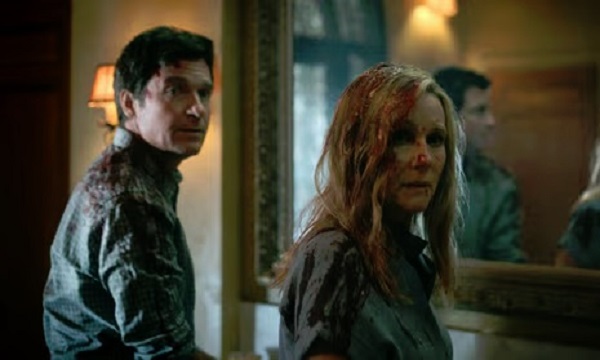
In 2018, I included a brief note about the Netflix streaming series “Ozark” in a morning “warm-up.” I wrote,
“Call me an old ethics fogey, but I don’t think these kinds of TV series are culturally healthy. I’ve been watching the Netflix series “Ozark,” and hating myself for it. The show is well acted and even has its ethics dilemmas, but like “Breaking Bad,” which was obviously its inspiration, there are no admirable characters, and the “heroes” are criminals. In the Golden Age of TV, there were unwritten (and sometimes written) rules that shows could not rationalize, trivialize or romanticize illegal, immoral or unethical behavior, and needed to reaffirm positive values. In “Ozark,” “Breaking Bad” and “Better Call Saul,” the latter’s spin-off, as well as “House of Cards,” and “Shameless,” among others, there are virtually no admirable characters at all. I have been watching “Ozark” in part because I like the actors, in part because there’s nothing I want to watch anywhere else except baseball, and, yes, in part because of voyeurism. Still, it makes me want to take a shower, and I felt that the increasing tendency of Hollywood to portray everything and everyone as corrupt makes a “the ends justify the means” rationalization seem like a matter of survival.”
Well, that was a shallow and unfair analysis, I am now compelled to say. Living alone with non-work time being a constant challenge between baseball seasons and disappointed by so many other series, I have returned to some old ones that I recalled as at least consistently excellent in scripting and performances, including consensus classics like “The Sopranos,” “Six Feet Under,” “Ray Donovan” and the best of them all, “Lonesome Dove.”
My reaction to “Ozark” the second time through has been completely different from the first time. For one thing, there is so much of it I don’t remember that I have to believe that I didn’t give the show my complete attention on the first viewing. Secondly, I realize now that “Ozark” is an ethics series as much as “The Walking Dead” is an ethics series, and for a similar reason. A normal family is thrust by a confluence of events beyond its control into a set of extreme circumstances beyond their experience and comprehension. They find themselves in a true Bizarro World ethical environment where what is considered ethical in a normal culture will not work, requiring the acceptance of new values and the mastering of new skills, with the alternative being death.
Layered into the stressful violent, frustrating and fascinating saga (that doesn’t go on too long and wear out its welcome like so many other series) are lessons on chaos theory, ethics conflicts, ethics zugzwang (“Ozark” is one long ethics zugzwang problem), corruption, obsessions, hypocrisy, denial, the perils of payback, and more.
The show has also surprised me with several forms of unethical conduct that had never occurred to me before. For example, the show’s protagonists, involuntary Mexican cartel money-launderers Marty and Wendy Bird (played by Jason Bateman and Laura Linney), resort to a marriage counselor as the stresse on their relationship caused by the almost daily life-and-death decisions that they have to make is in a real sense dangerous. The couple relies on their therapist to help them reach a consensus in situations where each believes that the wrong decision—the position of the other spouse—will be disastrous. So both secretly bribe the counselor to take their side of these disputes in their therapy sessions, while the therapist is secretly double-dipping.
I wonder if anyone has ever done that? Now that I’ve seen it played out, I wouldn’t be surprised.
What the series excels at is raising the question of what you would do if presented with alternatives that are only ethically repugnant, in a situation where the consequences of no decision will be the deaths of one or more loved ones, and/or yourself. It is easy to duck such considerations by saying, “I would never get in such a bind,” but Marty and Wendy would have said exactly the same thing—-until they were in one, indeed, in one after another.
 Ethics Alarms
I tried to watch this show and couldn’t. It was almost the same as when I tried to watch Seinfeld. I just can’t handle watching a show where I find every single character repulsive. I find embarrassment humor almost impossible to watch, I have too much empathy for the person being embarrassed and it is almost painful for me, so Seinfeld was never going to be pleasant for me to watch. On top of that, the fact that the characters were all horrible human beings made it worse. Ozark didn’t have the painful humor, but I wondered who would like this? I always suspected that people liked Seinfeld because they were secretly just as horrible as the characters in the show and either empathized or idolized them. I am wondering the same about Ozark. Are there just so many people that can relate to this?
Now, I don’t mind a character arc. A ‘good’ character who is pushed to do things they wouldn’t normally do until they have become something they hate can be a good story. The reverse also works for me. A horrible human being doing horrible things because they are horrible isn’t something that I can stand to watch (CSPAN?). I don’t see the appeal unless it is for horrible people to see horrible people portrayed as role models or heroes.
As I noted, that was my initial decision as well, but I’d urge you to try again with a different perspective. It’s a deal with the devil show, and as it proceeds, the main protagonist, Marty (Bateman) tries to devise multiple escape scenarios that will get him out of the deal. Remember: it begins with a cartel lieutenant serially executing everyone in his investment firm for the main partner and Marty’s best friend skimming cartel funds they were supposed to manage. Marty was either not complicit or engaging in contrived ignorance, but as the last one with a gun at his head, he concocts a deal to keep him alive that involves laundering money in the Ozarks. It works: he’s allowed to live, but his panicked promise means that his family has to be involved (the cartel routinely kills loved ones). The wife’s main ethical failure at that point was having an affair. Their kids are innocents. None of the family members are horrible human beings, but they all end up doing horrible things. Was there any way to avoid that fate? It’s an ethics train wreck.
This is an involuntary acceptance of criminal participation—unlike in Breaking Bad, where the protagonist resorts to drug dealing all by himself. I couldn’t watch that for the same reasons you cite. They don’t apply to “Ozark.”
I like Seinfield, and it’s not because I envy the characters, aside from the fact that they’d have pretty good lives if it weren’t for their numerous self-inflicted problems. The sheer over-the-top absurdity is what sells it for me. On other hand, I can’t get into the likes of “Breaking Bad” because they have more foul language than I usually care for, and they’re more serious. Watching horrible people do horrible things and actively trying to justify it doesn’t really entertain me that much, though I recognize there is a place for tragic character studies like “Macbeth”, “Othello”, and such.
We watched Ozark all the way through, as well as Breaking Bad and now Dexter.
All of them have common elements, namely a voyeuristic view into dastardly criminal behavior of the most outrageous sort. Breaking Bad made me feel bad all the way through — if not for my wife, I’m sure I would’ve stopped watching it. Same with Ozark. But there are many ethics lessons in all of them — they just tend to be very uncomfortable lessons.
Dexter is just absurd enough to trip my “this is just TV” response, but in a way, it is the saddest of all because the amoral yet tragic main character manages to ruin the lives of everyone he touches without meaning to. His evil deeds just drag in the innocent along with the guilty. Perhaps that is the ultimate point, but even if it isn’t, it sure is right there in your face.
I must say, this type of drama is not my favorite, but my wife loves it for some reason. Hopefully we can find something more heroic or at least less disturbing for the next series we watch together. I am more entertained by fantasy than reality-adjacent stuff, I guess.
I’ve heard it said before that marriage counseling is inherently biased even free of bribery.
1) for the most part it seems like marriage counselors are female and there’s a natural affinity bias towards the wife.
2) for the most part, the wife of a relationship will drive the marriage counseling “industry” as most times a couple is in counseling it is at the wife’s insistence. Husbands are more predisposed to “endure” a perceived “less than ideal marriage” than wives.
I say both those points knowing full well the ire of people who think men and women are exactly the same will be enroute shortly.
I feel the same way about most of what is now considered critically-acclaimed television. I don’t like excessive violence, profanity or sex (or really any of it, but I do allow that it exists on TV and isn’t going away). I don’t like not having a single character to root for – “House of Cards” was guilty as sin that way – and I don’t like having terrible decisions portrayed positively.
Yet, it’s like a train wreck. Sometimes you can’t stop watching because the characters are so interesting, albeit objectively awful people.
I wonder if you’ve seen the movie “Juror #2”? I have a faint recollection of it coming up on this site at some point but can’t place the exact point. It’s an interesting ethical conundrum-style film.